
In recent years, the quadrotor drone has emerged as a prominent platform in unmanned aerial vehicle (UAV) technology due to its agility, vertical take-off and landing capability, and relatively simple mechanical structure. However, the control of a quadrotor drone presents significant challenges owing to its inherent underactuated nature, high-order dynamics, multivariable couplings, and susceptibility to external disturbances. Achieving stable and precise control is crucial for applications ranging from aerial surveillance to payload delivery. In this article, I investigate a composite control strategy that integrates model predictive control (MPC) with classical proportional-integral-derivative (PID) control to enhance the flight performance of a quadrotor drone. The approach leverages the fast dynamic response of PID control and the optimal, constraint-handling capabilities of MPC, with a switching mechanism based on error thresholds. Through comprehensive modeling, controller design, and simulation studies, I demonstrate the effectiveness of this composite method in improving stability, accuracy, and robustness for quadrotor drone operations.
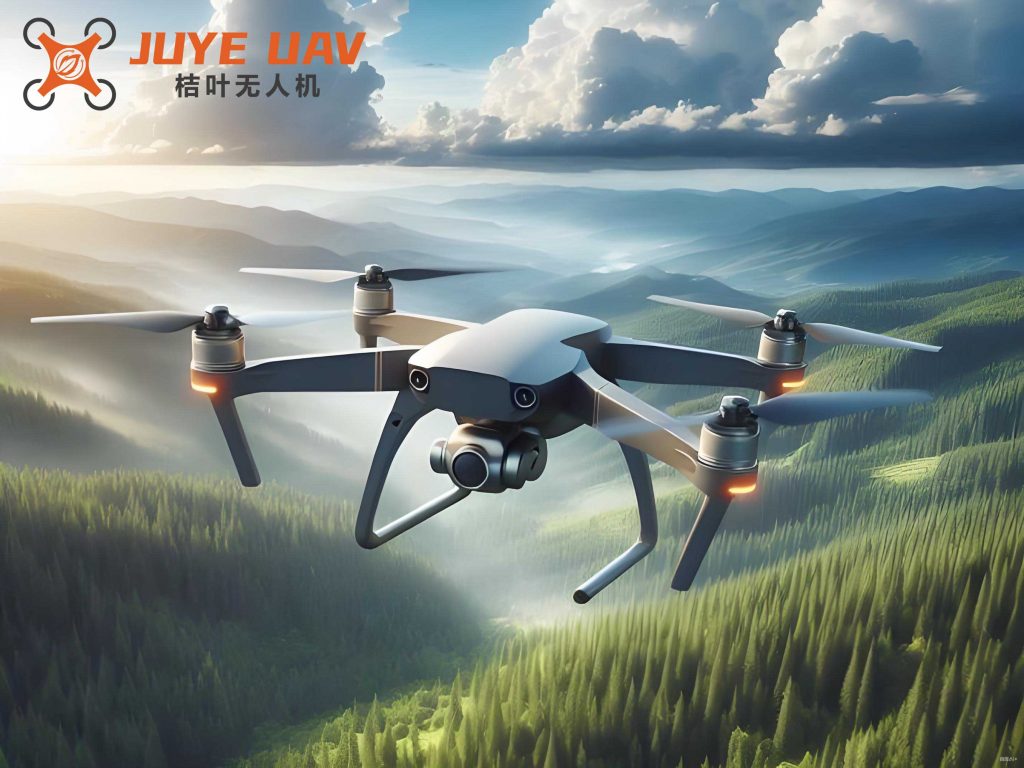
The dynamics of a quadrotor drone are derived from Newton-Euler equations, considering forces and moments generated by four rotors. The quadrotor drone is typically configured in a “+” or “×” shape, with rotors generating lift and torque. Assuming a rigid body structure and symmetric mass distribution, the nonlinear equations of motion can be expressed as follows. Let the position coordinates in the inertial frame be (x, y, z) and the Euler angles (roll φ, pitch θ, yaw ψ) represent the orientation. The control inputs are the collective thrust U₁ and the torque inputs U₂, U₃, U₄ corresponding to roll, pitch, and yaw, respectively. The nonlinear dynamics are:
$$
\begin{aligned}
\ddot{x} &= (\sin\theta \cos\phi \cos\psi + \sin\phi \sin\psi) \frac{U_1}{m} \\
\ddot{y} &= (\sin\theta \cos\phi \sin\psi – \sin\phi \cos\psi) \frac{U_1}{m} \\
\ddot{z} &= \cos\phi \cos\theta \frac{U_1}{m} – g \\
\ddot{\phi} &= \dot{\theta} \dot{\psi} \left( \frac{I_y – I_z}{I_x} \right) + \frac{l U_2}{I_x} – \frac{J_r}{I_x} \dot{\theta} \Omega \\
\ddot{\theta} &= \dot{\phi} \dot{\psi} \left( \frac{I_z – I_x}{I_y} \right) + \frac{l U_3}{I_y} + \frac{J_r}{I_y} \dot{\phi} \Omega \\
\ddot{\psi} &= \dot{\phi} \dot{\theta} \left( \frac{I_x – I_y}{I_z} \right) + \frac{U_4}{I_z}
\end{aligned}
$$
where m is the mass, g is gravity, l is the arm length, I_x, I_y, I_z are moments of inertia, J_r is the rotor inertia, and Ω is the overall rotor speed difference. For control design, linearization around a hover condition (small angles assumption) simplifies the model. Using the linear parameter varying (LPV) method, the state-space representation is obtained. Define the state vector as X = [x, y, z, φ, θ, ψ, ẋ, ẏ, ż, φ̇, θ̇, ψ̇]^T and control input U = [U₁, U₂, U₃, U₄]^T. The linearized system is decoupled into four channels: altitude (z), roll (φ), pitch (θ), and yaw (ψ). The transfer functions for each channel, incorporating motor dynamics as a first-order lag, are:
$$
G(s) = \begin{bmatrix}
\frac{K}{m \tau s^2 (\tau s + 1)} & 0 & 0 & 0 \\
0 & \frac{K l}{I_x \tau s^2 (\tau s + 1)} & 0 & 0 \\
0 & 0 & \frac{K l}{I_y \tau s^2 (\tau s + 1)} & 0 \\
0 & 0 & 0 & \frac{K}{I_z \tau s^2 (\tau s + 1)}
\end{bmatrix}
$$
Here, K is a gain and τ is the motor time constant. This decoupled model facilitates independent controller design for each channel of the quadrotor drone.
The composite control strategy for the quadrotor drone combines PID and MPC controllers via a switching mechanism based on error conditions. The objective is to exploit the rapid transient response of PID control during initial phases and the superior steady-state tracking of MPC once the error diminishes. The overall system structure is depicted in the block diagram below, though I avoid referencing figure numbers per instructions. The switching logic operates as follows: for the first 1.5 seconds, PID control is active to ensure quick stabilization; thereafter, if the tracking error exceeds a threshold (e.g., 0.27), PID control remains engaged for faster convergence, else MPC takes over for precise regulation. This hybrid approach aims to balance dynamic performance and steady-state accuracy for the quadrotor drone.
The PID controller for each channel employs the incremental form to minimize computational burden and integrate smoothly. For instance, the pitch channel PID control law is:
$$
\Delta u(k) = K_p [e(k) – e(k-1)] + K_i e(k) + K_d [e(k) – 2e(k-1) + e(k-2)]
$$
where e(k) is the error at step k, and K_p, K_i, K_d are tuned gains. Through simulation, I selected K_p=1.2, K_i=0.5, K_d=0.1 for the pitch channel of the quadrotor drone. The PID controller provides robust handling of initial disturbances but may exhibit steady-state error or overshoot.
The MPC controller utilizes a dynamic matrix control (DMC) algorithm, which is based on step response models. For the quadrotor drone, the predictive model uses a step response vector a = [a₁, a₂, …, a_N]^T over a horizon N. At each sampling instant k, future outputs are predicted over a prediction horizon P, and control increments are optimized over a control horizon M. The optimization problem minimizes a cost function:
$$
J(k) = \sum_{i=1}^{P} q_i [w(k+i) – \hat{y}(k+i)]^2 + \sum_{j=1}^{M} r_j \Delta u(k+j-1)^2
$$
where w is the reference, ŷ is the predicted output, q_i and r_j are weights. The control law is computed by solving a quadratic programming problem, with constraints on inputs and states if needed. For non-self-regulating systems like the quadrotor drone, I employ a modified DMC using a shift matrix S_uns to handle integrative dynamics. The MPC parameters are: sampling interval 1.0 s, prediction horizon P=10, control horizon M=2. This setup enables the quadrotor drone to achieve optimal tracking with constraint satisfaction.
To evaluate the composite control for the quadrotor drone, I conducted simulations in MATLAB/Simulink. Each channel (altitude, roll, pitch, yaw) was controlled independently with the same composite structure. The simulation model includes the linearized quadrotor drone dynamics, PID and MPC blocks, and a switching unit. For brevity, I focus on the pitch channel results, as similar trends apply to others. The reference pitch angle is set to 10 degrees via a step input. The performance of composite control is compared against standalone PID and MPC controllers.
| Control Method | Overshoot (%) | Settling Time (s) | Steady-State Error | Robustness to Disturbances |
|---|---|---|---|---|
| PID Only | ~5% | ~3.0 | Small error | Moderate |
| MPC Only | ~18% | ~3.0 | Nearly zero | High |
| Composite (Predictive-PID) | ~5% | ~2.8 | Zero | High |
The composite controller for the quadrotor drone achieves low overshoot akin to PID and zero steady-state error like MPC, confirming its superior performance. Furthermore, anti-disturbance tests were conducted. In one test, the reference step changed from 10 to 8 degrees at t=5 s; in another, a step disturbance of magnitude 1 was injected at t=5 s. The composite-controlled quadrotor drone recovered within 0.3 seconds with minimal deviation, demonstrating strong robustness. These results validate the efficacy of the predictive-PID composite approach for quadrotor drone control.
In conclusion, this research presents a composite control strategy integrating PID and MPC for quadrotor drones. The method addresses the challenges of underactuation and coupling by leveraging the strengths of both controllers: PID ensures fast dynamic response during transients, while MPC provides optimal tracking and disturbance rejection in steady state. The switching mechanism based on error thresholds enables seamless transitions, enhancing overall performance. Simulation results confirm that the composite controller offers improved stability, accuracy, and robustness compared to standalone methods. Future work may explore adaptive switching or weighted blending for further optimization of quadrotor drone control systems. The predictive-PID composite control thus represents a promising solution for advanced quadrotor drone applications in complex environments.