
In the pursuit of enhancing efficiency and safety in agricultural practices, I designed and developed a quadrotor drone equipped with a novel variable pesticide spraying system. Traditional manual sprayer methods pose significant health risks to operators and suffer from low chemical utilization rates due to excessive runoff. The emergence of multi-rotor UAV technology offers a compelling alternative. While many existing plant protection drones employ fixed-rate spray systems, they lack the capability for real-time adjustment of spray volume and angle, leading to potential over-application and environmental waste. My project focuses on integrating a simple, effective, and user-controllable variable spraying mechanism onto a standard quadrotor drone platform. The core objective is to create a system where the operator can dynamically adjust both the flow rate of the liquid and the angular orientation of the spray boom mid-flight, thereby optimizing coverage and minimizing chemical use based on real-time needs.
The fundamental flight principle of my quadrotor drone relies on the independent speed control of four brushless motors arranged symmetrically on the airframe. Each motor drives a propeller of identical size and pitch. The aircraft’s movement—including lift, roll, pitch, yaw, and lateral translation—is achieved by precisely manipulating the differential thrust generated by these four rotors. A centralized flight controller continuously processes data from onboard sensors (like gyroscopes and accelerometers) and GPS to stabilize the platform and execute pilot commands received via a radio link. This stable and maneuverable flight characteristic is essential for the precise application required in agricultural spraying.
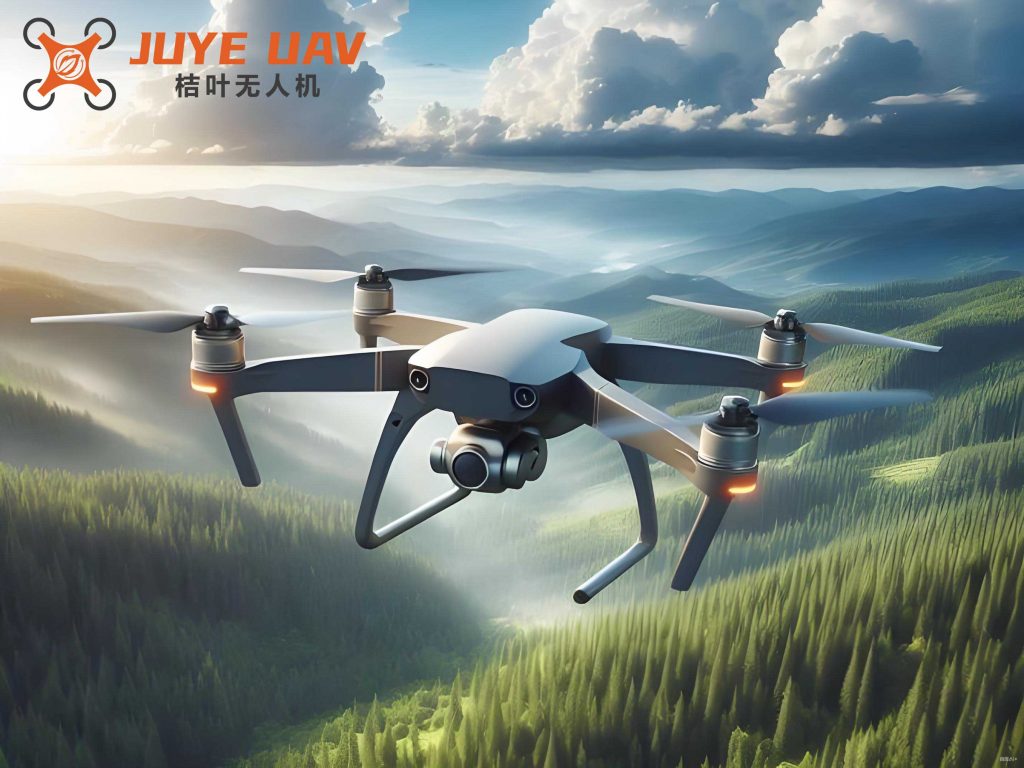
The structural design of my variable-spray quadrotor drone can be categorized into four major subsystems: the Variable Spray Control System, the Power System, the Flight Control System, and the Aircraft Mainframe. A tabular summary of key components is provided below for clarity.
| Subsystem | Component | Key Specification/Model |
|---|---|---|
| Variable Spray Control System | Liquid Pump (Diaphragm type) | Flow: ~1 L/min, Pressure: ~4 bar |
| Servo (for angle adjustment) | Torque: 25 kg.cm, Voltage: 6-7.2V | |
| Power System | Brushless Motor | KV880, Max Continuous Power: 320W |
| Electronic Speed Controller (ESC) | 40A Rating, 5V/3A BEC | |
| Lithium Polymer (LiPo) Battery | 5200mAh, 11.1V (3S), 35C Discharge | |
| Flight Control System | Flight Controller | STM32F103-based (e.g., OpenPilot CC3D) |
| Radio Transmitter/Receiver | 6-channel, 2.4GHz | |
| Aircraft Mainframe | Frame & Landing Gear | F450-type quadcopter frame with extended legs |
The airframe utilizes a two-layer fiberglass plate design, creating a central compartment for electronics. The brushless motors are mounted at the ends of the arms. A vibration-damping gimbal is installed on the top plate to isolate the flight controller from motor vibrations. The spray system’s support structure, including the pesticide tank, pump, and servo, is mounted on a dedicated bracket attached to the landing gear or lower frame. The spray boom is attached to this bracket via a pivot, allowing it to be tilted. A servo motor, connected to the boom by a cable, controls this tilt angle. The entire spray assembly is designed for easy attachment and detachment from the quadrotor drone.
The heart of the innovation lies in the Variable Spray Control System. Its purpose is to provide independent pilot control over pesticide flow rate and spray boom angle. The system uses a dedicated microcontroller (MCU) powered by a regulated 5V supply from the main battery. It consists of two primary control units: the Flow Rate Control Unit and the Spray Angle Control Unit.
Flow Rate Control Unit: This unit interfaces with one channel of the radio receiver (e.g., CH6). When the pilot manipulates the corresponding control on the transmitter, the receiver outputs a Pulse Width Modulation (PWM) signal. The MCU captures this signal. Based on the PWM value (which corresponds to the stick position), the MCU controls a solid-state relay or a transistor-based driver circuit. This circuit switches power to the DC diaphragm pump. By modulating the pump’s on/off duty cycle or using a PWM-driven motor driver, the effective flow rate of the pesticide can be varied proportionally. The relationship between the commanded signal and the resulting flow rate $Q_{actual}$ can be expressed as:
$$ Q_{actual} = k \cdot D_{pwm} $$
where $k$ is a system constant (L/min per PWM unit) determined by pump characteristics and $D_{pwm}$ is the duty cycle of the control signal. For a simple on/off control, it becomes a binary function, but a more advanced implementation allows for proportional flow control across the stick’s range.
Spray Angle Control Unit: This unit is connected to another receiver channel (e.g., CH5). The PWM signal from this channel is fed directly into a high-torque digital servo motor. The servo arm is linked to the spray boom via a cable. As the servo rotates in response to the pilot’s command, it pulls or releases the cable, causing the entire boom to pivot around its mounting point. This changes the spray’s projection angle relative to the ground, $\theta$, allowing the operator to adjust the swath width or target spray beneath foliage. The angle $\theta$ is a function of the servo’s angular position $\alpha$ and the mechanical linkage geometry:
$$ \theta = f(\alpha, L_{cable}, L_{boom}) $$
where $L_{cable}$ and $L_{boom}$ are the effective lengths of the control cable and spray boom, respectively. This simple mechanical solution provides direct and reliable control over the spray pattern from the quadrotor drone.
The power system of a quadrotor drone is critical, especially under the load of a liquid payload. Sizing the motors, propellers, and battery requires careful calculation to ensure adequate lift and flight time. For my design, the target payload included a 5-liter (approx. 5 kg) pesticide tank plus the airframe and electronics weight (approx. 5 kg), totaling a take-off weight of around 10 kg. Therefore, the total thrust required from all four rotors must exceed 10 kgf, meaning each motor-propeller combination must produce a steady-state thrust, $F_{single}$, of at least 2.5 kgf.
The thrust generated by a single propeller can be estimated using a simplified momentum theory-based formula:
$$ F = k \cdot \rho \cdot D^4 \cdot n^2 $$
Where $F$ is thrust (N), $\rho$ is air density ($kg/m^3$), $D$ is propeller diameter (m), $n$ is rotational speed (revolutions per second), and $k$ is a thrust coefficient dependent on propeller geometry (pitch, blade number, shape). A more practical empirical formula often used in the hobbyist community for initial sizing is:
$$ F_{single} (kgf) \approx \left( \frac{D^{3.5}}{ \sqrt{P}} \cdot \frac{d \cdot w \cdot r^{2}}{K} \right) \cdot E $$
In this version, $d$ is pitch (m), $w$ is blade width (m), $r$ is speed (RPS), and $P$ is the number of blades. $K$ is a unit conversion constant, and $E$ is an empirical error factor, typically around 0.25. For the selected 11×4.7 inch propeller (approx. 0.279m diameter, 0.119m pitch), a KV880 motor running on a 3S (11.1V) battery at a conservative 70% throttle yields an $r$ sufficient to generate over 2.6 kgf of thrust per motor, meeting the requirement. The corresponding power draw per motor, $P_{motor}$, is critical for battery life estimation:
$$ P_{motor} = V \cdot I_{motor} $$
$$ Total \ Power \approx 4 \cdot P_{motor} + P_{auxiliary} $$
where $P_{auxiliary}$ includes power for the flight controller, receiver, and spray pump. With a 5200mAh 11.1V (3S) battery, the theoretical maximum flight time $T_{flight}$ under hover conditions can be approximated by:
$$ T_{flight} (mins) \approx \frac{ Battery\ Capacity\ (Ah) \cdot 60 }{ Total\ Current\ Draw\ (A) } \cdot \eta $$
Here, $\eta$ is a discharge efficiency factor, usually taken as 0.8. These calculations guided the component selection detailed in the table above, ensuring the quadrotor drone had sufficient power and endurance.
The integration of flight and spray control is managed by software. The main flight control algorithm runs on the STM32-based flight controller, handling sensor fusion, attitude estimation (using complementary or Kalman filters), and PID control loops for stability. My custom variable spray control code runs on a separate microcontroller or as a task within the main flight controller if resources allow. The program flowchart for the integrated system involves initializing all sensors and peripherals, then entering a main loop. In this loop, the system continuously: 1) Reads pilot commands from the receiver (for both flight and spray functions), 2) Reads inertial measurement unit (IMU) data, 3) Calculates the current attitude and applies flight control algorithms to generate motor speed commands, 4) Processes the spray control channel signals to update the pump PWM output and the servo position, and 5) Outputs all control signals. This ensures stable flight of the quadrotor drone while simultaneously executing the operator’s spray commands.
Following assembly and software implementation, a series of flight tests were conducted to evaluate the performance of the variable-spray quadrotor drone. The tests measured flight endurance, spray system response, and effective coverage. Key data from these tests is summarized below:
| Test # | Flight Time (min) | Spray Test Time (s) | Spray Volume Used (mL) | Measured Flow Rate (L/min) | Estimated Coverage Area (m²) |
|---|---|---|---|---|---|
| 1 | 5 | 100 | 1600 | 0.96 | 151.5 |
| 2 | 8 | 130 | 2200 | 1.02 | 208.4 |
| 3 | 12 | 190 | 3100 | 0.98 | 293.6 |
The results confirmed the functionality of the variable spray system. The flow rate was controllable and remained consistent across tests. By calculating the pesticide consumption per unit area from the data, an average value of approximately 10.56 g/m² was achieved. Compared to a standard fixed-rate application benchmark of around 12 g/m², this represents a measurable reduction in chemical usage for the same coverage, validating the efficiency premise of the variable system. The total flight time approached 30 minutes under loaded conditions, which is adequate for covering small to medium-sized fields with one or two battery swaps. The quadrotor drone demonstrated stable hover and precise response to spray commands, proving the practical viability of the design.
In conclusion, the development of this quadrotor drone with an integrated variable spraying system addresses key limitations of conventional agricultural spraying methods and existing simplistic drone sprayers. The designed system successfully provides a pilot with direct, in-flight control over two critical application parameters: pesticide flow rate and spray boom angle. This is accomplished through a relatively simple electronic and mechanical interface connected to auxiliary channels on a standard radio controller. The modular design allows the spray system to be easily mounted onto a common quadrotor drone frame. The test data supports the conclusion that this approach can enhance spraying efficiency by enabling more targeted application, which can lead to reduced chemical consumption and operational costs. Future work on this quadrotor drone platform could involve integrating more sophisticated sensors, such as multispectral cameras or LiDAR, to enable fully autonomous, map-based variable rate application, further advancing the capabilities of UAV technology in precision agriculture.