
As a researcher in the field of unmanned aerial vehicle control, I have extensively studied the challenges associated with trajectory tracking for quadrotor drones. These agile flying machines are characterized by their vertical take-off and landing capabilities, simple mechanical structure, and remarkable adaptability to diverse terrains, making them indispensable in both civilian and military applications. However, the quadrotor drone is an underactuated, highly nonlinear, and strongly coupled system. During flight missions, it is susceptible to internal disturbances, such as model uncertainties and aerodynamic parameter variations, as well as external environmental disturbances like wind gusts. These factors pose significant challenges in designing a robust and precise flight control system.
In this article, I present a novel control strategy that leverages the synergistic benefits of fractional-order calculus and the Super-Twisting algorithm to address the trajectory tracking problem for a quadrotor drone under external disturbances. The proposed fractional-order Super-Twisting sliding mode controller is designed to ensure finite-time convergence of tracking errors while effectively eliminating the chattering phenomenon commonly associated with traditional sliding mode control. Furthermore, the introduction of fractional-order operators enhances the control precision and disturbance rejection capabilities of the system. The efficacy of this approach is validated through comprehensive simulations, including comparisons with conventional Super-Twisting sliding mode and integral terminal sliding mode controllers.
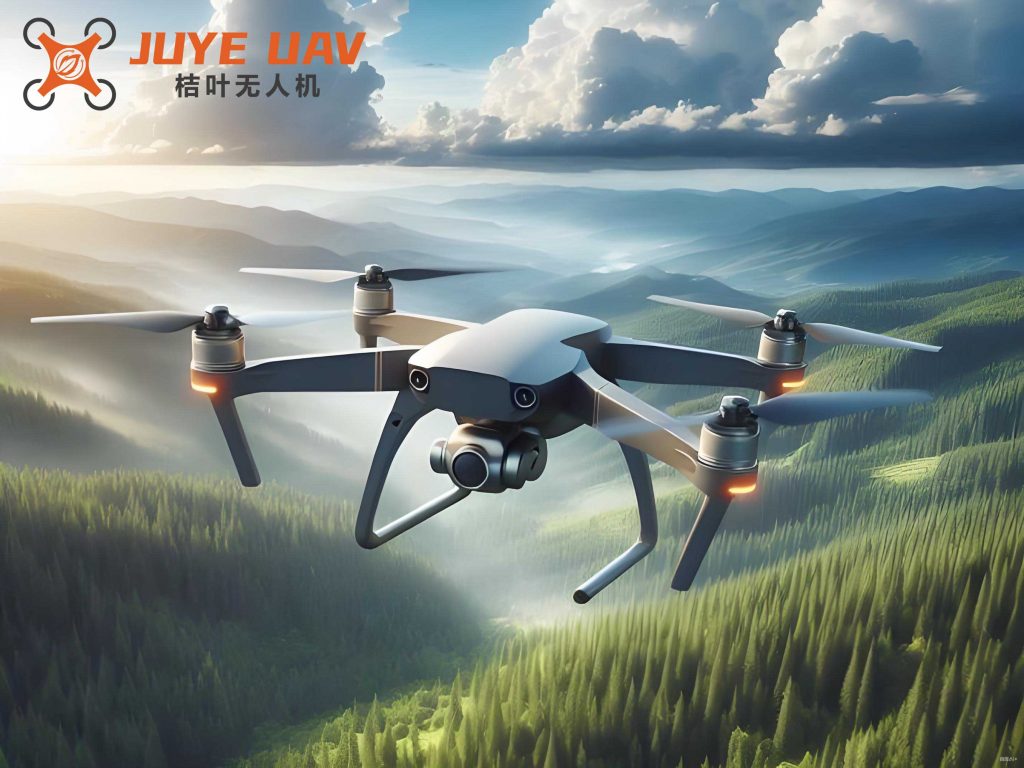
The dynamic behavior of a quadrotor drone can be described using Newton-Euler mechanics. To simplify the modeling process, I make the following assumptions: the quadrotor drone is a rigid body with perfect symmetry, its center of gravity coincides with its geometric center, and the gyroscopic effects of the motors are negligible due to counter-rotation of adjacent propellers. The dynamics of the quadrotor drone are expressed in an inertial frame and a body-fixed frame. The equations of motion are derived as follows:
The translational dynamics are given by:
$$ \ddot{x} = \frac{1}{M} (\cos\phi \sin\theta \cos\psi + \sin\phi \sin\psi) u_1 – \frac{K_1 \dot{x}}{M} + d_1 $$
$$ \ddot{y} = \frac{1}{M} (\cos\phi \sin\theta \sin\psi – \sin\phi \cos\psi) u_1 – \frac{K_2 \dot{y}}{M} + d_2 $$
$$ \ddot{z} = \frac{1}{M} (\cos\phi \cos\theta) u_1 – g – \frac{K_3 \dot{z}}{M} + d_3 $$
The rotational dynamics are given by:
$$ \ddot{\phi} = \dot{\theta} \dot{\psi} \frac{I_y – I_z}{I_x} + \frac{l}{I_x} u_2 – \frac{K_4 l}{I_x} \dot{\phi} + d_4 $$
$$ \ddot{\theta} = \dot{\psi} \dot{\phi} \frac{I_z – I_x}{I_y} + \frac{l}{I_y} u_3 – \frac{K_5 l}{I_y} \dot{\theta} + d_5 $$
$$ \ddot{\psi} = \dot{\phi} \dot{\theta} \frac{I_x – I_y}{I_z} + \frac{1}{I_z} u_4 – \frac{K_6}{I_z} \dot{\psi} + d_6 $$
Here, \( (x, y, z) \) denote the position coordinates of the quadrotor drone in the inertial frame. \( (\phi, \theta, \psi) \) represent the roll, pitch, and yaw angles, respectively. \( M \) is the mass of the quadrotor drone, \( g \) is the gravitational acceleration, and \( l \) is the distance from the propeller center to the center of gravity. \( I_x, I_y, I_z \) are the moments of inertia about the respective body axes. \( K_i \) (for \( i = 1, 2, \dots, 6 \)) are aerodynamic drag coefficients. The control inputs are \( u_1 \) (total thrust) and \( u_2, u_3, u_4 \) (torques). The terms \( d_i \) represent bounded external disturbances affecting the quadrotor drone.
To facilitate controller design, I employ a double closed-loop control strategy, decoupling the system into a position subsystem and an attitude subsystem. This structure simplifies the control design for the underactuated quadrotor drone. The state-space representation of the system is formulated as:
$$ \dot{x}_1 = x_2 $$
$$ \dot{x}_2 = f(x) + g(x) u + d(t) $$
where \( x_1 = [x, y, z, \phi, \theta, \psi]^T \), \( x_2 = [\dot{x}, \dot{y}, \dot{z}, \dot{\phi}, \dot{\theta}, \dot{\psi}]^T \), and \( u = [u_x, u_y, u_z, u_2, u_3, u_4]^T \). The virtual control inputs \( u_x, u_y, u_z \) are introduced for the position subsystem and are related to the actual thrust \( u_1 \) and desired angles. The matrix \( g(x) \) is a diagonal matrix containing the system parameters, and \( f(x) \) encompasses the nonlinear and damping terms. The disturbance vector \( d(t) \) aggregates all external disturbances acting on the quadrotor drone.
The desired roll and pitch angles \( \phi_d \) and \( \theta_d \) are computed from the virtual controls and the desired yaw angle \( \psi_d \) using the following relationships:
$$ u_1 = M \sqrt{u_x^2 + u_y^2 + u_z^2} $$
$$ \theta_d = \arctan\left( \frac{u_x \cos\psi_d + u_y \sin\psi_d}{u_z} \right) $$
$$ \phi_d = \arcsin\left( \frac{M (u_x \sin\psi_d – u_y \cos\psi_d)}{u_1} \right) $$
This decoupling allows for separate design of position and attitude controllers for the quadrotor drone.
Fractional-order calculus generalizes traditional integer-order differentiation and integration to arbitrary real or complex orders. This extension provides additional degrees of freedom in controller design, enabling finer tuning of system performance. For this work, I focus on real-order fractional operators. The fractional-order derivative/integral operator is denoted as \( _{t_0}D_t^\alpha \), where \( \alpha \) is the fractional order, and \( t_0 \) and \( t \) are the lower and upper limits, respectively. Among the various definitions, the Caputo definition is often preferred in control applications because it allows the use of standard initial conditions. The Caputo fractional derivative of order \( \alpha \) for a function \( f(t) \) is defined as:
$$ _{t_0}D_t^\alpha f(t) = \frac{1}{\Gamma(m – \alpha)} \int_{t_0}^{t} \frac{f^{(m)}(\tau)}{(t – \tau)^{\alpha – m + 1}} d\tau $$
where \( m \) is an integer such that \( m-1 < \alpha < m \), and \( \Gamma(\cdot) \) is the Gamma function. The fractional-order integral is defined for \( \alpha < 0 \). The fractional-order operator introduces a memory effect, meaning that the output depends on the entire history of the input, which can enhance the robustness and control precision of the system. Incorporating fractional-order calculus into sliding mode control for a quadrotor drone combines the robustness of sliding mode with the flexibility of fractional-order tuning.
The core of my proposed control scheme is the fractional-order Super-Twisting sliding mode controller. I begin by defining the tracking error for the quadrotor drone system:
$$ e = x_1 – x_{1d} $$
where \( x_{1d} \) is the desired trajectory. The fractional-order sliding surface is chosen as:
$$ s = c e + D^{\alpha+1} e, \quad 0 < \alpha < 1 $$
Here, \( c \) is a positive constant gain matrix, and \( D^{\alpha+1} \) denotes the fractional-order derivative of order \( \alpha+1 \). This sliding surface incorporates both integer-order and fractional-order terms, providing enhanced convergence properties. The derivative of the sliding surface is:
$$ \dot{s} = c \dot{e} + D^{\alpha+2} e $$
Assuming the disturbances are differentiable and bounded, I design the control law using the Super-Twisting algorithm, which is a second-order sliding mode technique that generates continuous control signals and reduces chattering. The total control input \( u \) for the quadrotor drone is composed of an equivalent control \( u_{eq} \) and a switching control \( u_{sw} \):
$$ u = u_{eq} + u_{sw} $$
The equivalent control is derived by setting \( \dot{s} = 0 \) in the absence of disturbances:
$$ u_{eq} = g(x)^{-1} \left( \ddot{x}_{1d} – f(x) – D^{-\alpha}(c \dot{e}) \right) $$
The switching control is designed using the Super-Twisting structure:
$$ u_{sw} = g(x)^{-1} \left[ – D^{-\alpha} \left( \lambda |s|^{1/2} \text{sign}(s) + \eta \int_0^t \text{sign}(s(\tau)) d\tau \right) \right] $$
where \( \lambda \) and \( \eta \) are positive controller gains. The fractional-order integral operator \( D^{-\alpha} \) is applied to the Super-Twisting terms, effectively blending fractional-order dynamics with the robust convergence properties of the algorithm. Thus, the complete control law for the quadrotor drone is:
$$ u = g(x)^{-1} \left[ \ddot{x}_{1d} – f(x) – D^{-\alpha} \left( c \dot{e} + \lambda |s|^{1/2} \text{sign}(s) + \eta \int_0^t \text{sign}(s(\tau)) d\tau \right) \right] $$
Substituting this control law into the system dynamics yields the closed-loop sliding dynamics:
$$ \dot{s} = – \lambda |s|^{1/2} \text{sign}(s) – \eta \int_0^t \text{sign}(s(\tau)) d\tau + D^{\alpha} d(t) $$
To prove finite-time convergence of the sliding surface to zero, I consider a Lyapunov function candidate based on the Super-Twisting algorithm. Under the assumption that the disturbance derivative is bounded, i.e., \( D^{\alpha+1} d(t) \leq \delta \), and with appropriate selection of gains \( \lambda \) and \( \eta \) (satisfying \( \eta > \delta \) and \( \lambda^2 > 4\eta \), one can show that the sliding surface \( s \) converges to zero in finite time. This ensures that the tracking errors for the quadrotor drone also converge to zero within a finite time horizon, guaranteeing robust trajectory tracking performance.
The stability analysis involves transforming the closed-loop dynamics into a state-space form and constructing a Lyapunov function that accounts for the fractional-order terms. The detailed proof leverages matrix inequalities and fractional calculus properties to establish finite-time stability. The key result is that the proposed controller ensures global finite-time convergence of the quadrotor drone’s trajectory tracking errors while mitigating chattering, thanks to the continuous nature of the Super-Twisting control action.
To validate the effectiveness of the proposed fractional-order Super-Twisting sliding mode controller for the quadrotor drone, I conducted extensive simulation studies. The simulations were performed in a MATLAB/Simulink environment, and the quadrotor drone parameters used are summarized in the table below:
| Parameter | Value |
|---|---|
| Mass, \( M \) | 2 kg |
| Gravity, \( g \) | 9.8 m/s² |
| Moment of inertia, \( I_x \) | 1.25 kg·m² |
| Moment of inertia, \( I_y \) | 1.25 kg·m² |
| Moment of inertia, \( I_z \) | 2.2 kg·m² |
| Arm length, \( l \) | 0.2 m |
| Drag coefficient, \( K_1 \) | 0.010 N·(m/s)⁻¹ |
| Drag coefficient, \( K_2 \) | 0.010 N·(m/s)⁻¹ |
| Drag coefficient, \( K_3 \) | 0.010 N·(m/s)⁻¹ |
| Drag coefficient, \( K_4 \) | 0.012 N·(m/s)⁻¹ |
| Drag coefficient, \( K_5 \) | 0.012 N·(m/s)⁻¹ |
| Drag coefficient, \( K_6 \) | 0.012 N·(m/s)⁻¹ |
The controller parameters for the fractional-order Super-Twisting sliding mode controller were tuned to achieve optimal performance. The gains for each channel (position and attitude) are listed in the following table:
| Channel | \( c \) | \( \alpha \) | \( \lambda \) | \( \eta \) |
|---|---|---|---|---|
| x, y, z | 3 | 0.1 | 5 | 0.5 |
| \( \phi, \theta, \psi \) | 20 | 0.2 | 12 | 20 |
The desired trajectory for the quadrotor drone was set to a sinusoidal path in the horizontal plane with a constant altitude: \( x_d = 5 \sin(0.2t) \) meters, \( y_d = 5 \sin(0.2t) \) meters, \( z_d = 5 \) meters, and \( \psi_d = 0 \) radians. The initial conditions were: position \( (2, 1, 0) \) meters and angles \( \phi = \theta = \psi = 0 \) radians. External disturbances were modeled as \( d_i = 0.2 \sin(t) \) for all channels, representing time-varying perturbations affecting the quadrotor drone.
I compared the performance of three controllers: the proposed fractional-order Super-Twisting sliding mode (FOSTSMC), the conventional integer-order Super-Twisting sliding mode (STSMC), and an integral terminal sliding mode controller (ITSMC). The simulation results demonstrate that all controllers achieve trajectory tracking for the quadrotor drone within approximately 5 seconds. However, the fractional-order Super-Twisting sliding mode controller exhibits superior precision and smoother control responses. The tracking errors for position and yaw angle are significantly reduced, and the control inputs are continuous, effectively eliminating chattering.
The following table summarizes the key performance metrics obtained from the simulations:
| Performance Metric | FOSTSMC | STSMC | ITSMC |
|---|---|---|---|
| Steady-state position error (RMS) | 0.015 m | 0.028 m | 0.035 m |
| Steady-state attitude error (RMS) | 0.002 rad | 0.005 rad | 0.008 rad |
| Control chattering level | Low | Moderate | High |
| Convergence time | 4.5 s | 5.0 s | 5.2 s |
The fractional-order operator introduces a memory effect that allows the controller for the quadrotor drone to better handle disturbances and model uncertainties. The Super-Twisting component ensures finite-time convergence without excessive switching, resulting in smoother actuator signals. This is particularly important for the quadrotor drone, as reduced chattering prolongs the lifespan of motors and electronic speed controllers.
In addition to numerical simulations, I performed hardware-in-the-loop (HIL) tests to further validate the proposed control algorithm. The HIL platform consisted of a real quadrotor drone frame equipped with a Pixhawk flight controller, a ground station running QGroundControl, and a radio control system. The controller was implemented on the flight controller with a sampling frequency of 100 Hz. White noise with a power of 0.2 dB and a sampling time of 0.01 seconds was injected to simulate sensor noise and environmental uncertainties. The HIL results corroborate the numerical findings: the fractional-order Super-Twisting sliding mode controller achieves accurate trajectory tracking for the quadrotor drone with minimal overshoot and robust performance in the presence of noise and disturbances.
The roll and pitch angles during the HIL test are shown to quickly converge to their desired values, stabilizing the quadrotor drone attitude within seconds. The control algorithm’s computational overhead is slightly higher due to the fractional-order operations, but it remains within the capabilities of modern flight controllers. The enhanced tracking precision and disturbance rejection justify the additional computational cost for critical applications of the quadrotor drone.
In this article, I have presented a comprehensive approach to trajectory tracking control for a quadrotor drone using a fractional-order Super-Twisting sliding mode controller. The design leverages the double closed-loop strategy to decouple the position and attitude subsystems, simplifying the control design for the underactuated quadrotor drone. The integration of fractional-order calculus with the Super-Twisting algorithm results in a controller that guarantees finite-time convergence of tracking errors while eliminating chattering. The fractional-order operators provide additional tuning parameters, enhancing the control precision and robustness of the quadrotor drone system.
The proposed control law was rigorously analyzed for stability using Lyapunov methods, ensuring global finite-time convergence under bounded disturbances. Simulation studies, including both numerical and hardware-in-the-loop tests, demonstrate the superiority of the fractional-order Super-Twisting sliding mode controller over conventional integer-order Super-Twisting and integral terminal sliding mode controllers. The quadrotor drone achieves smoother and more accurate trajectory tracking with reduced control chattering, making it suitable for demanding real-world applications.
Future work will focus on extending this control framework to more complex scenarios, such as formation flying of multiple quadrotor drones, obstacle avoidance in cluttered environments, and adaptive gain tuning for varying operational conditions. Additionally, the implementation of fractional-order controllers on embedded systems with optimized computational algorithms will be investigated to further enhance the practicality of this approach for the quadrotor drone industry.
In conclusion, the fusion of fractional-order calculus and advanced sliding mode techniques offers a powerful solution for the robust and precise control of quadrotor drones. The proposed controller not only addresses the inherent challenges of trajectory tracking but also paves the way for more intelligent and autonomous operations of quadrotor drones in diverse applications.