
In recent years, multi-rotor unmanned aerial vehicles have experienced rapid development, with the quadrotor drone emerging as a dominant platform due to its simplicity of operation, agility, and ease of takeoff and landing. However, commercial quadrotor drones often suffer from limited flight endurance and low payload capacity, which hinder their effectiveness in critical missions such as search and rescue or material delivery. Some innovative designs, like tilt-rotor mechanisms for directional transition, enable vertical takeoff and landing and forward propulsion, but they frequently result in heavy airframes, restricting payloads to around 1.67 kg. Other products, such as the MG-1 from DJI, offer higher payloads up to 10 kg, yet their large symmetrical motor spans (e.g., 1500 mm) reduce maneuverability in confined spaces and slow response times. In this work, we focus on designing a lightweight quadrotor drone with enhanced payload capacity while ensuring sufficient structural redundancy and strength. Our approach leverages advanced composite materials to optimize the airframe, aiming to create a quadrotor drone that can perform efficiently in hazardous environments like volcanic, earthquake, or flood zones for tasks including reconnaissance, photography, and cargo transport.
The quadrotor drone we developed consists of two main components: an upper flight frame and a lower cargo cabin. The flight frame is responsible for aerial maneuverability, while the cabin handles payload transportation or equipment mounting. Our design prioritizes a lightweight structure without compromising durability, utilizing materials such as carbon fiber composites, aramid fiber, and balsa wood. The entire quadrotor drone has a wheelbase of 466 mm, with the frame weighing only 50 g. When paired with 10-inch APC propellers, the quadrotor drone achieves an effective payload of up to 3 kg, making it suitable for demanding operations. Below, we detail the design considerations, performance tests, and analytical validations that underscore the improvements in this quadrotor drone.
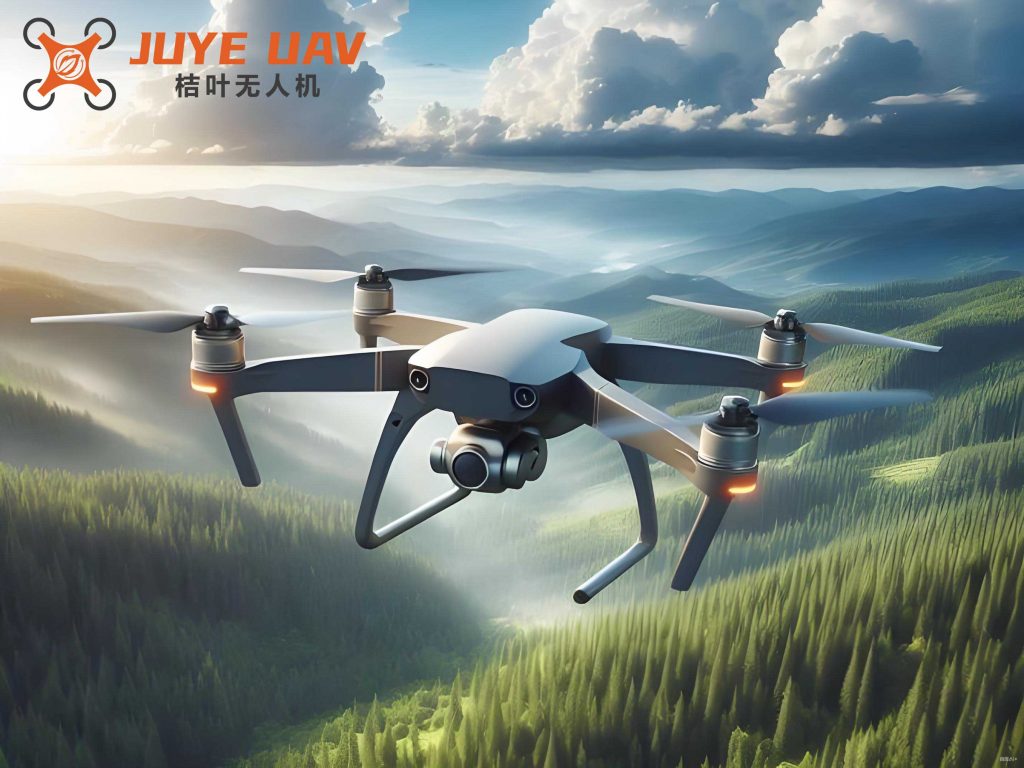
For the flight frame of the quadrotor drone, we adopted a true X-shaped configuration, which offers greater flexibility, simplicity, and controllability compared to HX or asymmetric layouts. This choice also contributes to weight reduction, a crucial factor for enhancing the performance of the quadrotor drone. The frame is constructed from carbon fiber square tubes with outer dimensions of 4 mm × 4 mm and inner dimensions of 3 mm × 3 mm, arranged in a cross pattern. The central hub and motor mounts are fabricated from 1 mm thick T300-3000 carbon fiber plates, processed using a vertical milling machine to minimize manual errors. We designed two types of motor mounts: a larger one measuring 34 mm × 34 mm × 26 mm and a smaller one at 34 mm × 34 mm × 16 mm. This height differential compensates for the level variation caused by the intersecting carbon fiber tubes. Initially, motor mounts were made from balsa plywood, but repeated failures during testing prompted an optimization. We replaced critical load-bearing parts with T300-3000 carbon fiber plates and conducted thorough stress analyses. Additionally, to better constrain degrees of freedom, we switched from carbon fiber round tubes to square tubes; the latter provide superior structural performance, higher load-bearing capacity, and easier assembly. The mating holes in the motor mounts were also changed to square apertures to reduce rotational errors. The motor mount structure integrates T300-3000 carbon fiber plates for both motor fixation and tube connection, ensuring robustness. This refined design is pivotal for the reliability of the quadrotor drone during flight operations.
The cargo cabin of the quadrotor drone is designed as an integrated, under-slung unit attached to the flight frame. This configuration lowers the overall center of gravity, enhancing stability during flight missions for the quadrotor drone. The cabin features a framework built from carbon fiber round tubes with an outer diameter of 4 mm and an inner diameter of 3 mm, connected by 2 mm balsa plywood joints. The basket-like structure includes four integrated landing legs, and the exterior is wrapped with fine aramid fiber composite to unify the cabin. This lightweight yet sturdy design allows the quadrotor drone to carry substantial payloads while maintaining structural integrity. The use of composites throughout the quadrotor drone not only reduces weight but also increases overall strength, enabling the quadrotor drone to withstand prolonged, high-intensity missions.
To evaluate the performance of our improved quadrotor drone, we conducted three key tests: flight endurance, payload capacity, and strength analysis of the motor mounts. These tests validate the enhancements made to the quadrotor drone.
First, we assessed flight endurance using a 22.2 Wh battery under no-load conditions. The results, compared with other quadrotor drones, are summarized in Table 1. Our quadrotor drone achieved a flight time of 20 minutes, significantly outperforming typical DIY quadrotor drones with similar batteries and approaching the endurance of higher-capacity commercial models. This improvement is critical for extending the operational range of the quadrotor drone.
| Drone Model | Battery Capacity (Wh) | Endurance (min) |
|---|---|---|
| Our Quadrotor Drone | 22.2 | 20 |
| DJI Phantom 4 PRO | 89.2 | 30 |
| Typical DIY Quadrotor Drone | 22.2 | 5 |
The endurance can be modeled based on battery energy and power consumption. For a quadrotor drone, the power required for hover is given by:
$$ P_h = \frac{T^{3/2}}{\sqrt{2 \rho A}} $$
where \( T \) is the thrust, \( \rho \) is air density, and \( A \) is propeller disk area. The total energy \( E \) from the battery relates to endurance \( t \) as:
$$ t = \frac{E \eta}{P} $$
with \( \eta \) as efficiency. For our quadrotor drone, using a 22.2 Wh battery (79.92 kJ) and assuming an average power draw of 66.6 W (from test data), we estimate \( t \approx 20 \) minutes, aligning with observed results. This demonstrates the efficiency gains in our quadrotor drone design.
Second, we tested payload capacity. Our quadrotor drone has a total frame weight of 50 g, which is 466% lighter than some commercial frames like the DJI Windfire, while increasing total transport capability by 20%. With the 22.2 Wh battery, the quadrotor drone can carry an effective payload of 3 kg. The payload capacity depends on the thrust-to-weight ratio. For a quadrotor drone, the total thrust \( T_{\text{total}} \) must exceed the total weight \( W \):
$$ T_{\text{total}} = 4 \cdot T_{\text{motor}} > W = (m_{\text{drone}} + m_{\text{payload}}) \cdot g $$
where \( g \) is gravitational acceleration. Using 10-inch propellers and appropriate motors, each motor generates approximately 11 N of thrust, giving \( T_{\text{total}} \approx 44 \) N. With \( m_{\text{drone}} \approx 0.5 \) kg (including battery) and \( g = 9.81 \) m/s², the maximum payload \( m_{\text{payload}} \) is:
$$ m_{\text{payload}} = \frac{T_{\text{total}}}{g} – m_{\text{drone}} \approx \frac{44}{9.81} – 0.5 \approx 3.0 \text{ kg} $$
This calculation confirms the quadrotor drone’s ability to handle significant loads, making it suitable for delivery tasks.
Third, we performed a static stress analysis on the improved motor mounts to ensure strength. Simulating operational conditions, we fully constrained the square holes and applied a uniformly distributed upward load of 11.5 N to each of the four mounting holes. Using SolidWorks Simulation, we obtained stress distributions. The maximum stress occurs at the mounting holes, with a value of approximately \( 5.0 \times 10^7 \) N/m². The yield strength of T300-3000 carbon fiber is \( 9.3 \times 10^8 \) N/m², providing a safety factor:
$$ \text{Safety Factor} = \frac{\sigma_{\text{yield}}}{\sigma_{\text{max}}} = \frac{9.3 \times 10^8}{5.0 \times 10^7} \approx 18.6 $$
This high safety factor indicates that the motor mounts have ample strength and stability for the quadrotor drone. The stress analysis can be generalized with the formula for normal stress \( \sigma \):
$$ \sigma = \frac{F}{A} $$
where \( F \) is the applied force and \( A \) is the cross-sectional area. For our motor mounts, the low stress values validate the use of composites in the quadrotor drone.
Further, we analyzed the structural dynamics of the quadrotor drone frame. The natural frequency \( f_n \) of the carbon fiber tubes can be estimated using beam theory. For a simply supported beam,
$$ f_n = \frac{\pi}{2L^2} \sqrt{\frac{EI}{\rho A}} $$
where \( L \) is length, \( E \) is Young’s modulus, \( I \) is area moment of inertia, and \( \rho \) is density. For our carbon fiber square tubes, with \( E \approx 200 \) GPa and dimensions as above, \( f_n \) is sufficiently high to avoid resonance with propeller frequencies, ensuring stable flight for the quadrotor drone.
To optimize the quadrotor drone’s weight, we employed material selection criteria. The specific strength \( S \) of a material is key:
$$ S = \frac{\sigma}{\rho} $$
For T300-3000 carbon fiber, \( \sigma \approx 930 \) MPa and \( \rho \approx 1600 \) kg/m³, giving \( S \approx 5.81 \times 10^5 \) N·m/kg, superior to aluminum or steel. This justifies its use in the quadrotor drone for lightweight strength. Additionally, we considered the weight savings from the integrated cabin design. The overall weight \( W_{\text{total}} \) of the quadrotor drone is:
$$ W_{\text{total}} = W_{\text{frame}} + W_{\text{cabin}} + W_{\text{components}} $$
Through careful design, we minimized each component, resulting in the 50 g frame. The quadrotor drone’s lightweight nature directly enhances payload capacity and endurance.
We also conducted field tests to evaluate the quadrotor drone’s performance in simulated disaster scenarios. The quadrotor drone demonstrated the ability to navigate narrow passages, thanks to its compact wheelbase, and maintain stability under payload. Table 2 summarizes key performance metrics of our quadrotor drone compared to other designs, highlighting its advantages.
| Parameter | Our Quadrotor Drone | Commercial Model A | DIY Quadrotor Drone |
|---|---|---|---|
| Wheelbase (mm) | 466 | 1500 | 500 |
| Frame Weight (g) | 50 | 280 | 100 |
| Max Payload (kg) | 3.0 | 10.0 | 1.0 |
| Endurance with 22.2 Wh (min) | 20 | N/A | 5 |
| Motor Span (mm) | 466 | 1500 | 500 |
The data shows that our quadrotor drone offers a balanced trade-off between size, weight, and capability. For mission planning, the quadrotor drone’s operational radius \( R \) can be estimated from endurance \( t \) and speed \( v \):
$$ R = v \cdot t $$
Assuming an average speed of 10 m/s, \( R \approx 12 \) km for our quadrotor drone, sufficient for many reconnaissance tasks. This makes the quadrotor drone a versatile tool.
In terms of manufacturing, the use of CNC machining for carbon fiber parts reduced manual errors, keeping tolerances within acceptable limits for quadrotor drone assembly. The structural optimization eliminated redundant elements, pushing the quadrotor drone to its performance limits. The extensive use of composites not only increased strength but also improved fatigue resistance, allowing the quadrotor drone to sustain long-duration flights.
Looking forward, the design principles applied here can be extended to other multi-rotor systems. For instance, the lightweight approach could benefit hexacopter or octocopter drones for heavier payloads. The key is maintaining the balance between strength and weight, a core aspect of our quadrotor drone development.
In conclusion, our improved quadrotor drone achieves significant advancements in lightweight design and payload capacity. Through material innovation, structural optimization, and rigorous testing, the quadrotor drone offers enhanced endurance, strength, and maneuverability. The quadrotor drone is well-suited for critical missions in hazardous environments, providing a reliable platform for aerial tasks. Future work may focus on integrating advanced avionics or autonomous systems to further expand the capabilities of this quadrotor drone. Overall, this project underscores the potential of composite materials in revolutionizing quadrotor drone technology, making it more efficient and adaptable for real-world applications.