
In recent years, I have observed a rapid evolution in firefighting methodologies, driven by technological advancements. The integration of Unmanned Aerial Vehicles (UAVs), specifically fire UAVs, has revolutionized emergency response strategies. As a professional engaged in this field, I believe that fire UAVs offer unprecedented capabilities in addressing the escalating challenges of urban density and complex disaster scenarios. This article delves into the current status, characteristics, applications, limitations, and future prospects of fire UAVs, emphasizing their pivotal role in enhancing fire safety and救援 efficiency. Throughout this discussion, I will use the term “fire UAV” to refer to drones specifically designed or adapted for firefighting and rescue operations, as this keyword encapsulates the core focus of our exploration.
The traditional approaches to firefighting often involve significant risks to human lives and limitations in accessing hazardous environments. With the advent of fire UAV technology, we now have a tool that can swiftly navigate未知 and复杂 terrains, providing real-time data and operational support. In the context of a “comprehensive disaster response” system, fire UAVs have become indispensable for tasks such as fire预警, scene reconnaissance, and emergency communication. From my perspective, the adoption of fire UAVs not only mitigates accident risks but also bolsters overall rescue capabilities. In this analysis, I will explore various dimensions of fire UAVs, incorporating tables and formulas to summarize key points, and I will insert a visual representation of a fire UAV in action to illustrate its practical deployment.
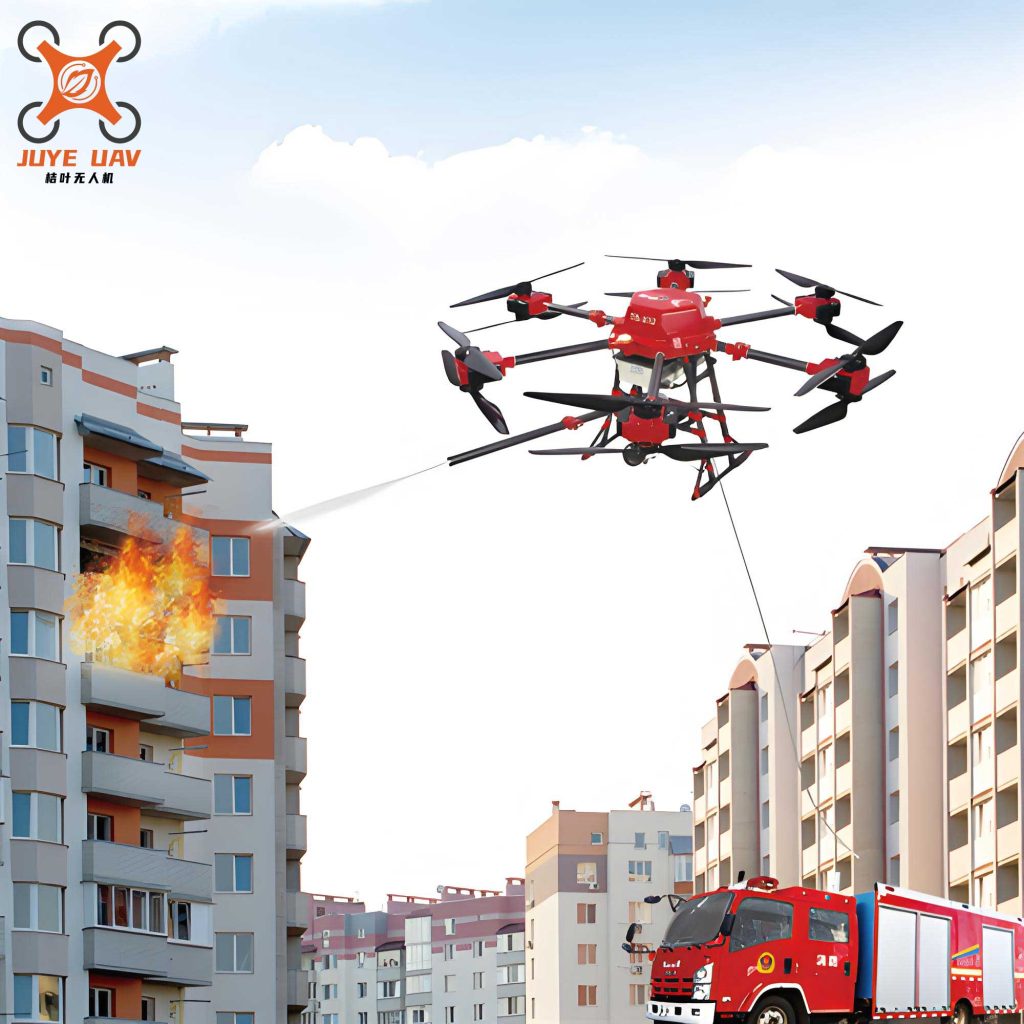
To begin, let me outline the fundamental characteristics and classifications of fire UAVs. A fire UAV is essentially an aircraft operated remotely via wireless or computer-based controls, leveraging technologies such as autonomous navigation, remote imaging, telemetry, GPS positioning, and data transmission. These technologies enable fire UAVs to perform detailed scene mapping, capture high-resolution imagery, and carry specialized firefighting payloads. From my experience, the advantages of fire UAVs can be summarized into three core aspects: high monitoring precision, cost-effectiveness, and operational safety. The precision stems from their low-altitude飞行 capabilities, allowing for close-range measurements with accuracy up to millimeter levels in engineering contexts. The cost-effectiveness is evident in their relatively low manufacturing costs and minimal external interference during operations. Additionally, by mounting cameras and other sensors, fire UAVs enhance their value without significantly increasing expenses. Safety and maneuverability are突出 due to their minimal takeoff and landing requirements and adaptability to real-time conditions.
In terms of classification, fire UAVs can be categorized based on外形特征 and动力 sources. Based on外形, they are typically divided into fixed-wing, single-rotor, and multi-rotor types. Each type has distinct applications; for instance, fixed-wing fire UAVs excel in long-range patrols, while multi-rotor fire UAVs offer superior hover stability for precise tasks. Based on动力, fire UAVs are classified into fuel-powered (using gasoline or diesel) and electric-powered (using lithium batteries) variants. Electric fire UAVs are generally safer, whereas fuel-powered ones boast longer endurance. To illustrate this, I present a table summarizing the key characteristics of these classifications:
| Classification Type | Subcategories | Key Features | Typical Applications |
|---|---|---|---|
| By外形特征 | Fixed-wing | Long endurance, high speed, suitable for large-area surveillance | Forest fire monitoring, disaster assessment |
| By外形特征 | Single-rotor | Heavy payload capacity, stable hover,但 complex control | Fire suppression with large equipment |
| By外形特征 | Multi-rotor | Vertical takeoff/landing, high maneuverability, easy operation | Urban fire reconnaissance, precise payload delivery |
| By动力 Source | Fuel-powered | High endurance,但 higher risk of combustion | Extended missions in remote areas |
| By动力 Source | Electric-powered | Safe, quiet,但 limited battery life | Short-duration tasks in populated zones |
Moreover, the performance of fire UAVs can be quantified using formulas. For example, the endurance of an electric fire UAV can be expressed as:
$$ T = \frac{C \times V \times \eta}{P} $$
where \( T \) is the flight time in hours, \( C \) is the battery capacity in ampere-hours (Ah), \( V \) is the voltage in volts (V), \( \eta \) is the efficiency factor (typically between 0.8 and 0.9), and \( P \) is the power consumption in watts (W). This formula highlights the critical role of battery technology in enhancing fire UAV capabilities. Similarly, the payload efficiency can be calculated as:
$$ \eta_p = \frac{W_p}{W_t} \times 100\% $$
where \( \eta_p \) is the payload efficiency percentage, \( W_p \) is the payload weight in kilograms, and \( W_t \) is the total takeoff weight in kilograms. Optimizing this ratio is essential for effective fire UAV operations.
Moving to the current applications of fire UAVs, I have analyzed several critical scenarios where these devices have proven invaluable. In high-rise building fires, traditional methods face challenges such as limited access and slow deployment. Fire UAVs address this by integrating transport vehicles,无人机 platforms, and灭火 payloads. They can carry rescue物资 for aerial drops, deploy灭火 agents like water or foam, and conduct reconnaissance using sensors. For instance, a fire UAV equipped with thermal cameras can detect heat sources through smoke, providing real-time data to commanders. In hazardous chemical fires, fire UAVs enable全程防控 by monitoring storage facilities pre-incident, detecting gas concentrations during events, and aiding post-disaster investigations. They often carry gas sensors and图传 modules to relay video and data back to指挥 centers.
In forest and grassland fire救援, fire UAVs are deployed for日常 patrols,火点 detection, and assistance in灭火 operations. Their遥感 payloads allow for 24/7 aerial surveillance, identifying高危火点 and monitoring火势 spread. Additionally, fire UAVs can perform life-sign detection in localized areas, guiding evacuation routes. During natural disasters like floods or泥石流, fire UAVs excel in rapid地形 mapping and机动 reconnaissance, avoiding human exposure to dangers. They integrate易燃易爆 gas detectors to monitor灾区 atmospheres, ensuring accurate decision-making. For定位搜索 and预警照明, fire UAVs utilize network coverage from multiple units to pinpoint trapped individuals or firefighters, with applications in emergency broadcasting and illumination.
To encapsulate these applications, I have compiled a table summarizing the roles of fire UAVs across different disaster types:
| Disaster Scenario | Primary Functions of Fire UAV | Key Payloads | Operational Benefits |
|---|---|---|---|
| High-rise Building Fires | Reconnaissance,灭火 agent delivery,物资 drops | Thermal cameras, water pumps, communication relays | Rapid access, reduced risk to personnel |
| Hazardous Chemical Fires | Gas detection, remote monitoring, post-event调查 | Gas sensors,高清 cameras, data transmitters | Enhanced safety, real-time hazard assessment |
| Forest/Grassland Fires | Patrol,火点 detection,火势 monitoring, life-sign搜索 | Multispectral sensors, GPS trackers, loudspeakers | Large-area coverage, early warning, efficient resource allocation |
| Natural Disasters (e.g., floods) | 地形 mapping, gas monitoring,搜救 coordination | LiDAR, gas analyzers, communication systems | Quick response, minimized human entry into危险 zones |
| General Rescue Operations | 定位搜索,预警照明, communication中继 | Searchlights, radio repeaters, thermal imagers | Improved accuracy in target acquisition, extended operational range |
Despite these advancements, I must acknowledge the limitations in current fire UAV research and application. Based on my observations, several shortcomings persist. First, fire UAVs often exhibit poor adaptability and reliability in harsh environments. Factors like wind fields, smoke, temperature extremes, downwash vortices, and electromagnetic interference can disrupt operations, leading to crashes or service failures. This can be modeled using a reliability function:
$$ R(t) = e^{-\lambda t} $$
where \( R(t) \) is the reliability over time \( t \), and \( \lambda \) is the failure rate influenced by environmental stressors. For fire UAVs, \( \lambda \) tends to increase under adverse conditions, highlighting the need for robust design.
Second, modular integration and compatibility are often low. Fire UAVs require multiple功能模块, such as imaging, temperature sensing, and flight control, which may conflict with existing emergency communication devices. This interference can hinder normal operations. Third, key performance aspects like endurance, payload capacity, explosion-proofing, and obstacle avoidance remain underdeveloped. Compared to the prolonged durations of firefighting missions, most fire UAVs have limited battery life,难以进行连续操作. The payload capacity of multi-rotor fire UAVs is often insufficient for heavy tasks in高层建筑 or自然灾害 scenarios. Explosion-proof capabilities are lacking for operations in volatile atmospheres, and intelligent obstacle avoidance is not yet standard. These limitations can be summarized in another table:
| Limitation Area | Specific Issues | Impact on Fire UAV Operations |
|---|---|---|
| Environmental Adaptability | Sensitivity to wind, smoke, temperature, electromagnetic fields | Increased risk of crashes, reduced operational availability |
| Modular Compatibility | Conflicts between imaging, sensing, and communication modules | Disrupted data transmission, compromised mission execution |
| Endurance and Payload | Short battery life, limited载重能力 | Inability to sustain long missions, restricted payload options |
| Explosion-proofing | Lack of防护 for explosive environments | Unsuitable for hazardous chemical or industrial fires |
| Obstacle Avoidance | Absence of smart避障 systems | Collision risks in complex terrains, e.g., urban or forested areas |
| Standardization | No unified standards for performance metrics | Inconsistent quality, hindered大规模 adoption |
Fourth, there is no unified system for fire UAV usage and management. Effective deployment requires科学 training and实战操作规程, yet comprehensive programs are scarce. Fifth, the absence of standardized norms for fire UAVs—covering endurance, payload, interference resistance, temperature tolerance, weatherproofing, explosion-proofing, and obstacle avoidance—impedes规范化发展. As a proponent of fire UAV technology, I stress the urgency of establishing these standards to foster科学化生产 and有序化应用.
Looking ahead, the future of fire UAVs is promising, with several key trends emerging. First,智能化 will transform fire UAVs from pre-programmed devices to adaptive systems. By integrating artificial intelligence (AI), GIS,云计算, and big data, fire UAVs can autonomously adjust parameters based on real-time scene changes. For example, an AI-powered fire UAV could optimize its flight path using a decision algorithm:
$$ \text{Optimal Path} = \arg\min_{\text{path}} \left( \alpha \cdot \text{Time} + \beta \cdot \text{Risk} + \gamma \cdot \text{Energy} \right) $$
where \( \alpha, \beta, \gamma \) are weighting factors for time efficiency, risk assessment, and energy consumption. This智能化 approach enhances monitoring品质 and operational flexibility.
Second,一体化及多机协同 will enable fire UAVs to perform comprehensive tasks. Instead of单一功能, future fire UAVs will combine reconnaissance, suppression, and rescue into integrated platforms. Multi-UAV协作 systems will allow swarms of fire UAVs to collaborate, such as dispersing for广播疏散 or lifting heavy objects in交通事故救援. The efficiency of such协同 can be expressed as:
$$ E_{\text{swarm}} = \frac{\sum_{i=1}^{n} T_i \cdot C_i}{n \cdot \max(T_i)} $$
where \( E_{\text{swarm}} \) is the swarm efficiency, \( n \) is the number of fire UAVs, \( T_i \) is the task completion time for UAV \( i \), and \( C_i \) is its capability score. Higher values indicate better协同 performance.
Third,量产化 will drive down costs and promote widespread adoption. Currently, the high expenses of机载设备 and maintenance limit fire UAV proliferation. By refining manufacturing techniques and exploring cost-effective alternatives, we can achieve mass production. This involves optimizing production functions, such as:
$$ \text{Cost}_{\text{fire UAV}} = \sum_{j=1}^{m} (M_j + L_j + R_j) $$
where \( M_j \) is material cost, \( L_j \) is labor cost, and \( R_j \) is R&D cost for component \( j \). Reducing these through economies of scale will make fire UAVs more accessible.
Fourth,普及化 will entail expanding training programs for operators. As fire UAVs become more common, we must enhance the业务知识 of消防 personnel through structured curricula and certification. Fifth,专业化 will lead to specialized fire UAVs tailored to specific火情 types. For instance, forest fire UAVs may prioritize endurance and遥感 range, while chemical fire UAVs focus on gas detection. Advances in动力源装置, such as hybrid or hydrogen fuel cells, could break through endurance barriers. Incorporating signal中继站 and quantum communication will enhance抗干扰性 and远程控制距离.
To support these developments, I propose two recommendations. First, we should出台消防无人机技术标准 by establishing universal technical specifications for fire UAVs. This will standardize研发,生产,采购, and配备 processes, ensuring interoperability and reliability. Key parameters to standardize include minimum endurance (e.g., \( T_{\text{min}} \geq 2 \) hours), payload capacity (e.g., \( W_p \geq 10 \) kg), and environmental ratings (e.g., operating temperature range of \(-20^\circ\text{C} \text{ to } 50^\circ\text{C}\)). Second, we must加强无人机人才队伍建设 by forming dedicated fire UAV救援 teams. Each基层消防救援单位 should train 1-2 certified pilots, with higher-level units training 3 or more. Developing a《消防无人机训练大纲》based on实战 scenarios will ensure competency. Additionally, fostering strategic partnerships with专业飞手 will facilitate knowledge exchange and共同保障.
In conclusion, fire UAVs have already demonstrated significant value in应急通信保障 and灭火救援行动. As we progress, fire UAVs will evolve from被动化,单任务化 systems to自组化,多任务化 networks. The integration of emerging technologies like AI and quantum通信 will further empower fire UAVs in消防信息化, providing robust support for防范化解重大安全风险 and应对处置各类灾害事故. From my standpoint, the continuous innovation in fire UAV technology holds the key to a safer and more efficient future in firefighting. I encourage ongoing research and collaboration to overcome current limitations and realize the full potential of fire UAVs in saving lives and protecting property.