
In the context of accelerating urbanization and frequent extreme weather events, fires have become a significant threat to public life and property safety. The annual incidence of fires remains high nationwide, with over 40% of rescue missions involving complex terrains, high-rise buildings, and hazardous industrial sites. Traditional rescue equipment, such as fire trucks and ladder trucks, exhibits notable shortcomings. With the leapfrog development of UAV technology, its payload capacity has exceeded 20 kg, and anti-electromagnetic interference flight control systems have matured, demonstrating significant advantages in emergency rescue. By modularly integrating professional fire suppression devices like dry powder喷射 systems and flame retardant投放 systems, fire UAVs establish a new fire extinguishing体系, breaking through the spatiotemporal limitations of traditional救援. This article focuses on the工况 adaptability and core efficacy indicators of fire UAV systems under different environmental parameters, aiming to provide scientific basis for optimizing emergency rescue plans and promoting the upgrade of intelligent fire protection systems.
The application of fire UAV technology in emergency rescue is广泛, with high flexibility enabling rapid response to fire situations,突破传统救援空间限制, and possessing adaptability to complex terrains, allowing efficient operations in scenarios such as mountainous areas and urban narrow spaces. However, current technical bottlenecks include insufficient endurance time and limited effective payload. Targeted solutions involve optimizing battery performance (e.g., applying hydrogen fuel cells, solid-state batteries) and lightweight structural design (using carbon fiber composite materials, modular design). Practice shows that合理配置 fire UAV灭火 systems can significantly enhance emergency response capabilities, reduce rescue costs. Future development may trend toward intelligent协同作战, providing robust technical support for safeguarding lives and property.
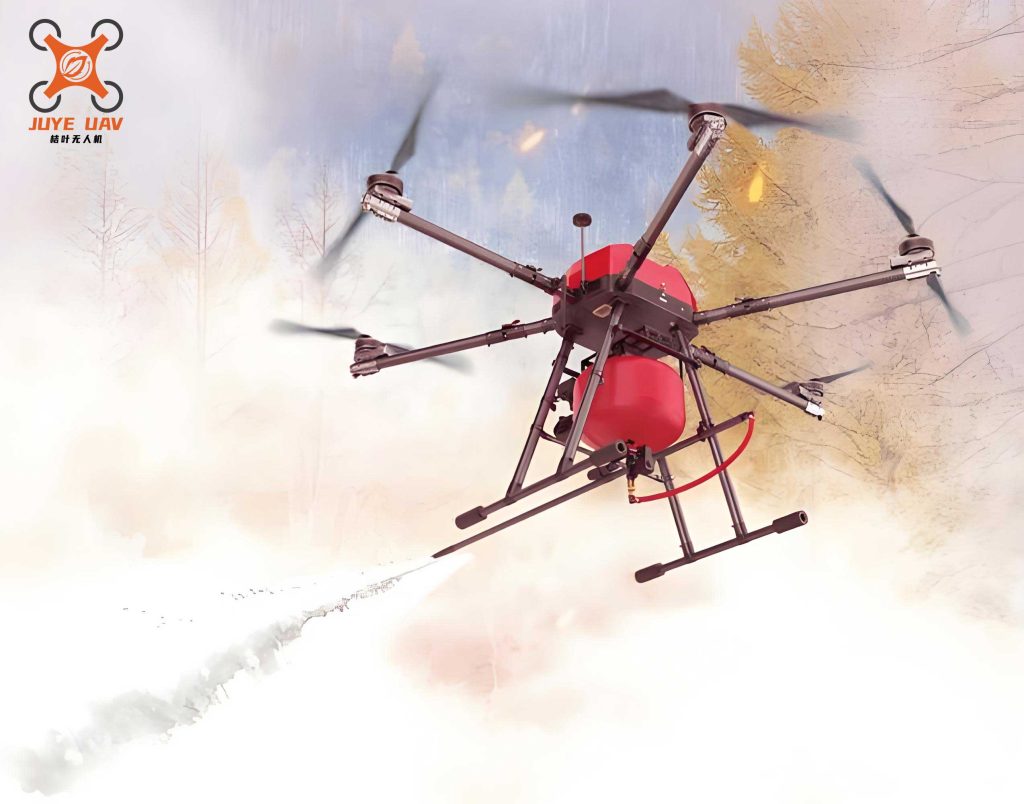
As a practitioner in this field, I have observed firsthand the transformative impact of fire UAVs. Their ability to swiftly navigate challenging environments makes them indispensable in modern firefighting. The integration of advanced sensors and灭火装置 has redefined救援 paradigms, offering a safer and more efficient alternative to traditional methods. In this analysis, I will delve into the characteristics, necessity, challenges, and enhancement strategies for fire UAVs, supported by tables and formulas to summarize key points.
Characteristics of Fire UAVs
Fire UAVs, or unmanned aerial vehicles equipped with fire suppression devices, exhibit several distinct features that enhance their efficacy in emergency救援.
| Characteristic | Description | Impact on Rescue |
|---|---|---|
| High Mobility | Small, lightweight airframe with flexible flight control;不受 road congestion or terrain限制. | Reduces response time, allows access to confined spaces like high-rises and forests. |
| Access to Complex Areas | Can reach rugged mountains, narrow urban structures, and水域 via flight. | Fills “spatial盲区,” enables precise fire suppression in inaccessible regions. |
| Real-time Monitoring and Feedback | Equipped with HD cameras, thermal imagers for live data transmission. | Facilitates informed decision-making,动态调整 of strategies. |
| Risk Reduction for Rescuers | Operates remotely, minimizing exposure to高温,烟雾, and structural hazards. | Enhances safety for消防 personnel, especially in老旧 buildings. |
The mobility of fire UAVs is quantified by their speed and agility. For instance, the time to reach a fire scene can be modeled as: $$T_{response} = \frac{D}{V} + T_{takeoff}$$ where \(D\) is the distance, \(V\) is the average velocity, and \(T_{takeoff}\) is the preparation time. Compared to fire trucks, fire UAVs often have lower \(T_{response}\) due to direct flight paths.
In complex regions, such as山地火灾, the fire UAV’s ability to bypass obstacles is crucial. The probability of successful access can be expressed as: $$P_{access} = 1 – \frac{A_{blocked}}{A_{total}}$$ where \(A_{blocked}\) is the area inaccessible by ground, and \(A_{total}\) is the total fire area. Fire UAVs typically yield higher \(P_{access}\) values.
Necessity of Fire UAVs in Emergency Rescue
The deployment of fire UAVs is essential for modern救援 operations, addressing limitations of traditional methods.
| Factor | Traditional Limitation | Fire UAV Advantage | Example Scenario |
|---|---|---|---|
| Enhanced Emergency Capability | Fire trucks constrained by road conditions;云梯 limited to ~100m height. | Overcomes geographical barriers, operates in remote or high-rise areas. | 偏远山区火灾 where roads are曲折;超百米建筑 fires. |
| Improved Timeliness | Slow response due to traffic or distance. | Rapid aerial deployment,黄金扑救时机 utilization. | Urban residential fires where火势 spreads in minutes. |
| Special Scenario Strategies | High risk in chemical or oil tank fires due to爆炸 and高温. | Remote操控, non-contact suppression with specialized agents. | 化工火灾 with易燃易爆 chemicals;油罐火灾 with变形风险. |
| Increased Rescue Efficiency | Sequential灭火 for multiple sites is time-consuming. | Simultaneous multi-point operations via aerial调度. | 老城区连片建筑 fires; coordinated suppression across structures. |
The timeliness benefit can be modeled using the火势蔓延 rate. Let \(S(t)\) be the fire spread area over time \(t\). With traditional response, the area grows as: $$S_{traditional}(t) = S_0 + r t_{delay}$$ where \(S_0\) is initial area, \(r\) is spread rate, and \(t_{delay}\) is response delay. For fire UAVs, \(t_{delay}\) is reduced, leading to: $$S_{UAV}(t) = S_0 + r (t_{delay} – \Delta t)$$ where \(\Delta t\) is the time saved by UAV deployment. The reduction in damage is proportional to \(\Delta t\).
In special scenarios like chemical fires, the effectiveness of fire UAVs can be quantified by the suppression efficiency: $$\eta = \frac{m_{extinguished}}{m_{total}} \times 100\%$$ where \(m_{extinguished}\) is the mass of fire suppressed, and \(m_{total}\) is the total fire mass. Fire UAVs often achieve higher \(\eta\) due to precise application of灭火剂.
Problems in the Application of Fire UAVs
Despite their advantages, fire UAVs face several challenges that hinder optimal performance.
| Problem | Technical Bottleneck | Impact on Rescue | Example Case |
|---|---|---|---|
| Insufficient Endurance | Battery technology limits flight duration; energy density constraints. | Frequent recharging interrupts operations, reduces efficiency in large-scale fires. | 大规模森林火灾 where火场 is vast; UAV must return for充电, allowing火势蔓延. |
| Limited Payload | Low carrying capacity restricts灭火剂 quantity. | Multiple replenishment rounds needed, increasing time and cost. | 大型商业中心火灾 requiring大量灭火剂;单次飞行 insufficient, leading to间断. |
| Communication Interference | Signal disruption from高温,烟雾,电磁场 at fire scenes. | Loss of control or data delay, compromises precision and safety. | 工厂火灾 with强电磁干扰; UAV experiences信号中断, risking失控. |
The endurance problem can be analyzed through the battery energy equation: $$E_{battery} = C \times V$$ where \(C\) is capacity in Ah, and \(V\) is voltage. The flight time \(T_{flight}\) is: $$T_{flight} = \frac{E_{battery}}{P_{consumption}}$$ where \(P_{consumption}\) is the power consumption of the fire UAV. Current lithium batteries yield \(T_{flight}\) of ~30 minutes, which is inadequate for extended missions.
For payload, the maximum灭火剂 mass \(m_{agent}\) is limited by the UAV’s structural capacity: $$m_{agent} = m_{max} – m_{UAV}$$ where \(m_{max}\) is the maximum takeoff mass, and \(m_{UAV}\) is the空机 weight. With typical \(m_{max}\) of 20-30 kg, \(m_{agent}\) is often less than 10 kg, necessitating optimization.
Communication reliability is affected by signal-to-noise ratio (SNR): $$SNR = \frac{P_{signal}}{P_{noise}}$$ where \(P_{signal}\) is the signal power, and \(P_{noise}\) is the noise power from interference. In fire environments, \(P_{noise}\) increases, reducing SNR and causing packet loss.
Strategies to Enhance the Efficacy of Fire UAVs
To overcome these challenges, targeted strategies are essential for improving fire UAV performance.
| Strategy | Approach | Expected Outcome | Technical Details |
|---|---|---|---|
| Develop High-performance Batteries | Invest in advanced materials like石墨烯 or氢燃料电池 to increase energy density. | Extended flight time, reduced charging frequency for continuous operations. | Graphhene batteries offer high energy density;氢燃料电池 provide longer endurance via chemical reactions. |
| Optimize Payload Design | Use lightweight materials (e.g., carbon fiber) and compact,高效灭火设备. | Increased灭火剂携带量, enhanced灭火强度 within weight limits. | Modular design reduces空机 weight;高浓度灭火剂 maximizes agent efficacy per unit mass. |
| Improve Anti-interference Communication | Adopt 5G technology, signal amplifiers, and屏蔽设备 to bolster reliability. | Stable control and data transmission in complex fire environments. | 5G offers low latency and high bandwidth;硬件强化 mitigates电磁干扰. |
For battery研发, the energy density improvement can be modeled as: $$E_{new} = k \times E_{current}$$ where \(k\) is the enhancement factor (e.g., \(k > 1\) for graphene). This directly boosts \(T_{flight}\) as per the earlier formula. Additionally, hydrogen fuel cells operate on: $$2H_2 + O_2 \rightarrow 2H_2O + \text{energy}$$ providing sustained power with water as byproduct.
Payload optimization involves structural efficiency. The weight reduction from carbon fiber can be expressed as: $$m_{reduction} = m_{traditional} – m_{CFRP}$$ where \(m_{CFRP}\) is the mass of carbon fiber reinforced polymer. This allows more mass allocation to灭火剂. The灭火剂 efficacy can be quantified by extinguishing coefficient \(K\): $$K = \frac{V_{fire}}{m_{agent}}$$ where \(V_{fire}\) is the fire volume extinguished. Using high-concentration agents increases \(K\), reducing required \(m_{agent}\).
Communication enhancement via 5G leverages its capacity公式: $$C = B \log_2(1 + SNR)$$ where \(C\) is channel capacity, and \(B\) is bandwidth. Higher \(B\) and SNR from抗干扰装备 ensure robust data flow for fire UAV操控. Signal amplifiers boost \(P_{signal}\), while shielding reduces \(P_{noise}\), improving SNR.
Future Directions and Conclusion
The integration of fire UAVs into emergency救援 represents an innovative变革. Their ability to quickly traverse complex terrains and deliver precise fire suppression agents significantly shortens response times, curbs火势扩散, and buys time for后续救援. However, challenges such as battery续航不足,载重限制, and通信干扰 persist. To突破这些瓶颈, concerted efforts in battery研发, structural design, and sensor optimization are crucial.
Looking ahead, fire UAV technology should evolve toward intelligent协同作战. This involves swarms of fire UAVs operating in coordination, guided by AI for optimal resource分配. The efficacy can be enhanced through networked systems where multiple fire UAVs share data and tasks. A formula for swarm efficiency might be: $$E_{swarm} = \sum_{i=1}^{n} \eta_i \cdot \frac{T_i}{T_{total}}$$ where \(n\) is the number of fire UAVs, \(\eta_i\) is individual efficiency, and \(T_i\) is operational time. Such advancements will solidify the role of fire UAVs in safeguarding lives and property.
In summary, as we continue to refine fire UAV capabilities, their impact on emergency救援 will only grow. By addressing technical limitations and leveraging innovations, fire UAVs will become a cornerstone of modern fire protection, offering a blend of safety, efficiency, and adaptability unmatched by traditional methods. The journey ahead requires持续 investment in R&D, but the potential rewards—in terms of saved lives and reduced destruction—are immense. Fire UAVs are not just tools; they are transformative assets in our fight against fire disasters.