
Based on extensive field experience and operational analysis, the integration of Unmanned Aerial Vehicles (UAVs), specifically fire UAV systems, into wildland firefighting protocols represents not merely an addition of technology but a fundamental shift in doctrine. The traditional paradigm, heavily reliant on ground personnel braving extreme hazards with limited situational awareness, is being augmented—and in some scenarios, superseded—by aerial platforms offering unprecedented capabilities. This article synthesizes experimental data, tactical case studies, and forward-looking analysis to outline the structural advantages, transformative applications, and future trajectory of fire UAV systems in forest fire prevention and suppression.
The core advantage of a modern fire UAV system lies in its integrated architecture. As defined by aviation authorities, the Unmanned Aircraft System (UAS) comprises the aerial platform, control station, and data links. For firefighting purposes, this expands to include specialized ground support equipment and, most critically, a modular suite of mission payloads. The versatility of a fire UAV is determined by its payload capacity and the interoperability of these modules.
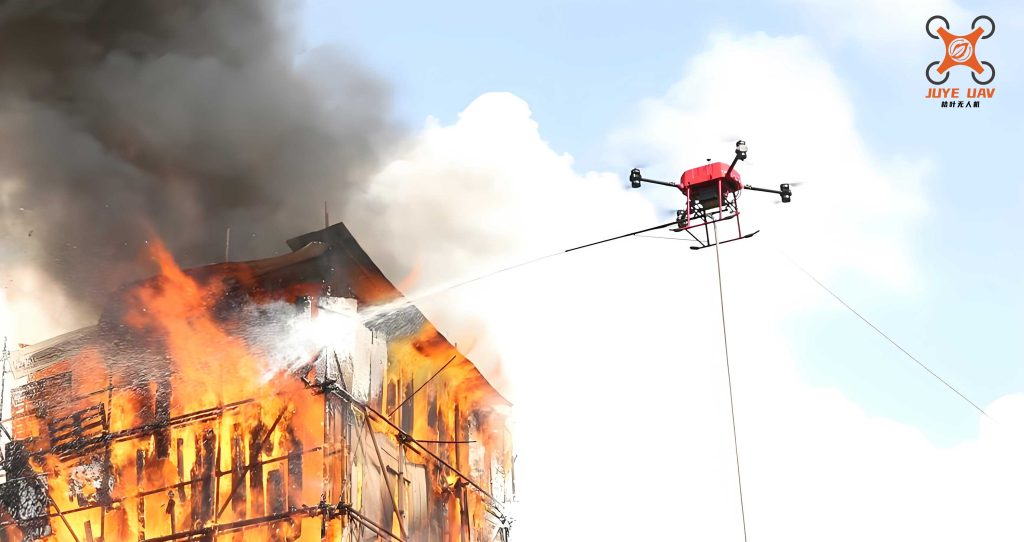
The operational superiority of the fire UAV over traditional methods can be quantified across several dimensions. A comparative analysis reveals its disruptive potential.
| Operational Parameter | Traditional Ground Crew | Manned Aircraft / Helicopter | Fire UAV System |
|---|---|---|---|
| Response Time to Remote Fire | Hours to Days (Terrain-dependent) | 30 mins – 2 hrs (Launch & Transit) | 5 – 20 mins (Direct flight) |
| Situational Awareness Resolution | Limited, line-of-sight (~100m radius) | Broad but low-detail (High altitude) | High-detail, persistent, multi-spectral |
| Operational Risk to Personnel | Extremely High (Direct flame contact, rollover) | High (Low-altitude flight, turbulence) | Negligible (Remote operation) |
| Cost per Operational Hour | Moderate (Logistics, manpower) | Very High (Fuel, maintenance, crew) | Low (Electricity/minimal fuel) |
| Ability for Precision Application | Low (Area saturation with retardant/water) | Moderate (Drops from altitude) | Very High (Hover-and-pour, targeted munitions) |
This advantage translates into a reimagining of core firefighting tactics. The traditional linear attack, where crews directly engage the fire’s edge, is now supplemented by a “deep strike” capability. A fire UAV can bypass surface dangers to directly attack key “anchor points” or “spot fires” ahead of the main front. The effectiveness of a single water/retardant drop from a fire UAV can be modeled. The volume required to suppress a target area is given by:
$$ V_{req} = A_{target} \cdot d_{rate} $$
Where \( V_{req} \) is the required retardant volume (liters), \( A_{target} \) is the target area (\(m^2\)), and \( d_{rate} \) is the recommended application rate (liters/\(m^2\)). A fire UAV with a 100L tank and a \( d_{rate} \) of 2 L/\(m^2\) can effectively treat:
$$ A_{treated} = \frac{V_{payload}}{d_{rate}} = \frac{100}{2} = 50 \, m^2 $$
This precision allows for strategic isolation of fire progression paths. Furthermore, the concept of “swarm tactics” is emerging. Instead of a single large, expensive platform, multiple smaller, coordinated fire UAV units can be deployed. The combined coverage rate (\( C_{swarm} \)) of \(n\) UAVs, each with treatment area \(A_{treated}\) and cycle time \(t_{cycle}\) (including flight, discharge, and reload), is:
$$ C_{swarm} = \frac{n \cdot A_{treated}}{t_{cycle}} $$
For 3 UAVs each treating 50 \(m^2\) in a 10-minute cycle, the sustained coverage rate is \(15 \, m^2/min\), enabling continuous, rolling attacks on a fire’s flank.
Beyond direct suppression, the fire UAV revolutionizes the entire fire management cycle, beginning with prevention. Traditional patrols are limited in scope and frequency. A fire UAV equipped with visual and infrared sensors can autonomously follow a pre-programmed grid, scanning for heat signatures indicative of illegal campfires or lightning strikes. The probability of detection \(P_{detect}\) over an area \(A\) by a UAV with sensor sweep width \(W\) flying a path length \(L\) is approximated by:
$$ P_{detect} \approx 1 – e^{-\frac{W \cdot L}{A}} $$
This formula highlights how increasing \(L\) (flight time/endurance) directly and exponentially improves surveillance efficacy, a task perfectly suited for long-endurance fire UAV models.
During a fire, the fire UAV acts as the command’s aerial nerve center. It provides real-time georeferenced data feeds, allowing for the dynamic calculation of fire spread. Using inputs for wind speed \(U\), slope gradient \(\phi\), and fuel moisture content \(M\), simplified spread models can be run in near-real-time to predict the fire’s vector and speed \(R\):
$$ R = R_0 \cdot (1 + f(U) + g(\phi) – h(M)) $$
Where \( R_0 \) is the base spread rate in nominal conditions, and \(f\), \(g\), and \(h\) are functions modifying the rate based on environmental factors measured by the fire UAV‘s sensors. This allows for predictive deployment of ground crews to strategic containment lines rather than reactive chasing of the flame front.
The logistical burden in wildland firefighting is colossal. A significant portion of crew fatigue and risk stems from hauling equipment, water, and supplies over rugged terrain. The fire UAV transforms into an automated logistics mule. Its payload capacity directly translates into manpower savings. The number of crew-member journeys saved \(N_{saved}\) by using a UAV to transport a mass \(m_{payload}\) over a vertical gain \(H\) and horizontal distance \(D\) is:
$$ N_{saved} = \frac{m_{payload} \cdot g \cdot H + E_{traverse}(D)}{E_{human\_trip}} $$
Here, \(g\) is gravity, \(E_{traverse}\) is the energy cost of moving the load over distance \(D\), and \(E_{human\_trip}\) is the metabolic energy expended by a firefighter on one supply trip. Deploying a fire UAV for this task preserves critical human energy for direct firefighting tasks and enhances safety.
The future of the fire UAV in wildland firefighting points towards fully integrated, networked, and intelligent systems. We are moving beyond individual remotely piloted vehicles towards an ecosystem.
| Future Development Axis | Current State | Future Vision | Key Enabler |
|---|---|---|---|
| System Connectivity | Isolated video feeds to a local commander. | Federated, cloud-based UAS Traffic Management (UTM) for all aerial assets. | 5G/Advanced Satcom, common data protocols. |
| Data Processing & AI | Manual analysis of imagery post-flight. | Onboard/edge AI for real-time fire line detection, hotspot classification, and predictive spread modeling. | Machine Learning algorithms, powerful onboard processors. |
| Tactical Autonomy | Remote-controlled flight with operator directing actions. | Supervised autonomy: AI suggests optimal strike points, flight paths, and logistics routes for human approval. | Advanced sensor fusion, reliable obstacle avoidance. |
| Manned-Unmanned Teaming (MUM-T) | Separate, non-communicating spheres of operation. | Seamless coordination: Fire UAV scouts for manned helicopter, guides its drops, assesses effectiveness, and provides a safety overwatch. | Secure, low-latency datalinks, shared tactical picture. |
| Payload Specialization | Generic water/retardant tanks or simple munitions. | Smart munitions (penetrating soil for peat fires), adhesive gel dispensers, targeted ember-suppression drones, and SEAD (Suppression of Enemy Air Defenses – i.e., clearing a safe corridor through the fire for manned assets) platforms. | Advanced materials science, micro-engineering. |
In this future operational model, the fire UAV transitions from a support tool to a primary combatant within a combined arms approach to firefighting. The ultimate metric for a fire UAV system’s effectiveness in a theater of operations could be expressed as a form of operational “power” \(P_{UAV}\), a function of its key attributes:
$$ P_{UAV} = k \cdot \frac{(Payload \cdot Endurance \cdot DataRate \cdot Autonomy)}{Cost} $$
Where \(k\) is a system integration constant. The pursuit of higher \(P_{UAV}\) drives innovation—increasing the numerator (capability) while minimizing the denominator (acquisition and operational cost). The path forward is clear: continued investment in R&D, rigorous operational testing in conjunction with firefighting units, and the development of robust doctrine and training will ensure that the fire UAV fulfills its potential to make wildland firefighting more strategic, less perilous, and ultimately, more effective in preserving our forest ecosystems.