
Witnessing the global response to the COVID-19 pandemic was a profound experience, one that laid bare both our profound vulnerabilities and our remarkable capacity for innovation. From my perspective within the field of public safety and intelligent systems, one of the most compelling narratives to emerge was the rapid, improvisational deployment of unmanned intelligent systems. These machines, operating on the front lines where human presence posed a risk, became silent partners in our collective fight. They delivered meals, disinfected streets, transported vital supplies, and connected doctors across continents. This event was not merely a test of medical infrastructure but a real-world validation of a technological paradigm shift. It underscored a critical truth: unmanned intelligent systems are transitioning from tools of convenience to essential components of our societal safety apparatus. This article explores this integration, analyzing the applications witnessed during the pandemic, framing them within a structured model of crisis prevention, and projecting their evolution—with a particular focus on the transformative potential of fire UAVs—into the future architecture of national emergency management systems.
The pandemic served as an unprecedented catalyst for the field deployment of unmanned systems. Their applications were diverse, yet unified by a common purpose: to interpose a layer of automation between humans and hazard. We can categorize these applications to understand their functional roles.
| System Type | Primary Function in Pandemic Response | Key Technology Enablers | Stage of Intervention |
|---|---|---|---|
| Service Robots (Delivery/Disinfection) | Intra-facility logistics, surface decontamination, patient interaction minimization. | Simultaneous Localization and Mapping (SLAM), sensor fusion (LiDAR, cameras), HEPA/UVC filtration systems. | Tertiary Prevention (Within infected zones) |
| Logistics UAVs/Ground Robots | Contactless delivery of medical supplies, specimens, and essentials over short-to-medium ranges. | Precision GPS (RTK), dynamic path planning algorithms, secure payload compartments. | Secondary & Tertiary Prevention |
| Monitoring & Broadcast UAVs | Aerial surveillance of public spaces, loudspeaker announcements for public guidance, crowd dispersal. | High-resolution EO/IR cameras, long-range acoustic devices (LRAD), LTE/5G real-time video downlink. | Primary Prevention (Community level) |
| Disinfection UAVs | Large-area aerial spraying of disinfectants in public squares, transportation hubs, and hard-to-reach areas. | Adapted agricultural spraying systems, variable-rate application technology, wind drift compensation models. | Primary & Secondary Prevention |
| Telemedicine Platforms | Remote diagnosis, specialist consultation, and even remote operation of medical equipment via high-bandwidth, low-latency networks. | 5G connectivity, edge computing, haptic feedback systems, ultra-high-definition medical imaging transmission. | Tertiary Prevention (Expertise extension) |
The efficacy of these systems can be modeled not just qualitatively, but through performance metrics. For instance, the efficiency gain from using a logistics UAV for time-sensitive deliveries can be expressed as a function of ground traffic congestion and direct aerial distance. A simplified model for mission time comparison is:
$$ T_{ground} = \frac{D_{road}}{v_{ground}} + \delta_{congestion} $$
$$ T_{UAV} = \frac{D_{air}}{v_{UAV}} + \tau_{launch/recovery} $$
Where \( T \) is total mission time, \( D \) is path distance, \( v \) is average velocity, \( \delta_{congestion} \) is a time delay factor for ground traffic, and \( \tau_{launch/recovery} \) is the UAV’s operational overhead. In urban quarantine scenarios, \( \delta_{congestion} \) can approach infinity for ground vehicles, making \( T_{UAV} \) decisively superior for critical shipments.
The observed applications align perfectly with a three-tiered prevention model for public health emergencies, demonstrating how unmanned systems provide targeted support at each level:
Primary Prevention (Pre-exposure): This aims to prevent the onset of disease in the general population. Unmanned systems like broadcast UAVs became agile platforms for disseminating health guidelines and monitoring public compliance with social distancing measures in real-time. Disinfection UAVs performed large-scale, pre-emptive sanitization of public environments. The strategic advantage here is the ability to cover vast areas rapidly without mobilizing large human teams, thus extending the reach of public health directives.
Secondary Prevention (Post-exposure, pre-symptomatic/symptomatic): This stage focuses on early detection and containment to halt progression. Here, UAVs equipped with thermal imaging sensors could potentially be deployed for wide-area fever screening in crowds, though data privacy protocols require careful design. More directly, remote triage and consultation platforms enabled by 5G networks allowed for the early assessment of potential cases without physical contact, a form of digital containment. The core function is enhanced situational awareness and rapid, remote intervention.
Tertiary Prevention (Symptomatic & Treatment): The goal is to mitigate the impact of established illness and prevent cross-infection. This is where intra-facility robots excelled. By handling delivery of food, medicine, and linens, and by executing precise UV-C disinfection cycles in patient rooms and hallways, they created a “human-out-of-the-loop” layer for routine but high-risk tasks. The benefit is twofold: protecting healthcare workers and ensuring continuous, reliable logistical support within contaminated zones. The operational reliability \( R_{system} \) in this high-stakes environment can be considered a product of the reliability of its components (sensors \( S \), navigation \( N \), power \( P \), and task-specific modules \( M \)):
$$ R_{system} = R_S \times R_N \times R_P \times R_M $$
This multiplicative model highlights why redundancy and robust design in unmanned systems for tertiary prevention are non-negotiable.
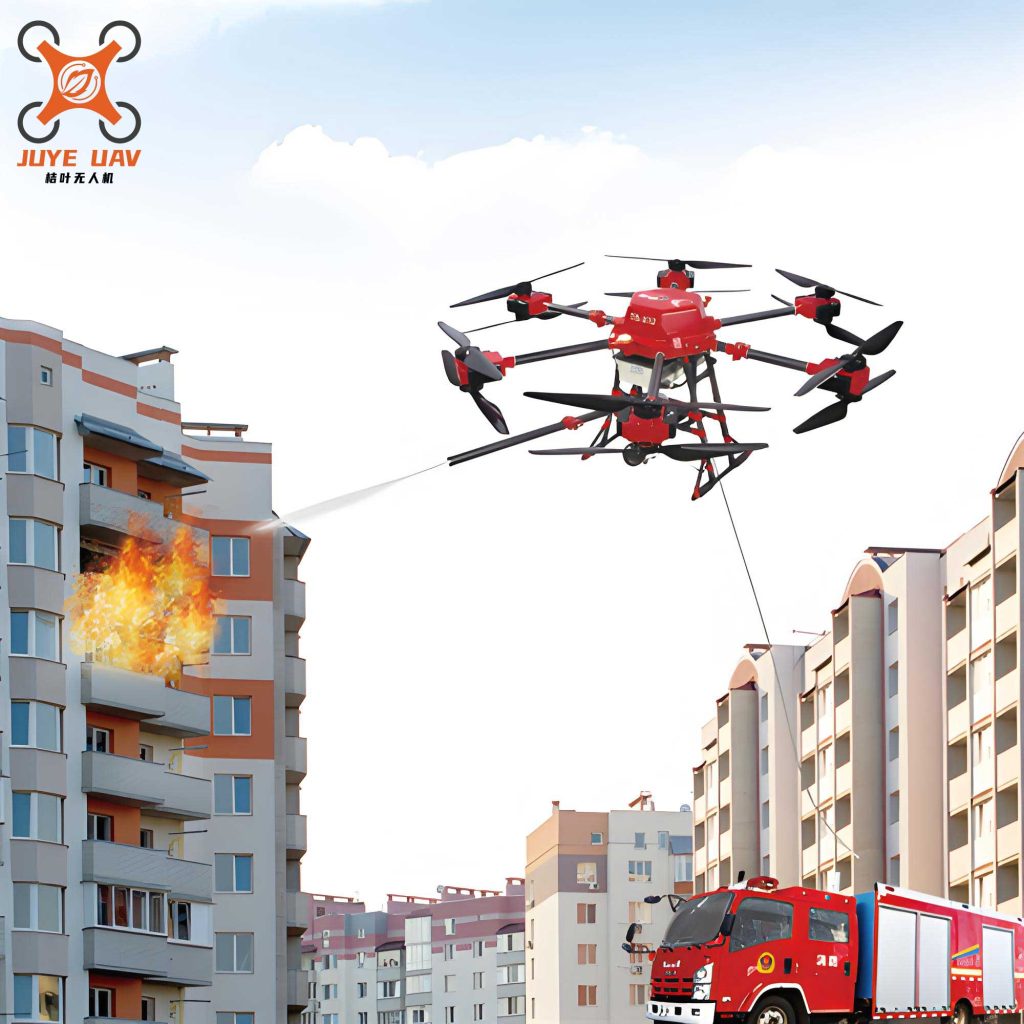
The pandemic has provided a powerful proof-of-concept, but the logic of unmanned intervention extends far beyond virology. The same principles of risk reduction, operational persistence, and access to hazardous environments apply to a broader spectrum of disasters. It is in this expanded context that the role of specialized systems like the fire UAV becomes paramount. A fire UAV is not a single tool but a platform capable of integrating various payloads—thermal cameras, gas sensors, communication relays, and even extinguishing agents—to combat fires and manage complex emergency scenes.
Consider the multidimensional advantages a fire UAV squadron brings to a major incident:
| Mission Phase | Fire UAV Capability | Impact on Emergency Response |
|---|---|---|
| Reconnaissance & Assessment | Rapid aerial deployment providing a live, overhead thermal view. Mapping fire front, identifying hotspots (\(T_{hotspot}\)), and locating trapped individuals through AI-powered image analysis. | Dramatically reduces initial size-up time. Enables data-driven resource allocation. The information gain \( I \) can be modeled as a function of area covered \( A \) and sensor resolution \( \rho \): \( I \propto A \times \rho \). |
| Persistent Monitoring | Loitering above the incident for hours, tracking fire progression, monitoring structural integrity, and detecting dangerous flare-ups or gas leaks. | Provides continuous situational awareness, allowing command to adapt tactics in real-time. Enhances safety by acting as an early warning system for sudden fire behavior changes (e.g., flashover conditions). |
| Active Intervention | Deploying targeted extinguishing agents (water, foam, dry chemical) from the air onto specific hotspots or creating firebreaks. Delivering emergency supplies to isolated responders or victims. | Allows attack on inaccessible fires (high-rises, wildfires, chemical plants). Increases precision while reducing water damage and exposure risk to firefighters. The payload capacity \( m_{payload} \) and flight time \( t_{flight} \) are key constraints: \( \text{Effectiveness} = f(m_{payload}, t_{flight}, \text{targeting accuracy}) \). |
| Communication & Coordination | Acting as a temporary aerial communication node (cell-on-wing/light) to restore critical comms for ground teams in areas where infrastructure is damaged. | Prevents communication breakdown, a major cause of responder fatalities. Ensures seamless coordination between air and ground assets, as well as with command centers. |
The operational planning for a fire UAV fleet can be optimized using combinatorial models. For example, task allocation for multiple UAVs at a large-scale incident can be framed as a variant of the Vehicle Routing Problem (VRP) with time windows and priority constraints. The objective function \( Z \) might seek to minimize the total time to complete all critical reconnaissance tasks \( K \), assigned to a fleet of \( n \) UAVs:
$$ \text{Minimize } Z = \sum_{i=1}^{n} \sum_{k \in R_i} (t_{k, end} – t_{k, start}) $$
$$ \text{Subject to: } \quad \sum_{k \in R_i} m_k \leq M_{max} \quad \forall i \quad \text{(Payload Capacity)} $$
$$ \quad \quad \quad \quad T_{k, start} \leq t_{k} \leq T_{k, end} \quad \text{(Time Windows)} $$
$$ \quad \quad \quad \quad \bigcup_{i=1}^{n} R_i = K \quad \text{(All Tasks Covered)} $$
Where \( R_i \) is the set of tasks assigned to UAV \( i \), \( m_k \) is the resource requirement for task \( k \), and \( M_{max} \) is the UAV’s maximum capacity.
Looking forward, the integration of unmanned intelligent systems into national emergency management frameworks is not just an option but a necessity. The lessons from pandemic response provide a blueprint. Future systems will move from being remotely piloted to being truly autonomous, capable of collaborative swarm behavior. A swarm of fire UAVs could self-organize to map a wildfire perimeter, with their collective intelligence governed by algorithms inspired by natural systems:
$$ \vec{v}_i(t+1) = w \cdot \vec{v}_i(t) + c_1 r_1 (\vec{p}_{best,i} – \vec{x}_i(t)) + c_2 r_2 (\vec{g}_{best} – \vec{x}_i(t)) $$
$$ \vec{x}_i(t+1) = \vec{x}_i(t) + \vec{v}_i(t+1) $$
This is a simplified form of a Particle Swarm Optimization (PSO) velocity update equation, where each UAV (\( i \)) in the swarm adjusts its position (\( \vec{x} \)) based on its own best-known location (\( \vec{p}_{best} \)) and the swarm’s best-known location (\( \vec{g}_{best} \)). Such coordination would allow for dynamic, efficient, and resilient coverage of a disaster zone.
Furthermore, the fusion of UAV data with other sources—satellite imagery, IoT sensor networks from smart cities, social media feeds—will create a comprehensive “digital twin” of the crisis in real-time. This Common Operational Picture (COP), powered by AI analytics, will enable predictive modeling of disaster progression, whether it’s the spread of a virus, the path of a flood, or the behavior of a fire. In this model, a fire UAV is no longer just a tool but a critical sensing and acting node in a vast, intelligent network.
Therefore, the strategic imperative is clear. We must institutionalize the role of unmanned intelligent systems. This involves:
- Standardization: Developing interoperable communication protocols, data standards, and safety regulations for UAVs and robots across all emergency services.
- Integration into Doctrine: Rewriting emergency response protocols to include unmanned systems as first-response assets, defining their command-and-control relationships with human teams.
- Investment in R&D: Focusing on core challenges: energy density for longer endurance, autonomous decision-making in complex environments, and robustness in extreme conditions (high heat, smoke, electromagnetic interference).
- Training & Education: Creating a new cadre of emergency professionals who are as skilled in data interpretation and fleet management as they are in traditional response tactics.
The COVID-19 pandemic was a harsh teacher. It revealed gaps but also illuminated a path forward—a path where technology serves as a force multiplier for human courage and compassion. Unmanned intelligent systems, from the humble delivery robot to the sophisticated fire UAV, represent more than just machines; they represent a commitment to preserving human life by redefining the front line. By weaving these systems into the very fabric of our public safety infrastructure, we build a more resilient society, one capable of meeting the uncertain challenges of the future with intelligence, agility, and an unwavering shield of silicon and steel.