
In the evolving landscape of emergency response, I have observed that technological advancements are revolutionizing traditional methods, particularly in firefighting communications. As a professional engaged in this field, I believe that the integration of fire UAV (Unmanned Aerial Vehicle) technology offers a transformative approach to enhancing safety, efficiency, and effectiveness in disaster management. This article delves into the application analysis of fire UAV systems, drawing from current practices and future potentials. The increasing frequency of disasters, coupled with the need for real-time data and robust communication, has made fire UAV technology indispensable. Through my analysis, I aim to highlight how these systems address critical gaps in firefighting communications, providing innovative tools for rescue operations, hazard assessment, and overall disaster mitigation.
The core of fire UAV technology lies in its sophisticated functional architecture, which enables it to perform diverse tasks in challenging environments. I will break down this architecture into key components, as summarized in the table below. Each component plays a vital role in ensuring the fire UAV operates seamlessly during emergencies. For instance, the flight control system maintains stability, while the sensor system gathers crucial environmental data. Understanding this architecture is essential for optimizing fire UAV applications in firefighting communications.
| Component | Description | Key Functions |
|---|---|---|
| Flight Control System | Includes flight controllers, gyroscopes, accelerometers, motors, and propellers. | Ensures stable flight, attitude control, and navigation; often governed by algorithms like PID controllers: $$u(t) = K_p e(t) + K_i \int e(t) dt + K_d \frac{de(t)}{dt}$$, where u(t) is the control output and e(t) is the error signal. |
| Communication System | Comprises wireless modules, antennas, and data links (e.g., LTE, satellite). | Transmits flight data, images, videos, and commands; supports real-time communication between fire UAV and ground stations. |
| Sensor System | Integrates cameras, infrared thermographers, radar, and meteorological sensors. | Captures environmental data such as fire intensity, smoke dispersion, and temperature; for example, thermal imaging can detect heat sources using Planck’s law: $$B_{\lambda}(T) = \frac{2hc^2}{\lambda^5} \frac{1}{e^{\frac{hc}{\lambda k_B T}} – 1}$$. |
| Payload System | Carries devices like high-definition cameras, gas sensors, or loudspeakers. | Executes specific tasks like image acquisition, target search, or rescue supply delivery; payload capacity is a key metric for fire UAV selection. |
| Data Processing and Storage | Uses embedded processors, memory units, and image processing algorithms. | Processes and stores data in real-time; enables analysis for decision-making, often involving machine learning models. |
| Navigation and Positioning | Relies on GPS, inertial navigation systems, and compasses. | Provides accurate location and heading information; critical for autonomous operations in GPS-denied environments. |
| Power System | Includes batteries, fuel cells, or generators. | Supplies electrical power to all components; flight time is a limiting factor, calculated as $$T = \frac{E}{P}$$, where E is energy and P is power consumption. |
Having explored the architecture, I now turn to the advantages of deploying fire UAV technology in firefighting communications. In my experience, these advantages stem from the fire UAV’s agility, versatility, and ability to operate in hazardous conditions. The table below summarizes the key benefits, which I will elaborate on. From rapid deployment to risk reduction, fire UAV systems enhance communication reliability and rescue coordination, making them invaluable assets in modern firefighting efforts.
| Advantage | Explanation | Impact on Firefighting |
|---|---|---|
| Rapid Deployment and Flexibility | Fire UAV can be launched quickly without complex setup, adapting to diverse terrains. | Reduces response time, enabling immediate communication support at disaster sites. |
| Aerial Perspective and Wide Coverage | High-altitude views from cameras provide real-time imagery over large areas. | Improves situational awareness for commanders, aiding in resource allocation and strategy. |
| Communication Relay and Signal Enhancement | Acts as a mobile base station to extend communication range and boost signals. | Ensures continuous communication in areas with damaged infrastructure, using models like $$R = \sqrt{\frac{P_t G_t G_r \lambda^2}{(4\pi)^2 S_{min}}}$$ for range estimation. |
| Flexible Network Formation | Fire UAV can form ad-hoc networks via wireless technologies like mesh networking. | Creates temporary communication networks for multi-point data transmission. |
| Post-Disaster Reconnaissance and Rescue Support | Enables quick scanning for survivors and hazard assessment after events. | Accelerates search-and-rescue operations, providing data for efficient planning. |
| Personnel Risk Reduction | Replaces humans in dangerous zones, such as those with high temperatures or toxic gases. | Enhances safety for firefighters, allowing them to focus on critical tasks. |
To visualize a typical fire UAV in action, consider the following representation, which highlights its compact design and operational readiness in firefighting scenarios. This image underscores the practical embodiment of the components and advantages discussed earlier.
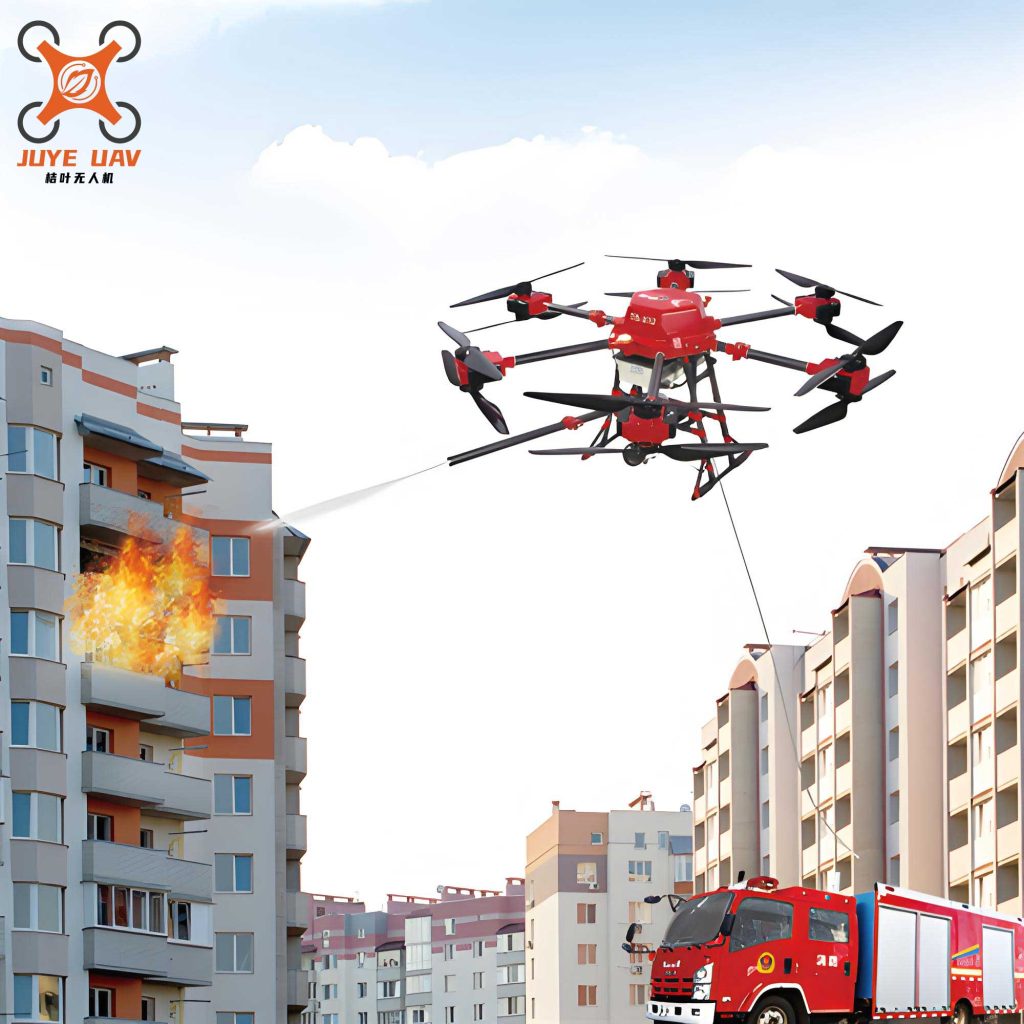
Moving to practical applications, I have identified several key paths where fire UAV technology integrates into firefighting communications. These paths demonstrate how fire UAV systems translate theoretical benefits into real-world solutions. In my analysis, I categorize these into command and rescue coordination, on-site detection, and dynamic instruction delivery. Each path leverages the fire UAV’s capabilities to address specific challenges in emergency response.
First, in command and rescue coordination, fire UAV technology plays a pivotal role. I have seen that by providing real-time video feeds and data, fire UAV enables commanders to monitor fire dynamics and make informed decisions. For example, a fire UAV equipped with infrared sensors can detect heat signatures, helping locate trapped individuals. The communication system of the fire UAV facilitates seamless information flow between ground teams and command centers. This can be modeled using a network efficiency formula: $$\eta = \frac{D_{success}}{D_{total}} \times 100\%$$, where η is communication efficiency, D_success is successfully transmitted data, and D_total is total data attempted. Additionally, fire UAV can serve as communication relays in areas with poor signal, ensuring that rescue instructions are relayed without delay. I emphasize that the fire UAV’s ability to hover over specific points allows for persistent surveillance, which is crucial for tracking fire spread and personnel movements.
Second, on-site detection is another critical application path for fire UAV technology. I have observed that fire UAV systems equipped with multi-sensor arrays can assess environmental conditions in real-time. For instance, gas sensors on a fire UAV can measure concentrations of hazardous substances like carbon monoxide, alerting teams to potential dangers. The data collected can be processed using algorithms for anomaly detection, such as: $$A(x) = \|x – \mu\|^2$$, where A(x) is the anomaly score, x is the sensor reading, and μ is the mean of normal readings. This enables early warning systems that enhance safety. Moreover, fire UAV can map fire perimeters and smoke dispersion patterns, providing visualizations that aid in evacuation planning. I often recommend deploying fire UAV for pre-emptive scans in high-risk zones, as this proactive approach minimizes surprises during actual emergencies.
Third, dynamic instruction delivery through fire UAV technology has revolutionized how commands are conveyed in chaotic environments. I have utilized fire UAV with loudspeaker payloads to broadcast evacuation orders or safety alerts directly to affected populations. This method is more effective than traditional megaphones due to the fire UAV’s mobility and altitude advantage. The sound propagation can be approximated by the inverse square law: $$I = \frac{P}{4\pi r^2}$$, where I is intensity, P is power, and r is distance from the fire UAV. By adjusting the fire UAV’s position, coverage can be optimized. In multi-lingual scenarios, fire UAV systems can pre-program messages to ensure clarity. I find that this application not only speeds up response but also reduces confusion, as the fire UAV can provide real-time updates based on evolving conditions.
Beyond these paths, I must address the recommendations and reflections for optimizing fire UAV technology in firefighting communications. Based on my insights, three areas require focused attention: institutional frameworks, maintenance protocols, and operator proficiency. These elements are foundational to sustaining the effectiveness of fire UAV systems.
Starting with institutional frameworks, I advocate for comprehensive policies that govern fire UAV usage. This includes privacy safeguards, such as encrypting data transmissions from fire UAV to prevent unauthorized access. Regulations should standardize fire UAV operations, ensuring compliance with airspace laws and emergency protocols. I propose a governance model where fire departments collaborate with aviation authorities to establish clear guidelines. For example, a licensing system for fire UAV operations could be implemented, with requirements based on risk assessments. This institutional support is crucial for scaling fire UAV applications across regions.
Next, maintenance of fire UAV systems is essential for reliability. I have learned that regular checks and updates prevent failures during critical missions. A maintenance schedule should include battery replacements, sensor calibrations, and software patches. The mean time between failures (MTBF) for a fire UAV can be expressed as: $$MTBF = \frac{T_{operational}}{N_{failures}}$$, where T_operational is total operational time and N_failures is the number of failures. By monitoring this metric, teams can predict and mitigate issues. I also suggest stocking spare parts for common fire UAV components, such as propellers and communication modules, to minimize downtime. Proper maintenance ensures that fire UAV technology remains a dependable asset in firefighting communications.
Finally, enhancing operator proficiency is key to maximizing fire UAV potential. I emphasize training programs that cover technical skills, safety procedures, and ethical considerations. Operators should be certified through practical exams that simulate real-fire scenarios. The competency level can be quantified using a score formula: $$C = w_1 S_k + w_2 S_a + w_3 S_e$$, where C is competency, S_k is knowledge score, S_a is application score, S_e is ethics score, and w are weights. Continuous education on emerging fire UAV technologies, like AI integration, is also vital. I believe that skilled operators can adapt fire UAV systems to novel challenges, thereby expanding their utility in firefighting communications.
In conclusion, my analysis underscores the transformative impact of fire UAV technology on firefighting communications. From its robust functional architecture to its diverse application paths, the fire UAV has proven to be a versatile tool that enhances real-time data acquisition, communication reliability, and operational safety. By implementing the recommended improvements in institutions, maintenance, and training, we can further harness the potential of fire UAV systems. As disasters grow in complexity, I am confident that fire UAV technology will continue to evolve, offering innovative solutions that save lives and protect communities. The integration of fire UAV into standard firefighting protocols represents a forward leap in emergency response, one that I eagerly support and promote through ongoing research and practice.
To summarize key technical aspects, I present the following formula that encapsulates the overall effectiveness of a fire UAV system in communications: $$E_{fire UAV} = \alpha \cdot D_{rate} + \beta \cdot C_{range} + \gamma \cdot S_{accuracy}$$, where E_fire UAV is effectiveness, D_rate is data transmission rate, C_range is communication range, S_accuracy is sensor accuracy, and α, β, γ are weighting factors based on mission priorities. This equation highlights the multi-faceted nature of fire UAV performance, emphasizing why it is indispensable in modern firefighting. As I continue to explore this field, I remain committed to advancing fire UAV applications, ensuring they meet the ever-changing demands of disaster management.