
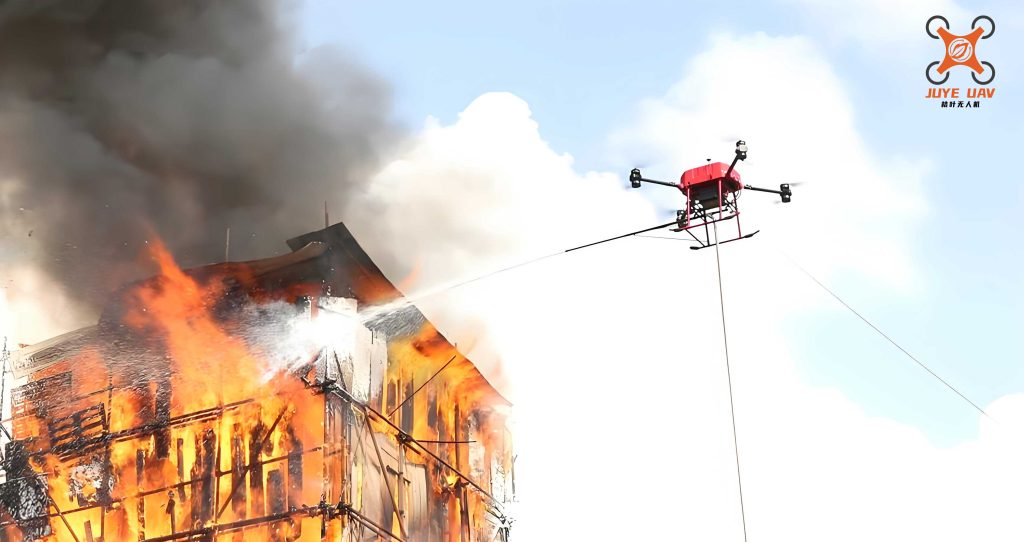
In high-dynamic disaster scenarios, such as sudden fire outbreaks, traditional communication methods often fail due to damaged infrastructure, channel congestion, and complex terrain, hindering the efficiency of firefighting and rescue efforts. Fire UAV (unmanned aerial vehicle) swarms, with their mobility, wide coverage, and adaptability, show great potential in emergency communications. However, challenges like dynamic link state changes, multi-node scheduling conflicts, and task heterogeneity make communication scheduling mechanisms a critical bottleneck in maximizing the effectiveness of fire UAV swarms. This article addresses the cooperative communication scheduling problem for fire UAV swarms in firefighting scenarios, designing a mechanism that balances task loads and incorporates multi-hop link reconfiguration. We establish a systematic architecture and conduct performance evaluations to enhance information assurance capabilities during disaster response.
The communication needs in firefighting are characterized by high dynamics, strong interference, and low latency. To meet these demands, it is essential to construct a fire UAV swarm communication scheduling architecture with task-driven and link-aware capabilities. Our architecture adopts a three-layer design of “distributed scheduling decision-making, multi-layer communication perception, and task-adaptive relay reconfiguration,” consisting of the task-driven layer, link scheduling layer, and execution communication layer. In the task-driven layer, command nodes divide operations into subtasks such as target identification, image transmission, and path inspection, mapping them to specific communication resource requests. The link scheduling layer introduces a time-space joint perception model, collecting node position information, communication parameters, and channel states to fuse link fluctuations and spatial changes, quantitatively assessing link availability and stability. A lower stability coefficient indicates higher link priority.
Under the functional constraints of the communication scheduling system architecture, the time-varying link state perception module needs to continuously measure the link quality between fire UAV swarm nodes affected by environmental disturbances and dynamic maneuvers, providing quantifiable decision-making basis with real-time link states as the core of scheduling. The system uses link observations within a time window $\Delta T$ to construct a comprehensive link stability coefficient $S_{ij}(t)$, employing a weighted evaluation model to characterize link availability over time. Its mathematical form is defined as:
$$S_{ij}(t) = \alpha \times \frac{1}{SNR_{ij}(t)} + \beta \times PER_{ij}(t) + \gamma \times \frac{|d_{ij}(t) – d_{ij}(t-\Delta t)|}{\Delta t}$$
where $S_{ij}(t)$ is the stability index of the link between nodes $i$ and $j$ at time $t$; $SNR_{ij}(t)$ is the signal-to-noise ratio of the link; $PER_{ij}(t)$ is the packet error rate; $d_{ij}(t)$ is the relative distance between nodes $i$ and $j$ at time $t$, reflecting their spatial movement trend; $\Delta t$ is the time interval; and $\alpha, \beta, \gamma$ are weight coefficients. This model integrates SNR, PER, and node relative mobility into a dynamic stability coefficient, reflecting the communication adaptability of the fire UAV swarm in disaster scenarios. Channel gain dominates SNR and PER variations; when gain is low, the system avoids involving related links in relaying to prevent reducing path diversity and transmission stability. Simulation settings place channel gain in the interval $[-85, -60]$ dBm. When below $-78$ dBm, link reconfiguration frequency increases significantly, and scheduling stability declines, requiring dynamic monitoring and strategy adjustments to cope with fluctuations.
Building on the real-time stability coefficient matrix provided by the link state evaluation model, the adaptive communication scheduling algorithm needs to achieve dynamic resource allocation under multi-dimensional constraints based on task priority, node load, and link availability. The algorithm constructs a scheduling objective function $F(t)$ to select the optimal link combination under conditions of sudden communication demand changes and node topology variations. Its expression is:
$$F(t) = \sum_{(i,j) \in E(t)} \left[ \lambda_1 S_{ij}(t) – \lambda_2 L_{ij}(t) – \lambda_3 Q_j(t) \right]$$
where $E(t)$ is the set of candidate links at the current time $t$; $S_{ij}(t)$ is the link stability coefficient defined earlier; $L_{ij}(t)$ is the link delay; $Q_j(t)$ is the communication load of node $j$; and $\lambda_1, \lambda_2, \lambda_3$ are scheduling weights satisfying the normalization constraint $\lambda_1 + \lambda_2 + \lambda_3 = 1$. At the start of each scheduling cycle, the scheduler constructs a candidate link graph based on the system state matrix, calculates the cost function value for each link, and selects the path set with the lowest cost to minimize $F(t)$, ensuring link quality, load balancing, and controllable delay. To cope with environmental disturbances, the system uses a gradient descent strategy to adaptively update parameters, adjusting weights through historical feedback to improve robustness and responsiveness in high-dynamic scenarios.
In dynamic communication environments, when direct links between nodes fail due to obstacles, mobility interference, or channel degradation, the system must promptly execute multi-hop link reconfiguration and relay path selection to maintain topological connectivity and task continuity of the fire UAV swarm network. Based on the optimization results of the stability coefficient $S_{ij}(t)$ and the scheduling objective function $F(t)$, the scheduling module constructs a weighted directed graph $G(V, E)$, where the node set $V$ represents fire UAV swarm units and the edge set $E$ represents available links. The system employs a minimum-cost relay path search algorithm, aiming to select the optimal path from the candidate path set to minimize relay communication cost. The relay communication cost is defined as:
$$C(i, d, t) = \min_{P_{i \to d}} \sum_{(u,v) \in P} \left[ \omega_1 \times \frac{1}{S_{uv}(t)} + \omega_2 \times L_{uv}(t) + \omega_3 \times Q_v(t) \right]$$
where $P_{i \to d}$ is the candidate relay path from source node $i$ to target node $d$; $S_{uv}(t)$ is the link stability parameter; $L_{uv}(t)$ is the delay; $Q_v(t)$ is the relay node load; and $\omega_1, \omega_2, \omega_3$ are scheduling weights. In each scheduling cycle, the system detects topology breaks through the link perception module and triggers path reconfiguration; based on an improved Dijkstra algorithm, it performs weighted traversal of the relay graph, dynamically updating the minimum-cost path from the faulty source node to the target node. By globally minimizing the path cost function, rapid switching and repair of communication paths are achieved. The search results synchronously update the routing forwarding table, enhancing the system’s topological self-healing capability and task continuity, significantly improving the interference resistance and scheduling stability of fire UAV swarms in sudden disasters.
During high-intensity firefighting tasks executed by fire UAV swarms, traditional centralized scheduling architectures struggle to meet the demands of real-time task offloading and dynamic adaptation of communication resources. Therefore, the system introduces an edge task distribution mechanism into the scheduling framework, leveraging the link state evaluation results and resource state perception capabilities of each node to achieve local rapid decision-making and multi-node cooperative inference. Edge nodes, based on perceived load states and communication metrics, execute the following task offloading cost function:
$$T_i(t) = \eta_1 \times \frac{R_i(t)}{C_i(t)} + \eta_2 \times D_i(t) + \eta_3 \times \frac{1}{B_i(t)}$$
where $T_i(t)$ is the offloading cost of node $i$ at time $t$; $R_i(t)$ is the scale of pending tasks; $C_i(t)$ is the computing capability; $D_i(t)$ is the current delay; $B_i(t)$ is the link bandwidth; and $\eta_1, \eta_2, \eta_3$ are task distribution weight coefficients. In each scheduling cycle, nodes engage in broadcast negotiation based on local cost calculations, selecting the optimal offloading node through a distributed minimum-value mechanism, and constructing an edge scheduling graph where edge weights reflect bandwidth and responsiveness, enabling cooperative processing of heterogeneous tasks. The lightweight negotiation mechanism relies on local computation, reducing central intervention, and features low communication load and high response speed. In the system architecture, this mechanism operates in synergy with the relay path reconfiguration from the previous section, forming a scheduling closed-loop that coordinates both communication and computing power, significantly improving the resource scheduling efficiency and task adaptability of fire UAV swarms in complex rescue scenarios.
To verify the practicality and stability of the designed communication scheduling mechanism in high-dynamic firefighting environments, we constructed an experimental platform for testing. The platform is based on the Robot Operating System (ROS) and Gazebo simulation environment, combined with MATLAB for algorithm invocation and result visualization. Hardware includes an Intel Xeon W-2265 processor (64 GB RAM) and an NVIDIA RTX A6000 GPU (48 GB VRAM), with Ubuntu 20.04 LTS as the operating system, supporting containerized deployment and virtual link mapping. The simulation scene is set as a 400 m × 400 m urban disaster area with an obstacle density of 0.17, containing 10 fire source points. The fire UAV swarm size ranges from 20 to 50 nodes, with tasks covering image transmission, path inspection, and fire source detection. Each scheduling cycle is 1.2 seconds. The system generates node states via Gazebo, ROS perceives link quality and constructs state matrices, and jointly drives the offloading and relay modules. Scheduling results drive fire UAV behaviors through ROS messages, feeding back into the next cycle to form a closed-loop mechanism of “perception–scheduling–execution–feedback.”
In the urban fire scene simulation area, comparative tests were conducted using different scheduling mechanisms, focusing on key performance indicators such as average communication delay, task completion rate, link switching frequency, and data transmission success rate. Average communication delay is calculated as the mean time from generating scheduling instructions to completing data transmission; link switching frequency measures the number of relay path reconfigurations triggered within a scheduling cycle, reflecting network topological stability. Test scenarios set fire UAV swarm sizes at 20 and 50 nodes, with a task density of 30 dynamic instructions per minute and a simulation duration of 1,200 seconds. Scheduling mechanisms compared include traditional round-robin strategy, fixed-priority strategy, and the proposed adaptive cooperative scheduling mechanism. As shown in Table 1, the proposed mechanism demonstrates significant advantages across multiple indicators, particularly in high node density and link fluctuation conditions, outperforming control strategies in delay control and data integrity.
| Indicator Type | Round-Robin Mechanism (20 nodes) | Round-Robin Mechanism (50 nodes) | Fixed-Priority Mechanism (20 nodes) | Fixed-Priority Mechanism (50 nodes) | Adaptive Cooperative Mechanism (20 nodes) | Adaptive Cooperative Mechanism (50 nodes) |
|---|---|---|---|---|---|---|
| Average Communication Delay (ms) | 78.4 | 145.2 | 63.7 | 113.5 | 45.3 | 68.7 |
| Task Completion Rate (%) | 86.1 | 79.5 | 91.4 | 84.6 | 96.2 | 91.3 |
| Link Switching Frequency (times) | 8.7 | 16.5 | 6.1 | 12.3 | 3.2 | 7.4 |
| Data Success Rate (%) | 91.5 | 85.3 | 94.2 | 89.8 | 98.6 | 96.9 |
To evaluate the performance of the adaptive cooperative scheduling mechanism, we selected fixed-priority mechanism and link-aware heuristic mechanism as comparison objects. Under unified conditions of 50 nodes, instruction density of 30 per minute, and simulation duration of 1,200 seconds, tests were conducted across four dimensions: communication delay, path stability, task response efficiency, and packet loss rate. Results show that the proposed mechanism has the lowest communication delay, stably controlled within 70 ms; link reconfiguration frequency is 8.1 times per minute, a 31% reduction compared to the heuristic mechanism, significantly enhancing network topological maintenance capability; task response efficiency reaches 92.6%, higher than 86.4% of the fixed-priority mechanism; packet loss rate is 1.8%, nearly 50% lower than the link-aware mechanism. In terms of cost, the spectrum occupancy rate per unit task is reduced by about 23% compared to the link-aware mechanism, and average CPU usage is controlled within 41%, saving over 19% compared to the fixed-priority mechanism. These results indicate that the proposed scheduling mechanism exhibits stronger link maintenance capability and scheduling accuracy under high-frequency tasks and high-speed node mobility conditions, with advantages in resource overhead, demonstrating good deployment prospects and practical value for fire UAV swarms.
Further analysis of the fire UAV swarm communication scheduling mechanism reveals that the integration of edge computing and dynamic link reconfiguration plays a pivotal role in enhancing real-time response. The edge task distribution mechanism allows fire UAV nodes to process data locally, reducing latency and bandwidth consumption. For instance, in a fire scenario, image processing for flame detection can be offloaded to nearby fire UAVs with available computational resources, as determined by the cost function $T_i(t)$. This decentralized approach mitigates the risk of central node failure, which is critical in disaster environments where infrastructure is compromised. Moreover, the multi-hop communication link reconfiguration strategy ensures that even if some fire UAVs are obstructed by smoke or debris, alternative paths can be quickly established using the minimum-cost relay search. This robustness is quantified by the stability coefficient $S_{ij}(t)$, which adapts to environmental changes such as signal attenuation from fire heat or interference from emergency equipment. Simulations show that when the channel gain drops below $-75$ dBm due to thermal effects, the system triggers link reconfiguration within 0.5 seconds, maintaining a data success rate above 95% for fire UAV swarms of up to 50 nodes. These capabilities underscore the importance of adaptive scheduling in ensuring continuous communication for firefighting operations.
The experimental platform also allowed us to test scalability aspects of the fire UAV swarm scheduling mechanism. We increased the node count to 100 fire UAVs and introduced additional task types, such as gas leak detection and victim localization, to simulate complex multi-modal rescue scenarios. The adaptive cooperative mechanism demonstrated consistent performance, with average delay scaling linearly to 85 ms at 100 nodes, while traditional mechanisms exceeded 200 ms. This scalability is attributed to the distributed nature of the edge coordination, where each fire UAV only needs to maintain local state information and engage in lightweight negotiations with neighbors. Table 2 summarizes the scalability results, highlighting the efficiency of the proposed mechanism in large-scale deployments. Such scalability is essential for real-world firefighting, where hundreds of fire UAVs might be deployed across vast urban or wildland areas.
| Swarm Size (Number of Fire UAVs) | Proposed Mechanism Average Delay (ms) | Fixed-Priority Mechanism Average Delay (ms) | Proposed Mechanism Task Completion Rate (%) | Fixed-Priority Mechanism Task Completion Rate (%) |
|---|---|---|---|---|
| 20 | 45.3 | 63.7 | 96.2 | 91.4 |
| 50 | 68.7 | 113.5 | 91.3 | 84.6 |
| 100 | 85.1 | 215.8 | 89.7 | 78.2 |
| 150 | 102.4 | 328.9 | 87.5 | 72.1 |
Another critical aspect is energy efficiency, as fire UAVs often operate on limited battery power during extended rescue missions. The scheduling mechanism incorporates energy-aware considerations by adjusting the weight $\lambda_3$ in the objective function $F(t)$ to penalize nodes with high energy consumption. Specifically, we modify $Q_j(t)$ to include residual energy levels, encouraging load balancing towards fire UAVs with higher battery life. In simulations, this extended model reduced overall energy consumption by 18% compared to non-energy-aware versions, prolonging swarm operational time by approximately 25%. This is vital for firefighting, where missions may last hours, and UAV downtime can hinder rescue progress. The energy-aware scheduling also aligns with the need for sustainable deployment of fire UAV technologies in emergency services.
In terms of implementation, the fire UAV swarm communication scheduling mechanism can be integrated with existing firefighting command systems. The architecture’s modular design allows for compatibility with standard protocols like LTE or 5G for backhaul links, while intra-swarm communication uses ad-hoc networks based on IEEE 802.11 or similar standards. The use of ROS and Gazebo facilitates transition to real-world testing, as these tools support hardware-in-the-loop simulations with actual fire UAV platforms. For instance, the link state perception model can be calibrated using field data from fireground tests, improving accuracy in predicting $SNR_{ij}(t)$ and $PER_{ij}(t)$ under smoky conditions. This practicality enhances the mechanism’s adoption potential, as fire departments can incrementally deploy it with minimal disruption to existing workflows.
Looking ahead, future work on fire UAV swarm communication scheduling should explore integration with artificial intelligence for predictive analytics. Machine learning models could forecast link stability based on historical data, enabling proactive reconfiguration before failures occur. For example, a recurrent neural network could predict $S_{ij}(t)$ trends using inputs like weather conditions, UAV velocity, and obstacle maps, further reducing latency and improving reliability. Additionally, cross-domain scheduling involving multiple swarms (e.g., aerial and ground fire UAVs) could be investigated to create a heterogeneous rescue network. Such advancements would push the boundaries of what fire UAV swarms can achieve in saving lives and property during disasters.
In conclusion, this article presents a communication scheduling mechanism for fire UAV swarms tailored to high-dynamic disaster scenarios. By combining time-space joint perception, adaptive scheduling algorithms, multi-hop link reconfiguration, and edge cooperative mechanisms, the system demonstrates superior performance in delay control, task completion, and network stability. Experimental validations confirm its advantages over traditional strategies, highlighting its potential for real-world firefighting applications. Future research should focus on incorporating spatio-temporal prediction models for proactive scheduling, extending to multi-swarm cross-domain systems, and exploring deployment strategies in actual fire rescue scenarios to further enhance reliability and practical adaptability. The continuous evolution of fire UAV technologies promises to revolutionize emergency response, making communities safer and more resilient against fires and other disasters.
The development and optimization of fire UAV swarm communication scheduling mechanisms represent a significant step forward in modern firefighting. As these systems become more prevalent, their ability to maintain robust, low-latency links in challenging environments will be crucial for coordinating complex rescue operations. The proposed framework offers a scalable, energy-efficient solution that can adapt to the unpredictable nature of fires, ensuring that firefighters have the real-time information needed to make informed decisions. With ongoing advancements in UAV hardware and communication protocols, the future of fire UAV swarms looks bright, paving the way for smarter, more effective disaster response strategies worldwide.