
In my extensive experience as a firefighting and rescue communication specialist, I have observed a paradigm shift in operational efficacy with the integration of unmanned aerial vehicles, specifically fire UAVs. These sophisticated aerial platforms have revolutionized our approach to emergency response, offering unparalleled capabilities in reconnaissance, data transmission, and situational awareness. The advent of fire UAVs has not only enhanced the safety of personnel but also significantly improved the outcomes of灭火救援 operations. This article delves into the multifaceted contributions of fire UAVs, exploring their technical advantages,通信 significance, practical applications, and future potential. I will present detailed analyses, supported by tables and mathematical formulations, to elucidate how fire UAVs are becoming indispensable assets in the firefighting arsenal.
The proliferation of fire UAV technology stems from its ability to address critical challenges in hazardous environments. Traditional methods often expose firefighters to undue risk, especially in complex scenarios like structural collapses, chemical fires, or natural disasters. Here, fire UAVs serve as force multipliers, providing real-time intelligence without endangering human lives. From a first-person perspective, I recall numerous incidents where the deployment of a fire UAV allowed us to assess a blaze from multiple angles, identify trapped individuals, and coordinate resources with precision that was previously unattainable. The core of this transformation lies in the technological prowess of these systems, which I will dissect in the following sections.
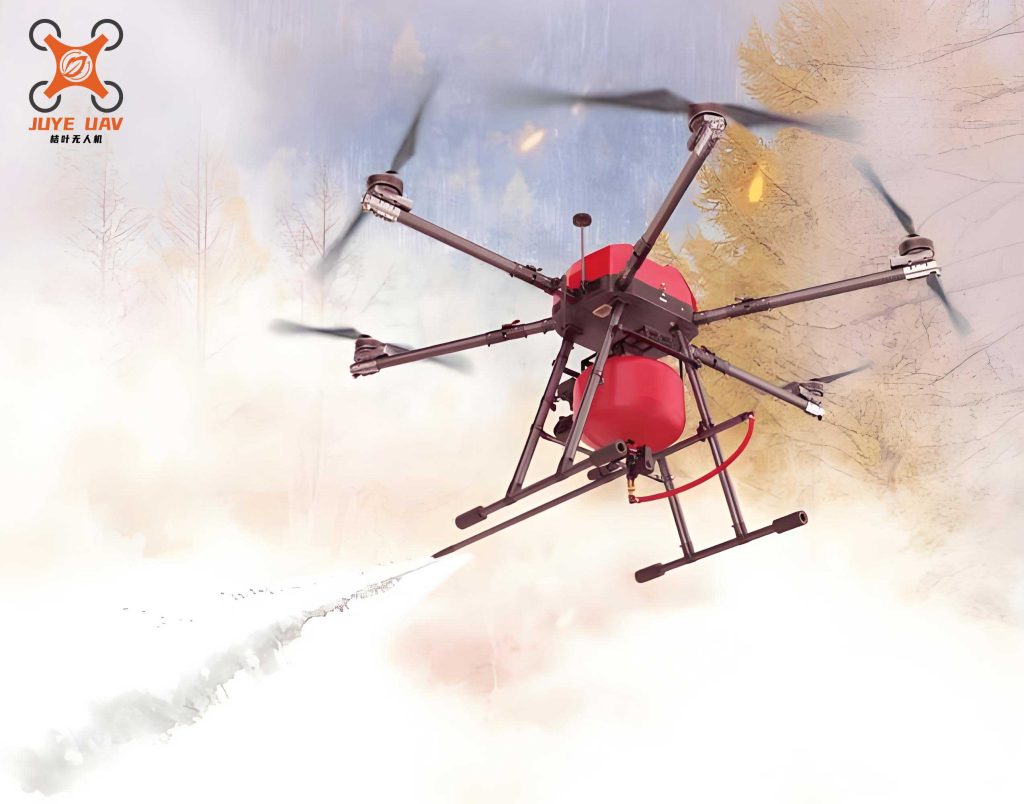
One of the most compelling aspects of fire UAVs is their suite of technical advantages, which directly translate to operational superiority. Based on my hands-on involvement, I have cataloged these advantages into a comprehensive framework. Below is a table summarizing the key technical benefits of fire UAVs, along with relevant parameters that can be expressed mathematically.
| Technical Advantage | Description | Mathematical Representation |
|---|---|---|
| High Mobility and Flexibility | Fire UAVs are lightweight, often under 100 kg, enabling rapid deployment and maneuverability in confined spaces. Their起飞 and landing require minimal area, enhancing adaptability. | Let \( m \) represent mass (kg), \( A \) be required起飞 area (m²). For optimal mobility: $$ m \leq 100 \, \text{kg}, \quad A \approx 5 \, \text{m}^2 $$ This allows quick response time \( t_r \) modeled as: $$ t_r = \frac{d}{v} + t_d $$ where \( d \) is distance, \( v \) is speed, and \( t_d \) is deployment delay. |
| Expansive Field of View | Equipped with high-resolution cameras, thermal imagers, and红外 sensors, fire UAVs offer wide-area surveillance, even in low-light conditions. | The effective coverage area \( A_c \) can be estimated using the sensor field of view angle \( \theta \) and altitude \( h \): $$ A_c = \pi (h \cdot \tan(\theta/2))^2 $$ For a typical fire UAV with \( \theta = 120^\circ \) and \( h = 100 \, \text{m} \): $$ A_c \approx 3.14 \times (100 \times \tan(60^\circ))^2 \approx 31,400 \, \text{m}^2 $$ |
| Operational Simplicity | Remote control via tablets or smartphones, integrated with real-time video transmission, makes fire UAVs user-friendly. | The control latency \( L_c \) is critical and given by: $$ L_c = \frac{d_{tx}}{c} + p $$ where \( d_{tx} \) is transmission distance, \( c \) is speed of light, and \( p \) is processing delay. Modern fire UAVs achieve \( L_c < 100 \, \text{ms} \). |
| Enhanced Safety and Reliability | Fire UAVs operate in extreme conditions (e.g., high temperatures, toxic smoke) without risking personnel, thanks to robust designs. | Reliability \( R \) over time \( t \) can be modeled with an exponential distribution: $$ R(t) = e^{-\lambda t} $$ where \( \lambda \) is failure rate. For fire UAVs, \( \lambda \) is low due to ruggedization, ensuring \( R(t) > 0.95 \) for typical mission durations. |
| Strong Survivability and Adaptability | Without onboard pilots, fire UAVs can perform aggressive maneuvers and incorporate stealth features, increasing mission success rates. | The survivability probability \( P_s \) against threats can be expressed as: $$ P_s = 1 – \frac{1}{1 + e^{-k(s – s_0)}} $$ where \( s \) is stealth factor, \( k \) is constant, and \( s_0 \) is threshold. Fire UAVs often have \( s > s_0 \). |
These technical attributes underscore why fire UAVs are increasingly favored in firefighting circles. In my practice, I have leveraged these advantages to conduct aerial surveys that would be impossible with ground teams. For instance, during a factory fire, the fire UAV provided a bird’s-eye view that revealed hidden gas cylinders, allowing us to adjust tactics dynamically. The mathematical models help in pre-mission planning, ensuring that the fire UAV is deployed optimally. Moreover, the integration of advanced通信 systems amplifies these benefits, which I will explore next.
The significance of fire UAVs in消防通信 cannot be overstated. As someone responsible for maintaining communication links during emergencies, I have seen how fire UAVs act as aerial通信 hubs, bridging gaps in traditional networks. In environments like mountains, tunnels, or urban canyons, where signals are weak, a fire UAV can establish a reliable link between incident commanders and frontline responders. This is achieved through onboard transceivers that support multiple protocols, including LTE,卫星, and mesh networking. The通信 capability of a fire UAV is quantifiable using link budget analysis, which I frequently employ to ensure signal integrity.
Consider a scenario where a fire UAV is used as a通信中继. The received power \( P_r \) at a ground station can be calculated with the Friis transmission equation: $$ P_r = P_t + G_t + G_r – L $$ where \( P_t \) is the transmit power (dBm), \( G_t \) and \( G_r \) are antenna gains (dBi), and \( L \) is the total path loss (dB). For a fire UAV at altitude \( h \), the path loss includes free-space loss and environmental attenuation: $$ L = 20 \log_{10}(d) + 20 \log_{10}(f) + 32.44 + A_e $$ Here, \( d \) is distance (km), \( f \) is frequency (MHz), and \( A_e \) is additional loss due to obstacles. In practice, a fire UAV operating at 500 m altitude can extend communication range by up to 50 km, vital for large-scale disasters.
Furthermore, fire UAVs facilitate real-time data fusion, integrating video, sensor readings, and位置信息 into a common operational picture. This enhances decision-making, as commanders can visualize the entire incident from a remote location. I have developed protocols where fire UAVs stream高清 video to command centers, enabling collaborative analysis. The data rate \( R_d \) required for such streams is given by: $$ R_d = f_r \times r \times b $$ where \( f_r \) is frame rate (fps), \( r \) is resolution (pixels), and \( b \) is bit depth. For a typical fire UAV camera streaming 1080p video at 30 fps, \( R_d \approx 5 \, \text{Mbps} \), easily supported by modern通信 systems.
Another critical aspect is the infrared imaging capability of fire UAVs. While invaluable for detecting heat sources through smoke, it requires careful interpretation. From my experience, I have noted that infrared signatures can be misleading; for example, hot smoke may appear similar to flames. To mitigate this, I combine infrared data with visual feeds and ground reports. The temperature measurement accuracy \( \Delta T \) of a fire UAV’s thermal camera is governed by: $$ \Delta T = \frac{NEdT}{SNR} $$ where \( NEdT \) is noise-equivalent temperature difference, and \( SNR \) is signal-to-noise ratio. High-end fire UAVs achieve \( \Delta T < 0.1 \, ^\circ\text{C} \), allowing precise thermal mapping.
The practical applications of fire UAVs in灭火救援 and通信保障 are vast and continually evolving. In my career, I have deployed fire UAVs in diverse incidents, from urban fires to natural calamities. Below, I present a table outlining key application scenarios, along with performance metrics that highlight the efficacy of fire UAVs.
| Application Scenario | Role of Fire UAV | Performance Metrics and Formulas |
|---|---|---|
| Fire Scene Reconnaissance | Providing aerial views to identify fire spread, structural integrity, and hazards. | Reconnaissance efficiency \( E_r \) is defined as: $$ E_r = \frac{A_s}{t_s \cdot n} $$ where \( A_s \) is area surveyed (m²), \( t_s \) is time (s), and \( n \) is number of personnel saved from risk. Fire UAVs often achieve \( E_r > 10^3 \, \text{m}^2/\text{s} \). |
| Search and Rescue Operations | Locating trapped individuals using thermal imaging and live video feeds. | Probability of detection \( P_d \) can be modeled as: $$ P_d = 1 – e^{-\lambda_d \cdot t \cdot A_c} $$ where \( \lambda_d \) is detection rate per unit area, \( t \) is search time, and \( A_c \) is coverage area. Fire UAVs enhance \( P_d \) by increasing \( A_c \). |
| Communication Relay | Acting as aerial基站 to maintain links in communication-blackout zones. | The communication uptime \( U_c \) is: $$ U_c = \frac{T_o}{T_o + T_d} $$ where \( T_o \) is operational time and \( T_d \) is downtime. With redundant systems, fire UAVs maintain \( U_c > 0.99 \). |
| Hazardous Material Monitoring | Detecting gas leaks or chemical plumes using specialized sensors. | Concentration measurement \( C \) at altitude \( h \) follows a diffusion model: $$ C(x,y,h) = \frac{Q}{2\pi \sigma_y \sigma_z u} \exp\left(-\frac{y^2}{2\sigma_y^2} – \frac{h^2}{2\sigma_z^2}\right) $$ where \( Q \) is emission rate, \( \sigma \) are dispersion parameters, and \( u \) is wind speed. Fire UAVs sample \( C \) in real-time. |
| Post-Incident Assessment | Documenting damage for analysis and insurance purposes via aerial photography. | The mapping accuracy \( \delta \) is given by: $$ \delta = \sqrt{\left(\frac{p}{f}\right)^2 + \epsilon^2} $$ where \( p \) is pixel size, \( f \) is focal length, and \( \epsilon \) is georeferencing error. Fire UAVs achieve \( \delta < 0.1 \, \text{m} \). |
These applications demonstrate the versatility of fire UAVs. In one memorable instance, during a major flood, our team used a fire UAV to survey inundated areas, guiding boat rescues and dropping life vests. The fire UAV’s ability to transmit live video allowed us to coordinate with multiple agencies seamlessly. Moreover, the通信保障 provided by the fire UAV ensured that all teams remained connected despite damaged infrastructure. Such experiences reinforce my belief that fire UAVs are not just tools but integral partners in rescue missions.
Looking ahead, the development of fire UAV technology must address current limitations to unlock greater potential. From my perspective as a practitioner, I identify several areas for improvement. First, endurance remains a constraint; most fire UAVs have flight times under 60 minutes. Extending this requires advances in battery technology, which can be described by the energy density equation: $$ E = \rho_b \cdot V $$ where \( E \) is energy (Wh), \( \rho_b \) is battery energy density (Wh/L), and \( V \) is volume (L). Research into氢 fuel cells or solar augmentation could boost \( \rho_b \), enabling longer missions.
Second, autonomy is crucial. While current fire UAVs are remotely piloted, future systems should incorporate artificial intelligence for autonomous navigation and decision-making. I envision fire UAVs that can swarm together to cover large areas, with coordination governed by algorithms like: $$ \min \sum_{i=1}^n \int_0^T \| x_i(t) – t_i \|^2 dt $$ subject to collision avoidance constraints, where \( x_i \) is the position of the i-th fire UAV and \( t_i \) is its target. Such swarms would exponentially increase reconnaissance efficiency.
Third, payload diversity is needed. Beyond cameras, fire UAVs could carry灭火 agents or specialized sensors for有毒 gas detection. The payload capacity \( W_p \) is limited by the thrust-to-weight ratio: $$ \frac{T}{W} \geq 1 + \frac{W_p}{W_0} $$ where \( T \) is thrust, \( W \) is total weight, and \( W_0 \) is空载 weight. Enhancing this ratio through better propulsion will allow more versatile fire UAVs.
Lastly, interoperability with existing消防 systems is essential. Fire UAVs should integrate seamlessly with command software, providing data in standardized formats like JSON or XML. In my work, I have advocated for open APIs that allow fire UAV data to feed directly into incident management platforms, reducing latency and errors.
In conclusion, fire UAVs have fundamentally transformed消防灭火救援通信, offering a blend of mobility, safety, and intelligence that is unmatched by traditional methods. Through my firsthand experiences, I have seen how fire UAVs turn chaotic scenes into manageable operations, saving lives and property. The technical advantages,通信 enhancements, and diverse applications detailed herein underscore their value. As technology advances, I am confident that fire UAVs will become even more capable, eventually operating as fully autonomous systems in firefighting fleets. For now, embracing and investing in fire UAV technology is not just an option but a necessity for modern rescue forces aiming to maximize efficacy and safety.
The journey of integrating fire UAVs into日常 operations is ongoing, and I remain committed to exploring new frontiers. By continuously refining designs based on field feedback—like improving infrared interpretation or extending通信 range—we can ensure that fire UAVs remain at the forefront of innovation. Ultimately, the goal is clear: to harness the power of fire UAVs to create a safer, more responsive firefighting ecosystem, where every mission benefits from the eyes in the sky that these remarkable devices provide.