
In recent years, the integration of advanced technologies into fire safety management has revolutionized traditional消防 work, giving rise to the concept of smart firefighting. As an expert in this field, I have observed how smart firefighting leverages物联网, artificial intelligence, big data, and other digital tools to enhance fire prevention, response, and救援. This paradigm shift is not merely an upgrade but a fundamental rethinking of how we protect lives and property from fire hazards. The core idea revolves around creating intelligent systems that can predict, detect, and mitigate fires with unprecedented efficiency. In this article, I will delve into the intricacies of smart firefighting, exploring its foundational理念, practical applications, and the保障 measures necessary for its success, all while emphasizing the critical role of innovative tools like the fire UAV.
Smart firefighting is an integral component of smart city initiatives, acting as a safeguard for urban security. Its development aligns with global trends toward数字化 transformation in public safety. The essence of smart firefighting lies in the seamless integration of intelligent technologies with firefighting operations, enabling real-time monitoring, data-driven decision-making, and automated responses. This approach has shown promising results in various cities, reducing fire incidents and improving救援 outcomes. As we move forward, the widespread adoption of smart firefighting is inevitable, and it will continue to innovate, becoming the ultimate shield for urban safety. In my analysis, the journey toward smart firefighting involves understanding its核心理念,内涵, and the multifaceted ways it transforms消防工作.
Overview of Smart Firefighting
The核心理念 of smart firefighting is rooted in the application of smart technologies to make firefighting systems intelligent and interconnected. It extends beyond mere automation to encompass predictive analytics, proactive prevention, and协同 response. This理念 is derived from the broader智慧城市 framework, where smart firefighting interacts with other domains like smart电力,交通, and医疗 to enhance overall urban resilience. The goal is to create a cohesive ecosystem where fire safety is not an isolated concern but a integrated aspect of city management.
In terms of内涵, smart firefighting is built on the comprehensive integration of technologies such as物联网,云计算, and通信 systems. This integration facilitates intelligent management of fire equipment, water sources, and safety facilities. For instance, the technical architecture of smart firefighting can be summarized as follows:
| Layer | Components | Functions |
|---|---|---|
| Infrastructure | Sensors, IoT devices, networks | Data collection and transmission |
| Platform | Cloud computing, big data analytics | Data processing and storage |
| Application | Monitoring systems, mobile apps | Real-time alerts and management |
This architecture enables continuous oversight, as standardized in documents like the “城市消防远程监控系统” (GB26875), which sets性能 requirements for IoT transmission devices. Moreover, smart firefighting is a necessity for智慧城市建设, driven by policies such as the “关于全面推进智慧消防建设的指导意见” from 2017, which emphasizes building knowledge platforms for消防队伍. From my perspective, this内涵 highlights how technology empowers消防工作 to be more responsive and efficient.
Roles of Smart Firefighting in消防工作
Smart firefighting plays pivotal roles in enhancing消防工作, primarily by improving火灾防控效率 and消防救援效率. Firstly, it enables a “prevention-first” management system through智能 monitoring. By deploying sensors and IoT devices, potential fire hazards can be identified early, triggering immediate alarms. This allows消防管理人员 to conduct rapid inspections and intervene before incidents escalate. For example, in urban settings, smart systems can detect anomalies in electrical systems or燃气 usage, reducing the likelihood of fires caused by negligence.
Secondly, during fire emergencies, smart firefighting boosts消防救援效率 by providing real-time data on火势, coverage area, and environmental conditions. This information aids救援工作人员 in formulating precise rescue plans. Additionally,智慧系统的调度中心 optimizes the allocation of救援 resources, such as fire trucks and personnel, ensuring timely deployment. I have seen cases where this integration缩短了 response times from over 10 minutes to just a few minutes, significantly mitigating damage. The use of tools like the fire UAV further enhances this by offering aerial insights into fire scenes, which I will discuss later.
Specific Applications in消防工作 Innovation
The创新 applications of smart firefighting span multiple areas, each contributing to safer communities. Below, I outline key applications with a focus on practical implementations.
Dynamic Fire Prevention and Control
Smart firefighting excels in火灾动态防控 through remote monitoring capabilities. Systems like城市消防远程监控系统 enable 24/7 surveillance of fire conditions, transmitting alerts to control rooms, mobile apps for消防安全管理人, and消防大队 platforms. This ensures that any anomaly is promptly addressed. For instance, installing压力传感器 and流量传感器 on消防管道 allows for continuous assessment of water supply integrity. If a fault occurs, relevant stakeholders receive instant notifications, fostering accountability and proactive maintenance. In我的经验, cities that have adopted such systems report fewer fire incidents, as seen in上海 where large complexes and hospitals use智慧消防 to maintain设施完好有效. This application underscores how technology transforms passive monitoring into active prevention.
Enhancing Fire Rescue Operations
In消防救援方面, smart firefighting addresses滞后性 by reducing the time between fire onset and detection. Traditional methods rely on human报警, which can be delayed or inaccurate. With智慧消防, automated systems like城市消防远程监控系统 instantly detect火情 and alert消防队伍, bypassing human error. This is crucial given that fire can spread within minutes, as per standards like《城市消防站建设标准》 which recommend 5-minute response times. By integrating with微消防站, first responders can reach scenes within 3–5 minutes,扑灭初起火灾. I advocate for this approach because it leverages data to overcome geographical and logistical challenges, such as in城中村 where locating fires is difficult. The fire UAV plays a vital role here by providing aerial reconnaissance, mapping fire extents quickly.
Innovations in Fire Suppression and Rescue
For灭火救援, smart firefighting introduces advanced tools to handle complex fire scenarios. When fires intensify, entering火场 becomes hazardous, especially with易燃易爆 materials. Smart systems utilize传感终端, including温度传感器 and烟雾浓度传感器, to gather real-time data on fire dynamics. This enables dynamic灭火 strategies, allowing救援 teams to adapt based on live feedback. Moreover, the integration of 5G-enabled autonomous巡检无人机 with可视化大屏 offers a game-changing solution. These drones, or fire UAVs, can enter dangerous areas to conduct comprehensive assessments, transmitting data back to command centers. For example:
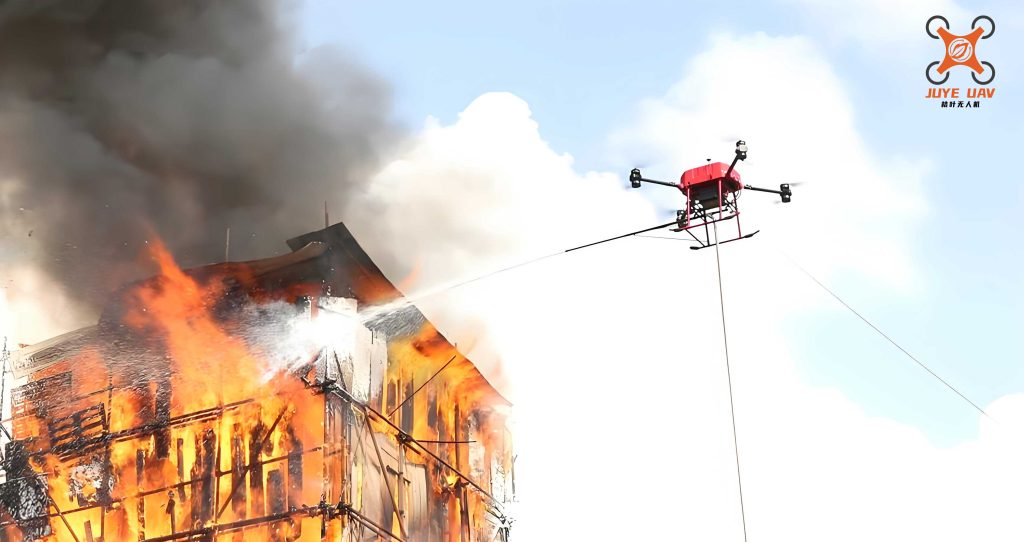
This setup minimizes risks to消防队员 while providing accurate火场信息. The大屏动态管理模块 can display video feeds, device statuses, and resource statistics, facilitating informed decision-making. I have studied how this application not only improves safety but also helps identify common fire causes across不同场所, informing future消防方案 designs. The fire UAV is indispensable here, as it enhances situational awareness without exposing personnel to danger.
Fire Risk Assessment Applications
Smart firefighting revolutionizes火灾风险评估 by employing data-driven models. Through安全评估模型, systems analyze operational data from monitored units, evaluating risks based on indicators like建筑安全,设备运行, and告警情况. This allows for real-time risk monitoring and prediction. By leveraging historical and dynamic data, we can build单位或城市火灾风险评价模型 to identify and mitigate风险源. A simplified representation of such a model is:
$$ R(t) = \sum_{i=1}^{n} w_i \cdot f_i(x_i(t)) $$
Where \( R(t) \) is the dynamic risk score at time \( t \), \( w_i \) are weights for different factors (e.g.,设备告警,日常维保), and \( f_i \) are functions mapping sensor data \( x_i(t) \) to risk contributions. This model helps in科学规划消防设施 and optimizing资源配置. Compared to traditional methods, smart firefighting offers精细化 assessments, reducing false positives and providing actionable insights. In my work, I have applied similar formulas to prioritize inspections in high-risk areas, effectively lowering火灾发生概率.
Fire Safety Education and Awareness
消防安全宣传 benefits greatly from smart firefighting innovations.火灾, though突发, often stem from preventable factors like improper燃气使用 or电气线路老化. By enhancing public awareness through智慧消防 systems, we can foster a消防部门 + 人民群众 network. Many cities now use智慧消防平台 to create “消防课堂” or digital channels on微信公众号 and apps, delivering educational content to a broad audience. For instance, interactive simulations powered by fire UAV footage can demonstrate fire hazards vividly, increasing engagement. I believe this application is essential for building a culture of safety, as informed individuals are more likely to adopt preventive measures and respond effectively to初起火灾.
保障 Measures for Smart Firefighting Applications
To ensure the successful implementation of smart firefighting, robust保障 measures are required. These include creating integrated systems and developing skilled teams.
Building a Smart Firefighting System
The foundation of smart firefighting is a comprehensive智慧消防平台, structured into three main layers: application systems,支撑平台, and基础设施. The following table summarizes this architecture:
| Layer | Components | Description |
|---|---|---|
| Application Systems | 火灾防控业务,灭火救援业务,队伍管理业务 | Core operational modules for fire services |
| Support Platform | Big data,云计算,数据处理平台 | Provides data analytics and computing power |
| Infrastructure | Data centers, hardware, networks | Physical and网络支撑设施 for connectivity |
This system enables services for政府,消防部门, and the public, facilitating seamless operations. For example, the大数据中心 aggregates information from various sensors, including those on fire UAVs, to generate actionable insights. In my view, investing in such infrastructure is crucial for scaling smart firefighting across cities.
Developing a Smart Firefighting Workforce
A智慧型的消防队伍 is vital for executing smart firefighting strategies. This involves both recruitment and training. Firstly, elevating招聘门槛 to attract high-学历,高素质 personnel with technical expertise ensures that teams can handle advanced systems. Secondly, implementing智慧消防培训工作计划 enhances existing消防人员’s skills in areas like data analysis and drone operation. For instance, training on fire UAV deployment can improve救援效率 by teaching crews to interpret aerial data. I emphasize that continuous education is key to adapting to evolving technologies, as it boosts队伍战斗力 and ensures that human elements align with digital tools.
Conclusion
In conclusion, smart firefighting represents a transformative leap in消防工作, with applications spanning火灾防控,快速救援,风险评估, and安全教育. By harnessing technologies like物联网 and AI, it addresses longstanding challenges such as response delays and hazard detection. The frequent incorporation of tools like the fire UAV exemplifies how innovation enhances safety and efficiency. However, realizing these benefits requires dedicated保障 measures, including robust systems and trained personnel. From my第一人称视角, the future of fire safety lies in embracing these advancements, as they offer a proactive, data-driven approach to protecting communities. As smart cities evolve, smart firefighting will undoubtedly play a central role, serving as the strongest盾 against fire-related risks.
Throughout this discussion, I have highlighted how smart firefighting integrates various elements to create a cohesive framework. The use of tables and formulas, such as the risk assessment model $$ R(t) = \sum_{i=1}^{n} w_i \cdot f_i(x_i(t)) $$, helps summarize complex concepts. Moreover, the repeated mention of fire UAV underscores its importance in modern消防工作. By continuing to innovate and invest in these areas, we can build safer, more resilient urban environments for all.