
The advancement of modern society is accompanied by increasingly complex and severe fire safety challenges. Data from emergency management departments globally consistently reveal significant annual losses in life and property due to fires and other disasters. Urbanization, characterized by dense high-rise buildings, intricate industrial facilities, and vulnerable historical districts, places immense pressure on traditional firefighting and rescue methodologies. Similarly, the expansion of human activity into forested areas elevates the risk of large-scale wildfires. These scenarios often present environments that are inaccessible, unpredictable, and highly hazardous for first responders. In this context, Unmanned Aerial Vehicles (UAVs) have emerged as a transformative technology for the fire and rescue services. The integration of fire UAV systems into emergency response protocols significantly enhances operational efficiency, provides critical situational awareness, and most importantly, reduces the risk to human life by performing reconnaissance and initial intervention tasks in dangerous zones. This article analyzes the technological principles, functional requirements, and design paradigms for fire UAV systems, with a particular focus on functional integration and biomimetic morphological design to outline future development directions.
The operational environment for a fire UAV is uniquely demanding. It must contend with high temperatures, turbulent air currents caused by thermal updrafts and structural collapses, low visibility due to smoke, and potentially explosive or toxic atmospheres. Therefore, the design of such systems extends far beyond the capabilities of commercial or recreational drones. It requires a holistic approach combining robust flight mechanics, specialized sensor payloads, secure data links, and an airframe designed for both functionality and resilience. The core advantage of a fire UAV lies in its ability to be a rapid, mobile sensor platform. It can provide an overhead, comprehensive view of an incident site within minutes of arrival, information that is crucial for incident commanders to deploy resources effectively and safely. This capability is summarized in the fundamental operational advantage equation for early-stage disaster response:
$$ \text{Response Effectiveness} (E) \propto \frac{\text{Situational Awareness} (SA)}{\text{Time to Acquire} (T_a) \times \text{Risk to Personnel} (R_p)} $$
Where a high value of \(E\) is desired. The fire UAV directly minimizes \(T_a\) and \(R_p\) while maximizing \(SA\), thereby theoretically optimizing \(E\).
Current Technological Landscape and Classification of Fire UAVs
Various UAV configurations are being explored or deployed for fire and rescue operations, each with distinct advantages and limitations. The choice of platform depends on the specific mission profile: indoor reconnaissance, open-area wildland fire monitoring, structural fire assessment, or hazardous material detection.
| UAV Type | Key Advantages | Major Limitations | Typical Fire/Rescue Application |
|---|---|---|---|
| Multi-rotor (Quadcopter, Hexacopter, Octocopter) | Vertical Take-off and Landing (VTOL), excellent hover stability, high maneuverability in confined spaces, relatively simple control. | Limited flight endurance and speed, sensitive to strong winds, lower payload capacity compared to fixed-wing. | Close-range structural inspection, toxic gas detection at ground level, indoor search, precision payload delivery (e.g., lifebuoy, communication relay). |
| Fixed-Wing | Long endurance and range, high cruising speed, stable flight in windy conditions, efficient for large-area coverage. | Requires runway or launcher for take-off, inability to hover, complex recovery, poor low-speed maneuverability. | Large-scale wildfire monitoring and mapping, pipeline or forest patrol, post-disaster area assessment. |
| Hybrid VTOL (Tilt-rotor, Tail-sitter) | Combines VTOL capability with fixed-wing efficiency for longer endurance and range. | Complex mechanical design and control algorithms, higher cost, currently less mature technology. | Extended-range missions requiring both hover (for inspection) and transit (to remote sites), such as offshore fire or mountain rescue support. |
| Single-rotor Helicopter | High payload capacity, efficient forward flight, good endurance. | Mechanically complex, higher maintenance, significant downwash, higher safety risk in crowds. | Heavy-lift applications, such as transporting larger fire suppression equipment or multiple sensors. |
For most urban firefighting and technical rescue scenarios, multi-rotor platforms currently offer the best balance of versatility, controllability, and cost-effectiveness, making them the primary focus for integrated fire UAV system design. The critical challenge is extending their operational window, which is governed by the power-to-weight ratio. The flight time \(T\) can be approximated by:
$$ T \approx \frac{C_b \cdot \eta \cdot \rho_b}{P_{total}} $$
where \(C_b\) is battery capacity (Wh), \(\eta\) is total powertrain efficiency, \(\rho_b\) is battery discharge depth factor, and \(P_{total}\) is total power consumption. \(P_{total}\) is the sum of the power for lift \(P_{lift}\) and the power for payload \(P_{payload}\):
$$ P_{total} = P_{lift} + P_{payload} = k \cdot (m_{frame} + m_{battery} + m_{payload})^{3/2} + P_{sensors} + P_{comms} $$
Here, \(k\) is a constant dependent on rotor geometry and air density, and \(m\) represents mass. This equation highlights the delicate trade-off: adding essential payloads (sensors, protective housings) for a fire UAV increases mass, which disproportionately increases lift power required and reduces flight time. Optimizing this equation through lightweight materials, efficient aerodynamics, and high-energy-density batteries is paramount.
In-Depth Functional Analysis of Fire UAV Systems
The utility of a fire UAV is defined by its integrated functional modules. These transform the platform from a simple flying machine into a multi-role emergency response tool.
1. Multispectral Imaging and Environmental Monitoring
This is the primary function. A standard fire UAV is equipped with a stabilized gimbal system hosting multiple imaging sensors:
- Visual (RGB) Camera: Provides real-time high-definition video for general situational awareness, structural damage assessment, and search for victims.
- Thermal Imaging Camera: Critical for seeing through smoke, locating hotspot fires inside structures or under forest canopies, and finding victims based on body heat signature. The temperature contrast is key.
- Gas Detection Sensors: These are point sensors (e.g., for CO, CH₄, H₂S, VOCs) or laser-based open-path sensors mounted on the fire UAV. They measure concentration levels in parts per million (ppm) or even parts per billion (ppb). The data can be used to create a real-time 3D concentration map of a hazardous plume. The diffusion of gas can be modeled simplistically for a point source with the Gaussian plume model in steady-state conditions:
$$ C(x,y,z) = \frac{Q}{2\pi u \sigma_y \sigma_z} \exp\left(-\frac{y^2}{2\sigma_y^2}\right) \left[ \exp\left(-\frac{(z-H)^2}{2\sigma_z^2}\right) + \exp\left(-\frac{(z+H)^2}{2\sigma_z^2}\right) \right] $$
where \(C\) is concentration at point \((x,y,z)\), \(Q\) is emission rate, \(u\) is wind speed, \(H\) is effective release height, and \(\sigma_y\), \(\sigma_z\) are dispersion coefficients. A fire UAV can sample points to estimate parameters like \(Q\) and verify plume models, guiding evacuation and mitigation efforts.
2. Illumination and Payload Delivery Systems
For nighttime operations, high-intensity LED lighting systems are essential. The required illuminance \(E_v\) at the ground depends on the luminous intensity \(I_v\) of the UAV’s lights, the flight altitude \(h\), and the beam angle. For a simplified point-source model perpendicular to the ground:
$$ E_v \approx \frac{I_v}{h^2} $$
Thus, to maintain a usable light level (e.g., 20 lux for general area lighting) while flying higher for a broader view, \(I_v\) must increase with the square of altitude, posing significant power and thermal management challenges for the fire UAV designer.
Payload delivery systems include mechanisms for dropping life-saving equipment (life vests, floatation devices, medical kits) or for establishing communication/abseil lines. The release mechanism must be precise, reliable, and unaffected by UAV vibrations or electromagnetic interference. The kinematics of a dropped payload (ignoring air resistance initially) are:
$$ x(t) = v_{uav} \cdot t, \quad y(t) = h_0 – \frac{1}{2}gt^2 $$
where \(v_{uav}\) is UAV ground speed, \(h_0\) is release altitude, and \(g\) is gravity. The fire UAV‘s flight control system can use such models to compute a release point for accurate delivery.
3. Communication Relay and Loudspeaker
A fire UAV can act as a temporary communication node, rebroadcasting radio signals between trapped individuals, interior firefighting teams, and the external command post, especially in environments where signals are blocked. Integrated loudspeakers allow direct communication from commanders to victims or crowds, providing instructions and reassurance.
The integration of these functions into a cohesive system is a major design task. The table below outlines a potential configuration for a advanced multi-role fire UAV:
| Functional Module | Sub-components / Technology | Key Performance Metrics | Design Impact on UAV |
|---|---|---|---|
| Sensing & Imaging Core | 4K RGB camera with 30x optical zoom; Uncooled VOx microbolometer thermal camera (640×512); Laser-based methane (CH₄) detector; Electrochemical CO/H₂S sensors. | Thermal sensitivity < 50 mK; Gas detection resolution ≤ 1 ppm; Data latency < 200 ms. | Determines gimbal size/weight; requires significant data bandwidth and processing power; influences center of gravity. |
| Data Link & Comm. | Dual redundant digital video links (e.g., COFDM); Secure command & control link; 4G/5G backup module; 100W loudspeaker. | Operating range ≥ 5 km (NLOS); Transmission latency < 100 ms for control. | Antenna placement is critical for signal integrity; adds weight and power consumption. |
| Deployment System | Motorized winch with 50m Kevlar line; Quick-release magnetic payload holder (for < 5kg loads). | Deployment accuracy ≤ 2m radius from target at 30m altitude; Release time < 3s. | Requires dedicated structural mounting points and internal space; affects aerodynamic profile. |
| Power & Propulsion | High-density Li-ion or Li-Po battery pack; Brushless DC motors; Carbon fiber reinforced propellers. | Flight time ≥ 45 mins with full payload; Maximum wind resistance ≥ 12 m/s. | Defines the core airframe size and motor count (e.g., hexacopter for redundancy); battery is a major mass component. |
| Autonomy & Safety | GNSS (GPS/GLONASS/BeiDou); Vision-based obstacle avoidance; Inertial Navigation System (INS); Return-to-Home (RTH) fail-safe. | Positioning accuracy < 1.5m; Obstacle detection range ≥ 20m. | Requires additional sensors (ultrasonic, ToF, stereo cameras) and computing hardware. |
Morphological Design and Biomimetic Inspiration for the Fire UAV
Moving beyond pure engineering, the external form of the fire UAV plays a crucial role in its performance, protection, and usability. Biomimetic design offers a powerful toolkit for innovation. By studying nature’s solutions to similar problems—efficiency in fluid flow, protection, and sensory perception—we can derive novel and effective designs for fire UAV systems.
The traditional multi-rotor frame, with exposed arms and motors, is vulnerable to collisions with debris, structural elements, or trees, and offers little protection against heat, water, or corrosive chemicals. A biomimetically inspired, integrated housing can address these issues. One potent biological analogue is the shark. Sharks possess a fusiform body that minimizes drag in water—a dense fluid. Air, while less dense, presents similar aerodynamic challenges, especially in the turbulent, particle-laden air of a fire ground. A shark-inspired fuselage for a fire UAV would feature:
- Streamlined Profile: A smooth, tapered body that reduces aerodynamic drag, increasing flight efficiency and stability in crosswinds. This is governed by the drag force equation: \(F_d = \frac{1}{2} C_d \rho A v^2\), where reducing the drag coefficient \(C_d\) and frontal area \(A\) directly extends flight time.
- Integrated Fin-like Structures: These could serve multiple purposes. Dorsal and lateral “fins” could house communication antennas internally, protecting them while maintaining optimal orientation. They could also act as vertical stabilizers to dampen yaw oscillations. This is analogous to the “shark-fin” antenna found on modern automobiles, which elegantly integrates function into form.
- Protected Propulsion: The rotors, akin to a shark’s gills, could be partially recessed or shielded by the body’s contour. This ducted-fan effect can improve thrust efficiency at certain angles and provides critical physical protection from side impacts.
Other biological inspirations are equally relevant:
- Bird Wing Morphology (for Hybrid VTOL): The adaptive wing shapes of birds that transition from flapping to gliding inspire morphing wing designs for hybrid fire UAV platforms, optimizing for both hover and efficient cruise.
- Insect Compound Eyes: For obstacle avoidance, a distributed sensor array mimicking an insect’s wide field of view provides robust spatial awareness without blind spots, essential for navigating complex indoor or collapsed structures.
- Beetle Exoskeleton: The hard, segmented shell of a beetle suggests a modular protective casing for the fire UAV. Individual segments could be made of high-temperature resistant composites, allowing for easy replacement if damaged.
The color scheme of a fire UAV is also part of its functional morphology. A high-visibility white or bright yellow on the upper surfaces enhances visibility for operators in daylight against dark smoke or structures. The underside may be darker to reduce glare for the operator looking up. Critical status indicators, like battery level or sensor activation, are best communicated through distinct, bright LED colors like red (warning) or green (operational). This color coding follows principles of human factors engineering to ensure quick and accurate interpretation of the fire UAV‘s status under stress.
Safety, Certification, and Future Trajectories
For a fire UAV to be deployed reliably in emergency scenarios, safety and regulatory compliance are non-negotiable. Key considerations include:
- Redundancy: Critical systems like flight controllers, power distribution, and communication links should be redundant. A hexacopter or octocopter configuration can often maintain stable flight even with the loss of one or two motors.
- Intrinsic Safety / Explosion Proofing: For operations in potentially explosive atmospheres (ATEX zones), the fire UAV must be designed to prevent ignition. This involves using brushless motors with special housings, sealing all electronics, and potentially purging compartments with inert gas.
- Geofencing and Fail-Safes: Software limits must prevent flight into restricted airspace. Automated fail-safes for low battery, lost link, or system failure must trigger predictable actions like automatic return and landing.
The future development of fire UAV technology points toward greater autonomy, interoperability, and specialization. We can anticipate:
- Swarm Intelligence: Multiple coordinated fire UAV units working as a swarm could map large fire perimeters simultaneously, perform distributed gas sensing to model plume dynamics in real-time, or collaborate to carry heavier payloads.
- Advanced AI Integration: Onboard AI for real-time video analytics can automatically flag potential victims, identify structural weaknesses, or classify fire behavior, providing instant decision-support to commanders.
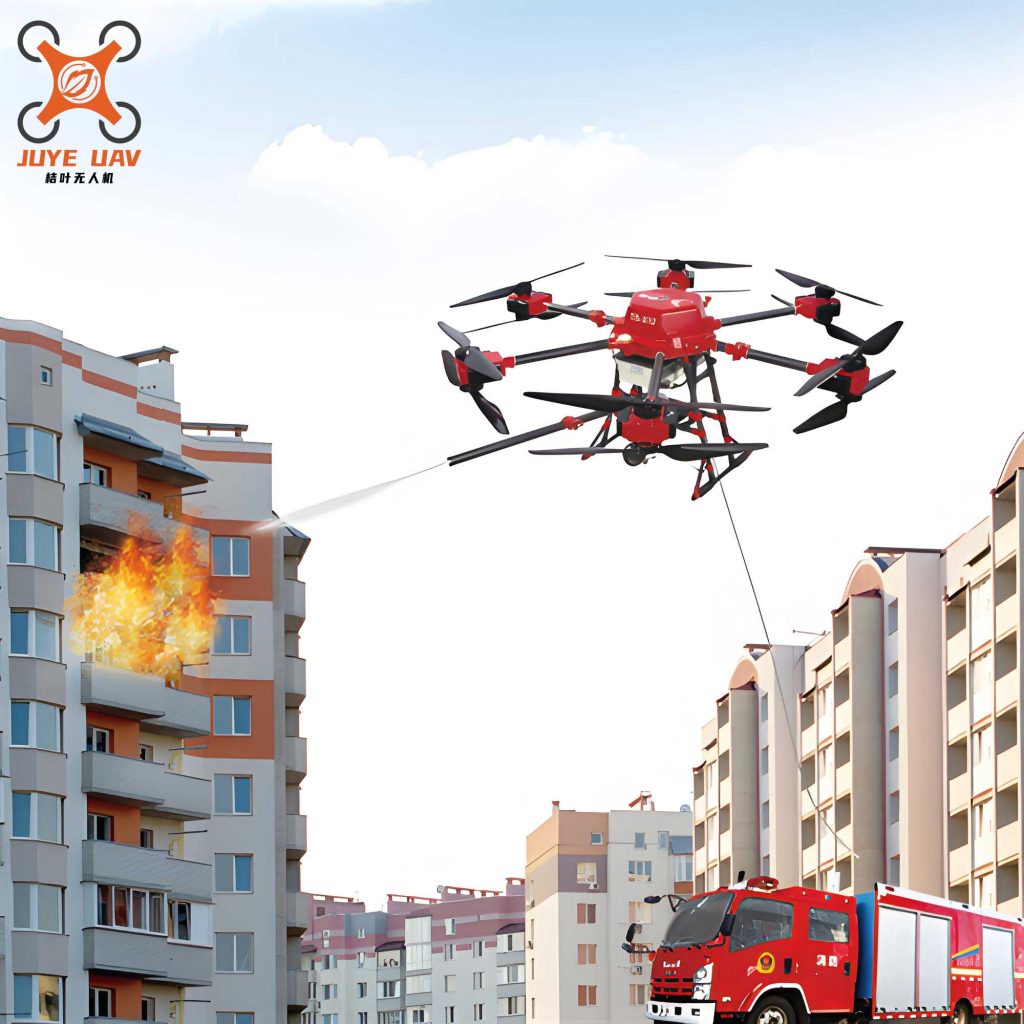
- Direct Intervention Capabilities: Beyond sensing, future fire UAV platforms may be equipped for direct fire suppression, such as carrying and deploying micro-encapsulated fire retardants or creating a water mist curtain using ultrasonic atomizers. The dynamics of such an intervention would require solving coupled equations for UAV stability and fluid discharge.
- Advanced Materials: Wider use of lightweight ceramic composites and aerogels for heat shielding, and shape-memory alloys for adaptive morphing structures will enhance durability and performance.
In conclusion, the design of an effective fire UAV is a sophisticated interdisciplinary challenge. It necessitates a deep integration of aerospace engineering, robotics, materials science, industrial design, and human factors. By rigorously analyzing functional requirements, leveraging biomimetic principles for innovative morphology, and adhering to the highest safety standards, the next generation of fire UAV systems will become even more indispensable partners to firefighters and rescue personnel. They will not only be tools for seeing the unseen but will evolve into active, intelligent agents in the mission to preserve life and property in the face of disaster.