
The challenge of effective fire suppression in high-rise buildings remains a critical issue in urban fire safety. Conventional firefighting equipment, such as aerial ladders and platform trucks, often face significant limitations in reach and deployment speed for structures exceeding 50 meters. Meanwhile, interior firefighting operations are hampered by the physical strain on firefighters and logistical difficulties. Unmanned Aerial Vehicles (UAVs), or drones, present a transformative potential for aerial firefighting. While current fire UAV applications are largely confined to reconnaissance, monitoring, and payload delivery, their direct intervention capability for active fire suppression, especially in the critical initial stages, is underdeveloped. Existing solutions for direct firefighting often involve large, expensive, and complex drone systems equipped with heavy payloads, limiting their accessibility and rapid deployment.
This article presents the design and analysis of a novel, lightweight ejection-type fire extinguishing apparatus specifically developed for integration with multirotor fire UAV platforms. The core innovation lies in a mechanically simple, reliable, and lightweight projectile launching mechanism designed to deploy compact, specialized fire-suppression grenades with precision. By focusing on structural simplification and weight optimization, this system aims to empower smaller, more agile, and cost-effective drones with a direct firefighting capability, thereby addressing the critical response gap for incipient fires in high-rise, industrial, and other difficult-to-access environments.
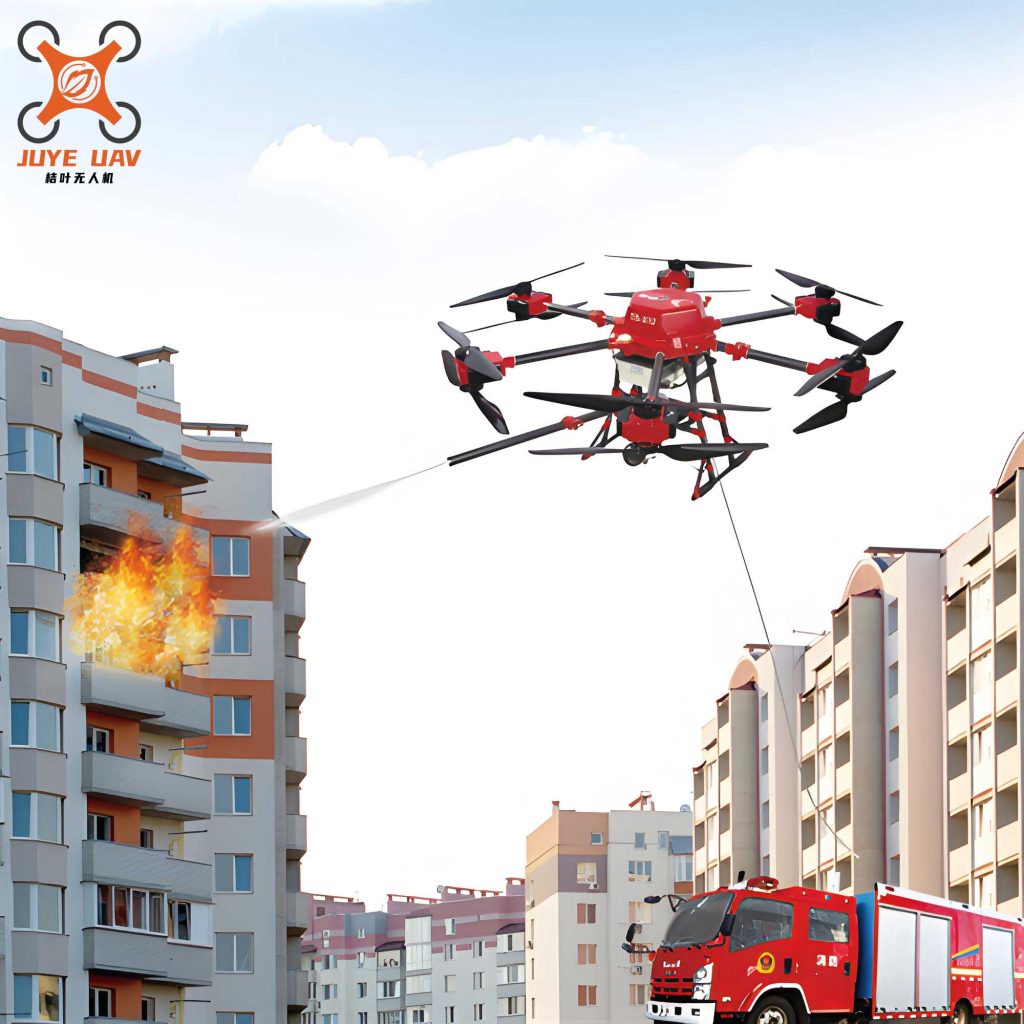
The proposed system is fundamentally an external payload module that can be mounted beneath a suitable fire UAV. Its primary function is to store, index, and ballistically launch fire-extinguishing projectiles toward a target window or opening. The overall system architecture is conceptualized to minimize electronic complexity and maximize mechanical reliability, which is paramount in the harsh, unpredictable conditions of a fire scene. The design philosophy prioritizes a minimal number of actuated components, leveraging kinematic principles to achieve the required sequence of operations.
System Architecture and Operational Principle
The ejection device is a self-contained mechanical system comprising four primary subsystems: the Drive Unit, the Reciprocating Transmission Mechanism, the Projectile Indexing Assembly, and the Quick-Return Launch Mechanism. A breakdown of the key components and their functions is provided in Table 1.
| Subsystem | Key Components | Primary Function |
|---|---|---|
| Drive Unit | Electric Motor, Synchronous Belts (I & II), Drive Pulleys | Provides rotary power to the reciprocating mechanism and the indexing assembly. |
| Reciprocating Transmission | Oscillating Slider-Crank, Rack-and-Pinion, Reciprocating Rod with Spring-Loaded Hook | Converts motor rotation into a linear reciprocating motion with a quick-return characteristic. |
| Projectile Indexing Assembly | Rotating Disk (Ammunition Carousel), Diverting Gate | Holds multiple fire grenades and sequentially presents one to the launch tube. |
| Quick-Return Launch Mechanism | Launch Bolt with Friction-Controlled Slider, Large Tension Spring, Guide Rods, Launch Tube | Latches, cocks, and releases the firing mechanism using the energy from the reciprocating rod. |
The operational cycle begins with the activation of the electric motor. The motor’s rotation is transferred via a synchronous belt (Belt I) to an oscillating slider-crank mechanism. This mechanism drives a pinion gear, which meshes with a rack attached to the main reciprocating rod. This kinematic chain produces the essential quick-return motion profile for the rod. The displacement over time for one cycle can be described by the motion of the slider-crank. If we denote the crank radius as $r$, the connecting rod length as $l$, and the crank angular velocity as $\omega$, the horizontal displacement $x$ of the reciprocating rod (and thus the slider block) relative to the crank center is approximately given by:
$$ x(t) = r \cos(\omega t) + \sqrt{l^2 – r^2 \sin^2(\omega t)} $$
The velocity profile derived from this equation shows that the return stroke (from right to left) is faster than the forward stroke, creating the advantageous quick-return effect.
Simultaneously, the motor drives a second synchronous belt (Belt II) that rotates the projectile indexing carousel. This rotation is synchronized such that a grenade is aligned with the entrance of the launch tube at the precise moment the launch mechanism is ready to receive it.
The core firing sequence is mechanically interlocked:
- Cocking Phase (Forward Stroke): As the reciprocating rod moves to its rightmost position (forward stroke), a spring-loaded hook on its end deflects and passes over a slider block attached to the launch bolt. The bolt remains stationary, and a large tension spring connected to it is stretched, storing energy.
- Release Phase (Return Stroke): On the rapid return stroke, the hook on the reciprocating rod engages the slider block on the launch bolt. The critical action occurs here. The slider block is not rigidly fixed; it is held against the bolt shaft by a tunable friction mechanism. This mechanism, shown schematically in Figure Y, consists of a spring-loaded ball detent. The force $F_f$ required to slide the block is governed by:
$$ F_f = \mu \cdot N $$
where $\mu$ is the coefficient of friction and $N$ is the normal force provided by the pre-compressed detent spring. A secondary cable-and-spring system temporarily reduces $N$ upon engagement. The kinetic energy and force from the quick-returning rod overcome this adjusted friction $F_f’$. - Launch: Once the static friction is overcome, the slider block—and consequently the entire launch bolt—is jerked rearward by the reciprocating rod. The bolt’s head, which acts as a breech block, retracts, opening the base of the launch tube. At this exact moment, the indexed grenade drops into the tube. The bolt then continues its rearward motion, compressing its own spring before being caught by a latch. The grenade, now unobstructed, is propelled forward by the suddenly released energy of the large tension spring acting on a pusher plate, ejecting it from the tube towards the target.
This elegantly simple cycle repeats for subsequent shots, with the indexing carousel advancing to present the next grenade.
Design Optimization and Structural Analysis via 3D Digital Modeling
To achieve the necessary lightweight and robust design, the entire system was modeled, analyzed, and optimized using SolidWorks 3D CAD software. This digital prototyping allowed for precise kinematic simulation, interference checking, and finite element analysis (FEA) of critical components. The primary structural goal was to minimize mass while ensuring sufficient strength to withstand launch forces and operational vibrations aboard the fire UAV.
Material selection was a key factor. Most non-critical structural components were specified as cast aluminum alloy ZL401 (ZAlZn11Si7), known for its good castability, strength-to-weight ratio, and corrosion resistance. However, for highly stressed wear components like the launch bolt slider block, a higher-strength aluminum alloy, 7075-T6, was selected for its superior yield strength and hardness. A comparative summary of material properties is presented in Table 2.
| Component | Selected Material | Key Properties (Typical) | Rationale |
|---|---|---|---|
| Frame, Casing, Carousel | Cast Aluminum ZL401 | Density: ~2.8 g/cm³, Tensile Strength: ~250 MPa | Excellent lightweight structural properties, good castability for complex shapes. |
| Reciprocating Rod, Launch Bolt | Wrought Aluminum 6061-T6 | Density: 2.7 g/cm³, Yield Strength: ~275 MPa | Good machinability and strength for dynamic load-bearing parts. |
| Slider Block, High-Wear Parts | Aluminum Alloy 7075-T6 | Density: 2.8 g/cm³, Yield Strength: ~503 MPa | Very high strength and wear resistance to endure repeated impact and friction. |
| Springs | Music Wire (ASTM A228) | High Carbon Steel | Provides reliable and consistent elastic force for cocking and release mechanisms. |
A critical step was the static structural FEA of the slider block, as its integrity is vital for reliable firing. The block was meshed with a free mesh configuration, and boundary conditions simulating the impact load from the reciprocating rod’s hook and the friction force from the detent mechanism were applied. The analysis provided contours for Von Mises stress, displacement, and factor of safety. The initial design using ZL401 showed localized stress concentrations near the engagement edges that approached the material’s yield limit under peak load. After optimization of fillet radii and a material change to 7075-T6, the FEA results confirmed a significant improvement. The maximum stress was well within the yield strength of 7075-T6, displacement was minimal (sub-millimeter), and the factor of safety increased to an acceptable operational level above 2.0. This iterative digital design process ensured the mechanism’s reliability without resorting to over-engineering and added weight.
Integration and Deployment Strategy for Fire UAV Operations
The designed ejection module is intended as a plug-and-play payload for commercially available medium-lift multirotor fire UAV platforms. Integration involves mechanical attachment to the drone’s underside payload release mechanism and electrical connection for motor control and optional status feedback. The drone’s flight controller and ground control station (GCS) would be responsible for navigating to the target waypoint (e.g., a specific window), stabilizing the aircraft, and triggering the firing sequence via a single command.
The operational concept involves the fire UAV approaching the building facade from a safe distance. Using its gimbal-stabilized optical and thermal cameras, the operator identifies the specific compartment or window that is the source of the fire or the optimal point for ventilation and agent injection. The drone is positioned at a stand-off distance of 5-10 meters from the target. Upon command, the onboard ejection system executes its automated firing cycle. The compact, high-velocity grenade is designed to shatter the window glass and disperse its fire-suppressing agent (e.g., dry chemical, compressed AFFF foam, or vaporizing liquid) directly into the compartment. One module could carry 4-6 such grenades, allowing for multiple engagement attempts or suppression of adjacent compartments.
The advantages of this system for a fire UAV are manifold:
- Lightweight and Modular: The predominantly aluminum construction and simplified mechanism keep the total system weight low, preserving the drone’s flight time and stability.
- High Reliability: Minimal use of solenoids or complex servos reduces points of failure. The purely mechanical firing sequence is robust against electromagnetic interference and harsh environments.
- Cost-Effectiveness: The design leverages standard mechanical components and manufacturing processes, making it more affordable than custom hydraulic or pneumatic systems, thus lowering the barrier to adoption for fire departments.
- Precision and Safety: Enables targeted application of extinguishing agent from a safe, external position, reducing risk to firefighters and avoiding unnecessary interior contamination.
Nevertheless, challenges remain, including final accuracy validation in windy conditions, the development of optimally effective frangible grenades, and seamless integration protocols with various drone models.
Conclusion
This article has detailed the design of a specialized ejection-type fire extinguishing apparatus to enhance the direct intervention capability of unmanned aerial systems in structural firefighting. By employing a kinematics-driven design philosophy centered on a quick-return mechanism and a tunable friction-based release, the system achieves reliable operation with minimal complexity. Through 3D digital modeling and finite element analysis, critical components were optimized for strength and weight, ensuring compatibility with the payload constraints of agile multirotor fire UAV platforms.
The proposed system addresses a significant gap in current aerial firefighting technology by transforming reconnaissance drones into active suppression assets. It enables rapid, remote, and targeted engagement of incipient fires in high-rise and otherwise inaccessible structures, potentially saving crucial minutes before conventional forces can be deployed. Future work will involve prototyping, rigorous live-fire testing to refine timing and accuracy, and further miniaturization of the fire-suppression grenades. This design represents a practical and promising step towards making effective, direct-firefighting capabilities standard for a wider range of fire UAV operations, ultimately contributing to improved urban fire safety outcomes.