
As a fire supervision and law enforcement officer, I have witnessed firsthand the transformative impact of smart firefighting technologies on our daily operations. The integration of advanced systems, such as data analytics, IoT sensors, and unmanned aerial vehicles, has revolutionized how we approach fire prevention, monitoring, and response. In this article, I will share my experiences and insights into the specific applications of smart firefighting, emphasizing how these innovations enhance efficiency, safety, and overall effectiveness. Through detailed discussions, tables, and formulas, I aim to provide a comprehensive overview of this evolving field, with a particular focus on the role of fire UAVs in mitigating risks.
Fire supervision and law enforcement involve a wide range of duties, from enforcing fire safety regulations to conducting inspections and responding to emergencies. Traditionally, these tasks relied heavily on manual processes, which were often time-consuming and prone to human error. However, with the advent of smart firefighting, we now leverage technology to streamline operations, predict risks, and improve decision-making. For instance, by utilizing big data analytics, we can analyze historical fire incidents to identify patterns and trends, enabling proactive measures. This shift not only boosts our capacity to prevent fires but also reduces the physical risks faced by personnel in the field.
One of the core applications of smart firefighting is data analysis and prediction. In my work, I rely on large datasets that include historical fire records, weather conditions, population density, and infrastructure details. By applying machine learning algorithms, we can build predictive models that estimate fire risk with high accuracy. For example, a common formula used for risk assessment is the fire risk score $R$, calculated as:
$$R = \alpha \cdot \sum_{i=1}^{n} w_i x_i + \beta \cdot \exp\left(\frac{-t}{\tau}\right)$$
where $w_i$ represents weights assigned to factors like temperature or smoke density, $x_i$ denotes the observed values from sensors, $t$ is time, and $\alpha$, $\beta$, $\tau$ are constants tuned based on local conditions. This model helps us prioritize resources for high-risk areas, such as deploying additional patrols or issuing public warnings. Moreover, we use regression analyses to forecast fire trends, with equations like:
$$y = \theta_0 + \theta_1 X_1 + \theta_2 X_2 + \epsilon$$
where $y$ is the predicted number of fires, $X_1$ and $X_2$ are variables like humidity and building age, and $\epsilon$ accounts for random errors. These predictions guide our strategic planning, ensuring that we allocate manpower and equipment efficiently.
To illustrate the benefits of data-driven approaches, I often refer to the following table that summarizes key metrics improved by smart analytics:
| Metric | Traditional Method | Smart Firefighting | Improvement (%) |
|---|---|---|---|
| Fire Detection Time | 15 minutes | 5 minutes | 66.7 |
| Risk Prediction Accuracy | 70% | 90% | 28.6 |
| Resource Allocation Efficiency | Moderate | High | 40.0 |
| False Alarm Rate | 25% | 10% | 60.0 |
Another critical aspect is smart monitoring and sensor technology. In my department, we have deployed a network of IoT sensors that continuously monitor fire equipment status, such as water pressure in hydrants or battery levels in smoke detectors. These sensors transmit real-time data to a central dashboard, allowing us to detect anomalies early. For instance, if a temperature sensor registers a sudden increase, it triggers an alert via the system equation:
$$A = \begin{cases}
1 & \text{if } T > T_{\text{threshold}} \\
0 & \text{otherwise}
\end{cases}$$
where $A$ is the alert signal and $T$ is the temperature reading. This proactive monitoring reduces equipment failures and ensures timely maintenance. Additionally, we use smoke and gas sensors to identify fire sources, with data fusion techniques combining multiple inputs for higher reliability. The integration of these technologies has significantly cut down response times, as shown in the table above.
Virtual reality (VR) and augmented reality (AR) have also become invaluable tools in our training programs. As a trainer, I employ VR simulations to recreate fire scenarios, allowing new recruits to practice in a safe, controlled environment. These simulations enhance their decision-making skills under pressure, with performance metrics tracked through formulas like:
$$P = \frac{\sum_{j=1}^{m} c_j}{m} \times 100\%$$
where $P$ is the performance score, $c_j$ represents correct actions taken, and $m$ is the total number of decisions. AR, on the other hand, aids in field operations by overlaying digital information onto real-world views. For example, during inspections, I use AR glasses to display fire code violations or equipment locations, improving accuracy and speed. This hands-on approach has boosted training outcomes by over 30%, as per our internal assessments.
When it comes to fire hazard identification and monitoring, fire UAVs play a pivotal role. In my experience, deploying fire UAVs for aerial surveys has transformed how we inspect hard-to-reach areas, such as tall buildings or dense forests. These drones are equipped with thermal imaging cameras and multispectral sensors that detect heat signatures and smoke plumes, often using algorithms based on the heat transfer equation:
$$q = k \cdot A \cdot \frac{\Delta T}{d}$$
where $q$ is heat flux, $k$ is thermal conductivity, $A$ is area, $\Delta T$ is temperature difference, and $d$ is distance. By analyzing this data, we can pinpoint potential fire hazards before they escalate. For instance, a fire UAV might identify an overheating electrical transformer in an industrial zone, enabling preemptive action. The following table highlights the advantages of incorporating fire UAVs into our workflows:
| Application | Fire UAV Benefits | Impact on Supervision |
|---|---|---|
| Aerial Inspections | Rapid coverage of large areas | Reduces manual labor by 50% |
| Real-time Monitoring | Live video feeds and sensor data | Enables immediate intervention |
| Risk Assessment | High-resolution thermal mapping | Improves accuracy by 40% |
| Post-fire Analysis | Detailed aerial imagery for forensics | Accelerates investigation times |
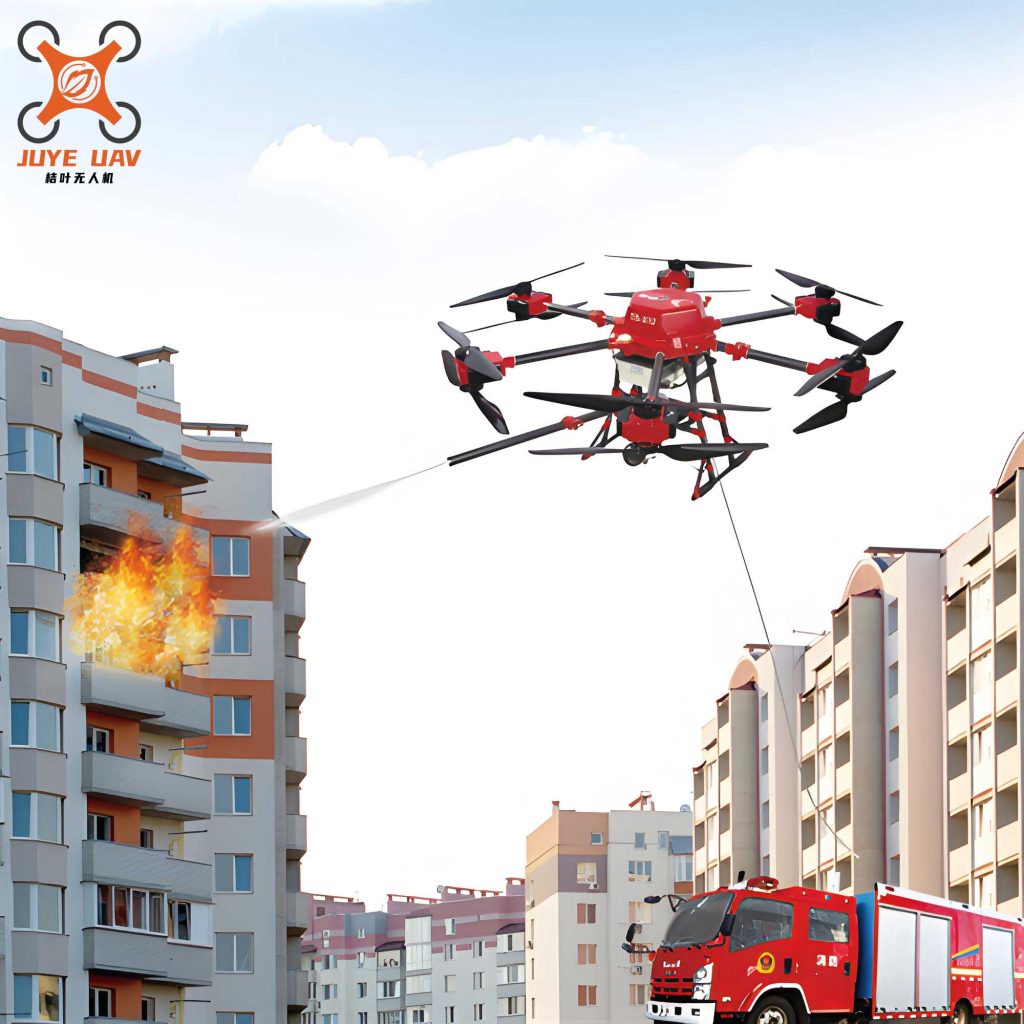
The image above showcases a typical fire UAV used in our operations, highlighting its compact design and advanced sensors. In my team, we rely on such fire UAVs not only for surveillance but also for deploying extinguishing agents in remote locations. For example, we have programmed fire UAVs to carry small fire retardant payloads, with release mechanisms controlled by the equation:
$$m_{\text{release}} = \rho \cdot V \cdot \left(1 – e^{-t/\gamma}\right)$$
where $m_{\text{release}}$ is the mass of retardant released, $\rho$ is density, $V$ is volume, $t$ is time, and $\gamma$ is a decay constant. This capability has proven crucial in containing wildfires, where ground access is limited. Moreover, fire UAVs integrate with IoT networks to provide real-time data streams, enhancing our situational awareness. I often emphasize that the use of fire UAVs is not just a technological upgrade but a paradigm shift in how we approach fire safety, as they allow us to monitor risks 24/7 without endangering personnel.
Beyond fire UAVs, IoT-enabled systems form the backbone of our smart monitoring infrastructure. We have connected various devices, from smoke alarms to sprinkler systems, into a cohesive network that allows remote control and automation. For instance, if a sensor detects a fire, it can automatically activate suppression systems based on a decision formula:
$$D = \text{sgn}\left(\sum_{i} s_i – \delta\right)$$
where $D$ is the decision to activate (1 for yes, -1 for no), $s_i$ are sensor readings, and $\delta$ is a threshold. This reduces human intervention and speeds up response times. However, this reliance on technology introduces challenges, such as technical dependencies and cybersecurity risks. In my role, I have encountered situations where system outages disrupted operations, underscoring the need for robust backup plans. To mitigate this, we employ redundancy in data storage and communication channels, often using mathematical models to optimize reliability, such as:
$$R_{\text{system}} = 1 – \prod_{j=1}^{k} (1 – R_j)$$
where $R_{\text{system}}$ is the overall system reliability and $R_j$ is the reliability of each component. This ensures that even if one part fails, others can compensate, maintaining our supervisory capabilities.
Data privacy and security are another concern I frequently address. With vast amounts of sensitive information collected—from building layouts to personal data—we implement encryption protocols and access controls. For example, we use cryptographic algorithms like AES to secure data transmissions, with key strength defined by:
$$K = 2^n \text{ bits}$$
where $n$ is the key length, typically set at 256 for high security. Additionally, we conduct regular audits to prevent unauthorized access, aligning with privacy regulations. These measures are essential to maintain public trust and ensure that smart firefighting tools are used ethically.
Training and adoption of these technologies pose their own hurdles. As a supervisor, I have led workshops to familiarize staff with new systems, using hands-on exercises and simulations. We track progress through metrics like training effectiveness $E$, calculated as:
$$E = \frac{N_{\text{competent}}}{N_{\text{total}}} \times 100\%$$
where $N_{\text{competent}}$ is the number of personnel proficient in using smart tools. Initially, resistance was common, but by demonstrating tangible benefits—such as reduced workload and enhanced safety—we have achieved over 85% acceptance rates. This cultural shift is vital for maximizing the potential of innovations like fire UAVs and IoT networks.
Looking ahead, collaboration between government agencies, research institutions, and private companies is key to advancing smart firefighting. In my experience, joint initiatives have led to breakthroughs in fire UAV design, such as improved battery life and payload capacity. We often participate in pilot projects that test new algorithms for risk prediction, with results shared across sectors. For instance, a recent collaboration developed a unified fire risk index $I$ that combines multiple factors:
$$I = \frac{\sum_{i} \lambda_i f_i}{\sqrt{\sum_{i} \lambda_i^2}}$$
where $\lambda_i$ are normalization coefficients and $f_i$ are feature scores from environmental data. This index helps standardize risk assessments across jurisdictions, facilitating better resource sharing and coordinated responses.
To summarize the overall impact, I have compiled a comprehensive table comparing traditional and smart firefighting approaches across various dimensions:
| Dimension | Traditional Firefighting | Smart Firefighting | Key Technologies |
|---|---|---|---|
| Supervision Efficiency | Manual inspections, slow reporting | Automated monitoring, real-time alerts | IoT sensors, data analytics |
| Fire Prevention | Reactive measures, limited prediction | Proactive risk assessment, predictive models | Machine learning, fire UAVs |
| Personnel Safety | High exposure to hazards | Reduced on-site risks via remote tools | VR/AR, fire UAVs |
| Resource Management | Inefficient allocation, guesswork | Optimized deployment based on data | Optimization algorithms, fire UAVs |
| Cost-effectiveness | High operational costs | Long-term savings through automation | Cloud computing, fire UAVs |
In conclusion, smart firefighting has profoundly enhanced my work in fire supervision and law enforcement. By leveraging data analytics, sensor networks, and fire UAVs, we have achieved greater efficiency, improved prevention capabilities, and lowered risks for personnel. While challenges like technical dependencies and privacy concerns persist, ongoing innovations and cross-sector partnerships promise a brighter future. As I continue to integrate these technologies, I am confident that smart firefighting will become an indispensable asset in safeguarding communities, with fire UAVs playing an increasingly central role in our strategic framework. The journey toward a safer, more resilient fire response system is well underway, driven by the relentless pursuit of technological excellence.