
In recent years, warehouse and logistics fires have shown a trend of frequent occurrence. Unlike ordinary structural fires, warehouse fires present unique and severe challenges: high concentrations of combustible materials, rapid fire spread, generation of massive amounts of toxic smoke and fumes, intense burning, and consequently, extreme difficulty in fire suppression and rescue operations. Confronting these complex scenarios, multi-rotor fire UAVs (Unmanned Aerial Vehicles) have provided fire and rescue services with a transformative new option. The deployment of fire UAVs, particularly in swarm configurations and in concert with various other equipment, significantly enhances firefighting efficiency while substantially reducing the risk to personnel.
The inherent complexity of warehouse structures and the diversity of stored goods make traditional firefighting methods often inadequate for quickly locating the seat of the fire and delivering an effective counterattack. Hasty, “get-results-quick” actions can prove futile and may even place responders in a precarious position. The fundamental principle must be “control first, then extinguish.” Primary effort should focus on intercepting and containing the fire’s direction of spread to prevent further expansion, thereby maximizing the effectiveness of initial firefighting forces. This strategic containment can be mathematically conceptualized. The rate of fire front advancement ( $v_f$ ) is a function of fuel load ( $Q_f$ ), compartment geometry, and ventilation conditions. Effective UAV-assisted containment aims to reduce the effective $Q_f$ ahead of the front or alter the thermal dynamics to slow $v_f$. A simplified model for required cooling power for containment near a ventilation opening can be expressed as:
$$ \dot{Q}_{cooling} \approx \dot{Q}_{fire} – \dot{Q}_{losses} $$
where $\dot{Q}_{fire}$ is the Heat Release Rate (HRR) of the fire and $\dot{Q}_{losses}$ represents heat losses through radiation and convection not contributing to spread. Fire UAVs contribute to increasing $\dot{Q}_{losses}$ through targeted application of extinguishing agents.
The positioning of firefighting apparatus is critical for both efficiency and safety. In the initial stages, the priority is controlling the blaze and preventing spread, setting up water streams as close to the source as possible using interior standpipes. When structurally sound, forces should advance from the windward side under the cover of barrier hoses, methodically tackling the fire in sections. Crucially, technologies like thermal imaging cameras, fire UAVs, and ground robots enable continuous, dynamic monitoring of the fireground, ensuring command can capitalize on advantageous conditions for a complete extinguishment. Creating offensive channels by safely moving stock, informed by building plans and witness accounts, allows for compartmentalization of the fire and a pincer attack strategy. Finally, effective warehouse firefighting demands the coordinated deployment of specialized resources—smoke evacuation vehicles, elevated platform trucks, large-volume water tenders, and, where available, advanced assets like turbo-jet firefighting vehicles, robots, and most pivotally, multi-rotor fire UAVs.
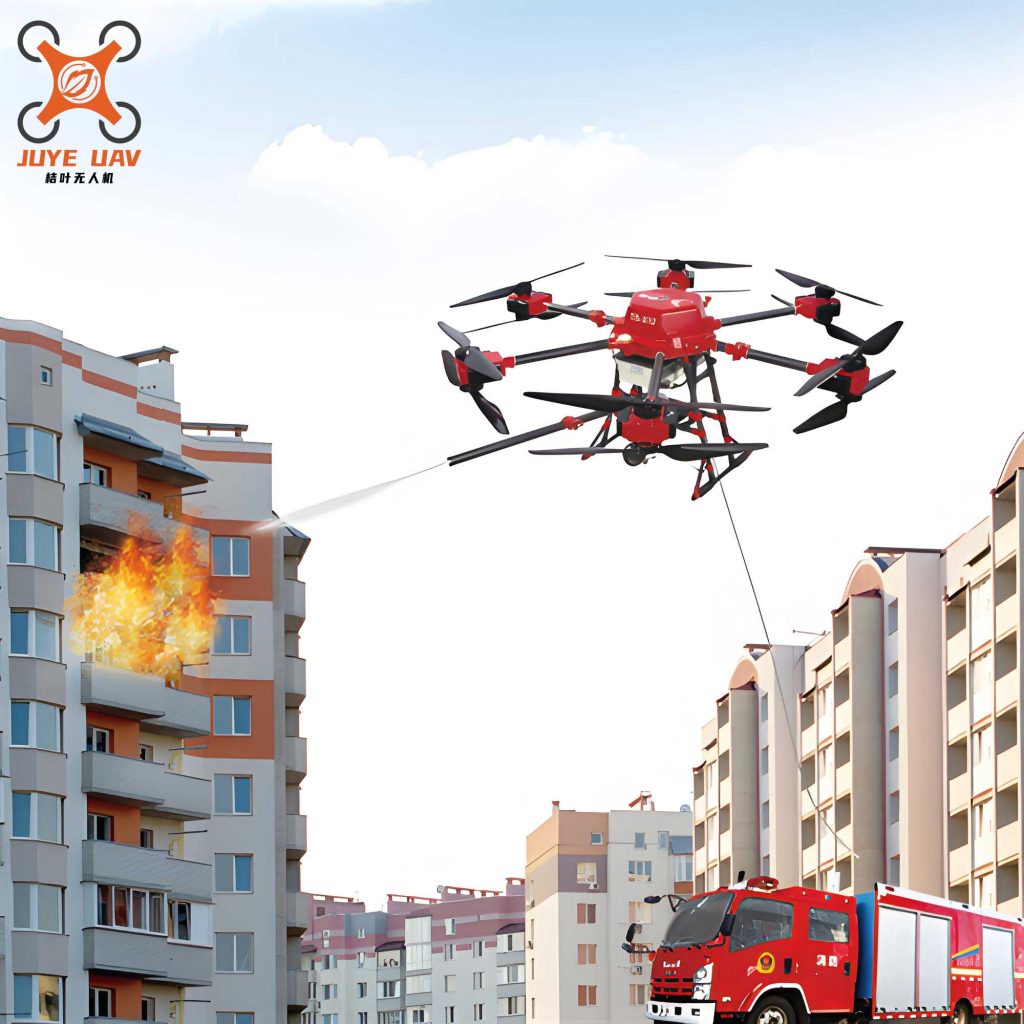
The adoption of fire UAVs within modern fire departments is typically structured across three operational levels, each with distinct capabilities suited to different phases of a warehouse fire incident.
| Tier | Typical Platform | Key Specifications | Primary Payloads & Modules | Operational Role |
|---|---|---|---|---|
| Station-Level | Consumer-grade (e.g., DJI Mavic series with dual-sensor) | High automation, obstacle sensing (~30m), automated flight modes. | Loudspeaker, RTK module, spotlight, basic gas sensor. | Initial scene assessment, basic reconnaissance, visual oversight. |
| Brigade-Level | Industrial-grade (e.g., DJI Matrice 300) | Longer endurance (>30 min), payload capacity >5 kg. | Intelligent multi-gas sensor, loudspeaker, payload dropper (for supplies, fire grenades). | Comprehensive reconnaissance, hazardous atmosphere monitoring, auxiliary rescue and firefighting support. |
| Special Service / Heavy-Lift | Custom heavy-lift multi-rotor | High gross takeoff weight (up to 50-110 kg), large payload capacity (20-60+ kg). | Equipment transport, tethered lighting/hose systems, large extinguishing agent containers. | Direct firefighting (water/foam/chemical delivery), sustained illumination, logistics support in inaccessible areas. |
The fire UAV has evolved from a simple eye in the sky to a multi-role platform central to warehouse firefighting strategy. Its applications span the entire timeline of an incident, from prevention to final overhaul.
1. Fire Surveillance, Reconnaissance, and Patrol: When a warehouse fire produces toxic gases, deploying a fire UAV for close-range inspection carries far less risk than deploying personnel. These systems provide multi-angle monitoring, delivering critical real-time data to the incident commander and greatly enhancing operational reliability and safety. Equipped with specialized detection modules—infrared (IR) cameras, high-resolution visual cameras, gas analyzers, and thermal sensors—the fire UAV makes the opaque fireground transparent. It locates hot spots through dense smoke, analyzes atmospheric hazards, and provides visual and thermal imagery. This data is vital for dynamic risk assessment, predicting fire spread, and formulating tactical decisions. Real-time video can be streamed to all responders’ devices, fostering shared situational awareness. Furthermore, intelligent fire UAVs can execute automated patrols over warehouse complexes. The coverage efficiency can be estimated. For a UAV cruising at $v_{cruise} = 10 \, m/s$, the time $T_{patrol}$ to cover a rectangular area of length $L$ and width $W$ with a scan width $s_w$ is approximately:
$$ T_{patrol} \approx \frac{L \times W}{v_{cruise} \times s_w} $$
For instance, covering a 1 km² ($L=W=1000m$) area with $s_w = 50m$ would take roughly $T_{patrol} \approx 2000 \, s$ or 33 minutes. Automated battery-swapping stations or multi-UAV swarms can enable 24/7 monitoring, with immediate alerts triggered upon detection of abnormal heat or gas concentrations.
2. Initial Fire Attack and Suppression: Heavy-lift fire UAVs are capable of direct firefighting intervention, especially in early-stage or hard-to-reach fires. They can carry various extinguishing agents. For liquid agents (water, foam), release coverage from a certain height can be modeled. The area $A_{cover}$ effectively covered by a released volume $V$ of liquid with a desired deposition density $\rho_d$ is:
$$ A_{cover} = \frac{V}{\rho_d} $$
For example, a fire UAV carrying $V = 60 \, L$ of foam concentrate mixed to a final application density of $\rho_d = 0.5 \, L/m^2$ could cover $A_{cover} = 120 \, m^2$. Advanced systems use ultrasonic atomizers to create fine water mist, enhancing the cooling and oxygen-displacing effects. Furthermore, fire UAVs can be equipped with launchers for dry chemical or specialized fire suppression grenades. The kinetic energy of a projectile, relevant for penetration or dispersal, is $KE = \frac{1}{2} m v^2$, where $m$ is the mass of the projectile/agent and $v$ its velocity upon impact.
| Suppression Method via Fire UAV | Typical Payload/Equipment | Key Mechanism | Advantage in Warehouse Context |
|---|---|---|---|
| Gravity-Dropped Liquid/Foam | 60L tank, foam inductor | Cooling, fuel separation, vapor suppression. | Rapid coverage of surface fires, cooling of exposed materials. |
| Atomized Water Mist | Ultrasonic atomizer, pump system | Extreme surface area for rapid heat absorption, oxygen displacement. | Penetrates narrow spaces and smoke, effective on deep-seated Class A fires. |
| Dry Chemical Projectiles | 60-82mm mortar/launcher, 3-5kg grenades | Chemical interruption of combustion chain reaction. | Rapid knock-down of flammable liquid (Class B) and electrical fires. |
| Tethered Water/Nozzle | High-pressure hose, remote nozzle | Sustained water delivery for cooling and exposure protection. | Provides persistent direct attack from optimal vantage point without UAV landing. |
3. Swarm Operations in Large-Scale Warehouse Fires: For major incidents, a coordinated group or swarm of fire UAVs multiplies effectiveness. This involves specialized roles:
a) Reconnaissance & Mapping Swarm: Multiple UAVs equipped with RTK and LiDAR/Photogrammetry sensors can rapidly 3D-scan the structure. Combining this model with real-time IR data from other fire UAVs in the swarm precisely locates the fire’s core and extent. Simultaneous gas sensing across the swarm creates a dynamic 3D hazard map, automatically defining exclusion zones and safe approach paths based on wind vectors ($\vec{w}$). The data fusion from $n$ UAVs provides a more complete model than any single system.
b) Combined Fire Suppression Swarm: A mixed swarm executes a sequenced attack. Scout fire UAVs identify optimal attack vectors. Suppression fire UAVs then use dry chemical projectiles to breach lightweight building elements (e.g., skylights, siding) and suppress flames, creating access or vent paths. The downdraft from the multi-rotor platforms of multiple fire UAVs can then be harnessed to assist in smoke extraction. Following initial knockdown, tethered-suppression fire UAVs move in to apply sustained cooling water to prevent re-ignition. Fine water mist, deployed by another unit and propelled by rotor wash, can be driven into hidden voids and crevices. The total extinguishing agent delivery rate $\dot{M}_{total}$ of a swarm of $k$ identical suppression fire UAVs is:
$$ \dot{M}_{total} = k \times \dot{M}_{UAV} $$
where $\dot{M}_{UAV}$ is the agent flow rate of a single fire UAV. This linear scaling demonstrates the force multiplication potential of swarm tactics.
c) Auxiliary Support Swarm: Different modules on similar fire UAV platforms provide versatile support. Tethered lighting fire UAVs can provide massive, mobile illumination (e.g., 2000 m² from 20m height) for night operations. Loudspeaker fire UAVs ensure evacuation and tactical commands are heard over site noise. A fire UAV acting as a communications relay node can solve the common problem of radio signal degradation within large steel warehouses, ensuring continuous command and control. IR cameras on search-dedicated fire UAVs are indispensable for locating trapped individuals. Experimental systems using low-frequency sound waves (< 60 Hz) to disrupt flame chemistry are also being explored for creating temporary safe passages.
Despite their transformative potential, the operational integration of fire UAVs faces several challenges that must be addressed to unlock their full capabilities in demanding warehouse fire environments.
| Challenge Category | Specific Issues | Potential Solutions & Future Directions |
|---|---|---|
| Environmental Adaptation | High temperatures, explosive/ corrosive atmospheres, steam, and flying embers can damage electronics, sensors, and airframes. Dry chemical agents can cause short circuits. | Development of hardened models with thermal shielding, sealed components, and corrosion-resistant materials. Active cooling systems. Strategic stand-off distances when deploying dry agents. |
| Operator Expertise | Piloting skill gap within fire services; often reliant on manufacturer technicians. Standard civilian UAV licenses (e.g., AOPA, ASFC) lack fireground-specific training. | Development of specialized fire service UAV operator curricula focusing on incident command integration, tactical flying in congested/ hazardous environments, and data interpretation under stress. |
| Endurance & Logistics | Limited flight time (often < 1 hour) for battery-electric models. Recharging/ swapping in the field is logistically burdensome and causes operational gaps. | Adoption of hybrid or gasoline-electric powertrains for extended loiter time. Deployment of field-deployable tethering stations for continuous power. Optimization of aerodynamics and use of lightweight composites to improve efficiency ($E_{flight} = P \times t$). |
| Swarm Coordination & AI | Effective real-time management of heterogeneous UAV swarms is complex. Optimal task allocation and collision avoidance in GPS-denied, smoky environments is non-trivial. | Advancement in decentralized swarm AI algorithms for autonomous cooperative behavior. Enhanced onboard sensors (ultrasonic, LiDAR) for Simultaneous Localization and Mapping (SLAM) in obscured conditions. Development of robust human-swarm interfaces for tactical control. |
The mathematical optimization of a fire UAV swarm’s performance is an active area of research. A simplified objective function $F_{swarm}$ for a suppression task might seek to maximize fire area reduction while minimizing resource use and time:
$$ F_{swarm} = \max \left( \frac{\Delta A_{fire}}{t \cdot \sum_{i=1}^{k} (E_i + C_i)} \right) $$
where $\Delta A_{fire}$ is the reduction in fire area, $t$ is mission time, and $E_i$ and $C_i$ represent the energy and consumable (agent) cost for the $i$-th fire UAV in the swarm of size $k$. Finding the optimal parameters (number of fire UAVs, their roles, attack vectors) that maximize $F_{swarm}$ is key to effective deployment.
In conclusion, multi-rotor fire UAVs offer compelling advantages over conventional equipment for warehouse firefighting: low operational footprint, relatively straightforward operation, cost-effective maintenance, rapid deployment, and high operational efficiency. Their modular “one-platform, multiple-roles” design is ideal for the dynamic needs of a fireground. A fire UAV drastically improves situational awareness through efficient reconnaissance. It creates a safer environment for ground crews through remote monitoring and hazard identification. Most significantly, in direct firefighting, especially in swarm configurations, the fire UAV enhances suppression effectiveness and reduces firefighter exposure to extreme hazards. As technology advances—improving endurance, resilience, autonomy, and swarm intelligence—the fire UAV is poised to become an indispensable, integrated component of modern firefighting strategy, providing the hardware and tactical flexibility essential for successfully combating large-scale, complex warehouse fires.