
In recent years, the firefighting landscape has become increasingly challenging, particularly due to rapid urbanization and the proliferation of high-rise buildings, which complicate fire suppression efforts and strain traditional methods. Existing techniques, such as fire ladders and water cannons, often fall short due to physical limitations, leading to suboptimal outcomes. With advancements in unmanned aerial vehicle (UAV) technology, there has been a growing interest in deploying UAVs for firefighting operations. Currently, fire UAVs are primarily used in reconnaissance missions under centralized command, where operators manually control them for灭火 tasks. However, this approach is limited to economically developed regions, relies on human intervention, and lacks automation and intelligent on-site capabilities. Moreover, fire UAVs often operate in isolation with minimal information exchange, resulting in low integration and inefficient灭火 performance,未能 fully leverage the potential of UAV-based firefighting. To address these issues, we propose a fire UAV cluster system that overcomes the shortcomings of single-platform fire UAVs, such as high manual操控 costs, complex operational procedures, and non-intelligent task execution. This system employs a sub-swarm design and self-organizing协同 mechanisms, enhancing autonomy and efficiency in firefighting missions.
The concept of UAV clusters draws inspiration from biological swarms in nature, such as fish schools evading predators or bird flocks during migration. These swarms exhibit collective intelligence, where individuals with limited capabilities interact to “emerge” with enhanced group functionalities. Similarly, our fire UAV cluster system leverages this principle to perform complex firefighting tasks through autonomous coordination. We introduce a sub-swarm architecture, dividing the cluster into reconnaissance, firefighting, and special rescue sub-swarms, which reduces platform complexity and cost while promoting智能性和 functional emergence. In this article, we detail the system composition, autonomous协同 decision-making mechanisms, and operational workflows, emphasizing the role of fire UAV clusters in modern firefighting.
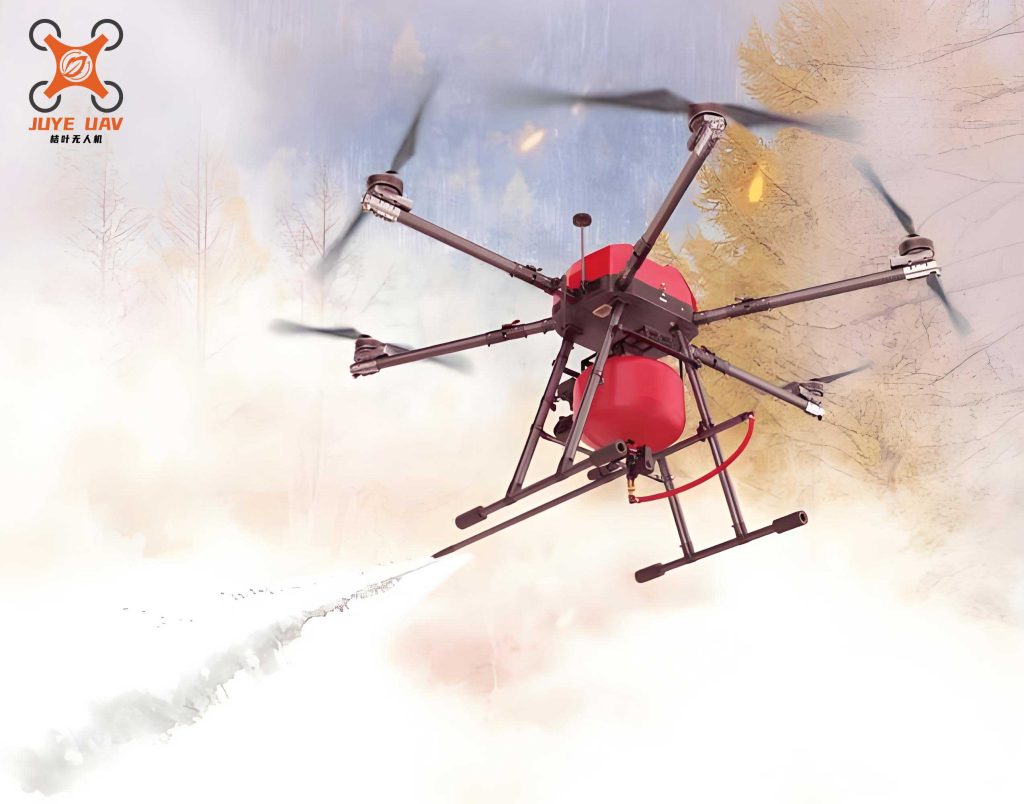
Unmanned aerial vehicles, commonly known as UAVs or drones, were initially developed for military applications but have since expanded into civilian domains due to their unique advantages. In recent years, the frequent occurrence of natural disasters has accelerated the adoption of UAVs in China. A typical UAV consists of an airframe, flight control system, data link system, power supply system, and propulsion system. Key features of UAVs include: (1) Rapid mobility and timely response: UAVs are highly flexible and can quickly reach target areas with minimal environmental constraints. (2) Low cost and reduced risk: Operating and maintenance costs are relatively low, and their compact size eliminates the need for dedicated takeoff and landing facilities; moreover, fire UAVs can access hazardous zones or operate under adverse weather conditions for emergency tasks. These attributes make fire UAVs ideal for firefighting scenarios, where speed and safety are paramount.
Building on this, UAV clusters refer to groups of UAVs that collaborate to achieve common goals. Inspired by biological swarms, we propose a fire UAV cluster system with self-organizing协同 capabilities. By designing sub-swarms, we enhance the overall intelligence and functionality of the cluster, allowing it to adapt dynamically to firefighting demands. The table below summarizes the core components and advantages of fire UAV clusters compared to single UAV platforms.
| Aspect | Single Fire UAV | Fire UAV Cluster |
|---|---|---|
| Functionality | Limited to specific tasks (e.g., reconnaissance or灭火) | Integrated tasks via sub-swarms (reconnaissance,灭火, rescue) |
| Autonomy | Low; relies on manual remote control | High; employs autonomous协同 mechanisms |
| Cost | Moderate per unit, but high operational costs | Reduced through shared resources and swarm intelligence |
| Efficiency | Inefficient due to lack of coordination | Enhanced via real-time information exchange and协同 |
| Scalability | Limited to individual platform upgrades | Easily scalable by adding more fire UAVs to the cluster |
The fire UAV cluster system comprises multiple rotary-wing UAV platforms, a ground station system, a power supply system, task payloads, and a fire cloud system. The ground station serves as the command and control center, handling mission planning, flight parameter monitoring, payload status display, and takeoff/landing control. Task payloads include fire extinguishing bombs, targeting devices, deployment mechanisms, and various sensors, which are essential for executing灭火 operations. The fire cloud system is a cloud-based computing, storage, and processing platform that continuously collects task data, extracts execution rules, and evolves the system’s intelligence over time. This architecture ensures that the fire UAV cluster can adapt to diverse fire scenarios. The sub-swarm design is critical: the reconnaissance sub-swarm identifies fire sources, the firefighting sub-swarm performs灭火, and the special rescue sub-swarm handles ancillary tasks like victim assistance. This division of labor enhances overall efficiency, as each fire UAV sub-swarm specializes in its role while协同 with others.
To enable autonomous operation, we propose several协同 decision-making mechanisms for the fire UAV cluster. These mechanisms allow fire UAVs to self-organize, avoid collisions, search for fire sources,定位 targets, and coordinate灭火 efforts. Below, we describe each mechanism in detail, incorporating mathematical formulas and tables to illustrate the underlying principles.
Autonomous协同 Decision-Making Mechanisms
1. Self-Organizing Collision Avoidance Mechanism
When fire UAVs execute missions, they must navigate safely in close proximity. We adopt a self-organizing network collision avoidance algorithm inspired by electrostatic repulsion. Each fire UAV continuously monitors its surroundings for collision risks. If a potential collision is detected, UAVs repel each other similar to like-charged particles. The repulsive force between two fire UAVs i and j can be modeled using a modified Coulomb’s law:
$$F_{ij} = k \frac{q_i q_j}{r_{ij}^2} \hat{r}_{ij}$$
where \(F_{ij}\) is the repulsive force, \(k\) is a constant scaling factor, \(q_i\) and \(q_j\) represent the “risk levels” of the fire UAVs (e.g., based on velocity or proximity), \(r_{ij}\) is the distance between them, and \(\hat{r}_{ij}\) is the unit vector pointing from UAV i to j. This force is integrated into the motion control system to adjust trajectories. The algorithm ensures that fire UAVs maintain safe distances while minimizing deviation from planned paths. The table below outlines key parameters for this mechanism.
| Parameter | Description | Typical Value |
|---|---|---|
| \(k\) | Scaling constant for repulsive force | 1.0 N·m²/C² (adjusted empirically) |
| \(q_i\) | Risk level of fire UAV i | 0.5 to 1.0 (normalized) |
| \(r_{ij}\) | Minimum safe distance between fire UAVs | 5 meters |
| Update rate | Frequency of risk assessment | 10 Hz |
2. Fire Source协同 Search Mechanism
Upon receiving a fire alarm, the approximate location of the fire source is often known, but precise定位 is required. The reconnaissance sub-swarm employs a全覆盖协同搜索 strategy to scan the area. First, the region of interest is defined by its vertex coordinates, which are transmitted to the leader of the reconnaissance sub-swarm. The leader then determines the number of fire UAVs needed and plans搜索 paths for each. The area is partitioned into sub-regions, with each fire UAV assigned to cover a specific zone using a zigzag or spiral pattern. The搜索 efficiency can be optimized by minimizing overlap and maximizing coverage. For a rectangular area of width \(W\) and length \(L\), with \(n\) fire UAVs each having a sensor range \(d\), the optimal number of fire UAVs can be estimated as:
$$n = \left\lceil \frac{W \times L}{\pi d^2} \right\rceil$$
This ensures that the fire UAV cluster can quickly locate the fire source. During搜索, fire UAVs exchange information via ad-hoc networks to update the search status in real-time.
3.协同定位 Mechanism
After detecting a fire source, the fire UAV cluster performs协同定位 to determine its exact coordinates. We use the Angle-of-Arrival (AOA) method, a ranging-based定位 algorithm common in wireless sensor networks. In this approach, multiple fire UAVs measure the angle of signal arrival from the fire source (e.g., using infrared or radio frequency signals). Suppose two fire UAVs at positions \((x_1, y_1)\) and \((x_2, y_2)\) measure angles \(\theta_1\) and \(\theta_2\) relative to a reference axis. The fire source position \((x_f, y_f)\) can be calculated by solving the intersection of the two lines defined by these angles. The equations are:
$$\tan(\theta_1) = \frac{y_f – y_1}{x_f – x_1}, \quad \tan(\theta_2) = \frac{y_f – y_2}{x_f – x_2}$$
Solving these yields the fire source coordinates. For enhanced accuracy, multiple fire UAVs can be used in a triangulation network, reducing errors from sensor noise. The AOA method offers low communication overhead and high定位 precision, making it suitable for fire UAV clusters. The table below summarizes the定位 performance metrics.
| Metric | Value | Notes |
|---|---|---|
| 定位 Error | < 2 meters | Under ideal conditions with 3+ fire UAVs |
| Communication Range | Up to 500 meters | Between fire UAVs in the cluster |
| Angle Measurement Accuracy | ±1 degree | Using high-resolution sensors |
| Computation Time | < 0.1 seconds | For real-time processing on fire UAVs |
4.协同投弹灭火 Mechanism
Once the fire source is located and assessed, the firefighting sub-swarm is deployed for灭火. The leader of this sub-swarm decides the number of fire UAVs required based on fire intensity and area. Each fire UAV is assigned a specific altitude layer to avoid mid-air conflicts and optimize灭火 coverage. The altitude assignment follows a sequential order: fire UAVs at lower altitudes投弹 first, followed by those at higher altitudes. This ensures that灭火 agents (e.g., extinguishing bombs) are delivered effectively without interference. The投弹 sequence can be modeled as an optimization problem to minimize total mission time. Let \(h_i\) be the altitude of fire UAV i, and \(t_i\) be its投弹 time. The objective is to minimize the maximum \(t_i\) subject to altitude constraints:
$$\text{Minimize } \max(t_i) \quad \text{subject to } h_i < h_{i+1} \text{ for } i = 1, 2, …, m-1$$
where \(m\) is the number of fire UAVs in the sub-swarm. After投弹, fire UAVs return to base for reloading, while reconnaissance fire UAVs monitor the fire suppression progress and provide feedback for further actions. This协同 approach enhances the efficiency of fire UAV clusters in extinguishing fires, especially in complex environments like high-rise buildings.
Operational Workflow of Fire UAV Cluster
To illustrate the practical application, consider a typical urban fire scenario, such as a vehicle fire in a residential小区. Urban fire stations are often designed to respond within 5 minutes to责任区 edges, with coverage areas up to 7 square kilometers for普通 stations and 15 square kilometers for suburban ones. The fire UAV cluster workflow proceeds as follows:
- Alarm Reception and Deployment: Upon receiving the fire alarm, the nearest fire station dispatches vehicles equipped with the fire UAV cluster. During transit, 1-3 reconnaissance fire UAVs are launched and pre-programmed with搜索 paths to rapidly reach the fire site.
- Reconnaissance and定位: The reconnaissance fire UAVs arrive at the scene and transmit live imagery and precise定位 data to the ground station. Using infrared sensors, the ground station analyzes the fire’s size, intensity, and spread area to determine the required scale of the firefighting sub-swarm.
- Firefighting Execution: The ground station commands the takeoff of灭火 fire UAVs. The reconnaissance and firefighting sub-swarms form an ad-hoc network, sharing real-time fire data and灭火 agent status. Reconnaissance fire UAVs assign tasks to firefighting fire UAVs based on火势; those depleted of extinguishing bombs automatically return for reloading by ground personnel.
- Post-Fire Monitoring: After明火 is suppressed, reconnaissance fire UAVs remain on-site to monitor the area for re-ignition risks and assess damage. Once the mission is complete, all fire UAVs are recalled and landed autonomously.
This workflow demonstrates how fire UAV clusters integrate seamlessly into existing fire response systems, reducing human intervention and improving reaction times. The use of multiple fire UAVs in a cluster ensures redundancy and adaptability, critical for dynamic fire environments.
System Architecture and Components
The fire UAV cluster system’s architecture is designed for scalability and robustness. Below is a detailed breakdown of its components, emphasizing the role of each in supporting autonomous operations. The integration of these elements enables the fire UAV cluster to function as a cohesive unit, with fire UAVs interacting intelligently to accomplish missions.
| Component | Description | Function in Fire UAV Cluster |
|---|---|---|
| Multi-rotor UAV Platform | Base aerial vehicle with flight control systems | Provides mobility for fire UAVs; supports various payloads |
| Ground Station System | Centralized control interface with software | Coordinates fire UAV sub-swarms, plans missions, monitors status |
| Power Supply System | Batteries or hybrid power sources | Ensures extended flight time for fire UAVs during operations |
| Task Payloads | 灭火 bombs, sensors, targeting devices | Enables fire UAVs to perform reconnaissance and灭火 tasks |
| Fire Cloud System | Cloud-based data processing and storage | Facilitates learning and adaptation for fire UAV cluster intelligence |
| Communication Network | Ad-hoc wireless links between fire UAVs | Allows real-time data exchange and协同 among fire UAVs |
The sub-swarm design further optimizes this architecture. For instance, reconnaissance fire UAVs are equipped with high-resolution cameras and thermal sensors, while firefighting fire UAVs carry payloads like dry powder or foam extinguishers. Special rescue fire UAVs might include tools for delivering first aid supplies. This modular approach allows the fire UAV cluster to be customized for different fire scenarios, from industrial blazes to forest fires. Moreover, the fire cloud system continuously analyzes mission data to improve algorithms, making the fire UAV cluster smarter over time. For example, it can refine搜索 patterns based on historical fire data, enhancing the efficiency of future deployments.
Mathematical Modeling for协同 Efficiency
To quantify the benefits of fire UAV clusters, we develop mathematical models for key performance metrics. These models help in optimizing cluster size, resource allocation, and mission planning. One critical aspect is the trade-off between the number of fire UAVs and mission completion time. Let \(T(n)\) be the total time to complete a firefighting mission with \(n\) fire UAVs in the cluster. This time includes搜索 time \(T_s(n)\),定位 time \(T_l(n)\), and灭火 time \(T_f(n)\). Assuming parallel processing among sub-swarms, we can approximate:
$$T(n) = \max(T_s(n), T_l(n), T_f(n))$$
where each component decreases with \(n\) due to parallelism, but with diminishing returns due to coordination overhead. For instance, the搜索 time might follow:
$$T_s(n) = \frac{A}{n \cdot v \cdot d} + C_s(n)$$
Here, \(A\) is the area to search, \(v\) is the average velocity of fire UAVs, \(d\) is the sensor range, and \(C_s(n)\) is a coordination overhead term that increases with \(n\) (e.g., due to communication delays). Similarly,灭火 time can be modeled as:
$$T_f(n) = \frac{E}{n \cdot r} + C_f(n)$$
where \(E\) is the total energy required to extinguish the fire (e.g., in terms of灭火 agent volume), \(r\) is the投弹 rate per fire UAV, and \(C_f(n)\) is overhead from altitude management. By optimizing \(n\) to minimize \(T(n)\), we can determine the ideal size for a fire UAV cluster in given scenarios. This analytical approach underscores the advantage of using clustered fire UAVs over single platforms, as they balance resource utilization and speed.
Another important model involves the reliability of the fire UAV cluster. Since individual fire UAVs may fail due to environmental hazards or technical issues, the cluster’s overall reliability \(R_c\) can be expressed as a function of the reliability of each fire UAV \(R_u\) and the redundancy provided by the cluster. For a cluster with \(n\) fire UAVs operating in parallel, where at least \(k\) are needed for mission success, the reliability follows a binomial distribution:
$$R_c = \sum_{i=k}^{n} \binom{n}{i} R_u^i (1-R_u)^{n-i}$$
This shows that fire UAV clusters offer higher fault tolerance, ensuring mission continuity even if some fire UAVs malfunction. Such mathematical insights guide the design and deployment of robust fire UAV systems.
Challenges and Future Directions
Despite the promise of fire UAV clusters, several challenges remain. Technical hurdles include improving battery life for extended operations, enhancing communication reliability in dense urban environments, and developing advanced sensors for accurate fire assessment. Additionally, regulatory frameworks for UAV operations in populated areas need to evolve to accommodate clustered fire UAVs. From a practical standpoint, integrating fire UAV clusters with existing fire department workflows requires training and infrastructure upgrades. However, ongoing research in swarm robotics and artificial intelligence is likely to address many of these issues. Future developments may include fully autonomous fire UAV clusters that can self-deploy from fire stations, collaborate with ground robots, and interface with smart city systems for proactive fire prevention. The fire cloud system will play a crucial role in this evolution, leveraging big data and machine learning to predict fire patterns and optimize response strategies.
Conclusion
In conclusion, fire UAV clusters represent a transformative approach to modern firefighting, addressing the limitations of traditional methods and single UAV platforms. Through sub-swarm design and autonomous协同 mechanisms, such as self-organizing collision avoidance,全覆盖搜索, AOA定位, and协同投弹, fire UAV clusters enhance task autonomy, intelligence, and efficiency. The proposed system reduces manual intervention, lowers operational complexity, and improves response times in critical scenarios like urban high-rise fires. As technology advances, fire UAV clusters are poised to become integral to fire safety infrastructure, offering scalable and adaptive solutions for diverse fire hazards. We believe that continued collaboration between research institutions and fire departments will drive innovation, enabling fire UAV clusters to maximize their综合效益 in saving lives and property. The journey toward intelligent firefighting has just begun, and fire UAV clusters are at its forefront, promising a safer future through aerial swarm intelligence.