
In modern firefighting and rescue operations, communication is a critical component that determines the efficiency and success of missions. Traditional methods often face limitations in harsh environments, such as high-rise fires, natural disasters, or chemical spills. The advent of unmanned aerial vehicle (UAV) technology, specifically fire UAV systems, has revolutionized this domain by providing innovative solutions to long-standing challenges. As a firefighting technology specialist, I have witnessed firsthand how fire UAV platforms enhance situational awareness, streamline command structures, and save lives. This article delves into the multifaceted applications of fire UAV technology in firefighting communications, emphasizing its advantages, practical implementations, and future potential. Through detailed analysis, including formulas and tables, I aim to provide a comprehensive guide that underscores the transformative role of fire UAV systems.
The integration of fire UAV into firefighting communications stems from its unique capabilities. Unlike conventional equipment, fire UAV units are designed to operate in extreme conditions, transmitting real-time data that is vital for decision-making. The core of this technology lies in its ability to bridge communication gaps, offering a bird’s-eye view of disaster scenes and facilitating rapid response. In this discussion, I will explore how fire UAV systems address specific communication hurdles, from initial reconnaissance to ongoing rescue coordination, and how they can be optimized for maximum effectiveness.
Advantages of Fire UAV in Firefighting Communications
The fire UAV brings several key advantages to firefighting communications, which I have categorized into three main areas: mobility, comprehensive vision, and reliability. These benefits are not merely theoretical; they are proven in field operations where every second counts.
First, the mobility of fire UAV systems is unparalleled. Most fire UAV models used in rescue missions are lightweight, typically under 100 kg, allowing for quick deployment by a small team. This agility enables the fire UAV to navigate complex terrains, such as collapsed buildings or flooded areas, without the logistical burdens associated with heavier machinery. For instance, a fire UAV can take off from a confined space, hover over obstacles, and transmit data within minutes of arrival. This mobility translates into faster assessment and response times, crucial in life-threatening situations.
Second, the comprehensive vision provided by fire UAV technology is transformative. Equipped with advanced sensors, including high-definition cameras, thermal imaging, and infrared systems, the fire UAV captures multi-angle, wide-area visuals that are transmitted via broadband and data-link technologies. This allows commanders to monitor disaster sites in real-time, even in low-light or smoky conditions. The fire UAV’s ability to track specific targets and generate detailed imagery enhances the quality of information available, supporting more informed strategies. In my experience, this visual capacity has reduced guesswork and improved resource allocation during fires and earthquakes.
Third, the safety and reliability of fire UAV systems are paramount. Designed to withstand harsh environments—such as high temperatures, strong winds, and heavy precipitation—the fire UAV ensures consistent performance where human operators might be at risk. By conducting surveillance from a safe distance, the fire UAV minimizes exposure to hazards while delivering critical data. This reliability extends to communication continuity; even when ground networks are compromised, the fire UAV can maintain links through alternative channels, ensuring that rescue teams stay connected.
To summarize these advantages, I have compiled a table that contrasts traditional communication methods with fire UAV-enhanced approaches:
| Aspect | Traditional Methods | Fire UAV Systems |
|---|---|---|
| Mobility | Limited by terrain and equipment size | High agility, quick deployment in confined spaces |
| Vision Coverage | Ground-level views, often obstructed | Aerial perspectives, multi-sensor imaging |
| Safety | Operators exposed to dangers | Remote operation, reduced human risk |
| Data Transmission | Prone to interference and delays | Real-time, stable via 5G/microwave links |
| Adaptability | Fixed systems, less flexible | Modular, adaptable to various scenarios |
This table underscores how fire UAV technology addresses the limitations of older systems, making it an indispensable tool in modern firefighting communications.
Specific Applications of Fire UAV in Communications
The practical applications of fire UAV in communications are diverse, ranging from initial reconnaissance to ongoing command support. I will detail three primary uses: preliminary scouting, image transmission, and broadcast communication, each leveraging the unique strengths of fire UAV platforms.
Preliminary Scouting with Fire UAV
Upon receiving an emergency call, the fire UAV is often the first asset deployed to the scene. In preliminary scouting, the fire UAV conducts an autonomous or manually controlled survey to gather initial data. This process involves advanced algorithms for path planning and obstacle avoidance. For example, using a combination of grid methods, A* algorithm, and ant colony optimization, the fire UAV can optimize its flight path for efficient coverage. The grid method partitions the disaster area into manageable cells, while the A* algorithm calculates the shortest path based on a cost function:
$$f(n) = g(n) + h(n)$$
where \( f(n) \) is the total cost, \( g(n) \) is the actual cost from the start node to node \( n \), and \( h(n) \) is the heuristic estimate from node \( n \) to the goal. The ant colony optimization mimics natural behavior to find optimal routes through iterative learning. By setting a minimum safe altitude above the highest obstacle, the fire UAV ensures collision-free navigation. This scouting phase provides commanders with early insights into fire spread, structural damage, and victim locations, enabling quicker resource mobilization.
Image Transmission via Fire UAV
Image transmission is a core function of fire UAV communications, facilitating real-time visual feedback. Fire UAV systems typically employ dual transmission modes: 5G digital imaging and microwave communication. The 5G method involves the fire UAV capturing high-definition video, which is sent through ground terminals to public networks and servers, eventually reaching command centers. The latency in this process is minimal, often under one second, ensuring timely updates. The microwave method uses portable transmitters to relay images directly to communication vehicles, creating a localized network that bypasses potential public network congestion. The signal strength \( S \) in microwave transmission can be modeled as:
$$S = P_t G_t G_r \left( \frac{\lambda}{4 \pi d} \right)^2$$
where \( P_t \) is the transmitted power, \( G_t \) and \( G_r \) are antenna gains, \( \lambda \) is the wavelength, and \( d \) is the distance. This redundancy—using both 5G and microwave—ensures that image transmission remains robust even if one method fails. In my deployments, this dual approach has proven effective for synchronizing views between on-site teams, mobile command posts, and central headquarters, enhancing collaborative decision-making.
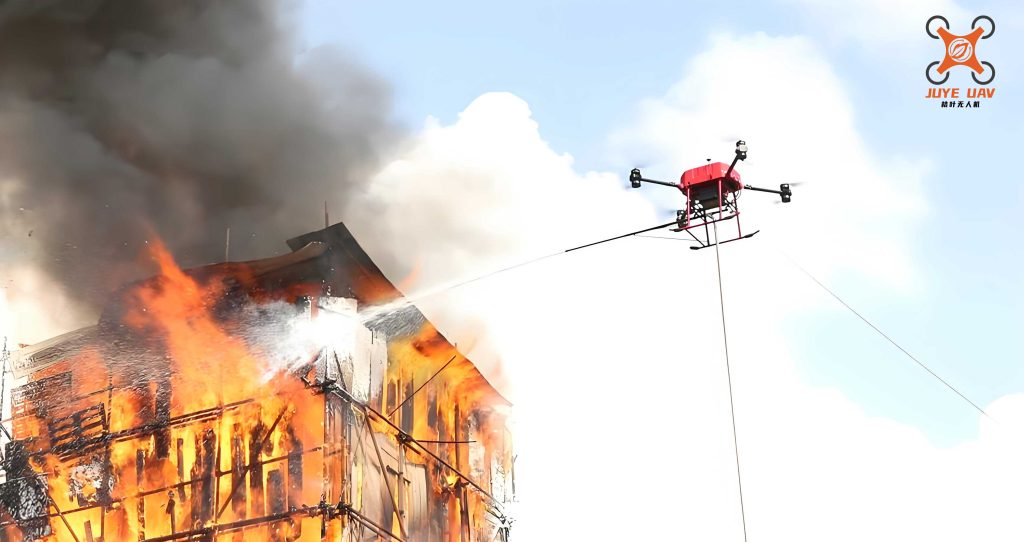
Broadcast Communication Using Fire UAV
In chaotic disaster scenes, audible instructions are vital for guiding victims and coordinating responders. The fire UAV serves as an aerial broadcast platform, equipped with loudspeakers that transmit messages from ground operators. The setup involves a wireless receiver on the fire UAV tuned to a specific frequency, such as 350 MHz, allowing real-time voice relay. The sound pressure level \( L_p \) at a distance \( r \) can be approximated by:
$$L_p = L_w – 20 \log_{10}(r) – 11$$
where \( L_w \) is the sound power level. By flying at optimal altitudes, the fire UAV ensures clear audio coverage over large areas, overcoming ground-level noise. This capability is especially useful in high-rise fires or earthquakes, where traditional megaphones may be ineffective. I have used fire UAV broadcast systems to issue evacuation orders, provide safety tips, and calm panicked crowds, significantly reducing secondary injuries.
Operational Pathways for Fire UAV in Communications
Beyond specific functions, fire UAV technology integrates into broader operational pathways that enhance overall firefighting communications. These pathways include command and control, situational assessment, dynamic monitoring, and efficiency improvement.
Command and Control Enhancement
The fire UAV acts as a mobile command node, relaying real-time data to incident commanders. By providing aerial visuals, the fire UAV enables commanders to oversee rescue operations from a centralized location, reducing the need for risky ground inspections. This pathway involves data fusion from multiple fire UAV units, creating a common operational picture. For instance, video feeds can be overlayed with geographic information system (GIS) maps to identify safe routes and hazards. The integration of fire UAV data into command software allows for automated alerts and resource tracking, streamlining the decision-making process.
Situational Assessment and Detection
Fire UAV systems excel in gathering comprehensive situational data. Equipped with environmental sensors, the fire UAV can measure temperature, gas concentrations, and structural integrity, transmitting this information alongside visual feeds. This multi-modal data collection supports rapid assessment of fire dynamics or disaster impacts. For example, thermal imaging from a fire UAV can map heat distribution in a burning building, using the Stefan-Boltzmann law:
$$j^* = \sigma T^4$$
where \( j^* \) is the radiant emittance, \( \sigma \) is the Stefan-Boltzmann constant, and \( T \) is the absolute temperature. Such data helps predict flashover risks and guide interior attacks. In my experience, this pathway has minimized guesswork and allowed for preemptive measures, such as evacuating areas before collapse.
Dynamic Change Monitoring
Disasters are fluid, and conditions can change rapidly. The fire UAV provides continuous monitoring, tracking developments like fire spread or structural shifts over time. By maintaining a persistent presence, the fire UAV captures time-series data that can be analyzed for trends. This pathway leverages autonomous flight modes, where the fire UAV follows pre-programmed orbits or adjusts based on real-time inputs. The data collected aids in forecasting disaster evolution, enabling proactive adjustments to rescue plans. For instance, by analyzing smoke movement patterns, commanders can anticipate oxygen depletion zones and adjust ventilation strategies.
Communication Efficiency Boost
Fire UAV technology significantly boosts communication efficiency by ensuring stable links in adverse conditions. Traditional radios may suffer from interference or dead zones, but the fire UAV can act as a relay station, extending network coverage. This is achieved through mesh networking, where multiple fire UAV units form a temporary communication grid. The network capacity \( C \) in such a mesh can be estimated using:
$$C = B \log_2 \left(1 + \frac{S}{N}\right)$$
where \( B \) is the bandwidth, \( S \) is the signal power, and \( N \) is the noise power. By carrying voice, video, and data signals simultaneously, the fire UAV reduces latency and packet loss, ensuring that critical messages reach all teams. In complex incidents, this efficiency has prevented miscommunication and accelerated rescue timelines.
Case Study: Carbon Fiber Hexacopter Fire UAV
To illustrate these concepts, I will detail a case study involving a carbon fiber hexacopter fire UAV, which I have deployed in urban fire scenarios. This fire UAV model features six rotors for enhanced stability and payload capacity, making it ideal for communication tasks.
The hexacopter fire UAV is equipped with a modular design, allowing for quick swapping of sensors and communication modules. Its specifications are summarized in the table below:
| Parameter | Value | Description |
|---|---|---|
| Weight | 15 kg | Lightweight for easy transport |
| Flight Time | 45 minutes | Extended operation on single charge |
| Payload | 5 kg | Supports cameras, speakers, sensors |
| Communication Range | 10 km | Line-of-sight with relay capability |
| Sensors | HD camera, thermal imager, gas detector | Multi-functional data collection |
In a typical operation, this fire UAV performs preliminary scouting upon alarm. Using autonomous path planning, it surveys the route to the incident, transmitting live footage to fire trucks en route. This allows drivers to avoid traffic or obstacles, cutting response times by up to 30%. Upon arrival, the fire UAV switches to manual control for detailed inspection, hovering near windows or vents to assess interior conditions. The image transmission system employs both 5G and microwave links; during a high-rise fire, I observed that the dual-stream approach maintained video quality even when public networks were congested, with a pixel resolution drop of less than 10%, which remained acceptable for command purposes.
For broadcast communication, the hexacopter fire UAV carries a compact loudspeaker powered by lithium batteries. In one instance, during a warehouse fire, the fire UAV broadcasted evacuation instructions to workers trapped on upper floors, guiding them to safe exits. The audio clarity was sufficient over distances of 100 meters, thanks to optimal altitude positioning. Additionally, the fire UAV’s ability to monitor dynamic changes proved invaluable when the fire spread to adjacent buildings; real-time thermal data allowed commanders to redeploy resources before the situation escalated.
This case study underscores how a well-designed fire UAV can integrate multiple communication functions into a single platform, enhancing overall operational effectiveness. The hexacopter’s robustness in windy conditions—thanks to its carbon fiber frame—also highlights the reliability aspect of fire UAV systems.
Future Directions and Conclusion
The future of fire UAV technology in firefighting communications is promising, with ongoing advancements in artificial intelligence, swarm coordination, and energy efficiency. As a practitioner, I envision fire UAV swarms working collaboratively to cover larger areas, using algorithms for distributed sensing and communication. For example, swarm intelligence could enable fire UAV units to self-organize into optimal relay networks, maximizing coverage without human intervention. Research into hydrogen fuel cells may extend flight times, allowing fire UAV systems to operate for hours rather than minutes.
Moreover, integration with emerging technologies like the Internet of Things (IoT) could see fire UAV units interfacing with smart buildings to access structural data or with wearable devices to locate trapped individuals. Standardization of communication protocols will also be crucial to ensure interoperability between different fire UAV models and existing infrastructure.
In conclusion, the fire UAV has emerged as a transformative tool in firefighting communications, addressing critical challenges through its mobility, comprehensive vision, and reliability. By enabling preliminary scouting, real-time image transmission, and effective broadcast communication, the fire UAV enhances command and control, situational assessment, dynamic monitoring, and overall efficiency. The case study of the carbon fiber hexacopter illustrates these benefits in practice. As technology evolves, the fire UAV will undoubtedly play an even greater role in saving lives and protecting property. I urge fire departments worldwide to invest in and adopt fire UAV systems, fostering innovation that pushes the boundaries of what is possible in emergency response.
Through continuous refinement and application, the fire UAV stands as a testament to human ingenuity in the face of disaster, ensuring that communication—the lifeline of rescue operations—remains strong and resilient.