
As a firefighting technology specialist, I have witnessed firsthand the transformative impact of unmanned aerial vehicles, particularly fire UAVs, in enhancing our ability to respond to emergencies. The integration of fire UAVs into firefighting and rescue workflows represents a paradigm shift, offering unprecedented capabilities in situational awareness, operational safety, and mission efficiency. In this comprehensive analysis, I will delve into the principles, technological advantages, and practical applications of fire UAVs, supported by quantitative models and systematic summaries. The core keyword, ‘fire UAV,’ will be emphasized throughout to underscore its centrality in modern fire service evolution.
The devastating nature of fire incidents demands rapid, precise, and safe intervention. Traditional firefighting approaches, while valiant, often encounter limitations in complex environments such as high-rise buildings, chemical plants, or wildland interfaces. Fire UAVs, or unmanned aerial vehicles specifically designed for fire service use, have emerged as a critical force multiplier. These systems eliminate direct human risk in hazardous zones and provide real-time data that is otherwise unattainable. The adoption of fire UAV technology is not merely an upgrade; it is a necessary evolution to address increasingly intricate fire scenarios and protect both responders and the public.
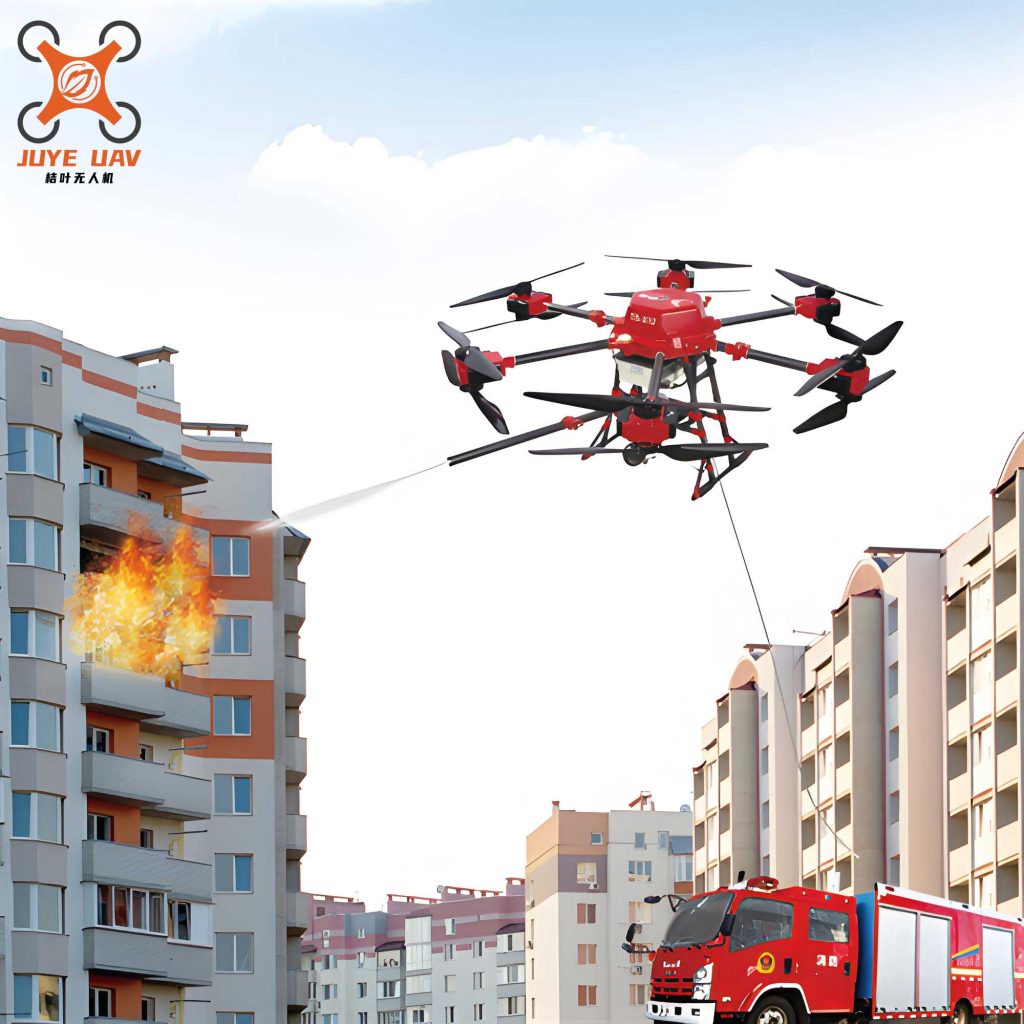
To understand the value of a fire UAV, one must first grasp its fundamental nature. A fire UAV is an aircraft that operates without an onboard human pilot, relying on a combination of aeronautical engineering and advanced information technology. Its design often incorporates principles from helicopter aerodynamics, allowing for vertical take-off and landing (VTOL) and stable hovering—capabilities essential for close-range inspection and persistent monitoring. The operational core of a modern fire UAV is its remote control and data transmission system, which enables firefighters to pilot the device from a safe distance while receiving live video, thermal imaging, and sensor data. This fusion of mechanics and digital intelligence forms the backbone of its utility in fireground operations.
The operational principles of a fire UAV in rescue contexts are rooted in its flexibility and controllability. The lift generation can be modeled using basic rotor dynamics. For a multi-rotor fire UAV, the total thrust T required to hover is given by:
$$ T = n \cdot k \cdot \omega^2 $$
where n is the number of rotors, k is a thrust coefficient dependent on rotor design, and \omega is the angular velocity of the rotors. This allows the fire UAV to achieve precise altitude control. Furthermore, its stability in hover is crucial for data acquisition. The data pipeline involves onboard sensors capturing information (e.g., video feed V(t), thermal data \Theta(x,y)), which is transmitted via a secure link to a central command platform. The effectiveness of this transmission, crucial for decision-making, can be expressed as a function of bandwidth B and latency L:
$$ \text{Data Utility } U = \int_{0}^{t} \frac{f(B, V(t), \Theta)}{L + \delta} \,dt $$
where \delta represents processing delay. This seamless flow of information is what empowers commanders on the ground.
The technological advantages of deploying a fire UAV are multifaceted and profound. The following table summarizes the core technological superiorities of a modern fire UAV system:
| Advantage Category | Key Features | Operational Impact |
|---|---|---|
| Intelligent Operation | Waypoint Navigation, Visual Tracking, Obstacle Perception & Avoidance | Enables autonomous, precise, and safe flight in complex environments, reducing operator cognitive load. |
| Search and Rescue Reliability | All-weather capability, resistance to toxic atmospheres, extended endurance. | Allows access to areas prohibitive for human responders, ensuring continuous operation in hazardous conditions. |
| Expansive Field of View | 360-degree rotating high-definition and infrared (IR) cameras, wide-angle lenses. | Provides comprehensive, real-time situational overview and enables victim detection through smoke and darkness. |
| Flexible Maneuverability | Small form factors, agile flight dynamics, ability to navigate tight spaces. | Permits interior reconnaissance in structural fires and precise positioning for targeted intervention. |
The intelligence of a fire UAV operation is perhaps its most significant leap forward. Through sophisticated algorithms, a fire UAV can execute complex tasks with minimal direct input. Waypoint flying, or point-to-point autonomous navigation, allows a fire UAV to be directed simply by tapping a location on a digital map derived from its live feed. The navigation algorithm can be conceptualized as solving a path optimization problem:
$$ \min_{P} \left( \sum_{i} d(p_i, p_{i+1}) + \alpha \cdot \text{ObstacleRisk}(P) \right) $$
where P is the path sequence of points p_i, d is the distance function, and the term weighted by \alpha penalizes proximity to obstacles. This ensures the fire UAV reaches its target, such as a specific fire seat, efficiently and safely.
Visual tracking is another intelligent feature where a fire UAV can lock onto and follow a moving object or expanding fire front. Using computer vision, the system identifies features in the video stream. The tracking performance can be modeled by the stability of the tracking loop’s error signal e(t). A proficient fire UAV system minimizes this error:
$$ e(t) = \| \text{TargetPosition}_{estimated}(t) – \text{TargetPosition}_{true}(t) \| $$
Effective tracking allows the fire UAV to monitor the dynamic progression of a fire or follow a fleeing victim for assessment, providing invaluable continuous intelligence.
Perception and obstacle avoidance are enabled by a suite of sensors like LiDAR, ultrasonic, and visual cameras. The fire UAV’s control system continuously fuses this sensor data to create a local map M and computes a repulsive field F_{rep} around obstacles to adjust its trajectory. A simple model for the avoidance vector \vec{V}_{avoid} can be:
$$ \vec{V}_{avoid} = – \sum_{o \in M} \nabla \left( \frac{\eta}{(\text{dist}(o))^2} \right) $$
where \eta is a scaling constant and dist(o) is the distance to obstacle o. This capability is indispensable for operating a fire UAV within collapsed structures or dense urban environments.
The reliability of a fire UAV in search missions is quantifiable. While human search teams are constrained by physiology and safety protocols, a fire UAV can operate in environments with extreme heat, low visibility, or toxic gas concentrations. Its mission reliability R_{UAV} over time t in a hazardous zone can be contrasted with human team reliability R_{human}. Often,
$$ R_{UAV}(t) = e^{-\lambda_{UAV} t} $$ and $$ R_{human}(t) = e^{-(\lambda_{h} + \lambda_{env}) t} $$
where \lambda_{UAV} is the mechanical failure rate, while \lambda_{h} and \lambda_{env} represent human fatigue and environmental hazard rates, respectively. For substantial \lambda_{env} (e.g., in a chemical fire), the fire UAV’s reliability dominates, making it the superior tool for initial reconnaissance.
The expansive visual coverage provided by a fire UAV’s camera systems dramatically improves situation assessment. A single fire UAV equipped with a 360-degree pan-tilt-zoom (PTZ) camera and an IR sensor can monitor an area A approximated by:
$$ A \approx 2 \pi h \cdot \tan(\theta/2) $$
for a given altitude h and camera horizontal field-of-view angle \theta. This area coverage is achieved without moving the platform, allowing for persistent, wide-area surveillance that would require multiple ground personnel.
The flexible mobility of various fire UAV models, from large heavy-lift platforms to micro-UAVs, allows for tailored responses. The turning radius r of a small fire UAV is a function of its airspeed v and maximum bank angle \phi:
$$ r = \frac{v^2}{g \tan \phi} $$
For micro fire UAVs, v is low and \phi can be high due to agile control systems, resulting in a very small r. This enables the fire UAV to navigate through broken windows, ventilation shafts, or between close structural members, places completely inaccessible to humans or larger equipment.
The practical application pathways for a fire UAV are diverse and impactful. They can be systematically categorized to understand their full scope. The table below outlines the primary application domains and specific functions of a fire UAV.
| Application Domain | Specific Functions | Typical Fire UAV Payloads | Expected Outcome |
|---|---|---|---|
| Direct Auxiliary Rescue | Extinguishing agent delivery, aerial lifeline/escape route setup, payload drop (survival gear), voice guidance. | Water/foam cannons, loudspeakers, winches with ropes, drop pods for supplies. | Direct mitigation of threat, victim extraction, and life support before human team arrival. |
| Fireground Monitoring & Surveillance | Real-time video/IR streaming, perimeter security monitoring, progress tracking of fire spread and suppression efforts. | High-definition EO/IR dual-sensor cameras, gas detectors, GPS. | Enhanced command and control, data for live tactical adjustments, and post-incident analysis. |
| Comprehensive Fire Scene Reconnaissance | Initial size-up, interior/exterior inspection, hazard identification (e.g., BLEVE risks), victim location, environmental parameter measurement. | EO/IR cameras, LiDAR for 3D mapping, multi-gas sensors, anemometers. | Rapid, accurate risk assessment, informed resource deployment, predictive modeling of fire behavior, and public warning. |
In auxiliary rescue, the fire UAV transitions from a passive observer to an active intervention platform. For instance, a heavy-lift fire UAV can carry a suppressant payload. The effectiveness of a water drop from a fire UAV can be modeled by considering the droplet dispersion and heat absorption. The rate of heat removal Q might be approximated as:
$$ Q = \dot{m} \cdot c_w \cdot \Delta T + \dot{m} \cdot L_v $$
where \dot{m} is the mass flow rate of water, c_w is the specific heat of water, \Delta T is the temperature change, and L_v is the latent heat of vaporization. While a single fire UAV’s capacity is limited compared to a fire hose, its ability to apply suppressant precisely to the base of a flame in an inaccessible location (e.g., a rooftop) is unique. Furthermore, a swarm of coordinated fire UAVs could establish a temporary aerial bridge or deliver multiple rescue lines, increasing the collective rescue capacity C_{swarm} linearly or super-linearly with the number N of units: C_{swarm} \propto N^{\beta}, where \beta \geq 1.
For fireground monitoring, the fire UAV acts as a persistent eye in the sky. The value of this monitoring is in the timeliness and quality of information. If we define a situational awareness metric SA(t) for the incident commander, the contribution \Delta SA_{UAV} from the fire UAV feed can be significant:
$$ \Delta SA_{UAV}(t) = \gamma \cdot \text{InfoQuality}(t) \cdot \text{InfoSpeed}(t) $$
where \gamma is a relevance factor, and the quality and speed are functions of the fire UAV’s sensor suite and data link. High \Delta SA directly translates to more effective and efficient deployment of ground crews and resources, optimizing the overall response function.
Reconnaissance is perhaps the most immediate and widely adopted use for a fire UAV. Upon arrival, a fire UAV can be deployed in seconds to perform a 360-degree size-up. The data collected feeds into predictive fire modeling. For example, using wind speed W and direction data from the fire UAV’s anemometer, along with fuel load estimates from visual and IR imagery, simple fire spread models like Rothermel’s surface fire spread model can be initialized in near real-time. The rate of spread R can be a key output:
$$ R = \frac{I_R \cdot \xi \cdot (1+\phi_W)}{\rho_b \cdot \epsilon \cdot Q_{ig}} $$
where I_R is reaction intensity, \xi is propagating flux ratio, \phi_W is wind factor, \rho_b is fuel bulk density, \epsilon is effective heating number, and Q_{ig} is heat of preignition. While full model computation is complex, a fire UAV provides the critical real-world inputs (W, fuel imagery) that allow simplified forecasting, helping commanders anticipate fire growth and plan containment lines proactively. Moreover, the fire UAV can simultaneously broadcast warnings to civilians via its loudspeaker, creating an immediate safety perimeter.
The integration of a fire UAV into standard operating procedures is an ongoing process that requires training, protocol development, and technological refinement. Future advancements in artificial intelligence will further enhance the autonomous decision-making capabilities of the fire UAV. Swarm intelligence, where multiple fire UAVs communicate and cooperate, promises to revolutionize large-scale incident management. Battery technology and hybrid power systems will extend the endurance of the fire UAV, making it a persistent asset throughout long operations. The continuous evolution of sensor miniaturization will allow even smaller fire UAV platforms to carry sophisticated diagnostic tools, making interior search and rescue in structural collapses more thorough and less risky.
In conclusion, the adoption and sophisticated utilization of the fire UAV is a cornerstone for the future of firefighting and technical rescue. As a tool, the fire UAV extends our senses, augments our strength, and protects our personnel. It transforms unknown, high-risk environments into mapped, managed operational spaces. The quantitative advantages in speed, coverage, and safety it provides are compelling. From initial reconnaissance to active suppression and victim aid, the fire UAV has proven its worth across the entire incident lifecycle. As technology progresses, the role of the fire UAV will only deepen, becoming an indispensable, intelligent partner in our relentless mission to save lives and protect property from the ravages of fire. The strategic investment in and development of fire UAV capabilities is not just a technical choice but an ethical imperative to maximize our effectiveness in serving the public.