
In my years of research and practical experience in firefighting and emergency response, I have witnessed a dramatic shift in how technology is leveraged to save lives and mitigate disasters. The rapid advancement of modern science and technology has ushered in an era where unmanned aerial vehicles, or UAVs, have become ubiquitous across various sectors. Among these, the application of fire UAV in firefighting and rescue work stands out as a particularly promising and transformative development. The challenges faced by firefighters in scenarios like high-rise building fires, hazardous chemical leaks, and natural disasters such as floods are immense. Often, these situations prevent personnel from approaching or entering the disaster site directly, thereby hampering rescue efforts and putting teams under severe strain. This article, drawn from my firsthand observations and analysis, delves into the utilization of fire UAV in firefighting and rescue operations. I will explore the principles and technical advantages of fire UAV, elaborate on their practical applications in firefighting contexts, and outline the future requirements for fire UAV technology in enhancing our firefighting capabilities.
To understand the impact of fire UAV, it is essential to first define what a UAV is. A UAV, or Unmanned Aerial Vehicle, commonly known as a drone, is an aircraft that operates without a human pilot onboard. It is controlled remotely via radio equipment or autonomously through pre-programmed flight plans. The scope of UAVs is broad, encompassing various designs such as unmanned helicopters, fixed-wing aircraft, multi-rotor crafts, unmanned airships, and parawing gliders. In a broader sense, it also includes near-space vehicles operating at altitudes of 20 to 100 kilometers, like stratospheric airships, high-altitude balloons, and solar-powered UAVs. From my perspective, a fire UAV can be considered an “aerial robot” capable of performing complex flight missions and carrying diverse payloads under unmanned conditions. This versatility makes the fire UAV a critical tool in modern firefighting. Below is a table summarizing common types of UAVs relevant to firefighting applications:
| UAV Type | Key Features | Typical Fire UAV Applications |
|---|---|---|
| Multi-rotor (e.g., Quadcopter) | Vertical take-off and landing, hovering capability, high maneuverability | Close-range inspection, real-time monitoring, payload delivery in confined spaces |
| Fixed-wing | Long endurance, high speed, large area coverage | Large-scale disaster assessment, mapping, and surveillance over extended areas |
| Unmanned Helicopter | Heavy payload capacity, stable flight in adverse conditions | Transporting fire suppression agents, deploying rescue equipment |
| Hybrid VTOL | Combines vertical take-off with fixed-wing efficiency | Versatile operations requiring both hover and long-range flight |
The working principle of a fire UAV is fundamentally rooted in the aerodynamics of rotorcraft, particularly for multi-rotor systems which are prevalent in firefighting due to their flexibility. A fire UAV typically consists of three core systems: the aircraft platform, the information acquisition system (sensors and cameras), and the ground control system. The aerodynamic lift is generated by rotating propellers, governed by principles that can be expressed through the lift equation:
$$L = \frac{1}{2} \rho v^2 S C_L$$
where \(L\) is the lift force, \(\rho\) is the air density, \(v\) is the velocity of air over the airfoil, \(S\) is the wing area (or rotor disk area), and \(C_L\) is the lift coefficient. For a multi-rotor fire UAV, precise control of motor speeds allows for stable hovering, vertical ascent/descent, and agile maneuvering. The onboard sensors, such as high-resolution cameras with pan-tilt-zoom capabilities, capture real-time imagery. This data is transmitted wirelessly to the ground station, enabling operators to remotely pilot the fire UAV and assess the situation. This capability addresses limitations of traditional methods like satellite遥感, which can be obstructed by clouds or have long revisit cycles, thus providing immediate situational awareness crucial for emergency response.
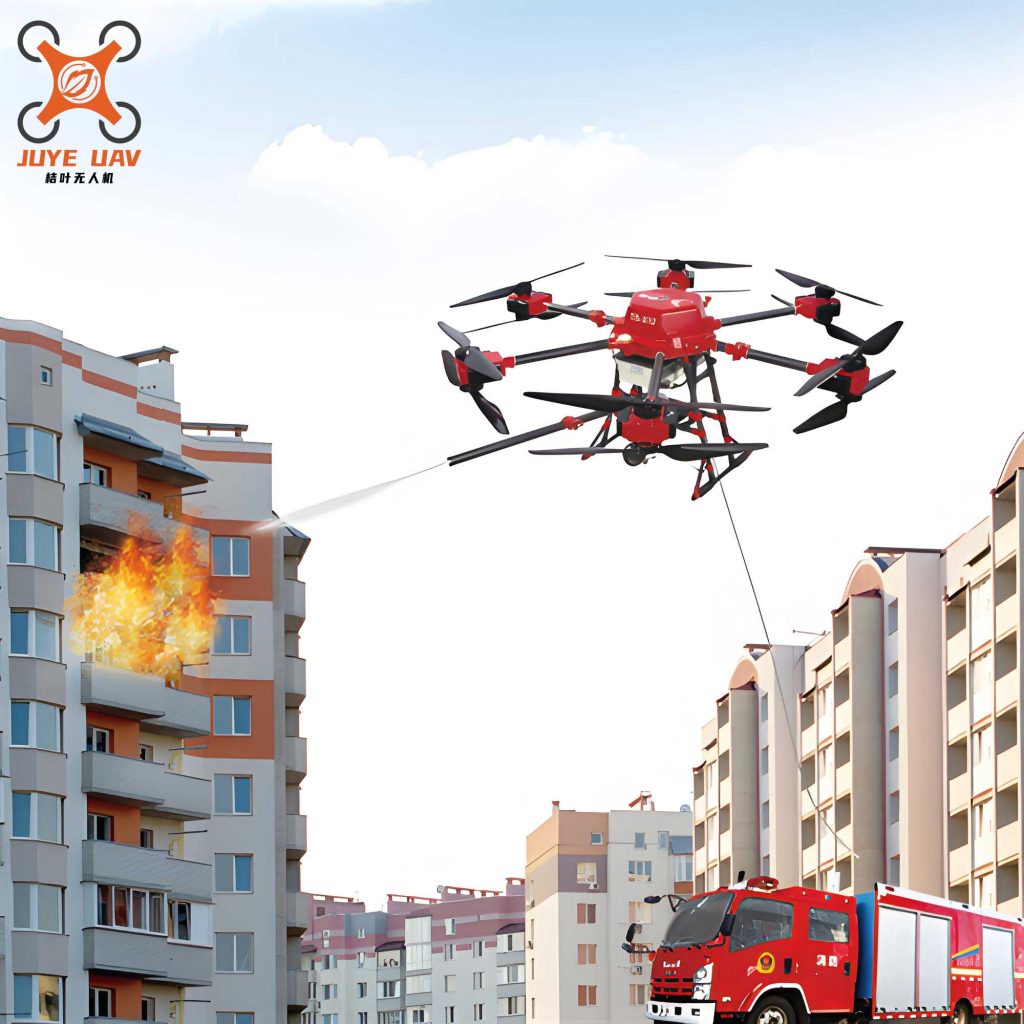
In my analysis, the integration of advanced sensors in a fire UAV allows for data fusion, enhancing decision-making. For instance, combining visual data with thermal imaging can be modeled as:
$$I_{fused}(x,y) = \alpha I_{visual}(x,y) + \beta I_{thermal}(x,y)$$
where \(I_{fused}\) is the fused image, \(I_{visual}\) and \(I_{thermal}\) are the visual and thermal image intensities, and \(\alpha\) and \(\beta\) are weighting coefficients optimized for fire detection. This technological synergy is what makes the fire UAV so effective.
The advantages of modern fire UAV technology are multifaceted, as I have observed in both simulations and real-world deployments. Firstly, fire UAV exhibit exceptional mobility. Most fire UAV models are lightweight, often under 116 kg, and can be operated by just one or two personnel. They can be transported on foot to inaccessible areas and require minimal take-off space. Their flight dynamics allow for sharp turns and responsive control, which is vital in complex disaster environments. Secondly, fire UAV provide an expansive field of view. Equipped with wide-angle or 360-degree cameras, a fire UAV can capture comprehensive visuals, even in low-light or obscured conditions when augmented with infrared or thermal imaging. Thirdly, fire UAV enhance reliability in search and rescue. They can operate in hazardous conditions—such as toxic atmospheres, explosive risks, or extreme weather—where human entry is perilous, thus ensuring continuous monitoring without risking lives. Lastly, fire UAV are becoming increasingly intelligent. With features like obstacle sensing, intelligent tracking, and waypoint navigation, a fire UAV can perform autonomous missions, reducing operator burden and increasing efficiency. To quantify these advantages, consider the following table summarizing key benefits:
| Advantage | Description | Operational Impact | Example Metric |
|---|---|---|---|
| Mobility | Small size, agile flight, easy deployment | Rapid response in congested or remote areas | Turn radius as low as 2 meters |
| Visual Coverage | High-resolution cameras, IR/thermal sensors | Comprehensive situational awareness | Up to 4K video resolution, 360° pan |
| Reliability | Operates in extreme/hazardous conditions | Continuous surveillance in unsafe zones | Operational in temperatures from -20°C to 60°C |
| Intelligence | Autonomous flight, obstacle avoidance, AI integration | Reduced human error, efficient mission execution | Obstacle detection range up to 30 meters |
Moreover, the endurance of a fire UAV, though currently limited by battery technology, can be analyzed using the formula for flight time:
$$T = \frac{C \cdot V}{P}$$
where \(T\) is the flight time, \(C\) is the battery capacity (in Ah), \(V\) is the voltage, and \(P\) is the average power consumption. Innovations in battery tech, such as燃料电池, are crucial for extending \(T\), a point I will revisit later.
In practical firefighting and rescue operations, the applications of fire UAV are diverse and impactful. Based on my studies, I categorize them into three main areas: disaster reconnaissance, real-time monitoring, and auxiliary rescue support. For disaster reconnaissance, a fire UAV can swiftly survey areas affected by earthquakes, fires, or floods, especially when terrain is impassable. It collects critical data—such as thermal hotspots, structural integrity, or gas concentrations—transmitting it back for analysis. This allows commanders to identify root causes and plan interventions without endangering personnel. For instance, in a chemical leak, a fire UAV equipped with gas sensors can measure concentration levels using models like:
$$C(x,y,t) = \frac{Q}{4\pi D t} \exp\left(-\frac{(x-x_0)^2 + (y-y_0)^2}{4Dt}\right)$$
where \(C\) is concentration, \(Q\) is source strength, \(D\) is diffusion coefficient, and \((x_0, y_0)\) is the leak point. This data guides evacuation and containment strategies.
For real-time monitoring, a fire UAV provides continuous footage of evolving disaster scenes, enabling dynamic resource allocation. In large-scale incidents like forest fires, a fire UAV can track fire spread, helping predict its trajectory using computational models. For auxiliary rescue, a fire UAV can deliver payloads such as life vests, communication devices, or even fire retardants. It can also assist in setting up rescue lines or providing lighting. The versatility of fire UAV in these roles is summarized in the table below:
| Application Scenario | Fire UAV Role | Typical Payload/Function | Key Benefit |
|---|---|---|---|
| High-rise Building Fire | Reconnaissance and monitoring | Thermal cameras, gas sensors | Assess internal conditions without entry |
| Hazardous Chemical Incident | Hazard detection and mapping | Multi-gas detectors, spectral analyzers | Real-time chemical analysis from safe distance |
| Natural Disaster (Flood, Earthquake) | Search and rescue, damage assessment | HD cameras, IR sensors, loudspeakers | Locate survivors, map affected areas |
| Wildland Fire | Fire spread monitoring and suppression support | Thermal imagers, payload drops (retardant) | Track fire front, deliver suppression agents |
| Urban Search and Rescue | Structural inspection and communication relay | LiDAR, two-way audio, mesh networking | Navigate rubble, establish comms links |
Furthermore, the integration of fire UAV with other technologies, such as AI for image recognition, enhances these applications. For example, a fire UAV can use machine learning algorithms to automatically detect humans in debris, with accuracy given by:
$$Accuracy = \frac{TP + TN}{TP + TN + FP + FN}$$
where \(TP\), \(TN\), \(FP\), and \(FN\) are true positives, true negatives, false positives, and false negatives, respectively. This boosts the efficiency of search operations.
Looking ahead, the future of fire UAV in firefighting demands several key improvements, as I have identified through trend analysis. First, fire UAV must enhance their resilience to natural environments. They need to operate reliably in high winds, rain, extreme temperatures, and smoky conditions. This requires robust design and advanced materials. For instance, the aerodynamic stability in wind can be modeled using the drag equation:
$$D = \frac{1}{2} \rho v^2 C_D A$$
where \(D\) is drag force, \(C_D\) is drag coefficient, and \(A\) is cross-sectional area. Improving \(C_D\) through streamlined designs can help. Second, fire UAV require better compatibility and integration. As payloads diversify—from sensors to extinguishing agents—the fire UAV platform must support modular systems without performance degradation. This involves standardizing interfaces and ensuring software interoperability. Third, operator training is crucial. With regulations mandating certification for UAV pilots, fire departments must invest in systematic training programs to ensure personnel are proficient in fire UAV operation and maintenance. Fourth, payload capacity must increase to carry heavier rescue equipment or larger quantities of suppressants. The relationship between payload weight \(W_p\) and flight time \(T\) can be expressed as:
$$T = \frac{E_{batt}}{P_0 + k W_p}$$
where \(E_{batt}\) is battery energy, \(P_0\) is base power, and \(k\) is a proportionality constant. Enhancing \(E_{batt}\) or reducing \(k\) through efficient motors is key. Fifth, battery endurance remains a critical hurdle. While current lithium-polymer batteries offer limited flight times, alternatives like hydrogen fuel cells promise longer endurance, with energy density \(\eta\) given by:
$$\eta = \frac{E}{m}$$
where \(E\) is energy and \(m\) is mass. Higher \(\eta\) directly extends fire UAV mission duration. The table below outlines these future requirements and potential solutions:
| Requirement | Current Challenge | Future Solution | Expected Impact on Fire UAV |
|---|---|---|---|
| Environmental Resistance | Limited operation in high winds, rain, smoke | Advanced materials, sealed designs, anti-icing systems | Operational in 7-8级 winds, full weatherproofing |
| System Compatibility | Fragmented payload interfaces, software conflicts | Standardized protocols (e.g., STANAG 4586), open APIs | Seamless integration of diverse sensors and tools |
| Operator Expertise | Lack of certified pilots, limited training | Mandatory certification programs, simulation-based training | Skilled personnel maximizing fire UAV potential |
| Payload Capacity | Limited lift capability restricts utility | Improved aerodynamics, hybrid propulsion, larger platforms | Ability to carry 50+ kg of rescue/firefighting gear |
| Battery Endurance | Short flight times (20-30 minutes typically) | Fuel cells, solar augmentation, wireless charging | Flight times extended to 2+ hours for sustained ops |
In my view, addressing these requirements will involve collaborative research across aerospace, robotics, and fire science disciplines, ensuring that fire UAV evolve to meet the growing demands of emergency response.
In conclusion, the integration of fire UAV into firefighting and rescue represents a paradigm shift in how we approach disaster management. From my perspective, the fire UAV is not merely a tool but a force multiplier that enhances safety, efficiency, and effectiveness in critical operations. As fire UAV technology continues to advance—with improvements in autonomy, resilience, and payload versatility—its role will expand, becoming indispensable in combating各类灾害. I am confident that by embracing these innovations, fire departments worldwide will be better equipped to protect lives and property, ultimately creating a safer and more responsive emergency services framework. The journey of the fire UAV is just beginning, and its potential to revolutionize firefighting is boundless, promising a future where technology and human expertise synergize to overcome even the most daunting challenges.