
In recent years, the rapid advancement of unmanned aerial vehicle (UAV) systems, coupled with improvements in data application and remote sensing technologies, has led to their significant integration into firefighting and emergency response operations. The traditional ground-based communication infrastructure, while offering broad coverage, often fails catastrophically in disaster scenarios such as large-scale fires, earthquakes, or floods. Satellite communication, though less susceptible to local environmental damage, typically requires specialized, costly equipment that is not universally accessible or rapidly deployable by first responder teams. In this context, the fire UAV emerges as a revolutionary tool, offering aerial reconnaissance, real-time situational awareness transmission, and logistical support. By providing comprehensive, accurate, and timely information from the disaster epicenter, fire UAV systems furnish command centers with the critical data necessary for informed decision-making, thereby enhancing operational efficacy and safety.
The deployment of fire UAV technology addresses a fundamental gap in emergency response. Its inherent capabilities for patrolling, surveillance, and real-time data relay transform the information landscape for incident commanders. This article delves into the defining characteristics of firefighting emergency communication, explores the multifaceted applications of fire UAVs in this domain, and presents a forward-looking analysis of their developmental trajectory, supported by technical models and comparative frameworks.
Characteristics of Firefighting Emergency Communication
Fire and rescue operations impose unique and stringent demands on communication systems, primarily defined by two core attributes: real-time performance and reliability.
1.1 Real-Time Performance
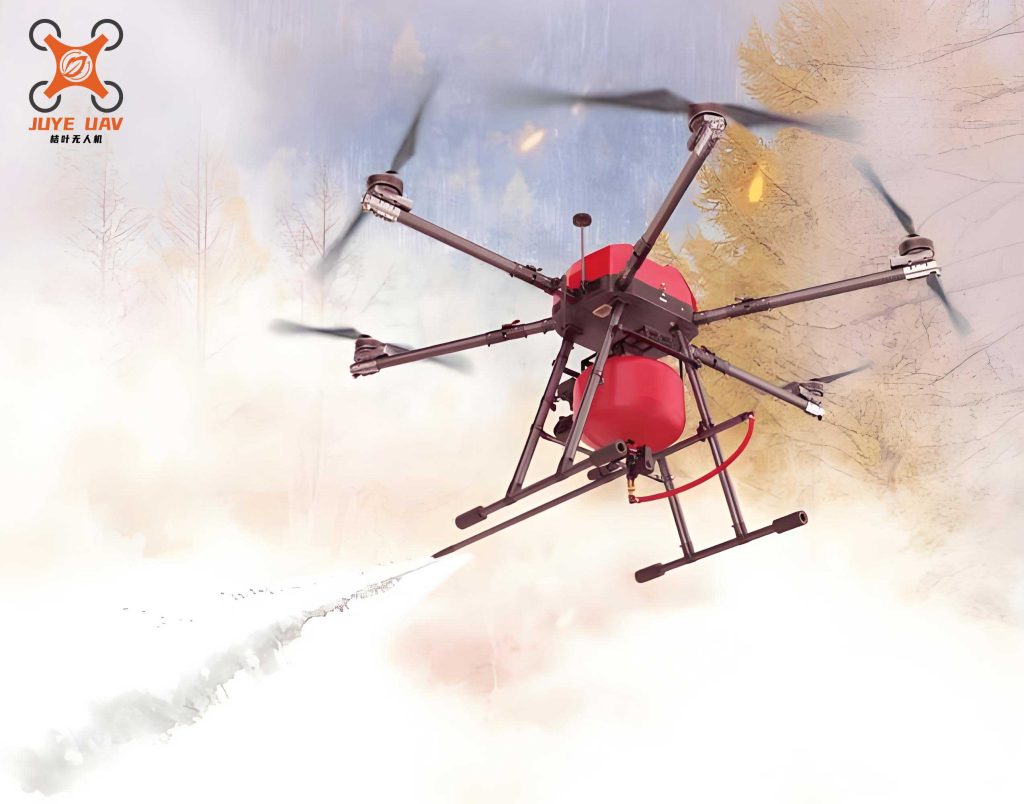
The mission of fire emergency communication is directly tied to the preservation of life and property. Consequently, the real-time nature of communication保障 is paramount. Visual, auditory, and data information from the disaster site must be transmitted to command and control agencies at all levels with minimal latency. Any delay can lead to misinformed decisions with potentially grave consequences. Therefore, establishing a robust, mesh-like应急 communication network from the point of incident outward is essential. This network ensures seamless information flow, facilitating coordinated rescue efforts. The fire UAV acts as a dynamic, airborne node within this network, rapidly establishing communication links where ground infrastructure is compromised.
The requirement for real-time data can be quantified. Let the total latency \( T_{total} \) be defined as the sum of acquisition time \( T_{acq} \), processing time \( T_{proc} \), transmission time \( T_{trans} \), and decision assimilation time \( T_{assim} \):
$$ T_{total} = T_{acq} + T_{proc} + T_{trans} + T_{assim} $$
For effective emergency response, \( T_{total} \) must be minimized. A fire UAV system directly reduces \( T_{acq} \) by providing immediate aerial access and can optimize \( T_{trans} \) through direct line-of-sight data links or by acting as a relay, bypassing damaged infrastructure.
1.2 Reliability and Resilience
Firefighters operate in inherently perilous and unpredictable environments: high-rise buildings, dense urban areas, subterranean structures, and petrochemical plants. Communication in these theaters is challenged by numerous factors:
- Physical Obstacles: Difficulty in deploying ground equipment.
- Environmental Interference: Extreme heat, water immersion, and structural collapse.
- Signal Degradation: Noise, electromagnetic interference from flames, and signal blockage by dense structures.
- Extreme Weather: Operations during typhoons, heavy rain, or blizzards.
The fire UAV provides a unique advantage in mitigating these challenges, enhancing operational safety for personnel. Furthermore, UAVs with sufficient payload capacity can perform rapid logistics, delivering critical supplies like ropes, breath masks, or medical kits directly to trapped individuals or isolated teams, thereby augmenting on-scene rescue capabilities beyond mere communication.
| Method | Real-Time Capability | Reliability in Disaster Zones | Deployment Speed | Cost & Accessibility | Role of Fire UAV |
|---|---|---|---|---|---|
| Ground-Based Networks | High (if intact) | Low (easily damaged) | Fixed | Low (operational) | N/A (often unavailable) |
| Satellite Communication | Medium (potential latency) | High | Slow (setup required) | High | Can integrate terminals as payload |
| Ad-hoc Mesh Radio | High (short-range) | Medium (line-of-sight limited) | Fast (portable) | Medium | Acts as aerial node to extend range |
| Fire UAV System | Very High | High (mobile, adaptable) | Very Fast | Medium (decreasing) | Core platform for sensing and relaying |
Applications of Fire UAVs in Emergency Communication保障
The utility of the fire UAV in消防应急通信保障 is not monolithic but spans a spectrum of critical functions, from basic reconnaissance to complex communication network extension.
2.1 Multi-Channel Audio-Video Communication
This constitutes the foundational application. Modern fire UAVs are integrated into消防指挥调度 networks, equipped with high-definition gimbaled cameras, thermal imaging sensors, and audio equipment. The real-time transmission of panoramic video and audio feeds to the command center provides an unprecedented “eye in the sky,” enabling commanders to assess火场态势, track the progression of hazards, and monitor the safety of their teams.
The technical architecture typically involves the fire UAV transmitting encoded video/audio streams via a dedicated radio link (e.g., COFDM) or cellular networks (4G/5G) to a ground control station. This data is then routed through secure gateways to the integrated image management platform. The use of multiple fire UAVs allows for simultaneous multi-point coverage, creating a composite, real-time operational picture that significantly enhances situational awareness and command efficiency.
2.2 Large-Area Remote Sensing, Monitoring, and Emergency Lighting
For disasters covering extensive geographical areas, such as forest fires or post-earthquake assessments, broad-area surveillance is crucial. While satellite遥感 offers wide coverage, fire UAV-based remote sensing provides superior temporal resolution and flexibility. Challenges historically associated with UAV遥感 include platform instability (vibration, tilt), limited payload capacity, and lower accuracy compared to manned aircraft. However, strategies involving swarms of coordinated, lower-cost UAVs can overcome these limitations.
By deploying a fleet of fire UAVs, data collection becomes multi-point and redundant. Advanced data fusion algorithms and photogrammetric techniques can correct for individual platform errors, yielding highly accurate orthomosaics, 3D models, and thematic maps (e.g., heat maps from thermal data). The processing can be modeled. For a UAV swarm of \( n \) units, the total effective monitoring area \( A_{total} \) and data accuracy correction factor \( \delta \) can be related:
$$ A_{total}(t) = \sum_{i=1}^{n} v_i \cdot r_i \cdot t \cdot \eta_i $$
$$ \delta \approx 1 – \prod_{i=1}^{n} (1 – \alpha_i) $$
where \( v_i \) is velocity, \( r_i \) is sensor swath width, \( t \) is time, \( \eta_i \) is coverage efficiency, and \( \alpha_i \) is the base accuracy of a single unit’s data. The product formula for \( \delta \) shows how swarm redundancy mitigates individual error.
Furthermore, fire UAVs equipped with high-lumen LED arrays and autonomous generators can provide powerful aerial lighting for nighttime operations, illuminating large search and rescue areas or specific structural zones, effectively extending operational hours.
| Payload Type | Specific Device | Primary Function | Communication Role |
|---|---|---|---|
| Visual Sensors | Zoom Camera, Thermal Imager, Multispectral Sensor | Situational Awareness, Victim/热点 Detection | Provides visual data stream |
| Audio Devices | Directional Microphone, Loudspeaker | Listening to survivors, Broadcasting instructions | Provides audio I/O channel |
| Communication Relay | LTE/5G Picocell, Mesh Network Radio, Satellite Modem | Extending Network Coverage | Acts as aerial base station or router |
| Logistics & Support | Payload Release Mechanism, Emergency Supply Canister | Delivering生命保障 Equipment | Enables physical “communication” of aid |
| Illumination | High-Power Searchlight | Nighttime Operations照明 | Enables visual communication and work |
2.3 Aerial Material Delivery and Public Address
In scenarios where victims are isolated in高空, confined, or chaotic environments, establishing a direct line of communication and supply is vital. A fire UAV can be outfitted with a loudspeaker for broadcasting evacuation instructions or safety information and a directional microphone to capture responses from survivors. Linked to the command center via its communication payload, it becomes a two-way communication node.
More tangibly, the fire UAV‘s delivery function is lifesaving. It can accurately transport critical items—such as respirators, life jackets, ropes, medicine, food, and water—to pinpoint locations unreachable by traditional means like throw lines. In water or mountain rescues, UAVs can deploy a light pilot line with high precision, which can then be used to pull across heavier ropes or cables, establishing a physical rescue channel.
2.4 Indoor Navigation and Personnel Guidance Using Communication Facilities
Indoor firefighting is exceptionally dangerous, accounting for a significant proportion of firefighter casualties. Communication and navigation inside structure fires, characterized by dense smoke, extreme heat, and complex layouts, are profoundly challenging. Fire UAVs, particularly small, agile models, are being developed to penetrate such environments. Key enabling technologies include:
- Vision-Based Navigation and SLAM (Simultaneous Localization and Mapping): Using onboard cameras, LiDAR, and ultrasonic sensors, the UAV构建s a real-time map of the unknown interior while tracking its own position, allowing it to avoid obstacles and navigate autonomously.
- Person-Following Modes: A fire UAV can be programmed to follow a firefighter carrying a GPS/Wi-Fi/Bluetooth beacon. This creates a persistent communication link between the frontline responder and the outside, transmitting video of the path ahead and the responder’s condition.
- Autonomous Search and Guidance: Pre-programmed with basic building layouts or exploring autonomously, UAVs can locate trapped individuals using thermal sensors and then guide them to safety via audible instructions or by leading the way to an exit, effectively acting as an intelligent beacon.
The path planning for such an indoor fire UAV can be formulated as an optimization problem minimizing risk \( R \) and time \( T \) to a target:
$$ \min \int_{path} (\alpha R(x,y,z) + \beta) \, ds $$
subject to constraints of dynamics, obstacle avoidance, and communication link maintenance.
2.5 Communication Range Extension
The quintessential application of a fire UAV in communication is serving as an aerial relay or base station to extend the effective range of ground networks. By carrying a communication payload (e.g., a mobile ad-hoc network router or a portable cellular base station), the UAV elevates the antenna, dramatically increasing line-of-sight coverage. This is often integrated with Mobile Ad-hoc Network (MANET) technology. In this configuration, one UAV may act as a “master” or “gateway” node connected to the command center, while others serve as “router”或 “client” nodes carried by firefighters, creating a resilient, self-healing aerial mesh network.
The theoretical communication range extension \( \Delta R \) provided by an aerial relay at altitude \( h \) compared to a ground station of height \( h_0 \) can be approximated using the radio horizon formula:
$$ \Delta R \approx \sqrt{2kR_e} \left( \sqrt{h} – \sqrt{h_0} \right) $$
where \( R_e \) is the Earth’s radius and \( k \) is the adjustment factor for atmospheric refraction. This clearly demonstrates the geometric advantage conferred by the fire UAV.
| UAV Type | Endurance | Payload Capacity | Typical Communication/Support Role |
|---|---|---|---|
| Multi-Rotor (Quadcopter, Hexacopter) | Short-Medium (20-45 min) | Low-Medium (1-10 kg) | Tactical Reconnaissance, Close-range A/V, Indoor Search, Light Delivery |
| Fixed-Wing | Long (1-6+ hours) | Low-Medium | Large-Area Surveillance, Mapping, Long-Range Communication Relay |
| VTOL Fixed-Wing | Medium-Long (1-4 hours) | Medium | Combined roles: Long-range transit + hover capability for focused inspection/relay |
| Large Hybrid / Gas-Powered | Very Long (4-12+ hours) | High (10-50+ kg) | Heavy Lifting (大型设备), Persistent Cellular/Radio Coverage, Swarm Mothership |
Future Development Trajectory and Integrated Systems
The evolution of fire UAV technology is moving from single-task, remotely piloted systems towards intelligent, collaborative, and multi-mission platforms. The convergence of Artificial Intelligence (AI), Internet of Things (IoT), and big data analytics will drive this transformation.
3.1 Autonomous Swarms and Cooperative Systems
Future operations will likely involve swarms of heterogeneous fire UAVs operating with a high degree of autonomy. Through distributed AI and inter-drone communication, swarms can self-organize to perform complex tasks: some mapping the perimeter, others monitoring hotspots, a group establishing a communication mesh, and dedicated units performing deliveries. This requires advanced coordination algorithms. A simplified task allocation model for a swarm of \( m \) UAVs and \( n \) tasks can be represented as a cost minimization problem:
$$ \min \sum_{i=1}^{m} \sum_{j=1}^{n} C_{ij} X_{ij} $$
subject to \( \sum_{j} X_{ij} = 1 \) (each UAV gets one main task) and \( \sum_{i} X_{ij} \geq 1 \) (each task is covered), where \( C_{ij} \) is the cost (time, energy) for UAV \( i \) to perform task \( j \), and \( X_{ij} \) is a binary decision variable.
3.2 Enhanced AI-Powered Perception and Decision Support
Deep learning algorithms will enable fire UAVs to move beyond simple video relay to intelligent scene understanding. They will automatically identify hazards (leaking chemicals, structural weaknesses), count and locate victims (even through smoke with thermal imaging), track firefront progression, and predict its spread using real-time environmental data. This processed intelligence, rather than raw data, will be streamed to commanders, accelerating the OODA (Observe, Orient, Decide, Act) loop.
3.3 Deep Integration with IoT and Unified Communication Networks
The fire UAV will become a key component of a broader “Internet of Emergency Things” (IoET). It will interact with sensors on firefighters’ gear (location, vital signs), environmental sensors deployed on the ground, and other robotic platforms. The UAV will fuse this multimodal data, creating a comprehensive Common Operational Picture (COP). Furthermore, it will facilitate a unified communication network that seamlessly integrates satellite, cellular, ad-hoc mesh, and UAV-based links, ensuring robust connectivity across all domains—aerial, terrestrial, underground, and aquatic.
3.4 Advanced Propulsion and Endurance
Developments in hydrogen fuel cells, hybrid gas-electric systems, and wireless charging will significantly extend the flight endurance of fire UAVs, enabling truly persistent presence over a disaster zone. This is critical for communication relay and continuous monitoring missions.
| Challenge | Description | Mitigation Strategy & Future Tech |
|---|---|---|
| Regulatory & Airspace Integration | Busy airspace, BVLOS restrictions, coordination with manned aviation. | UTM (UAS Traffic Management) systems, automated airspace deconfliction, standardized emergency protocols. |
| Harsh Environment Operation | High temperatures, smoke, water, strong winds. | Specialized materials (耐热 composites), fluid dynamic designs, sealed systems, advanced stabilization. |
| Communication Security & Resilience | Jamming, spoofing, cyber-attacks on data links. | Encrypted, frequency-hopping links, AI-based anomaly detection, blockchain for data integrity. |
| Power & Endurance | Limited flight time restricts operational scope. | Advanced batteries (solid-state), hydrogen fuel cells, in-field wireless charging stations, automated battery swapping. |
| Autonomous Intelligence in Complex Scenes | Difficulty in AI perception in chaotic, dynamic disaster scenes. | Multi-modal sensor fusion (vision, LiDAR, thermal), simulation-trained neural networks, edge computing on UAV. |
3.5 Quantitative Performance Metrics and Simulation
The effectiveness of fire UAV systems will be increasingly measured by quantitative key performance indicators (KPIs), such as:
– Time to Establish First Communication Link: \( T_{link} \)
– Area Coverage Rate: \( \frac{A_{covered}}{t} \)
– Data Delivery Latency: \( T_{total} \) (as defined earlier)
– Logistics Delivery Success Rate.
These metrics will be optimized using sophisticated simulation environments that model fire dynamics, communication physics, and UAV swarm behavior before real-world deployment.
In conclusion, the fire UAV has evolved from a novel reconnaissance tool into a cornerstone of modern firefighting emergency communication保障. Its ability to provide real-time, reliable data and services from the aerial domain addresses fundamental gaps in traditional methods. Looking forward, the integration of swarm intelligence, advanced AI, and resilient networked systems promises a future where fire UAVs operate as autonomous, collaborative agents. They will establish a ubiquitous communication and sensing grid over disaster zones, safeguarding both the public and the brave responders below, and fundamentally transforming the efficacy of emergency response.