
The integration of Unmanned Aerial Vehicles (UAVs) into modern firefighting and rescue operations represents a paradigm shift in emergency response. From their initial role as simple reconnaissance platforms, fire UAV systems have evolved into multifunctional, intelligent tools. Leveraging their superior mobility and extended loitering capability, they have become indispensable auxiliary assets. Their application not only addresses complex challenges inherent to dangerous firegrounds but also significantly enhances operational effectiveness and, most crucially, reduces the safety risks faced by firefighters. This article delves into the systemic advantages, technological foundations, and diverse applications of fire UAV technology, supported by analytical models and functional classifications.
The core of a modern fire UAV system extends far beyond the aerial vehicle itself. It is a sophisticated cyber-physical system comprising several integrated subsystems:
- Aerial Platform: Typically multi-rotor for hover stability, or fixed-wing for long-range reconnaissance. The platform must possess adequate payload capacity, flight time, and resilience to turbulent, hot air currents.
- Sensor Payload Suite: This is the “eyes and ears” of the system. It includes:
- Visible Light (RGB) Cameras: For general situational awareness and daylight reconnaissance.
- Thermal Imaging Cameras: Critical for seeing through smoke, identifying heat sources, and locating victims via body heat signatures.
- Gas/Smoke Detectors: Sensors for identifying toxic gases (e.g., CO, HCN) and measuring smoke density.
- Light Detection and Ranging (LiDAR): For creating 3D maps of structural integrity, especially in partially collapsed buildings.
- Data Link & Communication System: A robust, low-latency link for transmitting high-definition video, sensor data, and telemetry to the command center, often utilizing mesh networks for reliability.
- Ground Control Station (GCS): The command hub where operators pilot the UAV, monitor feeds, and analyze data in real-time.
- Mission-Specific Payloads: These can include emergency drop packages (medicine, respirators), loudspeakers, delivery mechanisms for extinguishing agents, or communication relay equipment.
The operational workflow can be modeled as a real-time data acquisition and decision-making loop. Let $E(t)$ represent the evolving emergency environment. The fire UAV equipped with sensor array $S$ captures data $D(t)$:
$$D(t) = S(E(t), \mathbf{p}(t))$$
where $\mathbf{p}(t) = (x(t), y(t), z(t))$ is the UAV’s position vector. This data is transmitted via link $L$ to the GCS for processing by analysis function $A$, producing actionable intelligence $I(t)$:
$$I(t) = A(L(D(t)))$$
The intelligence $I(t)$ directly informs the tactical response $R(t)$ and may also feed back to autonomously update the UAV’s flight path $\mathbf{p}(t)$ for optimal data collection, forming a closed-loop system.
Systematic Advantages of Fire UAVs in Emergency Response
The value proposition of fire UAV technology is built upon a confluence of tactical, operational, and safety advantages.
1. Unmatched Mobility and Access
Fire UAVs possess a kinetic agility that ground units and manned aircraft cannot match. They can rapidly deploy from a command vehicle, navigate complex urban canyons, fly vertically alongside high-rise structures, and hover precisely at windows or vents. Their small size allows access to confined spaces unsafe for personnel. This mobility is governed by fundamental flight dynamics. For a multi-rotor fire UAV, the net thrust $T$ required to maintain hover against its weight $W$ and external disturbance $d$ (e.g., wind, thermal updraft) is:
$$T = W + d = mg + \frac{1}{2} C_D \rho A v^2$$
where $m$ is mass, $g$ is gravity, $C_D$ is the drag coefficient, $\rho$ is air density, $A$ is frontal area, and $v$ is wind velocity. Advanced flight controllers constantly solve these equations to ensure stable positioning in hostile environments.
2. Comprehensive Situational Awareness
By serving as an elevated, mobile sensor platform, a fire UAV provides a God’s-eye view of the incident. It synthesizes data from multiple spectra. The primary gain is in overcoming the “smoke curtain” and darkness. A thermal camera detects infrared radiation, with the perceived intensity $I_{thermal}$ related to the object’s temperature $T_{obj}$ and emissivity $\epsilon$ by the Stefan-Boltzmann law:
$$I_{thermal} = \epsilon \sigma T_{obj}^4$$
where $\sigma$ is the Stefan-Boltzmann constant. This allows firefighters to “see” the main fire seat, spreading flame fronts, and hotspots hidden within walls or under debris, information critical for effective fire attack.
3. Enhanced Personnel Safety and Risk Mitigation
This is the paramount advantage. Fire UAVs act as force multipliers that keep firefighters out of harm’s way. They can perform initial reconnaissance of unstable structures, assess chemical hazards, and monitor for flashover conditions without risking a life. The risk reduction can be conceptually modeled. If the probability of a catastrophic event (e.g., collapse, explosion) in a zone $Z$ is $P_{event}(Z)$, and the necessity for a firefighter to enter $Z$ is $N_{entry}$, the overall mission risk $R_{mission}$ is reduced by deploying a UAV:
$$R_{mission} \propto \sum (P_{event}(Z_i) \cdot N_{entry}(Z_i))$$
UAV deployment minimizes $N_{entry}$ for the most dangerous zones $Z_{high-risk}$, thereby drastically lowering $R_{mission}$.
4. Intelligent and Autonomous Operation
Modern fire UAV systems incorporate varying levels of artificial intelligence (AI), transforming them from remotely piloted devices into intelligent partners.
- Automated Flight & Navigation: Using Simultaneous Localization and Mapping (SLAM) algorithms, UAVs can autonomously navigate GPS-denied environments like building interiors. The SLAM problem involves concurrently estimating the robot’s pose $\mathbf{x}_t$ and building a map $\mathbf{m}$ of landmarks from observations $\mathbf{z}_t$ and control inputs $\mathbf{u}_t$:
$$P(\mathbf{x}_t, \mathbf{m} | \mathbf{z}_{1:t}, \mathbf{u}_{1:t})$$
- Visual Tracking: AI-powered computer vision can lock onto and track moving targets, such as a firefighter in distress or the leading edge of a wildfire, maintaining them in the camera frame autonomously.
- Perception and Obstacle Avoidance: Using sensors like ultrasonic, LiDAR, or stereo vision, the UAV builds a real-time occupancy grid map. The path planning algorithm then finds an optimal, collision-free path from start $q_{start}$ to goal $q_{goal}$ through free space $C_{free}$.
5. Cost-Effectiveness and Operational Efficiency
Compared to manned aerial assets like helicopters, fire UAVs offer a radically lower cost of acquisition, maintenance, and operation. They enable continuous, persistent surveillance over a fireground for an extended period, providing more data per resource dollar spent. Their rapid deployment shaves critical minutes off the initial assessment phase, leading to faster, more informed decision-making.
The following table summarizes the key advantages and their operational impact:
| Advantage Category | Technical Basis | Operational Impact |
|---|---|---|
| Mobility & Access | Multi-rotor dynamics, small form factor, vertical take-off and landing (VTOL). | Rapid deployment, access to confined/vertical spaces, ability to loiter. |
| Situational Awareness | Multi-spectral sensor fusion (Visual, Thermal, LiDAR, Gas). | See-through smoke, identify heat sources, map structural integrity, detect hazards. |
| Personnel Safety | Remote sensing and operation; risk displacement from personnel to asset. | Dramatic reduction in firefighter exposure to immediate physical dangers. |
| Intelligent Operation | AI, SLAM, computer vision, autonomous path planning. | Reduced operator workload, consistent data collection, operation in complex/denied environments. |
| Cost & Efficiency | Low unit cost, minimal logistics, high reusability. | Scalable deployment, persistent oversight, faster initial scene size-up. |
Multifunctional Applications in Firefighting and Rescue
The theoretical advantages of fire UAVs are realized through a diverse and growing portfolio of concrete applications.
1. Incident Reconnaissance and Size-Up
This remains the foundational application. Upon arrival, the first fire UAV is launched to conduct a 360-degree aerial size-up. It identifies the fire’s location, extent, and intensity ($I_{thermal}$ map). It locates visible victims and potential access/egress points. For structural fires, it assesses building geometry and potential collapse indicators. The data provides the incident commander with a comprehensive common operational picture (COP) within minutes, forming the basis for the initial incident action plan.
2. Information Collection, Mapping, and Modeling
Fire UAVs move beyond live video to become data collection nodes. By flying pre-programmed grid patterns, they collect geotagged thermal and visual data. This data can be processed using photogrammetry software to generate highly accurate 2D orthomosaics and 3D models of the incident scene. These models are invaluable for planning interior attacks, identifying fire spread vectors, and performing post-incident analysis. Furthermore, data on wind speed/direction at various altitudes, collected by UAV-mounted anemometers, can feed computational fluid dynamics (CFD) models to predict fire spread in wildland-urban interface (WUI) fires. A simple radiative heat flux model for spread prediction might consider view factors $F_{ij}$ between burning element $i$ and fuel element $j$:
$$\dot{q}”_{rad, j} = \sum_i \epsilon \sigma T_i^4 F_{ij}$$
where $\dot{q}”_{rad, j}$ is the radiant heat flux incident on fuel $j$.
3. Communication Relay and Coordination
In large-scale incidents or in topographically challenging terrain (e.g., wildfires, mountain rescues), radio communication between teams and command can fail. A fire UAV equipped with a communication relay payload can ascend to an altitude where it establishes line-of-sight with all parties, acting as a temporary aerial cell tower or radio repeater. This restores and maintains the critical command-and-control network. The communication link budget can be analyzed to determine the required UAV altitude $h$ for a given ground distance $d$ and Earth’s radius $R_e$:
$$d \approx \sqrt{2 R_e h}$$
This shows that even a modest altitude significantly extends the radio horizon.
4. Direct Intervention: Suppression and Rescue Assistance
This is the most advanced application domain, where fire UAVs transition from observational tools to active intervention platforms.
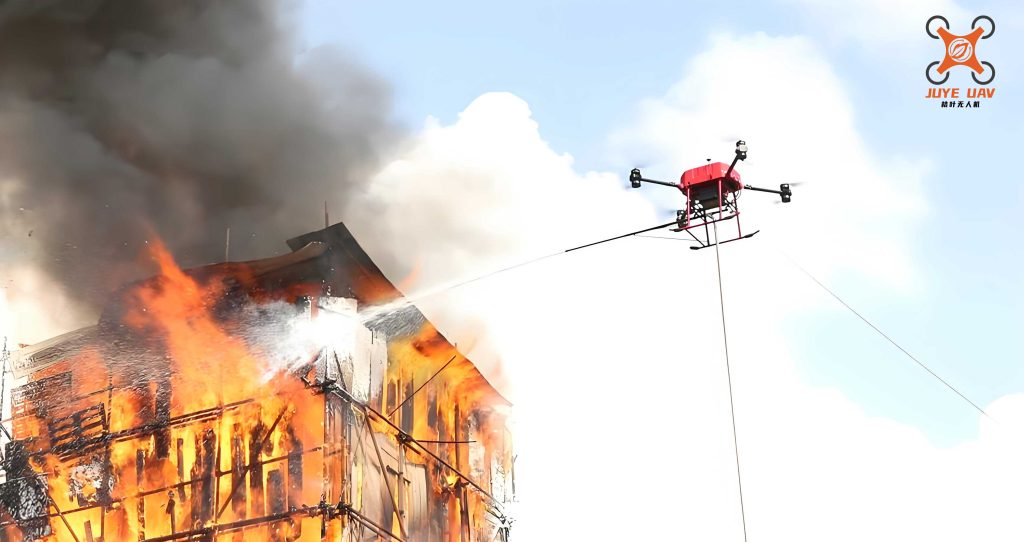
- Aerial Fire Suppression: Large, heavy-lift multi-rotor fire UAVs can carry and discharge extinguishing agents. They can deliver water, foam, or dry chemical directly to the fire seat, especially in hard-to-reach areas like high-rise facades, rooftops, or industrial chimneys. Some systems use “drone swarms” where multiple UAVs cooperate, potentially using a master-slave configuration to pump water through a hose suspended between them to great heights. The mass flow rate $\dot{m}$ of an extinguishing agent relates to the required suppression energy $E_{sup}$ and the heat release rate $\dot{Q}$ of the fire:
$$E_{sup} \propto \dot{Q} \cdot t \quad \text{and} \quad \dot{m} = \frac{E_{sup}}{h_{eff}}$$
where $t$ is application time and $h_{eff}$ is the effective heat of vaporization/suppression of the agent.
- Emergency Supply Delivery: UAVs can deliver small but critical payloads to trapped victims or isolated firefighting crews. This can include personal protective equipment (PPE), self-contained breathing apparatus (SCBA) bottles, medical kits, two-way radios, or emergency ropes for self-evacuation.
- Hazardous Material (HazMat) Assessment: In incidents involving chemicals or industrial facilities, fire UAVs equipped with specific gas detectors and samplers can safely enter the plume or leak area to identify the substance, its concentration, and the dispersion pattern, guiding evacuation and mitigation efforts.
The application portfolio can be categorized by mission phase and objective as shown below:
| Mission Phase | Primary Objective | Fire UAV Application | Typical Payload |
|---|---|---|---|
| Initial Response | Rapid Situation Assessment | Aerial Size-up & Reconnaissance | HD Zoom + Thermal Camera |
| Active Response | Fire Attack & Victim Location | Thermal Imaging & Search, Interior Mapping | Thermal Camera, LiDAR |
| Active Response | Fire Suppression | Targeted Aerial Delivery of Extinguishing Agents | Water/foam tank, discharge mechanism |
| Active Response | Communication & Coordination | Aerial Communication Relay | Radio repeater, mesh node |
| Active Response | Hazard Identification | Chemical/Radiation Detection | Multi-gas detector, sampler |
| Support | Logistics & Resupply | Delivery of Critical Equipment | Cargo hook, sealed container |
| Post-Incident | Investigation & Analysis | 3D Scene Mapping & Damage Assessment | High-res camera, photogrammetry software |
Mathematical Modeling for Fire UAV Deployment
Optimizing the use of fire UAV resources can be approached through operational research models. For example, the problem of deploying a limited fleet of heterogeneous UAVs to cover multiple points of interest (POIs) at a large incident can be framed as a variant of the Vehicle Routing Problem (VRP) or a resource-constrained scheduling problem.
Let us define a simplified coverage model. We have a set of $N$ POIs (e.g., suspected victim locations, fire fronts) with priorities $w_i$. We have $M$ UAVs with different endurance $E_m$ and sensor capabilities. The goal is to maximize the total prioritized coverage within a time window $T$. We define a decision variable $x_{m,i,t} \in \{0,1\}$ indicating if UAV $m$ is covering POI $i$ at time $t$. A simplified objective function is:
$$\text{Maximize } Z = \sum_{t=1}^{T} \sum_{i=1}^{N} w_i \cdot \min(1, \sum_{m=1}^{M} c_{m,i} \cdot x_{m,i,t})$$
subject to constraints such as:
$$\sum_{i=1}^{N} x_{m,i,t} \leq 1 \quad \forall m, t \quad \text{(one POI per UAV per timestep)}$$
$$\sum_{t=1}^{T} \sum_{i=1}^{N} e_{m,i} \cdot x_{m,i,t} \leq E_m \quad \forall m \quad \text{(endurance)}$$
where $c_{m,i}$ is the coverage effectiveness of UAV $m$ on POI $i$ (could be 1 if capable, 0 otherwise), and $e_{m,i}$ is the energy/time cost for the task. This model highlights the complexity of efficiently managing a fire UAV fleet.
Future Trajectories and Concluding Remarks
The evolution of fire UAV technology is far from complete. Future trends point toward:
- Increased Autonomy and Swarm Intelligence: Teams of UAVs operating collaboratively with minimal human guidance, performing distributed sensing and coordinated suppression tasks.
- Advanced Sensor Fusion and AI Analytics: Real-time AI that doesn’t just show data but interprets it—predicting flashover, automatically identifying victims, and assessing structural failure probability.
- Standardization and Integration: Seamless integration of UAV-derived data into existing incident command systems (ICS) and building information modeling (BIM) for pre-planning.
- Enhanced Durability and Payloads: Development of platforms capable of withstanding higher temperatures and carrying more versatile intervention tools.
In conclusion, the fire UAV has transitioned from a novel gadget to a core component of modern firefighting strategy. Its advantages in mobility, situational awareness, safety, and intelligent operation are proven and profound. Through applications ranging from reconnaissance and mapping to direct suppression and rescue support, it empowers incident commanders with unprecedented decision-making superiority. As the technology continues to mature through advancements in autonomy, sensing, and integration, the fire UAV will undoubtedly play an even more central role in saving lives, protecting property, and ensuring the safety of firefighters confronting increasingly complex emergencies. The mathematical frameworks and system models discussed herein provide a foundation for optimizing their deployment and unlocking their full potential as a transformative force in emergency response.