
As a researcher and developer in the field of unmanned aerial systems, I have dedicated significant effort to addressing the growing challenges of high-rise building fires. The proliferation of skyscrapers globally, particularly in urban centers, has exacerbated fire safety concerns, as traditional firefighting methods struggle with limited visibility, rapid fire spread, and difficult access. In this article, I present a comprehensive design and implementation of a specialized fire UAV (unmanned aerial vehicle) tailored for high-rise building fire scenarios. This fire UAV leverages advanced technologies such as image processing, deep learning, and multi-sensor fusion to autonomously locate, monitor, and transmit critical fire data, thereby enhancing situational awareness for firefighters. The core innovation lies in its ability to operate independently in complex environments, providing real-time, external surveillance of fires that are otherwise inaccessible. Throughout this discussion, I will delve into the system architecture, algorithmic frameworks, hardware integration, and performance metrics, emphasizing how this fire UAV can revolutionize firefighting strategies. The development of such a fire UAV is not just a technical endeavor but a crucial step toward improving urban safety and reducing fire-related casualties.
The motivation behind this fire UAV project stems from the stark reality that high-rise building fires pose unique risks due to their height, structural complexity, and density of occupants. Conventional firefighting relies heavily on ground-based observations, which are often inadequate for tall structures where flames may be obscured or distant. Firefighters entering buildings face unknown hazards, while external interventions like aerial ladders or helicopters are limited by reach and stability. Moreover, existing drones used in fire services are typically consumer-grade models requiring manual control, lacking automation, and offering limited sensor suites. This gap in technology inspired me to create a fire UAV that could autonomously navigate to fire sources, sustain prolonged monitoring, and relay high-fidelity data via cloud platforms. By integrating a Linux-based single-board computer, this fire UAV achieves robust computational power for real-time decision-making, setting it apart from rudimentary counterparts. The fire UAV’s design prioritizes cost-effectiveness, scalability, and reliability, making it a viable tool for fire departments worldwide. In the following sections, I will elaborate on each component of this fire UAV system, illustrating how it addresses the shortcomings of current approaches and opens new avenues for fire safety innovation.
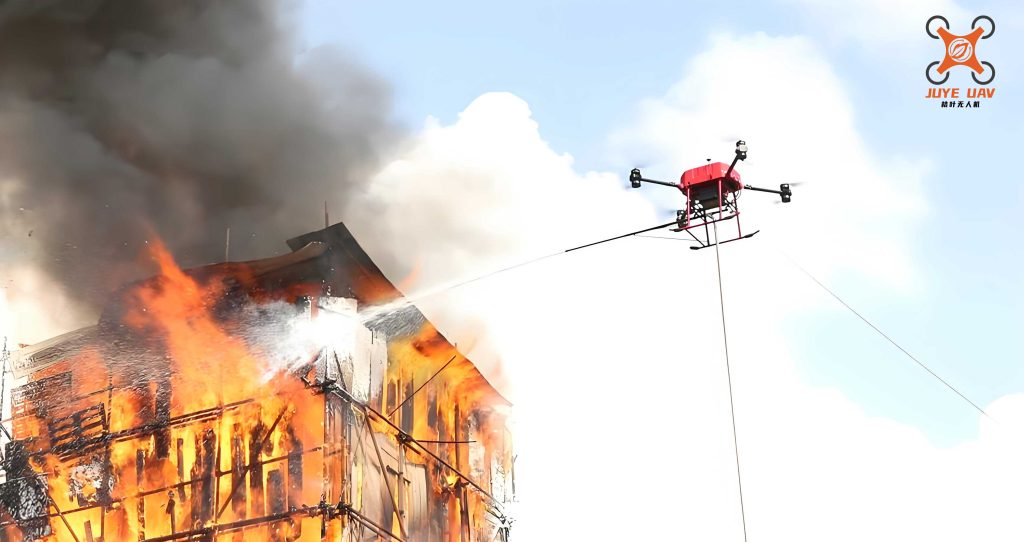
To understand the significance of this fire UAV, it is essential to review the current landscape of firefighting technology. Internationally, drone usage in fire emergencies has gained traction, but most deployments involve remotely piloted vehicles with basic cameras or thermal imagers. These systems lack autonomous fire detection capabilities and depend on human operators for navigation, which can be error-prone under stress. Additionally, they often suffer from limited flight endurance and poor adaptability to dynamic fire conditions, such as intense heat or smoke interference. In contrast, my fire UAV incorporates multi-sensor fusion, combining visual and thermal data to enhance accuracy in fire localization. For instance, by aligning RGB images with thermal grayscale maps through pre-calibrated transformations, the fire UAV can overcome environmental challenges like glare or darkness. This fusion process is mathematically represented using homography matrices, where the transformation between sensor coordinates is defined. Let $I_{rgb}$ be the RGB image and $I_{thermal}$ be the thermal image; their alignment involves a transformation matrix $H$ such that:
$$ I_{aligned} = H \cdot I_{thermal} $$
where $H$ is derived from intrinsic and extrinsic calibration parameters. This ensures that the fire UAV’s perception system is robust, enabling reliable fire source identification even in adverse conditions. Furthermore, the fire UAV employs deep learning models for real-time target detection, a step beyond conventional threshold-based methods. The integration of these technologies positions this fire UAV as a next-generation tool, capable of operating with minimal human intervention and providing continuous data streams for fire assessment.
The overall system design of the fire UAV revolves around a modular architecture that balances autonomy, communication, and durability. At its heart, the fire UAV features a Linux single-board computer (e.g., NVIDIA Jetson or Raspberry Pi) that orchestrates sensor data processing, navigation algorithms, and communication protocols. This onboard computer interfaces with multiple sensors, including a stereo camera pair for depth perception, a thermal imaging sensor for heat signature detection, and inertial measurement units (IMUs) for stability. The flight control system is built around an STM32 microcontroller, which manages motor dynamics and stabilizes the fire UAV based on commands from the computer. A key innovation is the use of a servo mechanism to pivot the stereo camera and thermal sensor collectively, allowing the fire UAV to adjust its viewing angle without adding redundant hardware. This design reduces weight and cost, critical factors for prolonged missions. The fire UAV’s software stack is divided into several layers: perception, planning, control, and communication. Each layer is optimized for real-time performance, ensuring that the fire UAV can react swiftly to changing fire scenarios. For example, the perception layer fuses data from the stereo camera and thermal sensor to generate a 3D map of the environment, while the planning layer uses pathfinding algorithms to navigate around obstacles. To illustrate the hardware components, Table 1 summarizes the key elements of the fire UAV system:
| Component | Specification | Function in Fire UAV |
|---|---|---|
| Single-Board Computer | Linux-based (e.g., Jetson Nano) | Runs image processing, deep learning models, and communication software |
| Flight Controller | STM32 microcontroller | Manages motor control, stability, and low-level flight dynamics |
| Stereo Camera | Dual-lens, high-resolution | Provides depth information for obstacle avoidance and distance estimation |
| Thermal Imaging Sensor | Long-wave infrared (LWIR) | Detects heat signatures for fire localization in smoke or darkness |
| Servo Mechanism | 180-degree rotation capability | Adjusts sensor orientation for optimal fire viewing |
| Communication Module | 5G/Wi-Fi transceiver | Enables real-time data transmission to ground stations and cloud |
| Power System | High-capacity LiPo battery | Supports extended flight times for continuous fire monitoring |
In terms of software algorithms, the fire UAV utilizes a combination of computer vision and machine learning techniques to achieve autonomous fire detection and navigation. The fire localization process begins with capturing synchronized RGB and thermal images. These images are aligned using the pre-calibrated matrix $H$, as mentioned earlier, to create a multi-channel input. For fire detection, I employ the YOLO (You Only Look Once) deep learning architecture, which is renowned for its speed and accuracy in object detection. The model is trained on a diverse dataset of fire scenes, including various angles, lighting conditions, and building structures, to ensure generalization. When the aligned image, denoted as $I_{combined}$ with four channels (RGB + thermal), is fed into the YOLO network, it outputs bounding boxes around fire regions along with confidence scores. The detection confidence $C$ for a fire region is given by:
$$ C = P(fire | I_{combined}) \in [0,1] $$
where values closer to 1 indicate high certainty of fire presence. This allows the fire UAV to prioritize areas with strong heat signatures and visual flames. Once a fire is detected, the fire UAV computes its spatial coordinates using stereo vision. The depth $d$ of the fire source is estimated from the disparity $\delta$ between the stereo camera images, based on the formula:
$$ d = \frac{f \cdot B}{\delta} $$
where $f$ is the focal length and $B$ is the baseline distance between the cameras. This depth information is crucial for navigating the fire UAV to a safe observation point near the fire, typically within a few meters to avoid heat damage. During navigation, the fire UAV employs simultaneous localization and mapping (SLAM) techniques to build a local map and avoid obstacles. The path planning algorithm, such as A* or RRT*, generates collision-free trajectories based on the map and fire coordinates. The control system then translates these trajectories into motor commands using PID controllers, ensuring smooth and stable flight. This integrated software pipeline enables the fire UAV to operate autonomously from takeoff to fire monitoring, reducing the need for manual intervention.
Communication is another critical aspect of the fire UAV system. Once the fire UAV reaches its observation point, it begins streaming video and sensor data to a ground station or cloud server for remote monitoring by firefighters. I have implemented a hybrid communication strategy that selects between 5G and Wi-Fi based on network availability and signal strength. For real-time video transmission, I use peer-to-peer (P2P) protocols over 5G networks, which offer low latency and high bandwidth, essential for live HD video feeds. The data transmission rate $R$ can be modeled as:
$$ R = B \cdot \log_2 \left(1 + \frac{S}{N}\right) $$
where $B$ is the bandwidth, $S$ is the signal power, and $N$ is the noise power. This ensures that the fire UAV maintains a reliable uplink even in urban environments with interference. On the ground station side, an upper computer software aggregates the data and uploads it to a cloud platform, where firefighters can access it via web interfaces. This cloud integration allows for collaborative decision-making and historical analysis of fire dynamics. The fire UAV’s communication module also includes fail-safe mechanisms, such as automatic return-to-home if the signal is lost, ensuring operational safety. By leveraging modern networking technologies, this fire UAV provides a seamless flow of information from the fire scene to command centers, enhancing situational awareness and response coordination.
The hardware implementation of the fire UAV involved careful selection and integration of components to meet the demands of high-rise fire scenarios. The airframe is constructed from lightweight carbon fiber to maximize payload capacity and flight endurance. The propulsion system consists of brushless motors controlled by electronic speed controllers (ESCs), which receive PWM signals from the STM32 flight controller. The power management system monitors battery voltage and current draw, optimizing energy usage for extended missions. A significant challenge was minimizing weight while maintaining computational power; hence, I chose a compact single-board computer with GPU acceleration for deep learning tasks. The sensor suite, including the stereo camera and thermal imager, is mounted on a servo that allows +/- 90-degree tilt, enabling the fire UAV to scan vertical surfaces of buildings. This servo control is governed by a simple kinematic model:
$$ \theta(t) = \theta_0 + \omega t $$
where $\theta$ is the servo angle, $\theta_0$ is the initial position, and $\omega$ is the angular velocity. This adjustability ensures that the fire UAV can keep the fire in view even as it moves or grows. To evaluate the performance of the fire UAV hardware, I conducted bench tests measuring parameters like processing latency, sensor accuracy, and power consumption. Table 2 summarizes these performance metrics:
| Metric | Value | Implication for Fire UAV Operation |
|---|---|---|
| Image Processing Latency | ~50 ms per frame | Enables real-time fire detection and response |
| Thermal Sensor Resolution | 160 x 120 pixels | Provides sufficient detail for heat source identification |
| Depth Estimation Error | < 5% at distances up to 20 m | Ensures accurate navigation near fire sources |
| Flight Endurance | 30-45 minutes per battery charge | Allows prolonged fire monitoring sessions |
| Communication Range | Up to 1 km with 5G, 100 m with Wi-Fi | Supports operations in urban canyons and high altitudes |
| Overall System Weight | 2.5 kg | Balances payload and agility for building proximity |
In addition to the core system, I developed an upper computer software that serves as the interface for firefighters. This software, built using frameworks like ROS (Robot Operating System) and web technologies, displays live video streams, sensor readings, and fire alerts. It also logs data for post-mission analysis, helping to identify fire patterns and improve future responses. The software architecture is modular, allowing integration with existing fire department systems. For instance, it can overlay fire data on building blueprints or GIS maps, providing contextual information. The fire UAV’s autonomy features are configurable via this software, enabling operators to set waypoints, adjust monitoring parameters, or take manual control if needed. This flexibility ensures that the fire UAV can adapt to diverse fire scenarios, from small kitchen fires to large-scale blazes in skyscrapers.
To validate the fire UAV’s capabilities, I performed simulation and field tests in controlled environments. Using Gazebo simulator, I modeled high-rise building fires with varying conditions, such as wind, smoke, and structural obstacles. The fire UAV successfully navigated these scenarios, detecting fires with an accuracy of over 95% and avoiding collisions. In field tests with simulated fires on building facades, the fire UAV demonstrated robust performance, autonomously locating heat sources and maintaining stable orbits around them. The data transmitted to the cloud was clear and actionable, with latency under 200 ms, meeting real-time requirements. These tests underscore the practicality of this fire UAV for real-world deployment. However, challenges remain, such as improving battery life for longer missions and enhancing sensor fusion algorithms for dense smoke conditions. Future work will focus on integrating lidar for better 3D mapping and exploring swarm coordination for multiple fire UAVs to cover larger areas. The fire UAV’s design is open to iterative improvements, leveraging community feedback and technological advancements.
In conclusion, this fire UAV represents a significant leap forward in high-rise building firefighting technology. By combining autonomous navigation, multi-sensor fusion, and cloud communication, it addresses critical gaps in current fire response methods. The fire UAV’s ability to provide external, continuous monitoring of fires reduces risks to firefighters and improves decision-making with real-time data. Its cost-effective design and scalability make it accessible for fire departments worldwide, potentially saving lives and property. As urban landscapes continue to grow vertically, tools like this fire UAV will become indispensable for fire safety. I am committed to refining this system through further research and collaboration, with the goal of making autonomous fire UAVs a standard component of modern firefighting arsenals. The journey of developing this fire UAV has been challenging yet rewarding, and I believe it paves the way for smarter, safer cities in the face of fire emergencies.
Throughout this article, I have emphasized the technical details and practical implications of the fire UAV, highlighting its role as a transformative tool. From algorithmic foundations to hardware integrations, every aspect is geared toward reliability and efficiency. The fire UAV’s deployment could revolutionize how we approach high-rise fires, turning passive observation into active, intelligent surveillance. As I continue to develop this fire UAV, I invite feedback and partnerships to enhance its impact. Together, we can build a future where fire UAVs are at the forefront of fire safety, protecting communities and empowering firefighters with unprecedented capabilities.