
As a practitioner deeply involved in the intersection of technology and forestry management, I have witnessed firsthand the revolutionary impact of Unmanned Aerial Vehicles (UAVs), specifically fire UAVs, on the strategies and outcomes of wildland fire management. The integration of this technology has shifted paradigms, enabling a level of situational awareness, operational efficiency, and personnel safety previously unattainable. In this article, I will delve into the multifaceted applications of fire UAV systems across the entire spectrum of fire management—from preventive patrols to post-fire analysis—and provide technical insights, often summarized through tables and mathematical models, to underscore their critical importance.
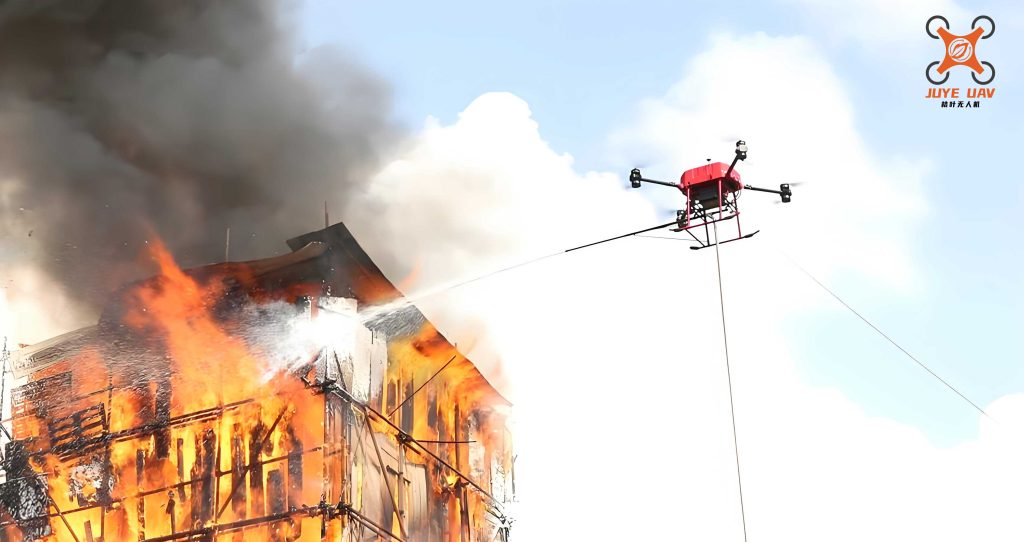
The core advantage of a dedicated fire UAV lies in its ability to serve as a persistent, agile, and intelligent sensing platform. Unlike manned aircraft, these systems can operate in hazardous conditions, penetrate dense smoke, and provide real-time data streams that form the backbone of modern firefighting command and control. The term ‘fire UAV’ encompasses a range of platforms equipped with specialized payloads, including high-resolution visible cameras, multispectral sensors, and crucially, thermal infrared imagers. The operational calculus for employing a fire UAV is compelling: it dramatically reduces the ‘detection-to-decision’ timeline, minimizes risk to ground personnel, and optimizes resource allocation.
I. The Fire UAV in Wildfire Prevention and Preparedness
Prevention is the most cost-effective element of fire management. Here, the fire UAV transitions from a reactive tool to a proactive sentinel.
1.1 Automated Patrols and Surveillance
Traditional ground-based patrols are limited by terrain accessibility and human endurance. A fire UAV system, particularly long-endurance fixed-wing or vertical take-off and landing (VTOL) models, can be programmed for automated, systematic coverage of vast forested areas. The effectiveness can be modeled by the area coverage rate $A_{cov}$:
$$A_{cov} = v \cdot w \cdot t \cdot \eta$$
where $v$ is the UAV’s ground speed, $w$ is the sensor swath width (a function of altitude and field of view), $t$ is the flight time, and $\eta$ is the overlap efficiency factor. For instance, a UAV flying at 50 km/h with a 200m swath for 4 hours can theoretically patrol a corridor of 40 square kilometers with high efficiency. Advanced systems use computer vision algorithms to automatically detect anomalies like smoke plumes or unauthorized human activity, triggering immediate alerts.
1.2 Fuel Assessment and Risk Modeling
A critical preventive task is assessing fuel load—the amount of combustible vegetation. Multispectral sensors on a fire UAV can generate vegetation indices like the Normalized Difference Vegetation Index (NDVI), which correlates with biomass and moisture content.
$$NDVI = \frac{(NIR – Red)}{(NIR + Red)}$$
Lower NDVI values often indicate drier, more flammable vegetation. By creating detailed, timely fuel maps, managers can prioritize areas for controlled burns or mechanical thinning. The data feeds into fire behavior models (e.g., Rothermel’s model) to predict potential fire intensity and spread, represented conceptually by the rate of spread $R$:
$$R = \frac{I_R \cdot (1+\phi_w + \phi_s)}{\rho_b \cdot \epsilon \cdot Q_{ig}}$$
where $I_R$ is reaction intensity, $\phi_w$ and $\phi_s$ are wind and slope factors, $\rho_b$ is fuel bulk density, $\epsilon$ is effective heating number, and $Q_{ig}$ is heat of preignition. A fire UAV provides the fine-scale fuel and terrain inputs ($\rho_b$, $\phi_s$) needed for accurate local predictions.
1.3 Training and Simulation
Fire UAVs are invaluable for creating high-fidelity training environments. They can map training areas in detail, and during exercises, provide a live “eye in the sky” to critique crew movements and strategy, fostering better coordination between aerial and ground resources.
| Platform Type | Typical Endurance | Primary Sensor Suites | Best for Prevention Task | Key Limitation |
|---|---|---|---|---|
| Multi-rotor (e.g., Quadcopter) | 20-45 min | Visible, Thermal (Medium Res) | Targeted inspection, law enforcement monitoring | Limited area coverage |
| Fixed-Wing | 2-6 hours | Visible, Multispectral | Large-area automated patrols, fuel mapping | Requires launch/landing area, less hover capability |
| VTOL Hybrid | 1-3 hours | Visible, Thermal, Multispectral | Versatile missions combining patrol and detailed inspection | Higher cost, operational complexity |
II. The Fire UAV in Active Wildfire Suppression
When a wildfire ignites, the fire UAV becomes an indispensable asset for the incident management team. Its roles are diverse and critical across the operational timeline.
2.1 Initial Attack and Reconnaissance
Upon initial report, a fire UAV can be rapidly deployed to verify the incident and perform the first reconnaissance. It provides immediate data on: Location & Size: GPS coordinates and perimeter estimate. Fire Behavior: Rate of spread, flame length, and spotting activity. Access & Safety: Identification of potential safety zones, escape routes, and hazards like snags or terrain traps. This real-time intelligence allows for precise initial resource dispatch, a concept formalized in the initial attack success probability $P_{ia}$:
$$P_{ia} = f(S_{delay}, R_{fire}, R_{response})$$
where $S_{delay}$ is the detection/reporting delay, $R_{fire}$ is the fire’s growth rate, and $R_{response}$ is the rate at which suppression resources can be mobilized and applied. The fire UAV directly reduces $S_{delay}$ and informs a more effective $R_{response}$.
2.2 Persistent Situational Awareness and Line Monitoring
As the incident expands, the fire UAV provides continuous “over-the-hill” awareness. It tracks the main fire head, monitors flanks for breakthroughs, and assesses the integrity of constructed firelines. Thermal imaging is paramount here, allowing operators to see through smoke and identify hotspots threatening control lines. The thermal contrast between a hot spot and the background can be described by the apparent temperature difference $\Delta T_a$ detected by the sensor:
$$\Delta T_a \approx \frac{\int_{\lambda_1}^{\lambda_2} [L_{obj}(\lambda, T_{obj}) – L_{bkg}(\lambda, T_{bkg})] \cdot R(\lambda) d\lambda}{\int_{\lambda_1}^{\lambda_2} \frac{\partial L_{bkg}(\lambda, T)}{\partial T} \bigg|_{T=T_{bkg}} \cdot R(\lambda) d\lambda}$$
where $L$ is spectral radiance, $T$ is temperature, $R(\lambda)$ is the sensor’s spectral response, and $\lambda$ is wavelength. A modern fire UAV’s thermal camera can detect $\Delta T_a$ of less than 1°C, identifying smoldering roots or embers invisible to the naked eye.
2.3 Direct and Indirect Suppression Support
Beyond sensing, fire UAVs are evolving into active suppression platforms. Unmanned helicopters or large multi-rotors can be equipped with tanks or dispensers to drop retardant, foam, or water on spot fires or to reinforce lines. While their payload is limited compared to manned air tankers, their precision and ability to operate at night or in heavy smoke make them unique. The effective coverage $C_{drop}$ of a UAV-delivered suppressant can be modeled as:
$$C_{drop} = \frac{V_{payload} \cdot \rho_{fluid} \cdot \eta_{dispersion}}{D_{rate}}$$
where $V_{payload}$ is tank volume, $\rho_{fluid}$ is density, $\eta_{dispersion}$ is the efficiency of the dispersal system, and $D_{rate}$ is the desired application rate (e.g., gallons per square foot).
Furthermore, a fire UAV can act as a communication relay, extending radio networks in rugged terrain, and even deliver critical supplies (e.g., water, batteries, medical kits) to remote firefighting crews.
2.4 Search and Rescue (SAR) Operations
In complex fire environments where personnel may become trapped or disoriented, the thermal imaging capability of a fire UAV is a life-saving tool. It can quickly scan large areas of dense smoke or nighttime terrain to locate missing individuals based on their heat signature. The probability of detection $P_d$ in a SAR grid search is enhanced by the UAV’s sensor performance and systematic flight pattern.
| Payload Type | Key Specifications | Primary Suppression Functions | Data Output Example |
|---|---|---|---|
| High-Res Visible Camera | >20 MP, Optical Zoom | Detailed damage assessment, documentation, perimeter mapping, public information imagery. | Geo-tagged orthomosaics for precise perimeter measurement. |
| Radiometric Thermal Imager | Resolution (e.g., 640×512), Sensitivity (<50 mK) | Hotspot detection through smoke, nighttime operations, crew/animal search and rescue, line scanning for holdover fires. | Heat maps with temperature values for every pixel, enabling quantitative hotspot analysis. |
| Multispectral/Hyperspectral Sensor | Multiple narrow bands (e.g., Red Edge, NIR, SWIR) | Assessing vegetation stress post-fire, mapping soil burn severity, identifying residual unburned fuel islands. | False-color composites highlighting ash, scorched vegetation, and green islands. |
| Payload Delivery System | Dropper mechanism, Payload capacity (2-20 kg) | Delivering emergency supplies to crews, deploying ignition spheres for backburning, precision water/retardant drops on small targets. | Operational success measured by delivery accuracy and time-to-target. |
2.5 Post-Fire Mop-up and Monitoring
After the main fire front has passed, the arduous task of mop-up—finding and extinguishing lingering hot spots—begins. This is one of the most effective applications of a fire UAV. Instead of crews laboriously probing every square meter of a large burn area, a fire UAV equipped with a thermal camera can systematically fly a grid pattern, automatically geotagging every residual heat source. The efficiency gain is enormous. The area a UAV can scan for mop-up $A_{mop}$ compared to a ground crew is:
$$\frac{A_{mop(UAV)}}{A_{mop(Crew)}} = \frac{v_{UAV} \cdot w_{sensor}}{v_{crew} \cdot w_{probe}} \cdot \frac{t_{UAV}}{t_{crew}}$$
Given that $v_{UAV} \gg v_{crew}$, $w_{sensor} \gg w_{probe}$, and $t_{UAV}$ can be similar to $t_{crew}$ (with battery swaps), the ratio is typically on the order of 100:1 or more. This allows ground crews to be deployed with surgical precision, significantly improving safety and reducing fatigue.
III. System Integration and the Data Pipeline
The true power of a fire UAV is not just in the airframe, but in its integration into a larger decision support system. The data pipeline is critical:
- Acquisition: The fire UAV collects raw sensor data (imagery, telemetry).
- Processing: Onboard or ground-based software performs tasks like orthorectification, thermal analysis, and change detection.
- Fusion & Analysis: Data from multiple fire UAVs, satellites, and ground sensors is fused. AI algorithms may run to automatically detect fire lines or predict spread vectors.
- Dissemination: Actionable intelligence (maps, target lists, video feeds) is pushed to command centers and, increasingly, directly to tablet devices carried by field supervisors.
This pipeline turns the fire UAV from a simple camera platform into a node in a networked, intelligent firefighting system. The latency $L$ in this pipeline, from data capture to actionable intelligence, is a key performance metric:
$$L = t_{acq} + t_{trans} + t_{proc} + t_{diss}$$
Modern systems strive to minimize $L$, with near-real-time video downlink and cloud-based processing enabling $L$ to be less than one minute, which is tactically significant during a fast-moving fire.
IV. Challenges and Future Trajectory
Despite the clear benefits, the operationalization of fire UAVs faces hurdles. Regulatory airspace integration, especially in congested airspace with multiple manned aircraft, remains complex. Battery technology limits endurance for electric multi-rotors, though gas-powered hybrids offer solutions. Sensor cost, data management, and the need for specialized training for pilots and analysts are also considerations.
The future trajectory points toward greater autonomy, swarm operations, and advanced sensor fusion. Imagine a swarm of fire UAVs autonomously mapping a fire perimeter every 30 minutes, while a larger suppression-focused fire UAV conducts targeted retardant drops guided by the swarm’s data, all coordinated by an AI “mission commander.” Research into automated fire behavior prediction directly from UAV imagery is also advancing rapidly.
In conclusion, the fire UAV has cemented its role as a cornerstone of modern wildland fire management. From the preventive phase through the chaos of suppression and into the recovery monitoring, it provides an unparalleled combination of perspective, persistence, and precision. As the technology continues to mature and integrate with artificial intelligence and next-generation communication networks, the fire UAV will undoubtedly become even more central to our efforts to understand, manage, and safely mitigate the threat of wildfires. The equation is simple: the intelligent application of fire UAV technology leads to faster detection, more informed decisions, safer firefighters, and more protected ecosystems.