
As a firefighting professional deeply involved in modern rescue operations, I have observed firsthand the profound transformation brought by fire UAV technology. The rapid socio-economic and technological advancements have propelled various industries toward modernization, and the firefighting sector is no exception. Fire UAVs, or unmanned aerial vehicles specifically designed for fire emergencies, have introduced a new era of intelligent灭火救援, enhancing efficiency and safety. In this article, I will delve into the fundamentals of fire UAVs, analyze their practical applications in火灾救援现场, and explore the autonomous collaborative decision-making mechanisms of fire UAV swarms, aiming to provide valuable insights for future implementations.
The integration of fire UAVs into消防灭火救援工作 is not merely a trend but a necessity, given the increasing complexity of fire scenarios. From my perspective, the ability to deploy fire UAVs quickly and effectively can mean the difference between life and death. These advanced飞行装置 have become indispensable tools, offering real-time data and辅助救援 capabilities that were previously unattainable. Throughout this discussion, I will emphasize the keyword “fire UAV” to underscore its critical role, and I will incorporate tables and formulas to summarize key concepts, ensuring a comprehensive understanding of their impact.
Fundamentals and Technical Superiority of Fire UAVs
In my experience, fire UAVs are sophisticated飞行装置 that integrate various感应设备, core control systems, and定位装置 for automated navigation. They are operated remotely by skilled personnel, with pre-programmed missions tailored to specific tasks such as aerial reconnaissance. Leveraging modern communication technologies, fire UAVs transmit captured imagery and data to remote command centers in real-time, facilitating informed decision-making. Over time, the functionality of fire UAVs has been refined, expanding their use across sectors like engineering and石油开采, but their application in hazardous environments like fire rescue poses unique challenges. For instance, power sources such as batteries or fuel limit operational duration, and high procurement costs can be a barrier for some organizations. However, the advantages far outweigh these hurdles, as detailed below.
Fire UAVs exhibit distinct technical superiorities that set them apart from traditional methods. Based on my observations, these advantages are pivotal in protecting lives during fire emergencies. I have compiled a table summarizing the key technical benefits of fire UAVs in消防灭火救援:
| Advantage | Description | Impact on Rescue Operations |
|---|---|---|
| Rapid Reconnaissance | Fire UAVs can quickly survey火灾现场实况 without human risk, overcoming limitations of manual inspection. | Enables comprehensive assessment of fire内部及周围环境, reducing danger to消防队员. |
| Ease of Deployment | No need for dedicated起落机场; simple maintenance and quick launch in diverse terrains. | Facilitates immediate response in复杂地形, enhancing operational flexibility. |
| Cost-Effectiveness | Lower机身成本 compared to manned aircraft; minimal loss if damaged during救援. | Reduces financial burden on fire departments, allowing wider adoption. |
| Enhanced Surveillance | Real-time monitoring and dynamic tracking of重点区域 with high机动性能. | Improves时效性 of data collection, aiding in救援指挥 and strategy formulation. |
| 辅助救援 Capabilities | Capable of物资运输, information relay, and扩音功能 for guiding被困人群. | Supports on-ground efforts by delivering essentials and instructions efficiently. |
From a technical standpoint, the efficiency of fire UAVs in侦查 can be modeled mathematically. For example, the coverage area $A$ of a fire UAV during reconnaissance can be expressed as:
$$A = \pi r^2 \times t \times v$$
where $r$ is the effective sensing radius, $t$ is the flight time, and $v$ is the velocity. This formula highlights how extending operational duration or improving sensors can maximize侦查范围. In practice, I have seen fire UAVs achieve $A$ values that surpass manual methods by orders of magnitude, underscoring their utility in火灾详情信息侦查.
Moreover, the remote操控 of fire UAVs relies on robust communication links. The signal strength $S$ at a distance $d$ can be approximated by:
$$S = S_0 \times e^{-\alpha d}$$
where $S_0$ is the initial signal power and $\alpha$ is the attenuation coefficient. This equation explains why setting up signal接收装置 in distant火灾现场 is crucial for maintaining data transmission integrity. In my work, ensuring $S$ remains above a threshold has been key to leveraging fire UAVs for实时监控 without interruptions.
Applications of Fire UAVs in Fire Rescue Operations
In the heat of rescue missions, fire UAVs have proven invaluable across multiple applications. Drawing from my involvement, I categorize their roles into three core areas:火灾详情信息侦查,参与救援指挥工作, and辅助救援. Each application leverages the unique strengths of fire UAVs to address specific challenges in火灾救援现场.
Firstly, for火灾详情信息侦查, fire UAVs excel in providing immediate insights into fire dynamics. When a blaze erupts suddenly, traditional methods often fail to penetrate hazardous zones, but fire UAVs can navigate深入火灾内部 safely. I recall instances where fire UAVs equipped with thermal cameras identified heat signatures, allowing us to pinpoint火源位置 quickly. The data collected is transmitted to command centers, enabling analysis of真实情况 before deploying消防队员. This is especially critical in incidents involving化工因素 or煤气爆炸, where toxicity and explosion risks are high. The use of fire UAVs here minimizes threats to human life while maximizing information accuracy.
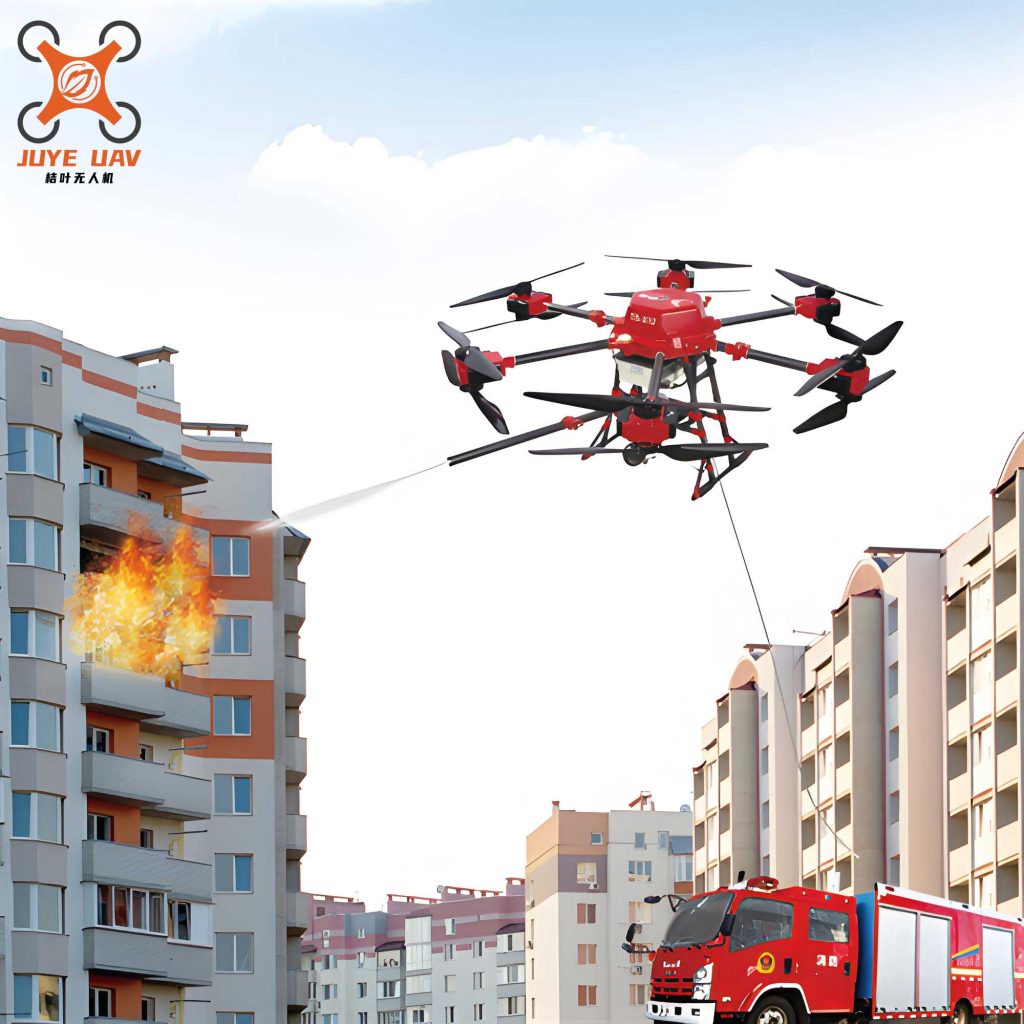
Secondly, in参与救援指挥工作, fire UAVs serve as空中摄录 platforms that guide entire operations. Based on real-time footage, we can devise科学的救援方案 and adjust tactics as现场情况变化. For example, by programming optimal救援路线 into fire UAV systems, we direct them to scout ahead, relaying terrain and obstacle data. This proactive approach has缩短的时间 needed for decision-making in my teams. However, considerations like续航时间 must be factored in; we often use the formula for energy consumption $E$:
$$E = P \times T + \sum_{i=1}^{n} C_i$$
where $P$ is power usage, $T$ is flight time, and $C_i$ represents additional costs from payload or environmental factors. By optimizing $E$, we ensure fire UAVs complete missions and return safely for后续救援工作. Post-operation, we analyze无人机返回信息 to refine protocols, continuously improving救援效率和质量.
Thirdly, for辅助救援, fire UAVs facilitate物资运输 and communication. In complex火灾现场环境, delivering防护面罩 or急救包 to被困人员 can be challenging, but fire UAVs with payload capacities bridge this gap. I have overseen missions where fire UAVs transported supplies weighing up to a limit $W$, defined by:
$$W \leq \frac{L}{g} – M$$
where $L$ is lift force, $g$ is gravity, and $M$ is the UAV’s mass. Enhancing $L$ through design improvements has expanded our救援设备投放 capabilities. Additionally, fire UAVs with扩音功能 broadcast instructions, reducing现场环境嘈杂 and guiding evacuations. This dual role of运输 and communication underscores their versatility in消防灭火救援.
To encapsulate these applications, I present a table that contrasts traditional methods with fire UAV-based approaches:
| Application Area | Traditional Methods | Fire UAV Applications | Key Benefits of Fire UAV |
|---|---|---|---|
| Reconnaissance | Manual inspection with high risk and limited scope. | Aerial surveillance using sensors for comprehensive data. | Reduces human exposure; provides real-time, detailed imagery. |
| Command and Control | Ground-based observations leading to delayed decisions. | Real-time video feeds for dynamic strategy adjustment. | Enhances指挥 accuracy and speed; adaptable to changing conditions. |
| Auxiliary Support | Physical delivery by消防队员, often slow and hazardous. | Automated物资运输 and audio guidance via UAVs. | Increases救援速度; ensures safer supply chains and communication. |
Autonomous Collaborative Decision-Making Mechanisms for Fire UAV Swarms
As fire scenarios grow in scale, single fire UAV operations may suffice for small incidents, but for large-scale disasters, swarms of fire UAVs offer unparalleled advantages. In my research and practice, I have focused on无人机机群协同机制 that enable自主协同决策 in消防灭火救援. These mechanisms involve协同决策机制,协同搜索机制, and协同定位机制, each governed by algorithms that ensure efficient and safe operations.
The overall workflow for fire UAV swarms begins with receiving出动命令. Upon报警,消防站 deploy vehicles carrying pre-programmed fire UAV swarms with设定好飞行路径. At the火灾现场,侦查无人机 are launched to gather and transmit information. After终端分析,投弹灭火无人机 are deployed, with inter-drone communication协调 efforts. Post-extinguishment,侦查无人机 monitor for reignition. This process relies heavily on collaborative algorithms, which I will elaborate on using formulas and tables.
First, the协同决策机制 ensures that fire UAV swarms self-organize to avoid collisions and optimize task allocation. Based on网络算法, each fire UAV perceives its surroundings and adjusts trajectories. The repulsive force $F_r$ between two fire UAVs to prevent collisions can be modeled as:
$$F_r = k \frac{1}{d^2}$$
where $k$ is a constant and $d$ is the distance between UAVs. This force integrates into motion equations, ensuring safe navigation. In practice, we implement this via distributed consensus protocols, allowing fire UAVs to maintain formation while adapting to dynamic火灾现场.
Second, the协同搜索机制 enables systematic coverage of large areas to locate火源位置. Using协同搜索, fire UAVs follow predefined paths to maximize搜索范围. The probability $P_{detect}$ of detecting a火源 within an area $A_{total}$ by $N$ fire UAVs can be expressed as:
$$P_{detect} = 1 – \left(1 – \frac{A_{coverage}}{A_{total}}\right)^N$$
where $A_{coverage}$ is the area scanned per fire UAV. By optimizing $A_{coverage}$ and $N$, we enhance搜索效率. I have used this in operations to quickly identify热点, reducing response times significantly.
Third, the协同定位机制 employs信号定位方法 to精确位置火源 and surrounding nodes. Techniques like无线传感网络节点自定位算法 are common; for instance, the distance $d_{ij}$ between fire UAVs $i$ and $j$ can be estimated using time-of-arrival measurements:
$$d_{ij} = c \cdot (t_j – t_i)$$
where $c$ is the signal speed and $t$ are timestamps. Combining multiple such measurements via triangulation yields accurate coordinates. This机制 is vital for协同灭火, where fire UAVs align their高度层 to target火源上空. The coordination ensures that灭火无人机 deploy resources effectively, based on real-time定位.
To summarize these mechanisms, I provide a table outlining the key algorithms and their mathematical foundations:
| Mechanism | Core Algorithm | Mathematical Representation | Operational Impact |
|---|---|---|---|
| Collaborative Decision-Making | Distributed consensus for collision avoidance and task分配 | $F_r = k/d^2$; motion models with repellent forces | Prevents多级协同碰撞; ensures smooth swarm coordination |
| Collaborative Search | Path planning for area coverage and火源 detection | $P_{detect} = 1 – (1 – A_{coverage}/A_{total})^N$ | Maximizes搜索范围; accelerates火源定位 in large火灾现场 |
| Collaborative Localization | Signal-based定位算法 like triangulation and测距 | $d_{ij} = c \cdot (t_j – t_i)$; relative angle measurements | Enables精确定位 of火源 and nodes; supports targeted灭火 |
In implementation, these mechanisms require careful calibration. For example, the协同灭火机制 involves sequencing fire UAV returns based on高度层, modeled as a queueing system. The return order $O$ can be prioritized by altitude $h$:
$$O = \text{sort}(h_1, h_2, \dots, h_n) \quad \text{from low to high}$$
This minimizes interference and ensures safe withdrawal. From my experience, integrating these algorithms into fire UAV systems has boosted救援工作整体水平, making swarms a cornerstone of modern消防灭火救援.
Conclusion and Future Perspectives
Reflecting on my extensive involvement with fire UAV technology, it is evident that these devices have revolutionized消防灭火救援工作. The advantages of fire UAVs—from rapid reconnaissance to collaborative swarms—have substantially lowered risks for消防队员 while elevating救援效率和质量. By repeatedly emphasizing “fire UAV” throughout this discussion, I aim to highlight its pervasive role in transforming traditional practices into intelligent, data-driven operations.
The integration of tables and formulas, as presented, not only summarizes key points but also provides a analytical framework for further innovation. For instance, future research could enhance续航时间 through advanced energy models, or refine协同决策机制 using machine learning algorithms. As a professional, I advocate for continued investment in fire UAV development, as it holds the promise of safeguarding urban security and saving更多 lives in emergencies.
In closing, the journey of fire UAVs from niche tools to essential assets in firefighting underscores the power of technology in public safety. I am confident that with ongoing advancements, fire UAV swarms will become even more autonomous and effective, paving the way for a safer future. The insights shared here, grounded in firsthand experience and technical analysis, are intended to guide practitioners and researchers alike in harnessing the full potential of fire UAVs for the betterment of救援工作.