
In recent years, with the rapid development of urban economies, the proliferation of high-rise buildings and high-risk industries has posed increasingly complex challenges for firefighting forces. These forces are tasked with fire suppression, emergency rescue, and fire prevention supervision, and the dangers faced by firefighters have escalated accordingly. During incidents such as petrochemical hazardous material disposal, earthquake disaster relief, flood rescue, mountain rescue, highway accidents, and large-span or large-space firefighting, the limitations of traditional on-site reconnaissance methods have become glaringly apparent. The safety of firefighting personnel is a paramount concern that cannot be overlooked.
Currently, the majority of firefighting equipment configurations in many regions remain stuck in conventional patterns. Due to insufficient adoption of new technologies and the lack of widespread high-tech, cutting-edge devices, critical opportunities during rescue operations are often missed, leading to exacerbated losses. For instance, in major accident scenarios involving hazardous chemicals, traditional disaster assessment methods falter, compelling the need for advanced solutions. Here, the fire UAV emerges as a transformative tool. Its deployment in critical situations, such as providing aerial reconnaissance and transmitting real-time imagery from core disaster zones, has proven invaluable for command decision-making, offering detailed and dynamic information that guides effective response strategies.
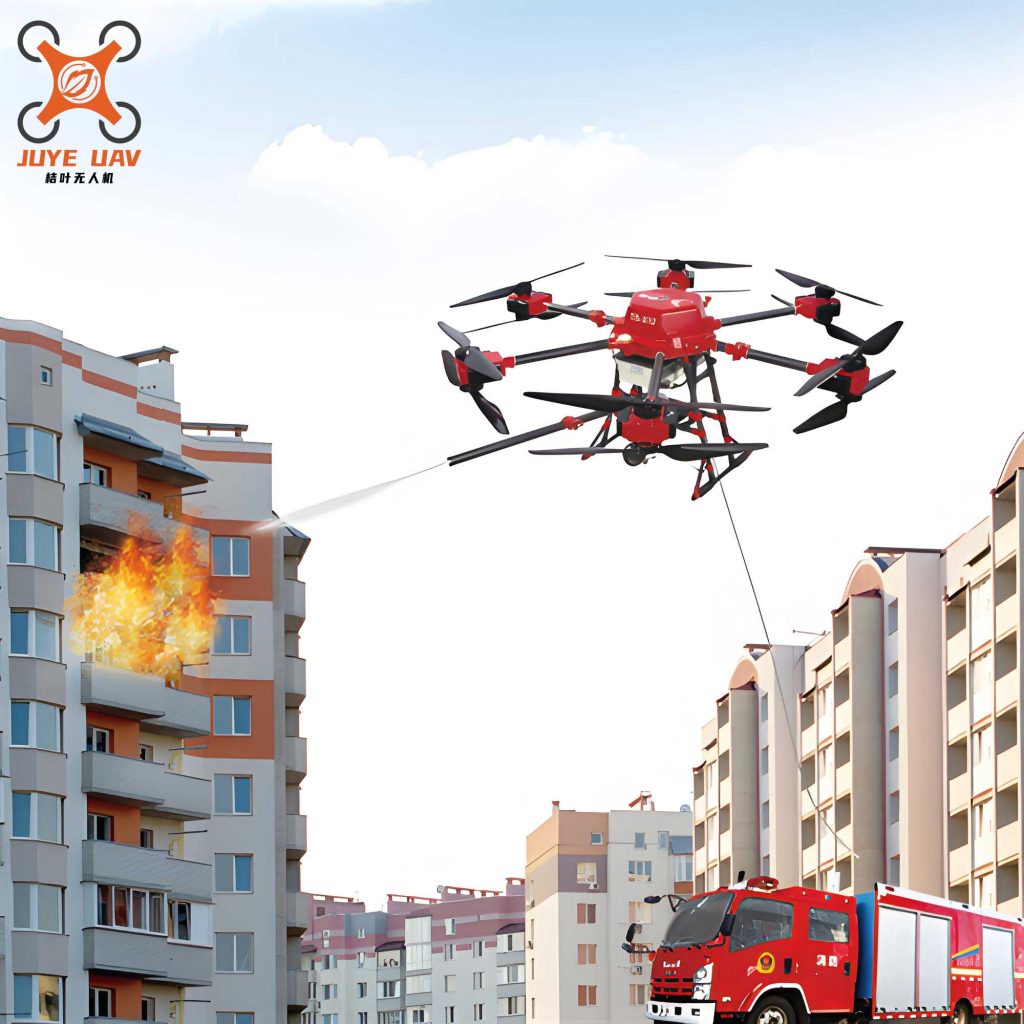
The role of the fire UAV in modern firefighting is multifaceted. As an aerial vantage point, it can fly at required altitudes to survey entire fire-affected areas, collect data from rescue scenes, and provide informational support for scientific resource deployment and strategy formulation. Rapid, safe, and effective disaster warning and on-site reconnaissance are persistent challenges for firefighting units; the specialized fire UAV promises to break through these barriers. Its application potential in firefighting is substantial, with technological advantages that offer robust support for灭火救援 operations.
Understanding the working principle of the fire UAV is essential. A fire UAV is an unmanned aerial vehicle operated via radio remote control and built-in program control systems. It boasts benefits such as compact size, low cost, ease of use, and low environmental requirements. Integrated with wireless image transmission systems, it possesses considerable autonomous control, flight planning, and image transmission capabilities. Commercially and militarily, UAV systems typically comprise: ground command and control systems, the UAV flight platform, an aerial video monitoring platform, microwave wireless real-time image transmission systems, GPS navigation and autopilot systems, high-capacity lithium polymer power units, and 3G image relay links. Mathematically, the flight control can be modeled using simplified dynamics. For instance, the altitude control might be expressed as: $$ h(t) = h_0 + \int_{0}^{t} v_z(\tau) d\tau $$ where \( h(t) \) is the altitude at time \( t \), \( h_0 \) is the initial altitude, and \( v_z(\tau) \) is the vertical velocity. Similarly, the image transmission rate in ideal conditions can be approximated by the Shannon-Hartley theorem: $$ R = B \log_2 \left(1 + \frac{S}{N}\right) $$ where \( R \) is the data rate, \( B \) is the bandwidth, \( S \) is the signal power, and \( N \) is the noise power. This underscores the technical backbone enabling the fire UAV’s performance.
The technological advantages of the fire UAV are profound, making it a cornerstone in firefighting informatization. Below is a summary table highlighting key advantages:
| Advantage | Description | Impact on Firefighting |
|---|---|---|
| Mobility and Flexibility | Small fire UAVs typically weigh under 100 kg, controllable via flight modules by 1-2 personnel. Portable and operable in disrupted terrains, with minimal takeoff requirements. | Enables rapid deployment in inaccessible areas, enhancing response agility. |
| Comprehensive Field of View | Utilizes broadband and data-link tech for beyond-visual-range control, offering multi-angle, multi-distance imaging under various light conditions. | Provides holistic aerial surveillance, improving situational awareness and侦察 capacity. |
| Operational Simplicity | Remote video transmission integrates with ground stations via networks; control through remotes or clients (PC, tablet, phone) simplifies user interaction. | Reduces training overhead and allows quick mastery for effective field use. |
| Cost-Effectiveness | Lower overall cost compared to manned aircraft, with minimal maintenance and operational expenses. | Facilitates wider adoption within budget constraints, democratizing advanced reconnaissance. |
These advantages are not merely theoretical; they translate directly into enhanced operational efficacy. For example, the机动灵活 nature allows fire UAVs to navigate complex urban canyons, while the视野全面 capability ensures no blind spots in disaster assessment. Moreover, the fire UAV’s integration potential expands its utility, as we will explore.
The application prospects of fire UAVs in实战 are vast, addressing four core areas in firefighting and rescue operations:
Disaster Reconnaissance: The fire UAV excels in scenarios where traditional侦察 teams are hindered. It can overcome terrain and environmental barriers, significantly boosting侦察 efficiency. By quickly identifying key disaster factors—such as fire origins, structural integrity, or victim locations—it informs指挥官 decision-making. Crucially, it mitigates personnel risks by venturing into toxic, flammable, or explosive environments where human entry is perilous. Enhanced with detection modules, the fire UAV can integrate sensors for combustible gases (e.g., methane) or toxic substances (e.g., carbon monoxide), providing remote concentration measurements. This can be modeled as: $$ C(x,y,t) = \frac{1}{4\pi D t} \exp\left(-\frac{(x-x_0)^2 + (y-y_0)^2}{4Dt}\right) $$ where \( C \) is concentration, \( D \) is diffusion coefficient, and \( (x_0, y_0) \) is the source location—a simplification for gas dispersion analysis. Additionally, thermal cameras and anemometers on fire UAVs yield细化 data on temperature and wind speed, critical for fire behavior prediction.
Fire Suppression and Rescue: Direct intervention using fire UAVs represents an evolving trend. By carrying extinguishing agents (water, foam, CO₂, dry powder), a fire UAV can tackle initial blazes in high-altitude, confined, or hazardous zones, curbing fire spread. For instance, the discharge rate might be quantified as: $$ \dot{m} = \rho A v $$ where \( \dot{m} \) is mass flow rate, \( \rho \) is density, \( A \) is nozzle area, and \( v \) is velocity. In rescue contexts, the fire UAV can deliver ropes or关键器材 for水上 or山岳 operations, improving precision over traditional抛投器. It can also transport救生物资 like communication gear, medical supplies, or food across danger zones, expediting relief. Furthermore, the fire UAV can perform高危 tasks such as controlled detonations to clear paths, with accuracy minimizing collateral risk.
Auxiliary Rescue Support: The fire UAV’s versatility shines in辅助 roles. Integrated audio and amplification modules enable aerial指令 transmission, more effective than ground-based shouts, especially in high-rise rescues. As a communication and lighting hub, it can relay signals and illuminate scenes during night operations. For应急测绘, equipped with航拍 modules, the fire UAV captures comprehensive site imagery for topographic mapping, aiding strategy formulation. In past incidents, similar UAVs have demonstrated载重 capabilities, enhancing搜救 efforts.
Continuous Monitoring: For ongoing surveillance, the fire UAV offers巡航拍摄 of high-rise structures, enabling real-time火情 detection, hazard identification, and image archiving. It can integrate with existing安防 systems, support long-term storage, and allow remote access via智能终端. This proactive monitoring aligns with preventive firefighting, reducing incident probabilities.
To fully harness these prospects, the fire UAV must meet specific technical requirements tailored to firefighting’s harsh environments. The table below outlines these needs:
| Technical Need | Specification | Rationale |
|---|---|---|
| Reliability | Wind resistance (e.g., up to 15 m/s), high-temperature tolerance (e.g., >200°C), explosion-proofing, smoke penetration, night vision, waterproofing (IP67). | Fire scenes involve extreme conditions; durability ensures operational continuity and safety. |
| Controllability | Operational radius ~20 km, endurance ≥90 minutes per battery, quick recharge/prep间隙 <5 min, flight altitude range 0-300 m. | Covers typical disaster sites, including tallest buildings, and sustains prolonged missions. |
| Stability | High-definition, continuous image transmission with anti-interference features (e.g., frequency hopping). | Uninterrupted video feed is crucial for accurate real-time assessment and command. |
| Integration Compatibility | Modular design to accommodate add-ons: voice, rangefinders, thermometers, gas detectors, etc., with seamless data transmission. | Enhances versatility for diverse scenarios, allowing customized payloads. |
| Rigor in Deployment | Strict training protocols, regular maintenance schedules, adherence to aviation regulations, and dedicated operator roles. | Ensures safe, efficient, and合规 use, minimizing accidents and maximizing lifespan. |
These requirements underscore that a fire UAV is not just a tool but a system demanding holistic management. For instance, reliability can be quantified through mean time between failures (MTBF): $$ \text{MTBF} = \frac{\text{Total Operational Time}}{\text{Number of Failures}} $$ aiming for high values in field conditions.
Regarding装备建议 for firefighting forces, a tiered approach based on organizational levels ensures optimal resource allocation. The following table summarizes配备标准:
| Level | Recommended Fire UAV Type | Primary Functions | Deployment Protocol |
|---|---|---|---|
| Brigade/Team Level (e.g.,特勤) | Portable, backpack-style fire UAV | Reconnaissance, short-range巡航 | Dispatch with first-response vehicles (e.g.,头车抢险车). |
| Detachment Level (支队) | Electric-powered fire UAV platform | Reconnaissance, auxiliary rescue | Deploy with detachment command centers for intra- and inter-regional support. |
| Provincial/General Corps Level (总队) | Fuel-powered fire UAV | Long-range reconnaissance, monitoring, auxiliary rescue | Mobilize with corps command for wide-area or cross-provincial missions. |
This stratification aligns with mission scope: smaller units benefit from agile fire UAVs for immediate local response, while higher echelons require extended capabilities for broader coordination. The fire UAV’s cost-effectiveness allows such scalable integration.
Looking ahead, as fire UAV technology advances and its application in firefighting matures, its role in combating各类灾害 will grow more pivotal. We must recognize the fire UAV’s transformative impact on灭火救援, progressively equipping forces and leveraging its capabilities to enhance operational outcomes. The integration of fire UAVs into信息化建设 signifies a leap toward smarter, safer firefighting—where data-driven decisions and reduced human risk become standard. Innovations in autonomy, AI-based image analysis, and swarm coordination (e.g., multiple fire UAVs collaborating) could further revolutionize this domain. For example, swarm dynamics might be modeled as: $$ \dot{\mathbf{x}}_i = \sum_{j \neq i} \left( \frac{\mathbf{x}_j – \mathbf{x}_i}{\|\mathbf{x}_j – \mathbf{x}_i\|} – \frac{\mathbf{x}_j – \mathbf{x}_i}{\|\mathbf{x}_j – \mathbf{x}_i\|^2} \right) $$ inspired by flocking algorithms, though simplified for illustration.
In conclusion, the fire UAV stands as a cornerstone of modern firefighting informatization. Its multifaceted applications—from侦察 to direct intervention—coupled with inherent technical strengths, address critical gaps in traditional methods. By adhering to rigorous technical standards and strategic配备, firefighting forces can harness the fire UAV to save lives, mitigate damage, and navigate the complexities of contemporary disasters. The journey toward widespread adoption requires continued investment in R&D, training, and regulatory frameworks, but the payoff in enhanced safety and efficiency is undeniable. As we embrace this technology, the fire UAV will undoubtedly become an indispensable ally in our relentless pursuit of public safety.