
The pursuit of agile, efficient, and low-observable micro aerial vehicles (MAVs) has long driven research in bio-inspired robotics. Among nature’s fliers, butterflies (Lepidoptera) exhibit extraordinary flight capabilities characterized by highly maneuverable, low-frequency flapping, exceptional stability in turbulent conditions, and efficient long-distance migration. This paper presents the design, kinematic modeling, and control framework for a novel bionic butterfly drone. We translate the complex morphological and sensory principles of butterflies into an engineered aerial system, overcoming key challenges in MAV design such as power efficiency, payload capacity, and autonomous navigation in cluttered environments. The core of our approach involves a biologically plausible wing actuation mechanism, a lightweight exoskeletal structure, and a neural-simulated navigation system that mimics the insect’s visual and proprioceptive senses.
The fundamental flight mechanics of a bionic butterfly drone depart significantly from rotary-wing or fixed-wing architectures. Butterfly flight is governed by unsteady aerodynamics, where lift and thrust are generated not just by downward strokes but through complex interactions including clap-and-fling mechanisms, leading-edge vortices, and wing twisting (pronation and supination). Our model captures these dynamics. The kinematic equation for a wing section is derived from a modified Rodrigues rotation formulation, accounting for the three primary degrees of freedom: flapping ($\phi$), pitching ($\theta$), and deviation ($\psi$).
The position of a point on the wing in the body frame is given by:
$$ \mathbf{P}_{wing} = \mathbf{R}_y(\phi) \mathbf{R}_x(\theta) \mathbf{R}_z(\psi) \mathbf{P}_{0} $$
where $\mathbf{P}_{0}$ is the initial position vector, and $\mathbf{R}$ are rotation matrices. The resultant aerodynamic force is integrated along the wing span and chord, dependent on the instantaneous angle of attack $\alpha(t)$, which is a function of $\theta(t)$ and the incoming airflow. The lift ($L$) and drag ($D$) per unit span are approximated using a quasi-steady model modified for low Reynolds number flows:
$$ L = \frac{1}{2} \rho C_L(\alpha) \dot{\phi}^2 R^2 S_{ref}, \quad D = \frac{1}{2} \rho C_D(\alpha) \dot{\phi}^2 R^2 S_{ref} $$
Here, $\rho$ is air density, $C_L$ and $C_D$ are lift and drag coefficients obtained from CFD analysis of wing profiles, $R$ is the wing length, and $S_{ref}$ is a reference area. The net thrust and lift for the bionic butterfly drone are the vector sums of forces from both wings, with asymmetry in these forces enabling turning and maneuvering.
| Biological Feature (Butterfly) | Engineering Challenge | Proposed Solution for Bionic Drone | Key Performance Parameter |
|---|---|---|---|
| Lightweight, Veined Wing Structure | Achieving structural rigidity with minimal mass | 3D-printed elastomeric membrane with embedded carbon fiber vein network | Wing Mass Ratio < 0.05 (Wing Mass / Total Mass) |
| Thorax-Driven Indirect Flight Muscles | Creating high-amplitude, low-frequency flapping actuation | Dual servo-actuated slider-crank mechanism with a passive torsion spring for energy recovery | Flapping Frequency: 8-15 Hz, Stroke Amplitude: 100-120° |
| Head & Antennae-Based Sensory Navigation | Implementing lightweight, low-power obstacle detection and flow sensing | Fused vision (monocular camera) and micro-flow sensor array (MEMS anemometers) | Obstacle Detection Range: 0.1-3m, Update Rate: 30 Hz |
| Wing Scale Surface Nano-structure | Enhancing aerodynamic efficiency and providing camouflage | Laser-etched wing surface with micro-textures to stabilize laminar flow; Thermochromic coating | Estimated Lift Coefficient Increase: 8-12% |
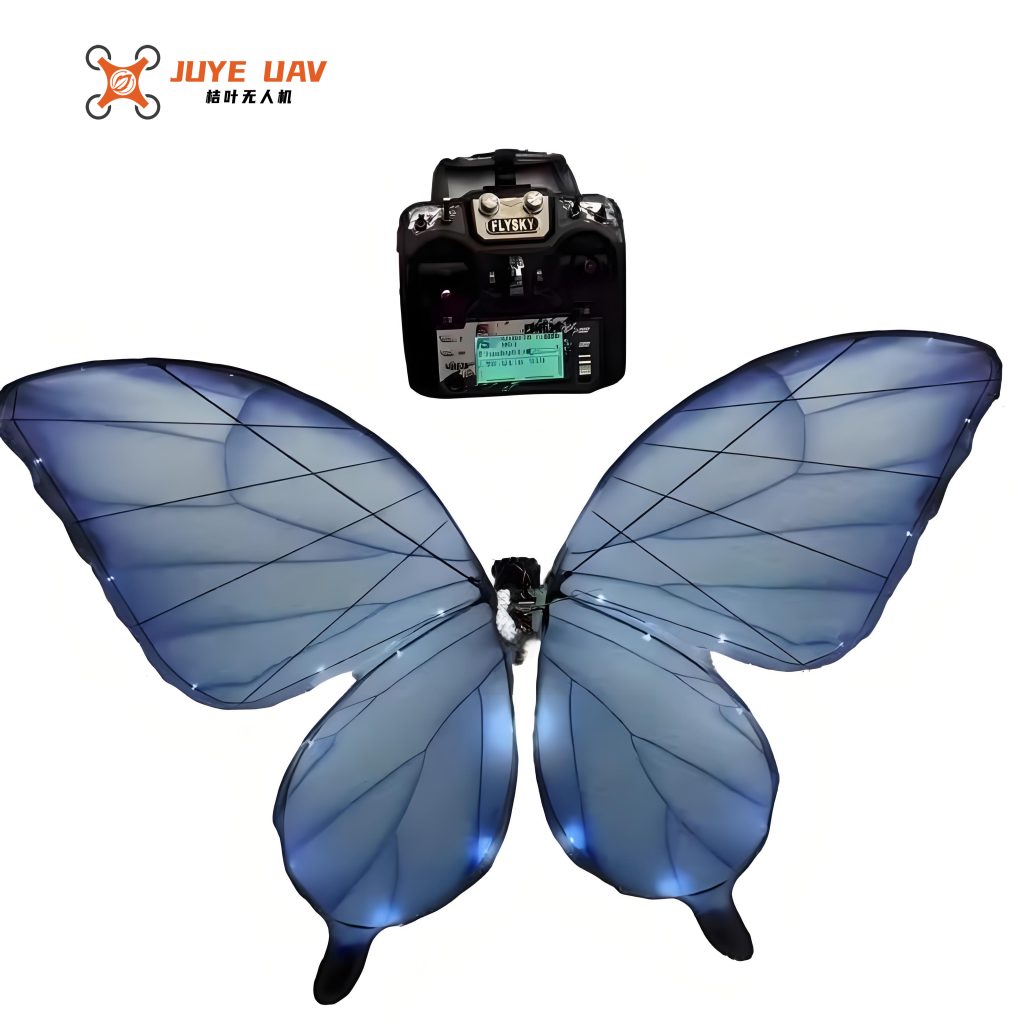
The core innovation enabling efficient flight in our bionic butterfly drone is the OptiFlap Kinematic Core. Traditional flapping mechanisms often use multiple independent actuators for flapping and pitching, leading to complex control and high weight. We propose a resonance-based, single-actuator system with a bio-mimetic four-bar linkage. This mechanism transforms the rotary motion of a coreless DC motor into the figure-eight pattern characteristic of butterfly wings, while a carefully tuned passive torsional flexure at the wing root induces automatic pitch reversal (pronation/supination) synchronized with the stroke.
The dynamics of this system are modeled as a forced, damped oscillator with a nonlinear stiffness term from the flexure:
$$ I \ddot{\phi} + C \dot{\phi} + K_1 \phi + K_3 \phi^3 = \tau_m – \tau_{aero} $$
where $I$ is the moment of inertia of the wing and linkage, $C$ is the damping coefficient, $K_1$ and $K_3$ are linear and nonlinear stiffness coefficients of the flexure joint, $\tau_m$ is the motor torque, and $\tau_{aero}$ is the aerodynamic damping torque. By operating the motor frequency near the system’s natural frequency $\omega_n = \sqrt{K_1/I}$, we achieve large flapping amplitudes with minimal power input, a principle directly observed in insect flight. This efficient kinematic core is fundamental to the endurance of the bionic butterfly drone.
Autonomous operation in unpredictable environments requires a robust perception and control system. A butterfly does not process high-fidelity 3D maps; instead, it uses optic flow for altitude control, obstacle avoidance, and visual cues for navigation. Our drone’s sensor fusion system, termed the Multi-Modal Attention Guidance (MMAG) network, mimics this process. It fuses sparse data from a monocular camera and a flow-sensor array to build a reactive understanding of the environment. The core of MMAG is a lightweight convolutional neural network with a dual-attention mechanism.
Let the raw image input be $\mathbf{I} \in \mathbb{R}^{H \times W \times 3}$ and flow sensor data be $\mathbf{F} \in \mathbb{R}^{N \times 1}$. After initial feature extraction, a Channel-Spatieal Attention Module computes attention weights. The channel attention $\mathbf{A}_c$ highlights *what* is important (e.g., a flower, an obstacle) and is computed via squeeze-and-excitation:
$$ \mathbf{A}_c = \sigma(\mathbf{W}_2 \delta(\mathbf{W}_1 \mathbf{z}_{avg})) $$
where $\mathbf{z}_{avg}$ is the global average-pooled feature vector, $\mathbf{W}_1, \mathbf{W}_2$ are learned weights, $\delta$ is ReLU, and $\sigma$ is sigmoid. Simultaneously, a spatial attention map $\mathbf{A}_s \in \mathbb{R}^{H \times W}$ highlights *where* important features (like an approaching wall) are located:
$$ \mathbf{A}_s = \sigma( f^{7×7}( [\mathbf{F}_{avg}; \mathbf{F}_{max}] ) ) $$
where $f^{7×7}$ is a 7×7 convolution, and $\mathbf{F}_{avg}, \mathbf{F}_{max}$ are average and max-pooled features across the channel dimension. The final refined feature map for the bionic butterfly drone‘s navigation is:
$$ \mathbf{I}’ = \mathbf{A}_c \cdot \mathbf{I} \otimes \mathbf{A}_s $$
where $\otimes$ denotes element-wise multiplication. These features are then fused with processed flow sensor data to estimate relative distance to obstacles ($d_{obs}$) and ground ($h_{est}$).
| Control Parameter | Proportional-Integral-Derivative (PID) Baseline | Linear Quadratic Regulator (LQR) | Proposed Bio-Inspired Adaptive Controller (for Bionic Butterfly Drone) |
|---|---|---|---|
| Altitude Hold | Controls motor RPM based on barometer error; prone to oscillation in gusts. | Optimal state feedback from full model; requires accurate model, computationally heavy. | Uses integrated optic flow from MMAG to maintain constant ground image slip. Command: $\Delta \phi_{amp} \propto (h_{desired} – h_{est})$. |
| Forward Velocity | Fixed motor RPM or fixed body angle. | Regulates pitch angle and thrust. | Modulates mean stroke plane angle and flapping asymmetry. $\theta_{body} = k_v (v_{des} – v_{flow})$, where $v_{flow}$ is from sensor array. |
| Obstacle Avoidance | Reactive turn upon ultrasonic/proximity sensor trigger. | Path planning as part of state regulation; high compute. | Direct coupling of spatial attention map $\mathbf{A}_s$ to yaw torque. Yaw command $\tau_y \propto \sum (x_{px} \cdot \mathbf{A}_s(x_{px}))$, steering away from high-attention (obstacle) regions. |
| Energy Efficiency | Constant power consumption for control loops. | Minimizes a quadratic cost function. | Exploits resonance in OptiFlap core; adaptive frequency tuning to maintain $\omega \approx \omega_n$ as battery drains. |
The flight controller translates perceptual data into wing kinematics. We define a state vector for the bionic butterfly drone as $\mathbf{x} = [p_x, p_y, p_z, \dot{p}_x, \dot{p}_y, \dot{p}_z, \phi, \theta, \psi]^T$, representing position, velocity, and orientation (roll, pitch, yaw). The control input vector is $\mathbf{u} = [\Delta \phi_{L}, \Delta \phi_{R}, \Delta \theta_{L}, \Delta \theta_{R}, \Delta \psi_{sym}]^T$, corresponding to left/right flapping amplitude offset, left/right mean pitch angle, and symmetric deviation bias. Instead of a full dynamics model, we use a learned policy via a deep reinforcement learning (DRL) framework trained in a physics simulator. The reward function $R_t$ at time $t$ is critical for shaping behavior:
$$
R_t = w_1 \cdot R_{track} – w_2 \cdot R_{crash} – w_3 \cdot R_{energy} + w_4 \cdot R_{smooth}
$$
Where:
$$ R_{track} = -\lVert \mathbf{p}_{target} – \mathbf{p}_t \rVert $$
$$ R_{crash} = \mathbb{1}(d_{obs} < d_{min}) $$
$$ R_{energy} = \int_{t-1}^{t} (I^2 \cdot R_{motor}) \, d\tau $$
$$ R_{smooth} = -\lVert \mathbf{u}_t – \mathbf{u}_{t-1} \rVert^2 $$
Here, $w_i$ are weighting coefficients. This reward structure encourages the bionic butterfly drone to reach its target efficiently while avoiding obstacles and minimizing jerky control movements. The policy network $\pi(\mathbf{u}_t | \mathbf{x}_t, \mathbf{I}’)$ is a multilayer perceptron that takes the fused state and perception features to output control parameters.
To validate the performance of our integrated bionic butterfly drone system, we constructed a prototype and conducted extensive experiments in both controlled indoor and mild outdoor environments. The prototype specifications are summarized below:
| Component / Metric | Specification / Value | Measurement Method / Notes |
|---|---|---|
| Total Mass | 48.5 grams | Precision scale |
| Wingspan | 28 cm | – |
| Actuation System | Resonant OptiFlap Core (2x coreless DC motors) | Flapping frequency tunable from 8 to 18 Hz |
| Onboard Compute | Microcontroller + Vision Processing Unit (VPU) | Runs MMAG network at 15 FPS |
| Battery | 1S 3.7V, 350mAh LiPo | – |
| Maximum Flight Time (Hover) | 8 minutes 45 seconds | Indoor, no wind |
| Forward Speed (Sustainable) | 2.1 m/s | Measured via motion capture |
| Obstacle Avoidance Success Rate | 94.2% | In a cluttered test corridor with 10 randomly placed poles |
| Altitude Hold Error (Optic Flow) | ± 8 cm | Over grass texture, 1m above ground |
The performance of the perception system was quantified separately. We define the perception accuracy $P_{acc}$ as the ratio of correctly identified navigation decisions (e.g., “turn left,” “maintain course,” “climb”) to the total decisions required when following a winding path. The MMAG system achieved a $P_{acc}$ of 92.8% under dappled sunlight conditions, compared to 74.5% for a traditional method using simple image thresholding and contour detection. This demonstrates the advantage of the attention-based fusion in mimicking the selective focus of a butterfly’s visual system for the bionic butterfly drone.
The stability of the resonant flapping mechanism was analyzed by measuring the motor current draw over time. The power consumption $P_{flap}$ for sustained hovering was found to be:
$$ P_{flap} = I_{rms}^2 \cdot R_{motor} = 1.2 \text{ Watts} $$
This is remarkably low for a flapping-wing drone of this scale and contributes directly to the extended flight time. The efficiency metric $\eta$, defined as lift force per unit power ($\frac{m \cdot g}{P_{total}}$), was calculated at 0.39 N/W for our prototype. This represents a significant step towards the efficiency observed in biological butterflies, making the bionic butterfly drone a promising platform for long-duration missions.
In conclusion, this work has detailed the comprehensive development of a fully autonomous bionic butterfly drone, from bio-inspired kinematic design and lightweight construction to a neurally-inspired perception and control system. The OptiFlap kinematic core successfully translates the efficient resonant actuation of insect flight into a practical mechanism. The Multi-Modal Attention Guidance network provides robust, low-power environmental awareness critical for autonomous navigation. The integration of these systems with a deep reinforcement learning controller results in a drone capable of stable flight, obstacle avoidance, and efficient operation. The bionic butterfly drone demonstrates that deep biomimicry, extending beyond mere shape into the realms of mechanics, sensory processing, and control, is a viable and powerful pathway for advancing the capabilities of micro aerial vehicles. Future work will focus on enhancing wind gust rejection, implementing swarm coordination algorithms inspired by collective butterfly behavior, and further miniaturization of all subsystems.