
In recent years, the rapid development of socio-economy and science and technology has significantly promoted the open-source nature of flight control systems and the advancement of supporting technologies. This has led to the emergence of unmanned aerial vehicles (UAVs), which have been widely adopted across various industries, bringing transformative changes. Based on my observations, fire drones, in particular, have shown remarkable application effects in firefighting and rescue units across regions. However, during daily operations, many firefighting units lack specialized training for drone operations, resulting in a limited understanding among frontline fire communication personnel. Consequently, the use of fire drones in firefighting communications is often restricted to aerial reconnaissance, without leveraging their full potential for in-depth applications. Therefore, in this article, I will elaborate on the technical advantages and requirements of fire drones, and propose effective applications in firefighting communications, aiming to provide valuable insights.
From my perspective, the integration of fire drones into firefighting communications represents a paradigm shift. These devices are not merely tools for surveillance; they are pivotal in enhancing operational efficiency and safety. I believe that by delving into their capabilities, we can unlock new avenues for disaster management. Below, I will systematically explore the technical aspects, supported by tables and formulas to summarize key points.
Technical Advantages of Fire Drones
Fire drones offer several distinct advantages that make them indispensable in firefighting scenarios. Based on my analysis, these can be categorized into three main areas: mobility, comprehensive视野, and safety.
Mobility and Flexibility
Typically, fire drones used in firefighting communications are small-scale UAVs. In my experience, these drones exhibit two key characteristics: lightweight design, usually under 100 kilograms, and minimal operational crew requirements, often just one or two personnel. Due to their lightweight nature, they can be easily transported to accident sites and deployed swiftly during rescue operations. Additionally, small fire drones boast high flight and response speeds, making them easy to maneuver. In practical environments, if there are prominent ground obstacles, only a few square meters of open space are needed for takeoff. These features are particularly beneficial in harsh or complex disaster scenarios.
To quantify this, consider the following table summarizing mobility parameters:
| Parameter | Typical Value | Impact on Firefighting |
|---|---|---|
| Weight | < 100 kg | Easy transport and deployment |
| Operational Crew | 1-2 personnel | Reduces manpower demands |
| Takeoff Area | Few square meters | Suitable for confined spaces |
| Flight Speed | Up to 18 km/h (example) | Rapid response times |
The mobility of fire drones can be modeled using a simple formula for deployment time: $$ T_d = \frac{D}{v} + T_s $$ where \( T_d \) is total deployment time, \( D \) is distance to site, \( v \) is transport speed, and \( T_s \) is setup time. For fire drones, \( T_s \) is often negligible due to quick assembly.
Comprehensive Field of View
Under modern technological advancements, developers have integrated宽带 and data link technologies into fire drone研发, significantly expanding their reconnaissance视野. In my view, this allows fire drones to conduct multi-angle and multi-lighting condition surveys. During low-altitude flights, operators can effectively track and film relevant objects. Currently, efforts are underway to incorporate thermal imaging and infrared night vision capabilities into fire drones, enhancing their utility in firefighting communications and improving the efficiency and quality of firefighting teams.
This advantage is crucial for real-time data acquisition. For instance, the visual coverage area \( A \) of a fire drone can be approximated by: $$ A = \pi \cdot (h \cdot \tan(\theta/2))^2 $$ where \( h \) is flight altitude and \( \theta \) is the camera’s field of view angle. This formula highlights how altitude adjustments can maximize surveillance area.
Safety and Reliability
Fire drones have gained widespread popularity in firefighting units largely due to their low environmental requirements. From my observations, they perform reliably in adverse conditions such as heavy rain or high temperatures. Thus, in actual fire rescue activities, fire drones mitigate limitations of traditional methods by providing continuous tracking and filming of accident scenes. This supports rescue operations with critical data, reducing casualties and enhancing team productivity.
To illustrate safety metrics, consider this table:
| Environmental Factor | Fire Drone Tolerance | Benefit |
|---|---|---|
| High Temperatures | Up to 150°C (example) | Operational in fire zones |
| Rainfall | Water-resistant designs | Functionality in storms |
| Wind Speed | Resistance to level 6 winds | Stability in gusty conditions |
The reliability of a fire drone in harsh environments can be expressed as: $$ R(t) = e^{-\lambda t} $$ where \( R(t) \) is reliability over time \( t \), and \( \lambda \) is failure rate, which is minimized through robust design.
Technical Requirements for Fire Drones in Firefighting Communications
Based on my analysis, to ensure effective application, fire drones must meet specific technical demands. These requirements focus on reliability, controllability, stability, and operational rigor.
Enhancing Reliability
As is well-known, disaster scenes often involve complex factors like wind and smoke. Therefore, fire drones must withstand恶劣 environments to facilitate accident site surveys. For example, during high-rise building fires, fire drones need strong wind resistance—typically above level 6. Additionally, they require high temperature tolerance and explosion-proof capabilities, as most rescues involve fire incidents. This prevents失控 and ensures mission completion.
A key formula for wind resistance is the drag force equation: $$ F_d = \frac{1}{2} \rho v^2 C_d A $$ where \( F_d \) is drag force, \( \rho \) is air density, \( v \) is wind speed, \( C_d \) is drag coefficient, and \( A \) is cross-sectional area. Fire drones are designed to minimize \( C_d \) and \( A \) to counteract high winds.
Improving Controllability
In practical applications, operators must ensure sufficient battery life for real-time monitoring. For instance, a fire drone with a speed of 18 km/h can patrol within a 2 km range. To complete巡视 effectively, battery life should exceed 30 minutes, with cruise intervals over 15 minutes. Moreover, flight altitude must be adequate to meet the needs of modern high-rise buildings.
Battery life \( L \) can be modeled as: $$ L = \frac{C}{P} $$ where \( C \) is battery capacity and \( P \) is power consumption. For fire drones, \( C \) is optimized to extend \( L \). The following table summarizes controllability requirements:
| Requirement | Specification | Rationale |
|---|---|---|
| Battery Life | > 30 minutes | Sustained operation |
| Cruise Interval | > 15 minutes | Recharging and repositioning |
| Flight Altitude | Up to 500 meters (example) | Covers tall structures |
Boosting Stability
Beyond environmental resistance, stable image transmission is crucial for firefighting communications. In my view, this is vital for on-site command and decision-making. Fire drones must deliver clear, continuous images with strong抗干扰 capabilities to ensure uninterrupted data flow.
The signal-to-noise ratio (SNR) for image transmission can be represented as: $$ \text{SNR} = \frac{P_s}{P_n} $$ where \( P_s \) is signal power and \( P_n \) is noise power. High SNR ensures image clarity. Additionally, stability in communication links can be assessed through bit error rate (BER): $$ \text{BER} = \frac{1}{2} \text{erfc}\left( \sqrt{\frac{E_b}{N_0}} \right) $$ where \( E_b \) is energy per bit and \( N_0 \) is noise density. Fire drones employ error-correcting codes to minimize BER.
Ensuring Operational Rigor
Despite the deployment of fire drones, many firefighting units lack specialized training. Therefore, in my opinion, departments should enhance personnel training, conduct systematic drills, and establish assessment mechanisms to standardize operations. Regular technical workshops can foster交流, leading to maintenance protocols that extend the lifespan of fire drones.
A formula for training effectiveness might include: $$ E_t = \frac{S_c}{T_t} $$ where \( E_t \) is training efficiency, \( S_c \) is skill acquisition score, and \( T_t \) is training time. Higher \( E_t \) indicates better preparedness.
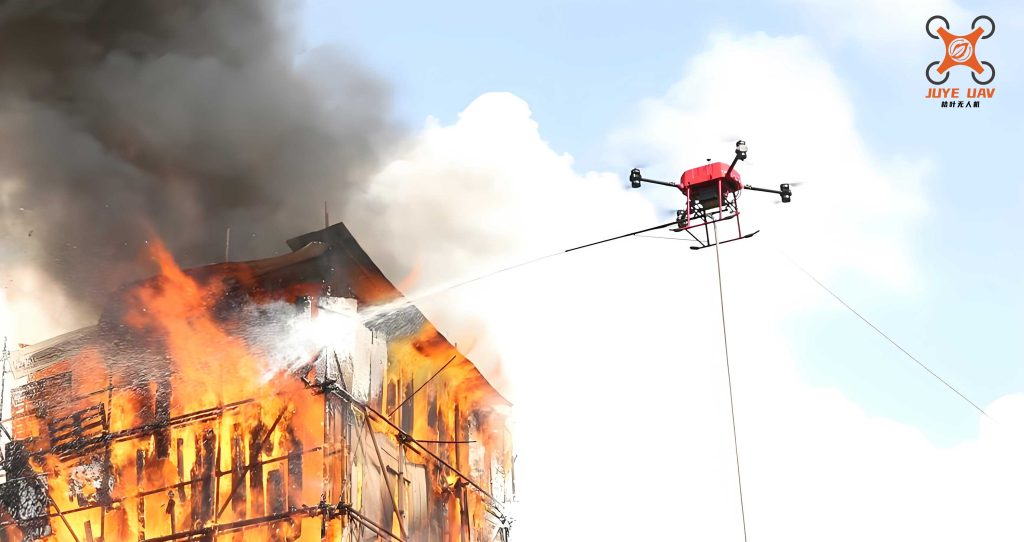
Effective Applications of Fire Drones in Firefighting Communications
From my experience, fire drones play transformative roles in actual firefighting scenarios. Their applications span from command support to detailed reconnaissance.
Commanding On-Site Rescue Operations
Upon arriving at a fire scene, rescue teams must quickly assess the situation, including火势焦点, casualties, and escape routes. Given the complexity, fire drones provide an aerial perspective, offering broader视野 for strategic planning. Operators can use fire drones to gather real-time data,辅助救援 activities, and enhance safety for firefighters.
This application leverages the mobility and视野 advantages. For example, the time saved in assessment can be quantified as: $$ T_s = T_t – T_d $$ where \( T_s \) is saved time, \( T_t \) is traditional assessment time, and \( T_d \) is drone-based assessment time. Typically, \( T_d \ll T_t \), highlighting efficiency gains.
Detecting Disaster Scene Conditions
Fire drones are instrumental in intelligence gathering. Through wireless networks, they capture multi-angle image data and transmit it to ground stations, enabling real-time monitoring. Additionally, with infrared detection, fire drones generate temperature fields based on sensed heat, aiding in灭火 strategy formulation.
The infrared detection capability can be modeled using Planck’s law for blackbody radiation: $$ I(\lambda, T) = \frac{2hc^2}{\lambda^5} \frac{1}{e^{hc/(\lambda k_B T)} – 1} $$ where \( I \) is spectral radiance, \( \lambda \) is wavelength, \( T \) is temperature, \( h \) is Planck’s constant, \( c \) is speed of light, and \( k_B \) is Boltzmann constant. Fire drones use this to map heat sources.
To summarize applications, here is a table:
| Application | Key Function | Outcome |
|---|---|---|
| Command Support | Real-time aerial views | Improved decision-making |
| Reconnaissance | Image and data collection | Accurate situational awareness |
| Thermal Mapping | Infrared detection | Identification of hot spots |
Future Prospects and Conclusion
In conclusion, the application of fire drones in firefighting communications holds immense practical significance. Not only do they enhance communication quality and efficiency, but they also ensure smooth rescue operations and boost productivity. I am confident that with ongoing technological advancements, fire drones will see expanded use in firefighting and other sectors, showcasing their full potential.
Looking ahead, I believe innovations in AI and automation will further integrate fire drones into emergency response systems. For instance, autonomous swarms of fire drones could collaborate for large-scale disasters, governed by algorithms like: $$ \min \sum_{i=1}^{n} E_i $$ subject to constraints on coverage and battery life, where \( E_i \) is energy consumption per fire drone. This represents a frontier in firefighting technology.
Ultimately, the journey of fire drones is just beginning. As we continue to refine their capabilities, they will undoubtedly become cornerstone tools in safeguarding communities and enhancing resilience against disasters.