
The evolution of society and the increasing density of urban populations have significantly amplified the complexity and severity of fire safety challenges. In the aftermath of disasters, operating within unknown and hazardous environments, the integration of unmanned aerial vehicles, specifically fire drone systems, has proven to be a transformative force, dramatically enhancing the efficiency and safety of rescue operations. Under the framework of a comprehensive emergency response system designed for “all-types of disasters and major emergencies,” the fire drone has assumed an increasingly critical role. Its applications span from early warning and on-site reconnaissance to direct intervention, playing an indispensable part in mitigating disaster impact and bolstering emergency response capabilities. This analysis delves into the current state, inherent characteristics, operational limitations, and specific applications of fire drone technology in firefighting and rescue, concluding with a prospective outlook on future developmental trends.
1. Introduction: The Rise of the Fire Drone
Compared to traditional rescue methodologies, unmanned aerial vehicles (UAVs), or drones, have garnered rapid favor within fire and rescue services due to their inherent flexibility, rapid deployment, and operational convenience. A fire drone can swiftly enter a disaster zone post-incident, providing first responders with immediate visual and situational data, thereby facilitating faster decision-making and potentially minimizing casualties. Parallel to advancements in robotics, sensor technology, and materials science, the technological sophistication of drones has evolved considerably. Modern fire drone platforms are now capable of operating in a diverse array of complex scenarios. They can be equipped with specialized payloads such as infrared thermal imaging cameras, LiDAR (Light Detection and Ranging) systems, and emergency communication relays. During critical incidents, these assets enable vital functions including emergency search and rescue, aerial delivery of supplies, and establishing airborne communication networks. This technological leap effectively addresses numerous challenges historically faced in conventional firefighting, providing command structures with powerful, data-driven support for the scientific deployment of resources.
2. Technological Characteristics and Classification of Fire Drones
A fire drone is fundamentally an unmanned aircraft system (UAS) operated via remote control or pre-programmed autonomous flight plans. Its core technology integrates several disciplines: autonomous flight control, remote sensing and imaging, telemetry, Global Positioning System (GPS) navigation, and robust data transmission. This synthesis allows for automated mapping of incident scenes, acquisition of high-resolution imagery and video, and the physical carriage of firefighting apparatus or sensors.
2.1 Defining Characteristics of Fire Drones
The operational advantages of contemporary fire drone systems are multifaceted, primarily manifesting in three key areas: high monitoring precision, favorable cost-effectiveness, and enhanced operational safety.
- High Monitoring Precision: Most tactical fire drone units operate at low altitudes, enabling detailed close-range observation and measurement. In engineering and emergency contexts, this allows for reconnaissance with precision that can approach millimeter-level accuracy for specific mapping applications, providing commanders with exceptionally detailed situational awareness.
- Favorable Cost-Effectiveness: The manufacturing and operational costs of multi-rotor drones, in particular, are relatively low compared to manned aerial assets like helicopters. Their operation is less susceptible to certain external logistical constraints. Furthermore, the modular nature of payloads (cameras, sensors, delivery mechanisms) allows a single platform to serve multiple functions, optimizing the cost-to-capability ratio and controlling overall system expenditure.
- Enhanced Safety and Mobility: Fire drone systems require minimal space for take-off and landing, a crucial factor in congested urban disaster sites. Their flight paths and operational parameters can be adjusted in real-time based on live feedback from the scene. Additionally, modern flight control systems have simplified pilot interfaces, reducing the training threshold for qualified operators.
2.2 Classification of Fire Drones
With continuous innovation in UAV technology, flight control and autopilot systems have become increasingly sophisticated and reliable. Fire drone platforms can be categorized based on several criteria:
By Aerodynamic Configuration:
| Type | Description | Typical Use Case in Firefighting |
|---|---|---|
| Fixed-Wing | Drones with a rigid wing that generates lift via forward airspeed. Cannot hover. | Large-area reconnaissance (forest fires, floods), long-endurance patrols, aerial mapping. |
| Single-Rotor (Helicopter) | Similar to a traditional helicopter, using one main rotor for lift and a tail rotor for anti-torque. | Heavy-lift operations, precise payload delivery (e.g., water/foam), missions requiring high stability in windy conditions. |
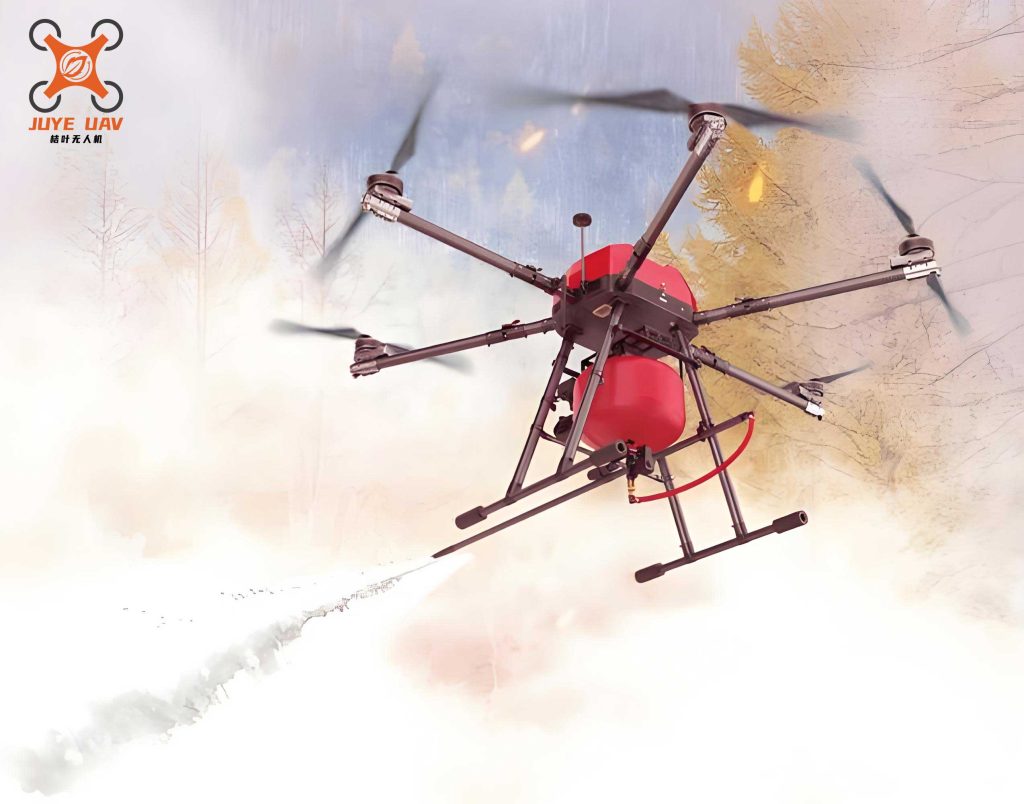
| Multi-Rotor | Utilizes multiple rotors (typically 4, 6, or 8) for lift and control. Can hover and perform vertical take-off and landing (VTOL). | Close-quarters inspection (building facades), stationary observation, gas detection, light payload delivery, most common tactical fire drone. |
By Power Source:
| Type | Power Source | Advantages | Disadvantages |
|---|---|---|---|
| Electric | Rechargeable Lithium-based batteries | Quieter operation, fewer moving parts, easier maintenance, zero local emissions, generally safer in volatile atmospheres. | Limited flight endurance (typically 20-45 minutes), longer recharge times, performance degrades in extreme cold. |
| Internal Combustion (Gasoline/Hybrid) | Gasoline or heavy-fuel engines | Superior flight endurance (can exceed several hours), higher power-to-weight ratio for heavy lifting. | Louder, produces exhaust, requires more complex maintenance, greater vibration, higher fire risk in certain environments. |
The choice between electric and combustion-powered fire drone units involves a critical trade-off analysis between endurance, payload capacity, and operational safety specific to the incident environment.
3. Current Application Landscape of Fire Drones
Today, the rapid deployment of a fire drone for initial scene assessment is a widely recognized and approved tactic within rescue command protocols for various specialized incidents. However, the full potential of UAVs to enhance operational efficiency is still constrained by technological limitations and evolving tactical doctrines.
3.1 High-Rise Building Fire Suppression
Combating fires in high-rise structures remains a persistent and formidable challenge. Traditional methods are often hampered by limited aerial access, protracted deployment times for ground-based ladders and hoses, and significant risks to personnel attempting interior attacks. The fire drone introduces a paradigm shift. Integrated systems combining transport vehicles, drones, and mission-specific payloads can be rapidly deployed. A fire drone can perform external reconnaissance to identify fire location and spread via thermal imaging, assess structural integrity, and locate victims near windows. Furthermore, it can carry and discharge extinguishing agents externally to suppress or cool areas, creating safer conditions for interior crews, or deliver small rescue supplies to trapped individuals.
3.2 Hazardous Materials (HazMat) Incident Response
Fires and explosions involving hazardous chemicals are frequently accompanied by the release and diffusion of toxic gases and particulates. A fire drone enables a “full-process” approach to HazMat incident management. In the pre-incident phase, drones can conduct routine remote surveillance of chemical storage facilities, identifying potential violations or unsafe conditions. During an active incident, a fire drone equipped with gas detectors (e.g., PID, multi-gas sensors) can safely sample the atmosphere downwind, identifying contaminant types and concentrations. Coupled with live video feed, this real-time data stream is invaluable for commanders in establishing safety perimeters, predicting plume dispersion, and guiding evacuation and mitigation strategies, all while keeping personnel out of the immediate danger zone.
3.3 Wildland and Forest Fire Management
Specially designed fire drone units capable of withstanding temperature extremes are revolutionizing wildland firefighting. Their applications span the entire fire management cycle:
- Prevention & Patrol: Drones with long-endurance capabilities perform automated patrols over vast, inaccessible forested areas, using visual and infrared sensors to detect nascent heat sources or smoke plumes long before they are visible from towers or ground patrols.
- Active Firefighting: During a wildfire, drones provide an aerial overview of the fire’s perimeter, rate of spread, and intensity. This intelligence is critical for resource allocation and firefighter safety. They can also perform “hotspot” detection post-suppression to prevent re-ignition.
- Search & Rescue: In complex terrain, drones equipped with thermal cameras can scan for missing personnel or civilians, penetrating smoke and identifying heat signatures that are invisible to the naked eye.
The operational equation for a fire drone in wildland fire can be conceptualized by its area coverage rate, a function of endurance, speed, and sensor swath width. A simplified model is:
$$ A_{cov} = v \cdot t \cdot w_{eff} $$
where \( A_{cov} \) is the total area covered (m²), \( v \) is the drone’s ground speed (m/s), \( t \) is the effective flight time (s), and \( w_{eff} \) is the effective sensor swath width (m).
3.4 Natural Disaster Assessment and Command
In the chaotic aftermath of natural disasters like earthquakes, floods, landslides, or major storms, a fire drone serves as a force multiplier for rapid situational assessment. It can bypass damaged infrastructure and impassable terrain to conduct aerial surveys, generating real-time maps, identifying blocked access routes, and locating survivors. Integrated gas sensors can also detect leaks from ruptured pipelines. This bird’s-eye view provides incident commanders with accurate, comprehensive information essential for prioritizing life-saving interventions and allocating rescue teams efficiently.
3.5 Search, Location, and Auxiliary Functions
Beyond primary firefighting roles, the versatility of the fire drone extends to several auxiliary functions critical to modern emergency response:
- Precision Location and Search: Using mesh networking or GNSS (Global Navigation Satellite System) technology, multiple drones can collaborate to create a communication and positioning network over a disaster site. This can provide real-time location tracking for both rescue teams and victims equipped with beacons, drastically reducing search times.
- Aerial Illumination and Communication: Drones can deploy powerful LED lighting arrays to illuminate night-time operations, extending operational windows. They can also act as temporary communication relays (cell-on-wings or COWs) to restore critical communications in areas where infrastructure has been destroyed.
4. Existing Shortcomings and Technical Challenges
Despite their proven utility, the widespread and reliable deployment of fire drone systems in all operational contexts is hindered by several significant challenges.
| Challenge Category | Specific Limitations | Impact on Operations |
|---|---|---|
| Environmental Robustness | High susceptibility to strong winds, turbulent fire-induced thermals, heavy rain/snow, dense smoke (obscures cameras), electromagnetic interference (EMI) from high-voltage lines or industrial sites, and the aerodynamic phenomenon of vortex ring state during descent. | Limited operational envelope, increased risk of crash or loss-of-control in adverse conditions, leading to mission failure or asset loss. |
| System Integration & Compatibility | Modular payload integration (thermal, gas, LiDAR, comms) often lacks standardization. EMI between drone electronic speed controllers (ESCs), onboard radios, and sensitive emergency communication bands used by responders can cause interference. | Unreliable data links, degraded control signals, or disruption of critical ground team communications, compromising overall mission safety and effectiveness. |
| Core Performance Parameters | 1. Endurance: Battery life is short relative to extended fireground operations. 2. Payload Capacity: Most multi-rotor drones have limited lift, restricting the size/weight of extinguishing agents or rescue tools. 3. Intrinsic Safety: Lack of explosion-proof ratings for motors and electronics limits use in flammable vapor zones. 4. Autonomous Navigation: Advanced sense-and-avoid capabilities for dynamic obstacle avoidance are not yet standard. |
Frequent battery swaps interrupt continuity; inability to carry meaningful fire suppressant loads; exclusion from high-risk CBRNe/industrial incidents; risk of collision in cluttered environments. |
| Operational Doctrine & Personnel | Lack of unified, standardized training programs, certification pathways, and tactical playbooks for fire drone operations specific to fire service needs. | Inconsistent skill levels among operators, suboptimal tactical employment, and potential airspace conflicts during multi-agency responses. |
| Lack of Standards | Absence of comprehensive industry or government standards defining minimum performance requirements for a “firefighting-grade” drone (e.g., minimum wind resistance, ingress protection rating, thermal operating range, communication protocols). | Difficulty for agencies in procurement, uneven quality of commercial offerings, and obstacles to interoperability between different units and manufacturers. |
5. Future Outlook and Developmental Trends
The future trajectory of fire drone technology points toward greater integration, intelligence, and specialization to overcome current limitations and unlock new capabilities.
5.1 Intelligent and Autonomous Systems
The next generation of fire drone will transcend pre-programmed flight paths. By integrating artificial intelligence (AI) and machine learning (ML) with onboard sensor fusion, drones will achieve a higher degree of situational awareness and autonomous decision-making. Imagine a fire drone that can automatically adjust its flight pattern to track a moving heat signature, identify structural collapse patterns from visual data, or optimize its gas sampling route based on real-time plume modeling. Coupling drone-gathered data with cloud-based GIS (Geographic Information Systems) and big data analytics platforms will provide commanders with predictive insights, such as forecasting fire spread or identifying the most probable locations of additional victims.
5.2 Swarm Technology and Multi-Drone Coordination
The concept of a single fire drone will evolve into coordinated teams or swarms. Different drones with specialized roles (scout, communicator, payload carrier) will operate collaboratively under a unified control system. For example, in a large industrial fire, one swarm could map the exterior thermal profile while another performs internal reconnaissance via available openings, with a third maintaining a persistent communications relay. Swarm algorithms, often based on bio-inspired behavior models, can ensure efficient area coverage and adaptive response. A simplified potential field model for swarm obstacle avoidance can be represented as:
$$ \vec{F}_{total, i} = \vec{F}_{goal, i} + \sum_{j \neq i} \vec{F}_{rep, ij} + \sum_{k} \vec{F}_{rep, ik}^{obs} $$
where for drone \( i \), \( \vec{F}_{total} \) is the resultant guidance force, \( \vec{F}_{goal} \) is the attractive force towards its objective, \( \vec{F}_{rep, ij} \) is the repulsive force from other drones \( j \), and \( \vec{F}_{rep, ik}^{obs} \) is the repulsive force from obstacles \( k \).
5.3 Specialization and Performance Breakthroughs
Future development will focus on creating purpose-built fire drone platforms for specific mission sets:
- Heavy-Lift Suppression Drones: Utilizing hybrid or advanced combustion engines to carry significant quantities of water, foam, or dry chemical agents for direct attack, especially on high-rise and industrial fires.
- Long-Endurance Patrol Drones: Fixed-wing or hybrid VTOL designs with advanced power sources (hydrogen fuel cells, solar augmentation) for patrolling forests, pipelines, or critical infrastructure for hours.
- Intrinsically Safe/Explosion-Proof Drones: Designed with sealed housings and pneumatically driven motors to operate safely in potentially explosive atmospheres (ATEX-rated).
Research into advanced materials, more energy-dense batteries, and novel propulsion systems will be crucial to extending the fundamental endurance and payload parameters that currently constrain fire drone utility.
5.4 Standardization, Proliferation, and Professionalization
For the technology to reach its full potential, several parallel developments are necessary:
- Technical Standardization: Establishing clear, enforceable standards for performance, safety, and data interoperability will drive responsible innovation and ensure reliability.
- Cost Reduction & Proliferation: Continued advancements in manufacturing and economies of scale will lower costs, making sophisticated fire drone systems accessible not only to large urban departments but also to smaller municipal and volunteer fire services.
- Professionalization of Personnel: The creation of formalized career pathways for UAS operators within fire services, including standardized training curricula, certification (beyond basic FAA Part 107), and continuous tactical development, is essential.
6. Concluding Recommendations
To harness the transformative potential of fire drone technology systematically, the following strategic actions are recommended:
6.1 Expedite the Development of Comprehensive Technical Standards. Regulatory bodies in collaboration with industry and fire service stakeholders must urgently establish minimum performance, safety, and interoperability standards for drones deployed in emergency response. This includes specifications for durability in extreme environments, electromagnetic compatibility, data security, and communication protocols. Standardization will guide ethical R&D, streamline procurement processes, and ensure fielded systems are fit for the harsh realities of fireground operations.
6.2 Invest in a Robust and Sustainable Talent Pipeline. Fire departments must institutionalize fire drone operations. This entails:
- Establishing dedicated UAS units or specialist positions within existing special operations frameworks.
- Implementing a tiered training and certification program, from basic piloting to advanced mission planning and data analysis, tailored to fire service objectives.
- Developing and regularly practicing standardized operational procedures (SOPs) and integrating drone tactics into broader incident command system (ICS) training.
- Fostering partnerships with academic institutions and private UAS companies for advanced training and joint R&D exercises.
7. Final Synthesis
The integration of unmanned aerial systems, particularly the specialized fire drone, into the fire and rescue service toolkit represents a significant leap forward in operational capability. From providing critical aerial intelligence and enhancing responder safety to enabling novel direct intervention methods, the fire drone has already demonstrated immense value. The trajectory is clear: the future lies in smarter, more collaborative, more robust, and more specialized systems. By addressing the extant challenges through focused research, standardization, and professional development, the fire service can fully realize the potential of this technology. The intelligent fire drone will evolve from a valuable tactical tool into a cornerstone of a modern, data-driven, and highly effective emergency response ecosystem, fundamentally strengthening our collective resilience against a wide spectrum of disasters.