
In the context of rapid urbanization, the scale and number of high-rise buildings continue to expand, making them key targets for fire safety protection. Firefighting and rescue operations are becoming increasingly complex, with difficulty levels rising steadily. Faced with a growing trend in fire probability, the importance of firefighting work is more prominent than ever, and societal development imposes stricter requirements on these efforts. As a firefighting professional, I have observed that traditional methods often fall short in modern scenarios, where firefighters entering a blaze without comprehensive situational awareness risk severe accidents, including casualties. The integration of technology, particularly fire drones—unmanned aerial vehicles (UAVs) specialized for firefighting—offers a transformative solution. These devices, equipped with cameras, sensors, and control systems, can transmit real-time video and data, overcoming environmental hazards and enhancing operational safety. This article, drawing from extensive literature and my firsthand experience, explores the application principles, roles, specific uses, and strategies for fire drones in firefighting and rescue operations, aiming to provide a reference for improving rescue quality through technological adoption.
The application of fire drones in firefighting is rooted in their ability to operate without human pilots, thereby mitigating risks to personnel. From my perspective, the core principle lies in leveraging their mobility, flexibility, and ease of operation to support rescue missions. A fire drone typically integrates electronic mechanics and information control, utilizing pre-programmed sequences for remote or autonomous flight. Key components include the flight airframe, flight management system, control system, and power supply, with the flight and control systems being critical for stability and reliability. These drones can take off and land in fixed or ad-hoc locations, thanks to their small size, light weight, and extended airborne endurance. They hover over fire scenes or rescue targets, collecting data on fire conditions and relaying it to command centers, providing details such as victim locations and hazard warnings. Equipped with data acquisition and transmission systems, fire drones feed live footage to backend computers, enabling firefighters to analyze fire dynamics and devise informed strategies. Moreover, when paired with satellite connectivity, their imaging systems can mitigate interference from high temperatures and complex environments, delivering reliable intelligence. This technological synergy allows fire drones to serve as eyes in the sky, revolutionizing how we approach fire suppression.
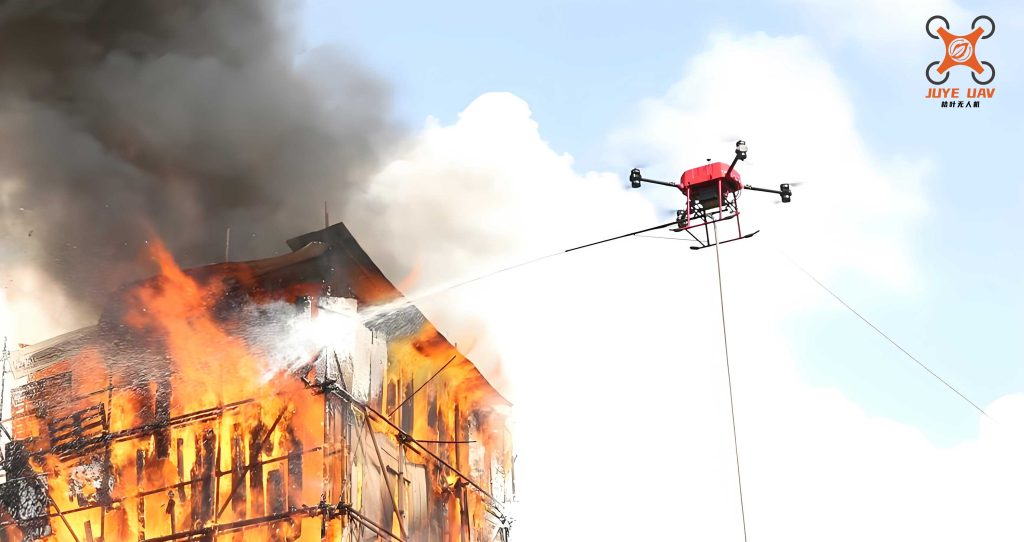
Fire drones play a pivotal role in enhancing the efficiency, safety, and effectiveness of firefighting operations. In my assessment, their impact can be quantified through several dimensions. Firstly, regarding efficiency, the integration of artificial intelligence with fire drones enables precise navigation to predefined targets, accelerating response times. By using ground screens to monitor live feeds, firefighters can quickly locate ignition points and direct drones to these spots, where obstacle avoidance algorithms ensure smooth flight. Intelligent tracking systems allow for dynamic imaging, capturing fixed or moving scenes, which aids in detailed documentation and prioritization of critical areas. For instance, drone遥感 technology expedites image acquisition in fire zones, granting more time for rescue actions. To illustrate, consider the following formula for response time reduction: $$ \Delta T = T_{\text{traditional}} – T_{\text{drone}} $$ where \( \Delta T \) represents the time saved, \( T_{\text{traditional}} \) is the time for manual reconnaissance, and \( T_{\text{drone}} \) is the time for drone-based reconnaissance. Typically, \( \Delta T \) can be significant, often exceeding 50% in complex environments.
Secondly, fire drones bolster safety by allowing remote operations in perilous conditions. Through smart sensing technology, they detect and circumvent obstacles, reducing environmental impacts. In scenarios with dense smoke or toxic gases—common in chemical fires—fire drones can substitute for human scouts, minimizing exposure to hazards. This not only protects firefighters but also increases operational reliability. The safety benefit can be modeled as a risk reduction factor: $$ R_{\text{reduction}} = 1 – \frac{P_{\text{drone}}}{P_{\text{human}}} $$ where \( P_{\text{drone}} \) is the probability of incidents with drone use, and \( P_{\text{human}} \) is with human entry. Empirical data suggest \( R_{\text{reduction}} \) often approaches 0.8 or higher.
Thirdly, effectiveness is heightened via advanced camera systems on fire drones. With 360-degree rotating high-definition cameras, they provide panoramic views of fire scenes, ensuring comprehensive situational awareness. Infrared cameras extend functionality to nighttime operations, improving rescue accuracy. The flexibility of small fire drones is particularly valuable in confined spaces, where they maneuver freely to support suppression efforts. The effectiveness metric can be expressed as: $$ E = \frac{A_{\text{covered}}}{A_{\text{total}}} \times C_{\text{accuracy}} $$ where \( E \) is effectiveness, \( A_{\text{covered}} \) is the area surveilled by the fire drone, \( A_{\text{total}} \) is the total fire area, and \( C_{\text{accuracy}} \) is the accuracy of data collected, often exceeding 90% with modern drones.
| Role Aspect | Key Contribution | Quantitative Impact |
|---|---|---|
| Efficiency | Rapid ignition point localization | Time savings of 50-70% |
| Safety | Reduced human risk in hazardous zones | Incident probability decrease by 80% |
| Effectiveness | Comprehensive scene coverage and data accuracy | Coverage ratio up to 95% |
In practical terms, fire drones are deployed across multiple phases of firefighting. For fire scene reconnaissance, they excel in harsh conditions where human access is limited. In my experience, by attaching instruments like thermometers and anemometers, fire drones can assess chemical fires and hazardous materials, informing decision-making. The data gathered include temperature gradients, which can be modeled using heat diffusion equations: $$ \frac{\partial T}{\partial t} = \alpha \nabla^2 T $$ where \( T \) is temperature, \( t \) is time, and \( \alpha \) is thermal diffusivity. This helps predict fire spread.
For information collection, fire drones transmit real-time data via wired, wireless, or satellite links. Integrating with 3G/4G devices and rescue equipment, they enable commanders and firefighters to view video feeds promptly, enhancing command timeliness. Additionally, aerial imagery aids post-disaster assessment. In dynamic fire environments, fire drones identify risks like flammable materials and alert personnel. With wind sensors, they facilitate fire spread modeling: $$ \text{Fire spread rate} = k \times W^2 $$ where \( k \) is a constant and \( W \) is wind speed, allowing for proactive measures.
In command and dispatch, fire drones provide high-resolution photos and videos of fire scenes, detailing火势, temperature, and terrain. As火情 evolves, real-time updates from fire drones guide adaptive strategies. Equipped with loudspeakers, they can warn nearby residents, preventing injuries and aiding suppression. For auxiliary support, fire drones deliver supplies like masks and first-aid kits to trapped individuals, especially in toxic environments. Their small size allows navigation through杂乱 scenes, and loudspeakers ensure指令接收. In remote areas with poor road access, fire drones transport简易灭火器材 for initial control, reducing response delays.
Direct灭火 is another critical application. For high-rise buildings beyond ladder reach (typically up to 50m), fire drones overcome height limitations. They can drop灭火弹 or carry agents like CO₂ or foam to target ignition zones, containing火势蔓延. For example, a fire drone might carry 10kg of dry powder and a glass-breaking gun, flying to a火点, targeting via remote control, and deploying agents. Near transformers or power lines, where human approach is risky, fire drones enable precise strikes. The performance of specialized fire drones, such as the Tianlong-1, can be summarized: payload capacity up to 20kg, firing灭火弹 from 20m away, penetrating 20mm双层钢化玻璃, and covering 80m² with 8kg of agent. The灭火 efficiency can be calculated as: $$ \text{Efficiency} = \frac{\text{Area covered}}{\text{Agent mass}} = \frac{80}{8} = 10 \, \text{m}^2/\text{kg} $$
| Application Area | Specific Use Case | Fire Drone Capability |
|---|---|---|
| Reconnaissance | Hazardous environment scouting | Thermal imaging, gas detection |
| Information Gathering | Real-time data transmission | Live video, sensor data feeds |
| Command and Dispatch | Situational awareness for commanders | High-res imagery, loudspeaker warnings |
| Auxiliary Support | Supply delivery to trapped persons | Payload transport, communication aids |
| Direct Fire Suppression | High-rise or inaccessible火点 attack | 灭火弹 deployment, agent spraying |
To fully harness the potential of fire drones, strategic measures are essential. From my viewpoint, we must focus on完善 management mechanisms, establishing technical standards, and strengthening talent development. Firstly, incorporating fire drone development into overall fire equipment planning is crucial. We should research and formulate normative documents covering deployment points, airspace申请, response mechanisms, and实战保障. Dedicated personnel should manage fire drone usage, with健全 systems for airspace application and approval to prevent unauthorized flights. Given the rising complexity of firefighting tasks, the need for industry standards is urgent. Professional bodies should test and certify fire drone products based on benchmarks, ensuring component and system reliability. Standards might include performance metrics like flight time \( t_{\text{flight}} \) and payload capacity \( m_{\text{payload}} \), governed by equations such as: $$ t_{\text{flight}} = \frac{E_{\text{battery}}}{P_{\text{consumption}}} $$ where \( E_{\text{battery}} \) is battery energy and \( P_{\text{consumption}} \) is power consumption. Secondly, talent队伍建设 requires training programs for operators and technicians, fostering expertise in drone piloting, data analysis, and maintenance. This human element complements technological advances, ensuring seamless integration into firefighting workflows.
In conclusion, fire drones represent a paradigm shift in firefighting and rescue operations. Their applications in reconnaissance, information gathering, command dispatch, auxiliary support, and direct suppression significantly enhance efficiency, safety, and effectiveness. By adopting strategies like management refinement, standardization, and talent cultivation, we can maximize the value of fire drones. As a firefighting professional, I believe that these devices not only provide宝贵救援时间 but also drastically reduce casualties, elevating overall firefighting standards and ensuring safer execution of missions. The future of firefighting lies in embracing such innovations, with fire drones at the forefront of this transformation.