
In the realm of emergency response, hazardous chemical warehouse fires present a formidable challenge due to their complexity, rapid escalation, and potential for catastrophic secondary incidents. Traditional firefighting methods often fall short in such environments, where responders face limited visibility, toxic atmospheres, and explosive risks. As a first-person researcher in this field, I have witnessed how the convergence of fifth-generation (5G) mobile communication technology and unmanned aerial vehicle (UAV) systems, particularly fire drones, is transforming our approach to these emergencies. This article delves into the integration of 5G and fire drone technology, exploring its theoretical foundations, practical applications, and future potential. We will employ tables and formulas to summarize key concepts, emphasizing the term “fire drone” throughout to highlight its pivotal role. The goal is to provide a comprehensive analysis that underscores how these advancements enhance safety, efficiency, and decision-making in crisis situations.
The inherent dangers of hazardous chemical warehouses—such as storage of flammable, explosive, toxic, and corrosive substances—mean that fires can quickly spiral out of control, releasing harmful plumes and hindering rescue efforts. Conventional ground-based reconnaissance and manual interventions are often slow, risky, and inadequate for real-time data acquisition. For instance, responders may struggle to assess the extent of a fire or monitor gas dispersion without endangering lives. This is where fire drones, augmented by 5G connectivity, offer a paradigm shift. By leveraging high-speed, low-latency networks, these aerial platforms can perform tasks like remote sensing, live monitoring, and even direct fire suppression, all while keeping personnel at a safe distance. In this exploration, we will dissect the technical specifications, operational benefits, and implementation strategies that make 5G fire drones indispensable tools in modern emergency response.
To begin, let us examine the core attributes of 5G technology that enable such advancements. 5G networks are characterized by three primary features: enhanced mobile broadband (eMBB) for high data rates, ultra-reliable low-latency communication (URLLC) for real-time control, and massive machine-type communication (mMTC) for connecting myriad devices. Mathematically, the achievable data rate in a 5G system can be expressed using Shannon’s capacity theorem, which models the maximum theoretical throughput over a channel. For a given bandwidth \(B\) and signal-to-noise ratio \(\frac{S}{N}\), the data rate \(R\) is given by:
$$R = B \log_2 \left(1 + \frac{S}{N}\right)$$
In practical terms, 5G can deliver peak data rates up to 10 Gbps, latency as low as 1 millisecond, and support for up to 1 million connections per square kilometer. This contrasts sharply with previous generations like 4G, which typically offer rates around 100 Mbps and latencies of 30-50 milliseconds. The low latency is particularly crucial for fire drone operations, as it ensures near-instantaneous transmission of control commands and sensor data. We can model the end-to-end latency \(L\) as the sum of propagation delay \(t_p\), transmission delay \(t_t\), processing delay \(t_{proc}\), and queuing delay \(t_q\):
$$L = t_p + t_t + t_{proc} + t_q$$
With 5G’s optimized architecture, \(L\) is minimized, enabling real-time remote piloting of fire drones even from kilometers away. This foundational capability unlocks new possibilities for emergency response, as we will see in subsequent sections.
Now, turning to fire drones themselves, these UAVs are specifically designed or adapted for firefighting and rescue missions. They come in various forms, from multirotor platforms for agility to fixed-wing models for endurance. Key characteristics that make fire drones suitable for hazardous chemical warehouse scenarios include their mobility, cost-effectiveness, and versatility. To summarize, we present a table outlining the core features of modern fire drones:
| Feature | Description | Impact on Emergency Response |
|---|---|---|
| High Maneuverability | Capable of vertical take-off, hovering, and navigating complex environments. | Enables access to confined or hazardous areas where ground vehicles cannot reach. |
| Low Operational Cost | Compared to manned aircraft like helicopters, fire drones require less fuel, maintenance, and personnel. | Reduces financial barriers and allows for scalable deployment in multiple incidents. |
| Modular Payload Design | Supports interchangeable modules such as high-resolution cameras, gas sensors, thermal imagers, and extinguishing agents. | Adapts to diverse mission needs, from reconnaissance to active firefighting. |
| Real-Time Data Transmission | Utilizes wireless links to stream video, sensor readings, and telemetry to command centers. | Facilitates informed decision-making and situational awareness for responders. |
| Autonomous Operation | Can follow pre-programmed flight paths or use AI for obstacle avoidance and target tracking. | Reduces pilot workload and enhances precision in dynamic fire environments. |
The integration of 5G with fire drones amplifies these traits exponentially. For example, the high bandwidth of 5G allows for the transmission of 4K or even 8K video feeds from fire drones, providing commanders with ultra-clear visuals of the fireground. Moreover, the low latency enables responsive remote control, which is vital for tasks like precise灭火剂投放. We can quantify the improvement in video quality using a metric like peak signal-to-noise ratio (PSNR), often expressed in decibels (dB). For a video stream, higher PSNR indicates better quality, and 5G’s robust connection helps maintain this even in interference-prone industrial settings. Consider a scenario where a fire drone captures footage of a chemical fire; the video data rate \(R_v\) required for a given resolution and frame rate can be estimated as:
$$R_v = n \times w \times h \times f \times b$$
where \(n\) is the number of pixels per color channel, \(w\) and \(h\) are width and height in pixels, \(f\) is the frame rate in frames per second, and \(b\) is the bit depth per pixel. With 5G’s multi-gigabit capacity, such high-demand streams are feasible, whereas older networks might degrade or drop the feed. This seamless connectivity transforms fire drones from mere observation tools into interactive nodes in a broader emergency ecosystem.
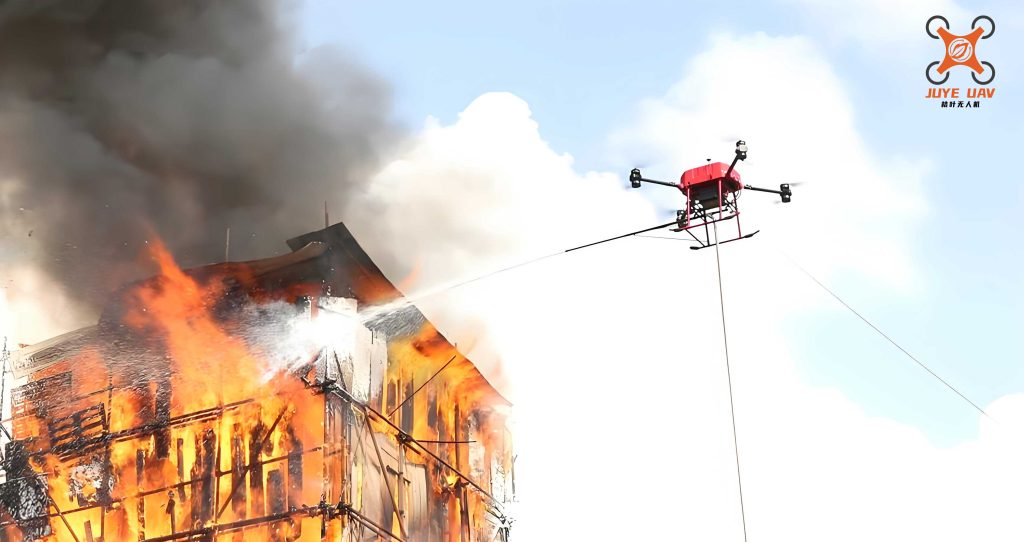
In hazardous chemical warehouse fires, the application spectrum of 5G fire drones is vast, spanning from initial detection to post-incident analysis. Let us break down these applications into distinct categories, each bolstered by specific technological synergies. First, in accident detection and reconnaissance, fire drones equipped with multi-sensor payloads can swiftly survey the site. For instance, they might carry electrochemical sensors for toxic gases like chlorine or ammonia, and infrared spectrometers for volatile organic compounds. The concentration \(C\) of a gas detected by a fire drone can be modeled as a function of distance from the source \(r\), diffusion coefficient \(D\), and time \(t\) using Fick’s laws of diffusion. A simplified form for steady-state dispersion in a uniform medium is:
$$C(r) = \frac{Q}{4\pi D r}$$
where \(Q\) is the emission rate. By mapping such concentrations in real-time, fire drones help identify hotspots and safe approach paths. Additionally, thermal imaging cameras on fire drones can visualize temperature gradients, pinpointing fire cores hidden behind smoke. The radiative heat flux \(\dot{q}\) received by a thermal sensor from a fire at temperature \(T_f\) and emissivity \(\epsilon\) can be described by the Stefan-Boltzmann law:
$$\dot{q} = \epsilon \sigma T_f^4$$
where \(\sigma\) is the Stefan-Boltzmann constant (\(5.67 \times 10^{-8} \, \text{W} \cdot \text{m}^{-2} \cdot \text{K}^{-4}\)). This data, transmitted via 5G, allows for rapid assessment of fire intensity and spread.
Second, in real-time monitoring and surveillance, 5G fire drones excel by providing persistent, high-fidelity oversight. They can orbit a burning warehouse, streaming live feeds to command centers where AI algorithms analyze the footage for anomalies like structural collapses or chemical leaks. The benefit here is not just visual; fire drones can also carry meteorological sensors to measure wind speed \(v_w\) and direction, critical for predicting smoke and toxic plume movement. The advection-diffusion equation for pollutant transport can be applied:
$$\frac{\partial C}{\partial t} + \mathbf{v} \cdot \nabla C = D \nabla^2 C + S$$
where \(\mathbf{v}\) is the wind velocity vector, and \(S\) represents sources or sinks. With 5G’s low latency, these computations can be performed in near-real-time, enhancing predictive accuracy. To illustrate the multifaceted roles of fire drones in monitoring, consider the following table that correlates sensor types with their outputs and emergency uses:
| Sensor Type | Data Output | Application in Chemical Fires |
|---|---|---|
| Electrochemical Gas Sensor | Concentration of specific gases (e.g., CO, H2S) in parts per million (ppm). | Detects toxic releases and defines evacuation zones based on threshold levels. |
| Infrared Thermal Camera | Temperature maps and hotspots with accuracy up to ±2°C. | Identifies fire seats, monitors for re-ignition, and assesses thermal radiation risks. |
| LIDAR (Light Detection and Ranging) | 3D point clouds of structures and terrain. | Models structural integrity and plans aerial灭火剂投放 trajectories. |
| Multispectral Camera | Images across visible and non-visible spectra (e.g., near-infrared). | Differentiates between smoke, flames, and chemical residues for damage assessment. |
| Anemometer and Gyroscope | Wind velocity, direction, and UAV orientation angles. | Adjusts flight paths for stability and inputs into dispersion models for hazard prediction. |
Third, in auxiliary firefighting functions, fire drones take on active roles beyond surveillance. They can be outfitted with extinguishing agents—such as dry chemicals, foam, or even water—and deploy them precisely onto fire sources. This is especially valuable for hard-to-reach areas, like tall storage tanks or interior spaces compromised by heat. The effectiveness of a fire drone in灭火 can be evaluated through parameters like discharge rate \(\dot{m}_a\) (mass of agent per second) and coverage area \(A_c\). For a fire requiring a specific application density \(\delta\) (agent per unit area), the time \(t_e\) to extinguish a fire of area \(A_f\) is approximated by:
$$t_e = \frac{\delta A_f}{\dot{m}_a}$$
With 5G-enabled precise control, fire drones can optimize \(\dot{m}_a\) and targeting, minimizing waste and maximizing impact. Moreover, fire drones can serve as communication relays, broadcasting instructions to trapped individuals via loudspeakers or establishing temporary networks for first responders. In scenarios where ground infrastructure is damaged, a fire drone equipped with a 5G small cell can provide connectivity, ensuring uninterrupted coordination. The link budget for such a system, determining the maximum allowable path loss \(PL_{max}\), is given by:
$$PL_{max} = P_t + G_t + G_r – P_{min} – L_{misc}$$
where \(P_t\) is transmit power, \(G_t\) and \(G_r\) are antenna gains, \(P_{min}\) is receiver sensitivity, and \(L_{misc}\) accounts for miscellaneous losses. 5G’s beamforming techniques enhance \(G_t\) and \(G_r\), extending the fire drone’s communication range in cluttered environments.
Fourth, in emergency communication and rescue, 5G fire drones bridge critical gaps. They can locate stranded personnel by detecting mobile phone signals or using computer vision to spot individuals in distress. Once identified, fire drones can drop survival gear—like respirators or first-aid kits—or guide rescue teams via live video feeds. The probability of detection \(P_d\) for a person in a search area \(A_s\) by a fire drone with sensor sweep width \(W\) and speed \(v_d\) over time \(T\) can be modeled using random search theory:
$$P_d = 1 – e^{-\frac{W v_d T}{A_s}}$$
5G’s high data rates ensure that video analytics for person detection are processed swiftly, increasing \(P_d\) through real-time feedback. Furthermore, fire drones can facilitate post-incident analysis by creating detailed 3D reconstructions of the scene. Using photogrammetry techniques, multiple images from a fire drone are stitched together to generate a digital twin of the warehouse. The accuracy of such a model depends on factors like image overlap and ground sample distance (GSD), which is the distance between pixel centers on the ground, calculated as:
$$\text{GSD} = \frac{H \times s}{f}$$
where \(H\) is flight altitude, \(s\) is sensor pixel size, and \(f\) is focal length. With 5G, large datasets from fire drones can be uploaded to cloud servers for rapid processing, aiding in forensic investigations and future prevention strategies.
To synthesize these applications, let us consider a hypothetical but realistic case study of a hazardous chemical warehouse fire. Upon alarm activation, a fleet of 5G fire drones is dispatched from a nearby station. The lead fire drone, carrying a thermal camera and gas sensors, approaches the site while streaming 4K video to the command center via a 5G network. Operators, viewing the feed on large screens, observe intense flames emanating from a storage unit containing organic peroxides. Using the real-time data, they calculate the heat release rate \(\dot{Q}\) of the fire using the formula:
$$\dot{Q} = \chi \dot{m} \Delta H_c$$
where \(\chi\) is combustion efficiency, \(\dot{m}\) is mass loss rate (estimated from visual cues), and \(\Delta H_c\) is the heat of combustion of the involved chemicals. This informs the deployment of additional fire drones equipped with dry chemical extinguishers. Meanwhile, a second fire drone performs a perimeter scan, detecting elevated levels of carbon monoxide using its electrochemical sensor. The concentration data is plotted on a map shared with ground teams, who adjust their approach accordingly. Throughout the operation, all fire drones maintain a meshed network via 5G, ensuring redundant communication paths and collaborative behaviors—like one fire drone illuminating the scene with lights while another conducts precision灭火剂投放. Post-suppression, a fire drone with a LIDAR payload generates a 3D model of the damaged structure, highlighting areas prone to collapse for safety assessments.
The future trajectory of 5G fire drones in hazardous chemical emergency response is poised for further innovation. As 5G networks evolve towards 6G, with promises of terahertz frequencies and even lower latency, fire drones will become more autonomous and integrated with artificial intelligence. For instance, machine learning algorithms could enable fire drones to predict fire spread based on real-time sensor inputs, using partial differential equations like the reaction-diffusion equation for flame propagation:
$$\frac{\partial T}{\partial t} = \alpha \nabla^2 T + f(T)$$
where \(T\) is temperature, \(\alpha\) is thermal diffusivity, and \(f(T)\) represents heat generation from combustion. Additionally, swarm technologies could allow multiple fire drones to cooperate seamlessly, dividing tasks such as surveillance,灭火, and communication relay. This swarm behavior can be optimized using collective decision-making models, perhaps drawing from particle swarm optimization (PSO) algorithms, where each fire drone’s position \(\mathbf{x}_i\) and velocity \(\mathbf{v}_i\) update based on global and local best solutions:
$$\mathbf{v}_i^{t+1} = w \mathbf{v}_i^t + c_1 r_1 (\mathbf{p}_i – \mathbf{x}_i^t) + c_2 r_2 (\mathbf{g} – \mathbf{x}_i^t)$$
$$\mathbf{x}_i^{t+1} = \mathbf{x}_i^t + \mathbf{v}_i^{t+1}$$
Here, \(w\) is inertia weight, \(c_1\) and \(c_2\) are acceleration coefficients, \(r_1\) and \(r_2\) are random numbers, \(\mathbf{p}_i\) is the personal best position, and \(\mathbf{g}\) is the global best position. Such advancements will make fire drone operations more efficient and adaptive to complex disaster scenarios.
In conclusion, the marriage of 5G technology and fire drones represents a transformative leap in emergency response for hazardous chemical warehouse fires. From enhanced reconnaissance and real-time monitoring to active firefighting and rescue support, these systems address longstanding limitations of traditional methods. The tables and formulas presented throughout this article underscore the technical rigor and practical benefits of this integration. As we continue to refine these technologies, the focus must remain on reliability, interoperability, and ethical deployment to maximize public safety. The fire drone, empowered by 5G, is not merely a tool but a cornerstone of next-generation emergency management, promising a future where responders can tackle even the most daunting blazes with unprecedented precision and confidence.