
In my extensive experience with fire rescue operations, hazardous chemical warehouse fires present unique and formidable challenges due to the presence of multiple dangerous elements, such as flammable, explosive, toxic, and corrosive substances. These complexities often hinder traditional rescue methods, putting firefighters at significant risk and delaying effective response. The integration of 5G technology with unmanned aerial vehicles, commonly referred to as fire drones, has emerged as a transformative solution in this domain. This article explores how I, along with fire rescue agencies, leverage 5G and fire drone technologies to enhance emergency response efficiency, reduce casualties, and mitigate property damage. I will delve into the development status, advantages, and practical application methods, supported by tables and formulas, while emphasizing the critical role of fire drones throughout.
The convergence of 5G and drone technology has overcome traditional limitations like WiFi and Bluetooth connectivity, enabling real-time, high-bandwidth data transmission. This synergy has propelled drones from recreational uses to critical applications in fields such as urban security, high-definition live streaming, power line inspection, base station maintenance, and emergency communication rescue. For instance, in urban security, 5G’s low latency and high bandwidth allow fire drones to stream video feeds to control centers, where AI algorithms analyze data for target identification. In emergency scenarios, fire drones equipped with 5G can rapidly survey disaster zones, locate trapped individuals, and transmit高清 footage to guide rescue teams. This foundational progress sets the stage for specialized applications in hazardous chemical fire rescue, where every second counts.
The advantages of deploying 5G and fire drones in fire emergency rescue are multifaceted. First, fire drones offer unparalleled flexibility, allowing remote reconnaissance without exposing personnel to hazardous environments like toxic fumes or structural collapses. Second, they provide broader视野, enabling comprehensive aerial surveys of accident sites to assess火势 spread, victim locations, and environmental conditions. Third, fire drones boast significant expansion capabilities; modules such as gas sensors, thermal cameras, and payload delivery systems can be swapped based on real-time needs. Lastly, these drones assist directly in rescue operations, such as deploying灭火剂 or delivering essential supplies to inaccessible areas. These benefits underscore why I advocate for widespread adoption of fire drones in modern firefighting.
To implement 5G and fire drone technology effectively, fire rescue agencies must first establish a robust无人机 platform. Typically, I recommend using electric multi-rotor fire drones due to their stability and maneuverability. The platform involves installing software on ground control computers for image analysis, toxic gas detection, and real-time monitoring, all connected via 5G networks. Key hardware includes tilt cameras, high-definition lenses,升降式 gas detection pods, various sensors, and物资抛投 devices. This setup ensures seamless communication between fire drones and command centers, facilitating rapid decision-making. For example, the fire drone’s sensors collect data, which is transmitted via 5G to analysts who can quickly identify hazards and plan responses.
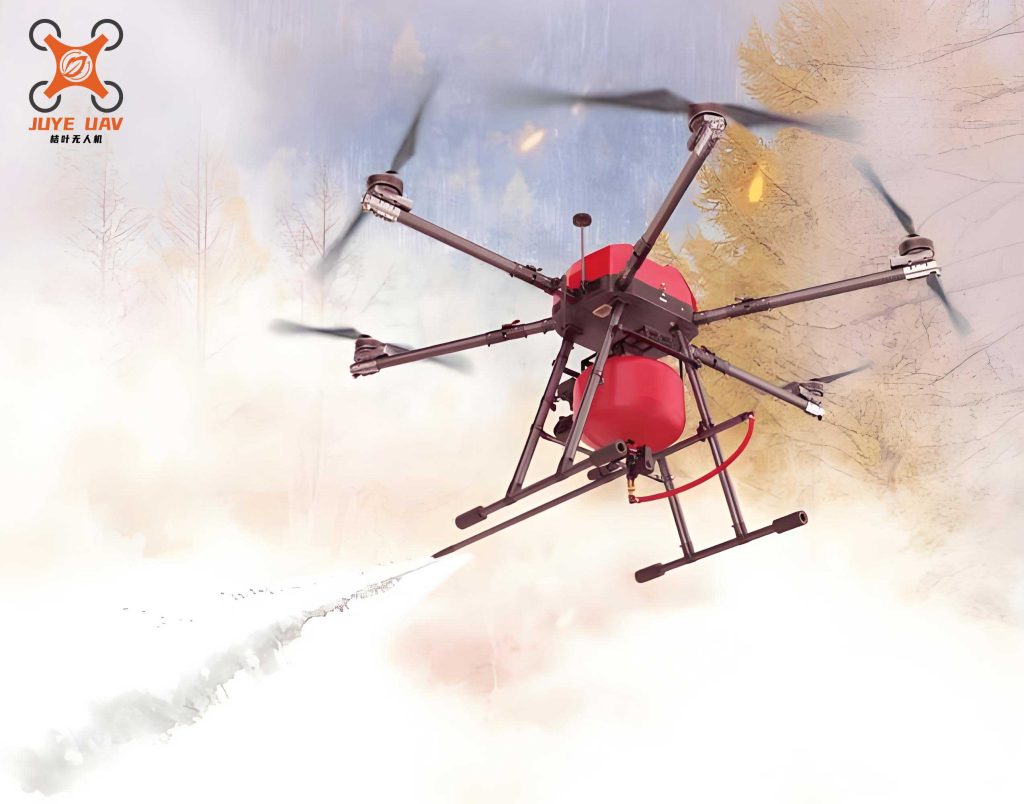
In accident scene reconnaissance, fire drones play a pivotal role in assessing hazardous conditions without risking human lives. When a hazardous chemical warehouse fire erupts, unstable materials may release toxic gases like carbon monoxide (CO), methane (CH4), hydrogen sulfide (H2S), and oxygen (O2) fluctuations. I utilize fire drones equipped with electrochemical and catalytic combustion sensors to detect these gases in real-time. Based on standards like GB 50493-2009, the fire drone’s sensors must trigger alarms within 30–60 seconds upon detecting hazardous levels. The following table summarizes key gas detection indicators for fire drones in such scenarios:
| Gas Type | Detection Range | Response Time (s) | Error Allowance | Precision | Alarm Point |
|---|---|---|---|---|---|
| CO | 0–1000 mg/L | ≤45 | ±5% of actual value | 1 mg/L | 25 mg/L |
| CH4 | 0–100% | ≤25 | ±5% of actual value | 0.01% | 1% |
| H2S | 0–500 mg/L | ≤45 | ±5% of actual value | 1 mg/L | 10 mg/L |
| O2 | 0–30.0% | ≤35 | ±3% of actual value | 0.1% | 18% |
The sensor principles involve electrochemical reactions. For CO detection, the fire drone’s sensor uses a working electrode where CO oxidizes, producing H+ and e–, which migrate to a counter electrode via electrolyte, generating a measurable current. Similarly, for H2S, oxidation at the working electrode releases ions, while O2 sensors rely on a reaction forming OH– that reacts with lead. For CH4, catalytic combustion sensors measure resistance changes due to heat from flameless burning. The data is processed by a microcontroller and transmitted via 5G to a ground station with audible and visual alarms. To ensure reliable operation, the fire drone must meet specific internet metrics, as shown below:
| Business Attribute | Uplink Rate | Downlink Rate | End-to-End Delay (ms) | Control Delay (ms) | Coverage Height (m) | Positioning Accuracy (m) |
|---|---|---|---|---|---|---|
| Autonomous Flight | 200 kbps | 300 kbps | <500 | 100 | 100 | <1.0 |
| Scene Reconnaissance | 25 Mbps | — | <200 | 20 | 100 | <0.5 |
These metrics highlight how 5G enhances fire drone performance by minimizing latency and maximizing data throughput, crucial for real-time monitoring in volatile fire environments.
Aerial monitoring with fire drones provides continuous surveillance of火场 dynamics. I integrate thermal imaging cameras on fire drones to detect hotspots through smoke or darkness, transmitting视频 via 5G for immediate analysis. This helps identify re-ignition risks in chemical storage areas. Additionally, anemometers on fire drones measure wind speed and direction, informing firefighting strategies to prevent火势 spread. The use of倾斜摄影 technology allows fire drones to capture multi-angle images, which are processed using automated aerial triangulation, DSM matching, TIN modeling, and 3D texture mapping to generate accurate三维 models of the site. These models assist in understanding warehouse layout and terrain, enabling optimized rescue plans. The transmission of these data streams relies on 5G’s high-speed capabilities, ensuring that command centers receive updates without lag. For instance, the fire drone’s thermal data can be analyzed using algorithms to predict fire behavior, such as calculating heat flux $$Q = \sigma \epsilon A (T^4 – T_0^4)$$, where $\sigma$ is the Stefan-Boltzmann constant, $\epsilon$ is emissivity, $A$ is area, $T$ is surface temperature, and $T_0$ is ambient temperature. This公式 aids in assessing radiation hazards and planning evacuation routes.
Fire drones also assist directly in消防 operations, extending rescue capabilities beyond human reach. When firefighters cannot access起火 points due to structural damage or toxic clouds, I deploy fire drones equipped with灭火剂 tanks and payload release mechanisms. Controlled via 5G, these fire drones can perform precision drops of extinguishing agents, such as foam or dry powder, to suppress flames remotely. Moreover, fire drones carry物资抛投 devices to deliver ropes, respirators, and medical kits to trapped individuals, facilitating swift补给. In communication, fire drones with integrated speakers and microphones enable空中 command broadcasts, allowing coordinators to relay instructions to现场 personnel. The effectiveness of such辅助救援 can be quantified by the response time reduction $\Delta t = t_{\text{traditional}} – t_{\text{drone}}$, where $t_{\text{traditional}}$ is the time for manual delivery and $t_{\text{drone}}$ is the fire drone’s flight time. Empirical data show that fire drones can cut delivery times by up to 70% in complex scenarios, significantly boosting survival rates.
Looking ahead, the integration of fire drones with emerging technologies like big data and AI promises even greater advancements. By combining 5G-transmitted data from fire drones with cloud-based analytics, rescue agencies can perform real-time hazard等级 assessments, resource allocation calculations, and predictive modeling. For example, machine learning algorithms can analyze fire drone footage to identify chemical leak patterns using卷积神经网络 (CNNs), expressed as $$y = f(W \cdot x + b)$$, where $W$ represents weights, $x$ is input data, $b$ is bias, and $f$ is an activation function. This enables automated threat detection and response recommendations. Additionally, research into fire drone续航 enhancement, through improved battery technologies or solar辅助 systems, will extend operational range in large-scale incidents. I envision fire drones becoming integral to smart firefighting ecosystems, where他们 autonomously coordinate with ground teams and other drones via 5G mesh networks.
In conclusion, the application of 5G and fire drone technology in hazardous chemical warehouse fire rescue represents a paradigm shift in emergency response. From搭建 platforms and conducting侦查 to空中监测 and assisting消防, fire drones offer versatile, safe, and efficient solutions. The tables and formulas presented herein underscore the technical rigor behind these applications. As I continue to explore this field, I emphasize the need for ongoing innovation in fire drone capabilities, such as longer endurance and deeper data integration, to further safeguard lives and property. The future of fire rescue lies in harnessing these technologies to create resilient, adaptive systems that can tackle the most daunting challenges with precision and speed.