
In this article, we explore the development of a comprehensive training model for fire drone pilots, based on our extensive research and practical experience in the field of emergency response. The rapid growth of the civilian drone industry has highlighted a critical shortage of skilled operators, particularly in firefighting and rescue operations. We propose an integrated approach that combines post requirements, curriculum design, competition, certification, and training—often referred to as the “post-course-competition-certification-training” model—to address these challenges. This model is especially relevant for fire drone pilots, who must master complex technical skills while operating in high-stakes environments. Throughout this discussion, we will emphasize the importance of fire drone technology and its role in modern rescue missions, using tables and formulas to summarize key concepts and ensure clarity.
The background of this study stems from the explosive growth of the drone industry. In April 2019, the Ministry of Human Resources and Social Security, along with other Chinese authorities, officially recognized “drone pilot” as a new occupation, signaling the maturity of the drone sector. According to data from the Civil Aviation Administration of China, by the end of 2022, there were over 152,800 valid licenses for civilian drone pilots in China, with more than 958,000 registered drones and over 700,000 registered users. Additionally, the total flight hours for drones in 2022 reached 20.67 million, a 6.17% increase from the previous year. These figures underscore the industry’s expansion, but they also reveal a pressing issue: a severe shortage of fire drone pilots. In particular, firefighting and emergency rescue drone operators account for only about 5.18% of the total, with projections indicating a need for nearly 1 million such professionals over the next five years. This gap is exacerbated by the unique characteristics of fire drone pilot training, which demands high technical precision, practical orientation, long-term development, and extended training cycles.
The significance of our research lies in the “post-course-competition-certification” education model proposed at the National Vocational Education Conference in April 2021. This model, integrated with training, offers a novel method for systematically cultivating fire drone pilots. By linking job post requirements with curriculum, competitions, and certifications, it creates a cyclical process that enhances learning outcomes. Our aim is to adapt this model specifically for fire drone pilots, addressing their distinct needs in fire and rescue scenarios. We believe that this approach can streamline training, improve skill acquisition, and ultimately boost the effectiveness of fire drone operations in saving lives and property.
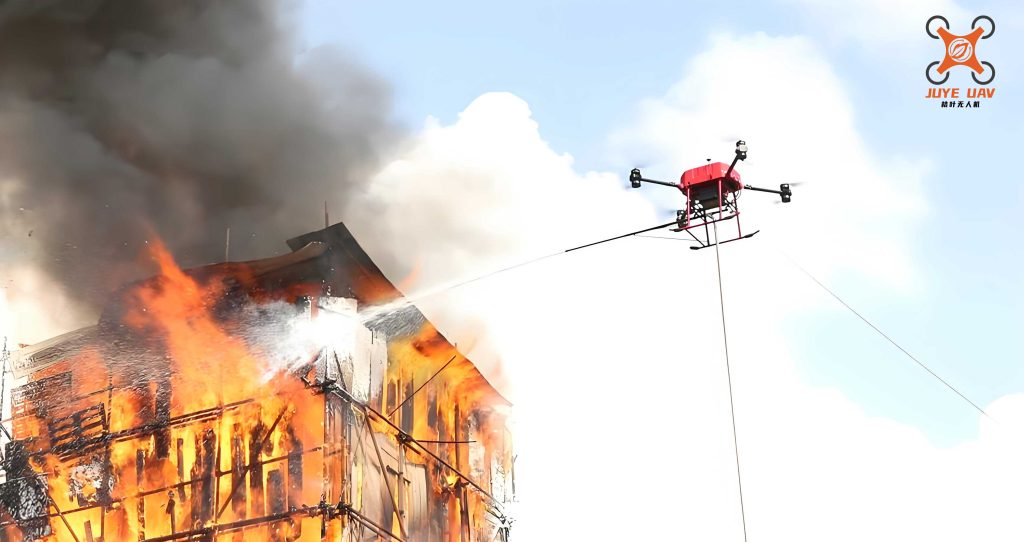
To contextualize our work, we first examine the current state of research both internationally and domestically. Internationally, the United States leads in drone training technology. In 2008, the U.S. military experimented with transitioning manned aircraft pilots to operate drone systems, but this led to negative transfer effects—where prior experience interfered with new skills—resulting in a high rate of human error accidents. By 2009, they shifted to recruiting new trainees directly for drone systems, alleviating shortages in manned aircraft pilots. However, by 2015, the persistent gap in drone pilots prompted the U.S. Department of Defense to lower entry barriers, allowing civilians and newcomers to join. This evolution highlights the challenges in selecting and training fire drone pilots, where specialized skills are paramount. Domestically, researchers have proposed collaborative mechanisms involving drone companies, fire training brigades, research institutes, and rescue teams. Simulation training has gained traction, with virtual systems developed to enhance basic operations and实战 capabilities in fire scenarios, reducing costs and improving safety. The training objectives for fire drone pilots extend beyond flight skills to include knowledge of drone systems, payload usage, and decision-making under pressure. Pilots must possess focus, spatial reasoning, and稳健 problem-solving abilities, all of which are crucial for effective fire drone deployment.
We summarize key international and domestic approaches in Table 1, focusing on fire drone pilot training aspects.
| Aspect | International (e.g., U.S.) | Domestic (China) |
|---|---|---|
| Selection Criteria | Shifted from manned pilots to direct recruitment of civilians | Emphasis on collaborative培养 mechanisms |
| Training Methods | Integrated simulation and实战 training | Virtual仿真 systems for fire scenarios |
| Key Challenges | Negative transfer effects, high accident rates | Shortage of skilled pilots, high training costs |
| Training Goals | Technical proficiency and tactical decision-making | Comprehensive skill sets including payload operation |
Building on these insights, we propose the “post-course-competition-certification-training” model for fire drone pilots. This model is grounded in the defined occupation of “unmanned aerial vehicle pilot,” which involves remote-controlled operation of drones for specific tasks. In the context of firefighting, the post refers to roles such as firefighter or forest firefighter, as outlined in the National Professional Qualification Directory. These posts serve as the foundation for our model. The course component translates post requirements into structured learning, acting as a bridge between theory and practice. For fire drone pilots, courses should adhere to standards like those from the Aircraft Owners and Pilots Association (AOPA), balancing theory and实操. Based on U.S. military practices, we recommend a theory-to-practice ratio of 3:7, tailored to trainee needs. Practical courses can be divided into three levels: single-post skill enhancement, crew coordination training, and tactical协同 training. Competition serves as both an output and motivational tool, encompassing events like “Flame Blue” contests, drone skill competitions, and national-level drills. These competitions promote training and validate课程 effectiveness. Certification includes entry-level credentials like civil aviation licenses, evaluation certificates from human resources departments, and荣誉 certificates from competitions. Training is the core element, divided into initial单人 training and advanced合成 training. Initial training for fire drone pilots involves six stages: solidifying theory, mastering flight skills, strengthening real-machine simulation, instructor-guided flight, solo flight training, and professional certification. Advanced training includes four stages: single-post skill simulation, crew coordination, tactical application, and payload实战 training. Only upon completing all stages can a fire drone pilot be deemed qualified. Training methods should combine periodic intensive sessions, stage-based reinforcement, and日常训练,借鉴 international best practices.
To illustrate the training progression, we present a formula for skill acquisition in fire drone pilots. Let \( S(t) \) represent the skill level at time \( t \), influenced by training intensity \( I \), prior experience \( E \), and environmental factors \( F \). The model can be expressed as:
$$ S(t) = S_0 + \alpha \cdot \ln(1 + \beta I t) + \gamma E – \delta F $$
where \( S_0 \) is the initial skill level, \( \alpha \), \( \beta \), \( \gamma \), and \( \delta \) are coefficients specific to fire drone training. This equation highlights the logarithmic growth of skills with training, emphasizing the need for sustained effort. Additionally, we break down the training stages in Table 2, detailing the focus and duration for fire drone pilots.
| Training Stage | Description | Key Activities for Fire Drone Pilots | Estimated Duration |
|---|---|---|---|
| 1. Theory Foundation | Building knowledge of drone systems and aviation principles | Study of fire drone components, regulations, and safety protocols | 2 weeks |
| 2. Flight Skill Mastery | Developing basic操控 abilities | Hands-on practice with fire drone models in controlled environments | 4 weeks |
| 3. Real-Machine Simulation | Using simulators for实战 scenarios | Virtual firefighting missions with various fire drone payloads | 3 weeks |
| 4. Instructor-Guided Flight | Supervised real-flight training | 实操 flights under mentor guidance, focusing on fire response techniques | 5 weeks |
| 5. Solo Flight Training | Independent operation of fire drones | Autonomous missions in模拟 fire scenarios, with risk assessment | 4 weeks |
| 6. Professional Certification | Obtaining official credentials | Exams and assessments for fire drone pilot licenses | 2 weeks |
| 7. Advanced合成 Training | Crew and tactical coordination | Team-based exercises with multiple fire drones in complex救援 operations | 6 weeks |
The applicability of this model is particularly relevant for firefighter trainees, who often have educational backgrounds at the high school level or equivalent. Many lack strong theoretical foundations, learning habits, or self-discipline, posing challenges for specialized subjects like fire drone operation. Traditional training methods, inherited from past military practices, may fail to engage learners due to unclear goals, low motivation, or limited career planning. The “post-course-competition-certification-training” approach addresses these issues by aligning with trainees’ psychological expectations and organizational needs. It enhances skill mastery, problem-solving abilities, and teamwork—all essential for fire drone pilots operating in high-pressure rescue missions. For instance, competitions can simulate real fire scenarios, encouraging pilots to apply their knowledge dynamically, while certifications provide tangible milestones for progression.
To further quantify training effectiveness, we introduce a cost-benefit analysis for fire drone pilot programs. Let \( C \) be the total training cost, including equipment, instructors, and time. The benefit \( B \) can be measured in terms of operational efficiency, such as reduced response times or increased success rates in fire incidents. We define a performance metric \( P \) for fire drone pilots as:
$$ P = \frac{B}{C} = \frac{\sum_{i=1}^{n} w_i \cdot M_i}{\sum_{j=1}^{m} c_j} $$
where \( M_i \) represents mission outcomes (e.g., lives saved, fire containment area), \( w_i \) are weighting factors, and \( c_j \) are cost components. This formula helps optimize training investments for fire drone units. Additionally, we can model the learning curve for fire drone skills using a differential equation:
$$ \frac{dS}{dt} = k \cdot (S_{max} – S) – \lambda \cdot S $$
where \( S_{max} \) is the maximum skill level achievable, \( k \) is the learning rate, and \( \lambda \) accounts for skill decay. This emphasizes the need for continuous training to maintain proficiency in fire drone operations.
In conclusion, we stress several key points for cultivating fire drone pilots. First, training programs must closely monitor trainee progress and adapt flexibly to ensure effectiveness. For beginners, the focus should be on foundational “course” and “training” elements, without premature pressure from “competition” or “certification.” As pilots advance, they should engage in实战 scenarios that serve as true练兵场s, with evaluations based on objective performance rather than subjective judgments. Second, there is a tendency to prioritize technical skills over command and management in specialized units. To achieve实战 goals, we advocate for integrated培养 of skills, coordination, and指挥. Fire drone pilots and unit commanders should train simultaneously, ensuring that technical prowess and tactical decision-making evolve in tandem. This holistic approach maximizes the synergy between personnel and equipment, unleashing the full potential of fire drone teams in emergency responses. Ultimately, the “post-course-competition-certification-training” model, when tailored to fire drone contexts, offers a robust framework for addressing the critical shortage of skilled operators, enhancing救援 capabilities, and saving lives in fire-related disasters.
To support ongoing research, we recommend further studies on the integration of artificial intelligence with fire drone training, as well as cross-border collaborations to share best practices. The fire drone industry continues to evolve, and training models must keep pace with technological advancements. By fostering innovation and commitment, we can build a resilient workforce of fire drone pilots ready to tackle the challenges of modern firefighting and rescue operations.