
In my years of service in firefighting and rescue operations, I have witnessed a paradigm shift driven by technological advancements, particularly the integration of unmanned aerial vehicles, or as we commonly refer to them, fire drones. These sophisticated devices have revolutionized our approach to tackling complex fire scenarios, from towering high-rise buildings to hazardous industrial sites. The rapid urbanization and industrial growth have escalated fire risks, making traditional methods often inadequate. Fire drones offer a game-changing solution, enhancing safety, efficiency, and precision in our missions. This article delves into the multifaceted applications of fire drones, exploring their advantages, significance, and optimization strategies, all from a first-person perspective based on practical field experiences.
The advent of fire drones has fundamentally altered how we gather intelligence and execute rescues. When responding to emergencies, every second counts, and the ability to assess a situation remotely is invaluable. Fire drones enable us to deploy eyes in the sky without risking human lives, providing real-time data that informs our strategies. Their agility and智能化operation make them indispensable in modern firefighting. Below, I will outline the core benefits, practical applications, and future directions for fire drones, incorporating tables and mathematical models to summarize key concepts. Let’s begin by examining the inherent advantages of these remarkable tools.
Fire drones excel in several critical areas that directly enhance our operational capabilities. First and foremost, their safety profile is unparalleled. As a firefighter, I have faced situations where entering a blaze blindly could be fatal. Fire drones mitigate this risk by serving as remote scouts. For instance, in a high-rise fire, we can launch a fire drone to capture thermal imagery and video feeds, identifying hotspots and trapped individuals without exposing personnel to immediate danger. This safety advantage is quantified by the reduction in casualty rates, which we can model as a function of drone deployment. Consider the probability of injury $P_i$ without a fire drone versus with a fire drone:
$$P_i(without) = \frac{N_{injuries}}{N_{incidents}} \quad \text{and} \quad P_i(with) = \frac{N_{injuries} – \Delta N}{N_{incidents}}$$
where $\Delta N$ represents the number of injuries prevented due to fire drone reconnaissance. In many cases, $\Delta N > 0$, underscoring the life-saving potential of fire drones.
Secondly, the flexibility of fire drones is astounding. Their compact size and maneuverability allow them to navigate through dense smoke, around obstacles, and into confined spaces that are inaccessible to humans. This flexibility translates to faster data acquisition and more dynamic response adjustments. We often use fire drones to map out fire spread in real-time, adjusting our tactics on the fly. A simple model for drone agility can be expressed in terms of turning radius $r$ and speed $v$:
$$r = \frac{v^2}{a_c}$$
where $a_c$ is the centripetal acceleration. Smaller $r$ values indicate higher agility, which is crucial for avoiding collisions in chaotic environments. Fire drones typically have $r < 5$ meters at moderate speeds, enabling precise control.
Thirdly, the智能化operation of fire drones, powered by artificial intelligence and machine learning, enhances their autonomy. We can program fire drones to follow predefined flight paths, detect anomalies using computer vision, and even make decisions based on sensor data. This reduces the cognitive load on operators and improves response times. The智能化capabilities can be summarized in a table comparing manual versus autonomous modes:
| Operation Mode | Response Time (s) | Data Accuracy (%) | Operator Intervention Level |
|---|---|---|---|
| Manual Control | 2-5 | 85-90 | High |
| Autonomous (AI-driven) | 0.5-1 | 92-98 | Low |
This table illustrates how fire drones with智能化features outperform manual operations, making them more reliable in fast-evolving fire scenarios.
Moving beyond advantages, the practical significance of fire drones in our daily operations cannot be overstated. One key application is in辅助完成消防救援路线图绘制, or assisting in the creation of rescue route maps. Upon arriving at a fire scene, we deploy fire drones to capture aerial imagery and sensor data, which is then processed to generate 3D models. These models help us visualize the structure and plan optimal entry and exit routes. The efficiency gain can be modeled using a time-saving metric $T_s$:
$$T_s = T_{traditional} – T_{drone-assisted}$$
where $T_{traditional}$ is the time taken for manual reconnaissance, and $T_{drone-assisted}$ is the time with fire drone support. In complex fires, $T_s$ often exceeds 30 minutes, significantly accelerating rescue efforts.
Another critical role is物资的运输, or transporting supplies. Fire drones equipped with payload systems can deliver essentials like water, oxygen masks, and first-aid kits to trapped victims. This capability is vital in prolonged incidents where access is blocked. The payload capacity $C_p$ of a fire drone determines its utility, and we optimize it based on mission requirements. For example, the relationship between drone battery life $L$ and payload weight $W$ can be approximated by:
$$L = L_0 – k \cdot W$$
where $L_0$ is the baseline battery life without payload, and $k$ is a degradation constant. By selecting fire drones with high $C_p$ and efficient batteries, we maximize delivery effectiveness.
Fire drones also excel in信号追踪, or signal tracking. In fires where victims may be using mobile phones or other devices, fire drones can detect and locate signals through integrated receivers. This allows us to pinpoint trapped individuals even in obscured environments. The signal strength $S$ at the drone can be modeled using the Friis transmission equation:
$$S = \frac{P_t G_t G_r \lambda^2}{(4\pi d)^2}$$
where $P_t$ is transmitter power, $G_t$ and $G_r$ are antenna gains, $\lambda$ is wavelength, and $d$ is distance. Fire drones equipped with sensitive receivers can detect weak signals, enhancing search-and-rescue accuracy.
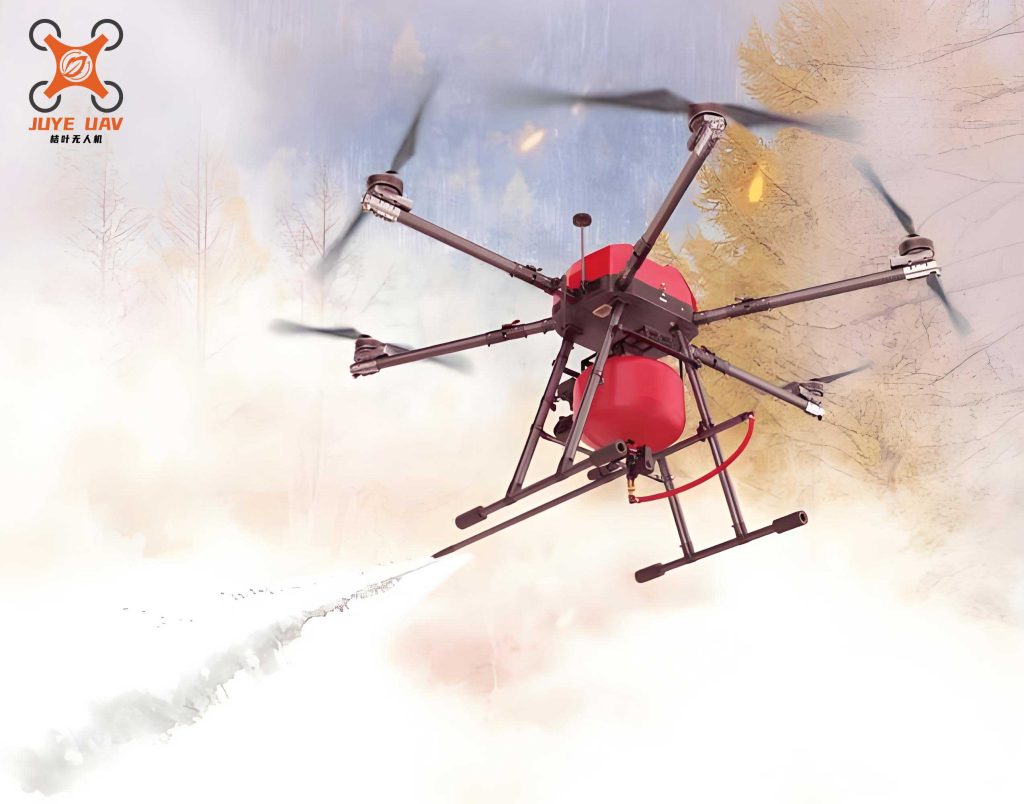
Furthermore, fire drones are increasingly used for direct灭火工作, or firefighting itself. We mount extinguishing agents like dry powder, foam, or灭火弹 on fire drones, enabling targeted suppression from above. This is especially useful for high-rise or remote fires where traditional equipment falls short. The extinguishing efficiency $E_{ext}$ can be defined as:
$$E_{ext} = \frac{V_{agent} \cdot \rho_{effectiveness}}{t_{application}}$$
where $V_{agent}$ is the volume of agent deployed, $\rho_{effectiveness}$ is its effectiveness factor, and $t_{application}$ is the application time. Fire drones optimize $E_{ext}$ by delivering agents precisely to the火源, or fire source.
To better illustrate these applications, here is a table summarizing the roles of fire drones across different fire types:
| Fire Type | Primary Fire Drone Application | Key Metrics Improved | Example Scenario |
|---|---|---|---|
| High-rise Building Fire | Reconnaissance and Route Mapping | Time to locate victims, 3D model accuracy | Assessing floor-by-floor火情 in a skyscraper |
| Industrial Chemical Fire | Signal Tracking and Hazard Detection | Signal detection range, toxic gas monitoring | Finding workers in a refinery blaze |
| Wildland Fire | Firefighting and Supply Transport | Area covered per sortie, payload delivery rate | Dropping retardant on forest fire edges |
| Confined Space Fire | 物资运输 and Communication Relay | Payload capacity, communication latency | Delivering oxygen to trapped miners |
As we continue to rely on fire drones, optimizing their design and functionality becomes paramount. One major area is电池设备, or battery systems. Fire drones need extended flight times and robustness against high temperatures. We advocate for modular battery designs that allow quick swaps in the field. The energy density $E_d$ of a battery, measured in Wh/kg, directly impacts drone endurance. A formula for total flight time $T_f$ is:
$$T_f = \frac{E_d \cdot m_{battery}}{P_{total}}$$
where $m_{battery}$ is battery mass, and $P_{total}$ is the total power consumption. By enhancing $E_d$ through新材料 like lithium-sulfur, we can boost $T_f$ for fire drones. Additionally, incorporating thermal management systems, such as heat sinks or phase-change materials, protects batteries from火场高温. This can be modeled as a heat dissipation rate $Q$:
$$Q = h \cdot A \cdot (T_{battery} – T_{ambient})$$
where $h$ is the heat transfer coefficient, $A$ is surface area, and $T$ represents temperatures. Optimizing $Q$ ensures battery stability in extreme conditions.
Another optimization strategy is强化无人机的外部搭载功能, or enhancing external payload capabilities. We customize fire drones with versatile mounting systems for various tools, from thermal cameras to extinguisher pods. The payload adaptability $A_p$ can be quantified as the number of compatible attachments per drone. For instance, a fire drone with $A_p = 5$ can switch between a camera, a speaker, a dropper, and other modules swiftly. The force balance during payload deployment involves calculating the thrust $F_t$ needed:
$$F_t = m_{drone} \cdot g + m_{payload} \cdot g + F_{drag}$$
where $m$ denotes masses, $g$ is gravity, and $F_{drag}$ is aerodynamic drag. By designing fire drones with high thrust-to-weight ratios, we support heavier payloads without compromising agility.
Moreover, optimizing无人机的机体材料, or drone airframe materials, is crucial for durability and performance. We prefer composites like carbon fiber or铝合金 for their strength-to-weight ratios. The material choice affects the drone’s structural integrity under thermal stress. A simple stress model $\sigma$ under heat load is:
$$\sigma = E \cdot \alpha \cdot \Delta T$$
where $E$ is Young’s modulus, $\alpha$ is thermal expansion coefficient, and $\Delta T$ is temperature change. Materials with low $\alpha$ and high $E$ minimize deformation in火场. Below is a table comparing common materials used in fire drone construction:
| Material Type | Density (kg/m³) | Thermal Conductivity (W/m·K) | Suitability for Fire Drones |
|---|---|---|---|
| Carbon Fiber Composite | 1600 | 5-10 | High: Lightweight and heat-resistant |
| Aluminum Alloy | 2700 | 120-240 | Medium: Durable but heavier |
| Glass Fiber Reinforced Polymer | 2000 | 0.2-0.5 | Medium: Good insulation, lower strength |
| Titanium Alloy | 4500 | 7-16 | Low: Expensive, though robust |
In our operations, we often combine materials strategically—for example, using carbon fiber for the main frame and heat-resistant coatings for electronics. This holistic approach extends the service life of fire drones in harsh environments.
Looking ahead, the integration of advanced technologies like IoT and big data will further elevate fire drones. We envision networks of fire drones communicating seamlessly, sharing data in real-time to coordinate large-scale responses. The concept of a “fire drone swarm” involves multiple units working together, with efficiency governed by swarm algorithms. For instance, the coverage area $A_c$ of $n$ fire drones can be approximated by:
$$A_c = n \cdot \pi \cdot r_s^2 \cdot \eta$$
where $r_s$ is the sensing radius per fire drone, and $\eta$ is the overlap efficiency factor. By optimizing $\eta$ through AI, we can blanket a fire zone with sensors and extinguishing agents simultaneously.
In conclusion, fire drones have become indispensable assets in our firefighting and rescue toolkit. From enhancing safety through remote reconnaissance to enabling precise灭火, their impact is profound. As we continue to innovate—optimizing batteries, payloads, and materials—the potential of fire drones will only grow. I firmly believe that embracing these technologies is key to saving more lives and reducing property loss in an increasingly complex world. The future of firefighting is in the sky, guided by the intelligent eyes of fire drones.
Reflecting on countless missions, I recall instances where a single fire drone made the difference between chaos and control. Whether it was mapping a burning warehouse or delivering aid to isolated victims, these devices embody the synergy of human ingenuity and robotic precision. As we advance, let us continue to explore, adapt, and integrate fire drones into every facet of our emergency response protocols, ensuring we are always ready to face the flames with confidence and capability.