
As a professional deeply involved in firefighting and emergency response, I have witnessed firsthand the escalating challenges faced by rescue teams. With the expansion of rescue functions and the increasing complexity of disaster scenarios—such as earthquakes in rugged terrains, large-scale fires with volatile conditions, and the proliferation of high-rise and underground structures—the pressure on firefighting operations has intensified. In this context, the ability to quickly grasp the real-time situation at a disaster site is paramount for effective disaster relief. Fire drones, as emerging technological tools, have garnered significant favor among firefighting personnel. However, their adoption is not without issues and misconceptions. Based on my practical experience, I will delve into the配备应用 of fire drones, aiming to provide insights for fire departments considering their procurement and deployment.
The term “fire drone” refers to unmanned aerial vehicles (UAVs) specifically utilized in firefighting and emergency services. These fire drones are revolutionizing how we approach rescue missions, offering unparalleled advantages in reconnaissance,辅助救援, and data collection. Throughout this discussion, I will emphasize the critical importance of fire drones in modern firefighting, highlighting their分类, applications, challenges, and strategic considerations. The integration of fire drones into our toolkit represents a significant leap forward, but it requires careful planning and execution to maximize their potential.
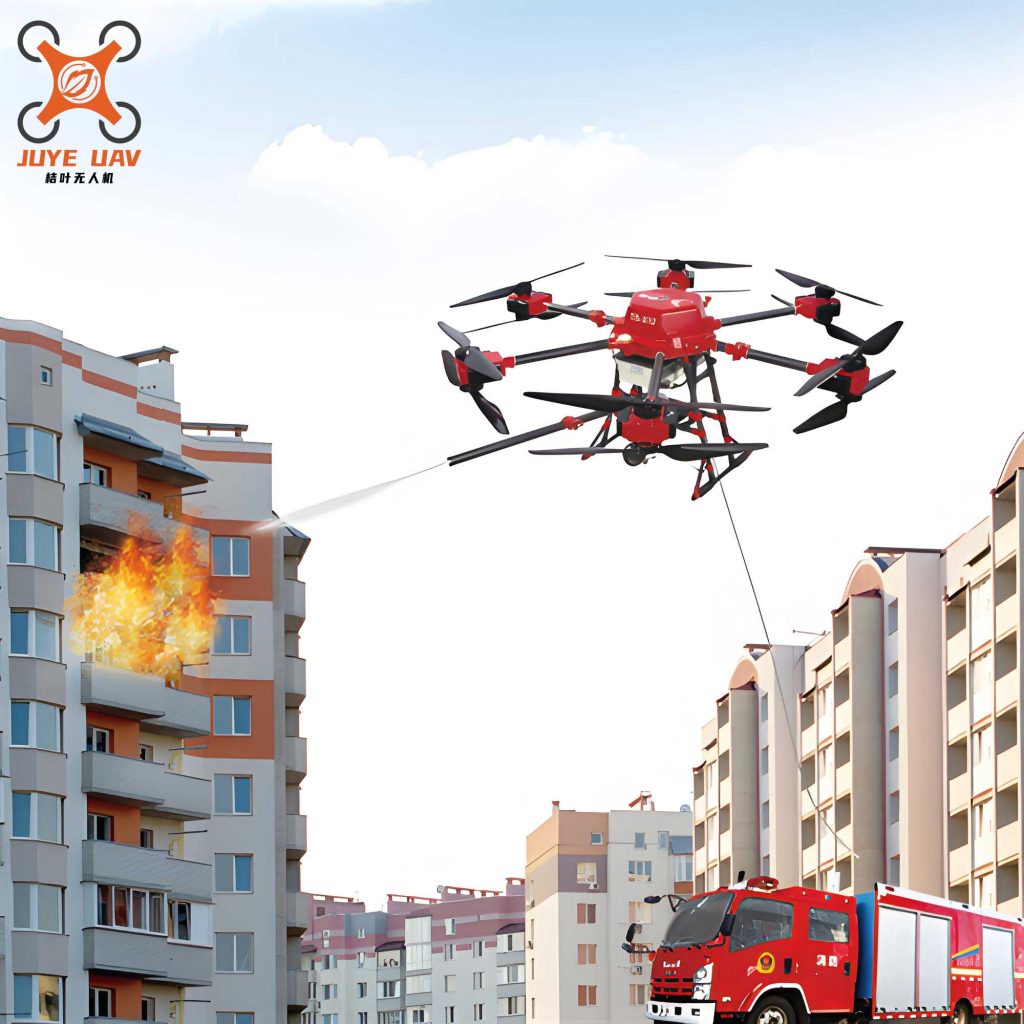
To understand the capabilities of fire drones, it is essential to first explore their classification. Fire drones can be categorized based on various criteria, which influence their performance and suitability for different firefighting tasks. Below, I summarize the primary classifications using a table for clarity.
| Classification Basis | Categories | Key Characteristics | Relevance to Firefighting |
|---|---|---|---|
| Usage Domain | Military, Civilian (Government/Public Service) | Military fire drones prioritize stealth and endurance; civilian fire drones focus on cost-effectiveness and versatility for public safety. | Fire departments typically use civilian fire drones tailored for emergency response, as they offer practical features like real-time video transmission and payload flexibility. |
| Power System | Electric, Fuel-powered | Electric fire drones: low maintenance, quiet operation, but limited flight time. Fuel-powered fire drones: longer endurance, better wind resistance, but higher complexity and vibration. | In firefighting, electric fire drones are often preferred for short-range missions due to their ease of use, while fuel-powered fire drones may be deployed for extended operations in harsh conditions. |
| Platform Configuration | Fixed-wing, Multi-rotor, Helicopter | Fixed-wing fire drones: efficient for large-area coverage. Multi-rotor fire drones: hover capability, ideal for precise inspections. Helicopter fire drones: versatile but complex. | Multi-rotor fire drones are most common in firefighting due to their maneuverability in confined spaces, such as urban environments or disaster zones. |
The choice of a fire drone depends on specific mission requirements. For instance, the flight time of an electric fire drone can be approximated by the formula: $$ T = \frac{C \cdot V}{P} $$ where \( T \) is the flight time in hours, \( C \) is the battery capacity in ampere-hours (Ah), \( V \) is the voltage in volts (V), and \( P \) is the power consumption in watts (W). This highlights the technical considerations when selecting fire drones for prolonged operations.
Moving to applications, fire drones have become indispensable in various aspects of firefighting and emergency response. Their versatility allows them to perform tasks that are too risky or inaccessible for human responders. I will outline the primary applications, supported by a table and mathematical models where applicable.
| Application Area | Description | Typical Payloads | Benefits |
|---|---|---|---|
| Disaster Reconnaissance | Fire drones provide aerial views of disaster sites, enabling real-time assessment without exposing personnel to danger. They can transmit video via 4G or satellite links to command centers. | High-resolution cameras, thermal imaging sensors, 4G图传 systems. | Rapid situational awareness, identification of trapped individuals, and optimal route planning for rescue teams. |
| Assisted Rescue Operations | Fire drones carry specialized equipment to support rescue efforts, such as communication devices, life-detection instruments, and payload delivery systems. | Loudspeakers,生命探测仪,智能抛投装备, gas samplers. | Enhanced communication with survivors, efficient搜救,精准投放 of supplies, and safe chemical sampling in hazardous environments. |
| 3D Modeling and Mapping | Using倾斜相机, fire drones capture aerial imagery to create detailed 3D models of disaster areas, aiding in damage assessment and strategic planning. | Tilt cameras, GPS modules, photogrammetry software. | Accurate volume calculations (e.g., for landslides), digital预案 development, and可视化力量部署 for fire departments. |
In disaster reconnaissance, the effectiveness of a fire drone can be quantified by its coverage area. For a fire drone flying at altitude \( h \) with a camera field of view \( \theta \), the ground coverage width \( W \) is given by: $$ W = 2h \cdot \tan\left(\frac{\theta}{2}\right) $$ This formula helps in planning flights to maximize侦查 efficiency. Similarly, for 3D modeling, the accuracy of the model depends on image overlap and resolution. The ground sample distance (GSD), which determines pixel resolution, is calculated as: $$ \text{GSD} = \frac{h \cdot s}{f} $$ where \( s \) is the sensor width, and \( f \) is the focal length. Fire drones equipped with high-quality sensors can achieve GSD values as low as a few centimeters, enabling precise建模 for firefighting scenarios.
However, the deployment of fire drones is not without challenges. As I have observed, several issues can hinder their effective use in fire departments. These problems range from technical limitations to operational risks, and they must be addressed to ensure that fire drones serve as reliable tools rather than liabilities.
First, the technological maturity of fire drones is still evolving. A critical concern is the lack of fully autonomous obstacle avoidance systems, which can lead to accidents in complex environments. Additionally, fire drones may struggle with stability in GPS-denied areas, such as indoor fires or dense urban canyons. The reliability of a fire drone in such conditions can be modeled using probability theory. For instance, if the probability of autonomous避障 failure is \( p_a \) and the probability of GPS signal loss is \( p_g \), the overall failure risk \( R \) might be expressed as: $$ R = 1 – (1 – p_a)(1 – p_g) $$ This underscores the need for fire drones with advanced sensors and robust flight control systems.
Second, operational safety poses significant hazards. Fire drones are susceptible to crashes due to operator error, inadequate training, or adverse weather conditions. The锋利螺旋桨 of a fire drone can cause injury or damage upon impact. To mitigate this, fire departments must prioritize comprehensive training programs. The kinetic energy \( E_k \) of a falling fire drone, which relates to potential damage, is given by: $$ E_k = \frac{1}{2} m v^2 $$ where \( m \) is the mass of the fire drone and \( v \) is its velocity at impact. This highlights why lightweight designs and safety protocols are crucial for fire drones.
Third, there is a common misconception regarding operator proficiency. Many assume that brief training is sufficient to master industrial-grade fire drones. In reality, operating fire drones requires continuous practice and expertise. The learning curve can be described by a skill acquisition function: $$ S(t) = S_{\text{max}} \left(1 – e^{-kt}\right) $$ where \( S(t) \) is the skill level at time \( t \), \( S_{\text{max}} \) is the maximum skill achievable, and \( k \) is a learning rate constant. For fire drone operators, achieving high \( S(t) \) demands dedicated training over months or years, not just a few sessions.
To address these challenges, I offer several reflections based on my experience. These considerations are vital for fire departments looking to integrate fire drones into their operations successfully.
First, stringent procurement practices are essential to acquire high-quality fire drones. The market for fire drones can be opaque, with vendors sometimes exaggerating capabilities or inflating prices. Fire departments should conduct thorough research, comparing brands, specifications, and prices. A useful approach is to evaluate fire drones based on key performance indicators (KPIs), such as flight time, payload capacity, and durability. These can be summarized in a decision matrix. For example, the overall score \( O \) for a fire drone model can be computed as: $$ O = \sum_{i=1}^{n} w_i \cdot s_i $$ where \( w_i \) is the weight assigned to each KPI (e.g.,续航能力,飞控 stability), and \( s_i \) is the score for that KPI. This quantitative method helps in selecting the most suitable fire drone for firefighting needs.
| Performance Indicator | Weight (w_i) | Score Range (s_i) | Example Calculation |
|---|---|---|---|
| Flight Time (minutes) | 0.3 | 0-10 (based on benchmark) | If a fire drone offers 40 min flight time vs. benchmark of 30 min, s_i = 8. |
| Payload Capacity (kg) | 0.25 | 0-10 | A fire drone with 5 kg capacity might score 9. |
| 避障 Capability | 0.2 | 0-10 (subjective assessment) | Advanced sensors could yield s_i = 9. |
| Cost-Effectiveness | 0.15 | 0-10 (inverse relation to cost) | Lower cost relative to features gives higher s_i. |
| After-Sales Support | 0.1 | 0-10 | Comprehensive服务 agreements score well. |
Second,强化培训工作 is critical to ensure that operators are certified and competent. Regulatory frameworks, such as the FAA’s Part 107 in the United States or similar AOPA certifications globally, mandate that fire drone pilots undergo formal training and testing. The certification process covers topics like airspace regulations, weather effects, and emergency procedures. From a pedagogical perspective, the retention of training material can be modeled using the Ebbinghaus forgetting curve: $$ R = e^{-\frac{t}{S}} $$ where \( R \) is memory retention, \( t \) is time since training, and \( S \) is the strength of memory. For fire drone operators, regular refresher courses and实战训练 are necessary to maintain high \( R \) values, ensuring safe and effective deployments.
Third, considering采购服务方式 can enhance the application of fire drones. Instead of merely purchasing hardware, fire departments might opt for service-based models where vendors provide飞行服务和售后维护. This approach transfers technical risks to experts and ensures that fire drones are always mission-ready. The cost-benefit analysis of such services can be framed using net present value (NPV) calculations: $$ \text{NPV} = \sum_{t=0}^{T} \frac{C_t}{(1 + r)^t} $$ where \( C_t \) are the cash flows (savings from avoided crashes or improved efficiency), \( r \) is the discount rate, and \( T \) is the service period. For many fire departments, the NPV of service contracts for fire drones may be positive due to reduced operational downtime and enhanced救援 capabilities.
In conclusion, fire drones represent a transformative technology in firefighting and emergency response. Their ability to perform灾情侦查,辅助救援, and三维建模 tasks with minimal risk to human life is unparalleled. However, realizing the full potential of fire drones requires addressing technical shortcomings, prioritizing operator training, and adopting strategic procurement practices. As fire drone technology continues to advance—with improvements in AI, battery life, and sensor integration—their role will only expand. I am confident that with careful implementation, fire drones will become indispensable assets, playing a crucial part in saving lives and protecting property. The future of firefighting is increasingly aerial, and fire drones are at the forefront of this evolution, offering new possibilities for efficiency and safety in even the most challenging scenarios.