
As a researcher deeply involved in the advancement of firefighting technologies, I have observed the transformative potential of unmanned aerial vehicles, particularly fire drones, in enhancing the professionalism and specialization of rescue teams. These fire drones serve as critical tools for fulfilling the mission of national and main force emergency response. In this article, I will explore the application types, existing challenges, and propose long-term development strategies for fire drones in the firefighting domain. My aim is to provide valuable insights that can drive the integration of fire drones into rescue operations, ultimately improving efficiency and safety.
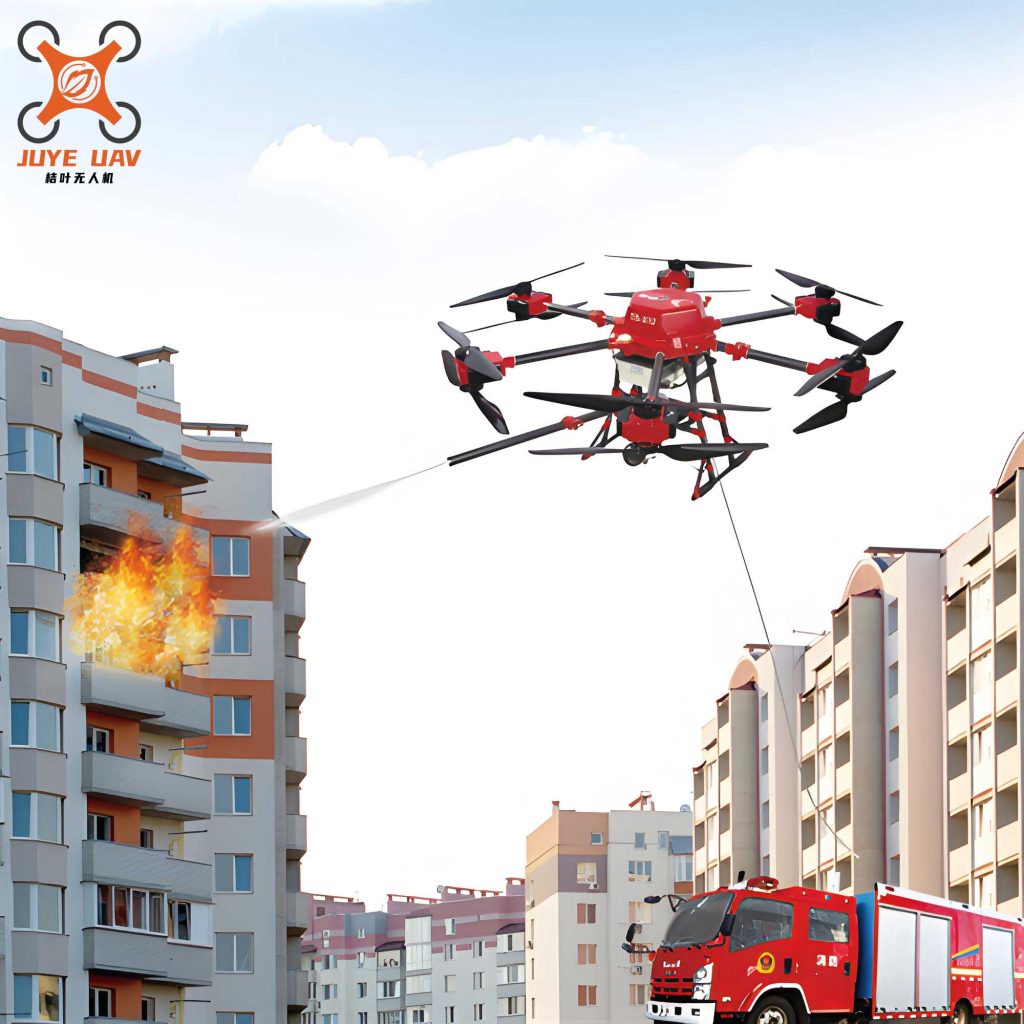
Fire drones are characterized by their flexibility, ease of operation, and comprehensive aerial perspective, making them widely applicable in technology and emergency fields. In firefighting实战, fire drones have played a significant role, though their current use is predominantly in reconnaissance, image transmission, and mapping. Applications such as indoor building reconnaissance and direct fire suppression remain limited. This highlights the need for further research and推广 of fire drone experiences. From my perspective, the evolution of fire drones is crucial for building a数字化 transparent battlefield and enhancing command systems.
Currently, fire drone applications can be categorized into several key areas. I have summarized these based on我的 analysis of various rescue scenarios, emphasizing the versatility of fire drones. Below is a table outlining the primary applications and their corresponding payloads:
| Application Type | Description | Common Payloads |
|---|---|---|
| Disaster Reconnaissance | Using hovering, circling, and close approaches to conduct全域侦察 with various cameras. | Visible light (panoramic, wide-angle, zoom), infrared thermal imaging, night vision全彩 cameras. |
| Monitoring and Detection | Continuous surveillance of fire, smoke, temperature, and gas changes for hazard assessment. | Thermal cameras, gas detection modules (e.g., combustible/toxic gas sensors). |
| Personnel Search | Locating trapped individuals through multiple sensing technologies and marking positions. | Visible light, thermal imaging, night vision,全彩 cameras, lasers, mobile phone定位 systems. |
| Mapping and Modeling | Creating panoramic maps, orthophotos, and 3D models for situational analysis and planning. | Visible light cameras, LiDAR sensors for航拍 and测绘. |
| Communication Relay | Extending communication coverage in disaster zones using airborne networks. | Broadband/narrowband自组网 payloads, mobile base stations for public network restoration. |
| Assisted Rescue | Aiding灭火救援 actions with specialized devices for precise operations. | Payloads for投抛, loudspeakers, lighting, and破拆 equipment. |
| 辅助执法监督 | Inspecting high-rise buildings for fire hazards and monitoring through aerial views. | High-resolution cameras for空中检查 and video storage integration. |
The efficiency of a fire drone in reconnaissance can be modeled using the following formula for area coverage: $$ A = \pi r^2 $$ where \( A \) represents the侦察覆盖面积 and \( r \) is the effective侦察 radius of the fire drone’s sensors. For instance, in灾情侦察, a fire drone with a thermal camera can cover a large area quickly, reducing the time needed for manual inspection. Additionally, the operational effectiveness \( E \) of a fire drone in辅助救援 can be expressed as: $$ E = \frac{T_{\text{successful missions}}}{T_{\text{total missions}}} \times 100\% $$ where \( T \) denotes mission counts, highlighting how fire drones enhance救援成功率.
Despite these applications, several challenges hinder the optimal use of fire drones. From my experience, the first issue is the limited variety and quantity of fire drones, which prevents systematic deployment. Most firefighting units possess fire drones for reconnaissance and mapping, but specialized types like灭火 fire drones, heavy-lift transport fire drones, and indoor侦察 fire drones are scarce, especially at municipal levels. This leads to inefficient dispatch based on disaster types. To quantify this, consider the resource allocation formula: $$ R = \sum_{i=1}^{n} D_i \times C_i $$ where \( R \) is the total resource availability, \( D_i \) is the number of fire drones of type \( i \), and \( C_i \) is their capability score. When \( D_i \) is low for critical types, \( R \) diminishes, impacting overall readiness.
Another problem is the lack of吸引力 in communication operator roles, which affects fire drone pilot retention. In my observation, many trained fire drone pilots leave due to limited career advancement or transfer to other positions. This流失率 can be analyzed using a retention model: $$ P_{\text{retention}} = \frac{N_{\text{current pilots}}}{N_{\text{trained pilots}}} $$ where \( N \) represents personnel numbers. For example, if only 67% of trained fire drone pilots remain, as noted in some cases, it indicates a need for better incentives. Furthermore, the absence of a unified飞行平台 for fire drones restricts advanced applications. Currently, different fire drone systems operate independently, lacking integration with command systems. This can be expressed as an interoperability gap: $$ I = 1 – \frac{S_{\text{integrated}}}{S_{\text{total}}} $$ where \( I \) is the interoperability deficiency, \( S_{\text{integrated}} \) is the number of integrated systems, and \( S_{\text{total}} \) is the total fire drone systems. A high \( I \) value hinders协同作战.
Command调度 and decision-support levels also require improvement. Fire drone applications are often managed by communication departments, with limited involvement from operations teams. This reduces the辅助决策 effectiveness. To address this, I propose a holistic建设应用模式 for fire drones, focusing on multiple strategies to elevate their role in firefighting.
First, strengthening the fire drone operator队伍 is essential. I recommend establishing dedicated fire drone flight teams at provincial and municipal levels, with clear roles and responsibilities. At基层 fire stations, setting up fire drone operator positions with at least two personnel can enhance吸引力. Training should combine social certification, internal retraining, and实战检验. The competency improvement can be modeled as: $$ C_{\text{improvement}} = \alpha \times T_{\text{training}} + \beta \times E_{\text{experience}} $$ where \( C \) is competency, \( T \) is training hours, \( E \) is experience积累, and \( \alpha, \beta \) are coefficients. Regular training boosts \( C \), ensuring fire drone operators are well-prepared.
Second, enhancing fire drone装备配备 is crucial. I suggest制定 standards for fire drone procurement across different levels, categorized by functions like侦察, mapping,灭火, and系留照明. For instance, municipal teams should have fire drone保障 vehicles integrated with power and communication systems. Additionally, deploying automated fire drone airports in key areas like industrial parks can enable rapid response. The efficiency of such airports can be calculated using: $$ T_{\text{response}} = \frac{D_{\text{distance}}}{V_{\text{fire drone}}} $$ where \( T_{\text{response}} \) is the response time, \( D \) is the distance to the scene, and \( V \) is the fire drone speed. Compared to ground vehicles, fire drones from airports offer faster \( T_{\text{response}} \), aiding initial指挥调度.
Third, adopting a unified fire drone飞行管控平台 is vital for large-scale救援. This platform should allow remote control, mission planning, cloud modeling, and integration with existing fire command systems. By enabling real-time information sharing, it enhances辅助决策. The benefit can be expressed as: $$ B_{\text{platform}} = \frac{I_{\text{shared}}}{I_{\text{total}}} \times 100\% $$ where \( B \) is the benefit percentage, \( I_{\text{shared}} \) is the amount of shared information, and \( I_{\text{total}} \) is the total information available. A higher \( B \) improves救援效率. Below is a table summarizing the key features of such a platform:
| Platform Feature | Function | Impact on Fire Drone Operations |
|---|---|---|
| Unified航線规划 | Automated route design for multiple fire drones | Reduces manual errors and optimizes侦察 paths |
| Cloud Modeling | Real-time 3D mapping and data storage | Facilitates态势标绘 and analysis for commanders |
| Remote Flight Control | Centralized management of fire drone fleets | Enables协同作业 across不同 fire drone types |
| Integration with Command Systems | Seamless data flow to existing消防指挥 systems | Enhances一体化指挥 and decision-making |
| Training Analysis | Recording and evaluating fire drone mission logs | Improves operator skills and战术创新 |
Fourth, innovating指挥调度应用模式 is necessary. I propose a tiered approach where fire drone airports are activated immediately upon报警, providing站级前突侦察 before human responders arrive. This can be supplemented by municipal-level fire drone teams for complex disasters. The overall efficiency model is: $$ E_{\text{total}} = \sum_{i=1}^{4} w_i \times E_i $$ where \( E_{\text{total}} \) is the total efficiency, \( E_i \) represents efficiency at each tier (e.g.,站级, municipal), and \( w_i \) are权重 factors. This multi-tier system ensures faster and more comprehensive fire drone support.
Fifth, advancing fire drone-assisted灭火 is critical for tackling challenges like high-rise building fires. I advocate for developing大载荷旋翼 fire drones equipped with灭火 modules, such as高压液体系留 systems or灭火弹发射装置. These fire drones can perform external灭火, complementing internal救援 efforts. The灭火 effectiveness \( M \) can be modeled as: $$ M = \frac{V_{\text{extinguishing agent}}}{t_{\text{application}}} $$ where \( V \) is the volume of extinguishing agent deployed and \( t \) is the time taken. By increasing \( M \), fire drones help achieve “灭早灭小” tactics. Additionally, fire drones with破拆 modules can assist in breaking windows for ventilation, with破拆 force calculated using: $$ F = m \times a $$ where \( F \) is the force, \( m \) is the mass of the破拆 projectile, and \( a \) is its acceleration upon impact.
Sixth, establishing a robust应急联动体系 is essential. Collaborating with telecom operators, fire drone manufacturers, and professional飞行队伍 can enhance resources during disasters. This联动 can be quantified through a cooperation index: $$ CI = \frac{N_{\text{joint drills}}}{N_{\text{total drills}}} \times 100\% $$ where \( CI \) is the cooperation index, and drills measure readiness. High \( CI \) values ensure that fire drone support is reliable and effective when needed.
In conclusion, the深入应用 of fire drones in firefighting has a profound positive impact on rescue operations. From my perspective, continuous总结经验, investment in new装备, and cultivation of专业人才 are imperative. By fostering扁平化可视化指挥 systems and leveraging fire drones as战斗力倍增器, we can harness technology to enhance救援 capabilities. The future of firefighting lies in embracing innovations like fire drones to fulfill the mission of saving lives and mitigating disasters. I believe that through systematic implementation of these modes, fire drones will become indispensable in modern firefighting, driving the industry toward greater efficiency and safety.
To further illustrate the potential of fire drones, consider the following formula for overall system effectiveness: $$ OSE = \alpha \cdot E_{\text{recon}} + \beta \cdot E_{\text{rescue}} + \gamma \cdot E_{\text{command}} $$ where \( OSE \) is the overall system effectiveness, \( E_{\text{recon}} \), \( E_{\text{rescue}} \), and \( E_{\text{command}} \) represent effectiveness in reconnaissance, rescue, and command respectively, and \( \alpha, \beta, \gamma \) are weighting coefficients based on mission priorities. By optimizing each component through the proposed fire drone models, \( OSE \) can be maximized, ensuring that fire drones contribute significantly to救援成功. This holistic approach underscores the importance of integrating fire drones into every aspect of firefighting, from initial侦察 to complex灭火 operations, ultimately building a resilient and tech-driven emergency response ecosystem.