
The relentless vertical growth of cities worldwide has led to the proliferation of super-tall structures. According to incomplete statistics, there are currently tens of thousands of buildings exceeding 100 meters in height in China alone, with 895 structures surpassing 200 meters (including those under construction). This new urban landscape presents a formidable challenge to traditional firefighting methodologies. Conventional mobile firefighting equipment, the backbone of fire suppression, is increasingly revealing critical shortcomings characterized by an inability to “reach high enough, enter the space, deploy effectively, and strike accurately.” In this context, the integration of Unmanned Aerial Vehicles (UAVs), specifically engineered as fire drone systems, into fire rescue operations is not just an innovation but an inevitable and indispensable trend. This article provides a comprehensive analysis of the application of fire drone technology in combating fires within super-tall buildings. By examining real-world case studies and leveraging advanced computational modeling, it delineates the critical roles fire drone platforms play in fire scene reconnaissance, personnel evacuation guidance, logistics supply, and auxiliary fire suppression. Furthermore, it employs numerical simulation via MATLAB to explore and optimize flight path planning for coordinated fire drone squadrons engaged in reconnaissance missions.
Introduction: The Limitations of Tradition and the Rise of Aerial Assets
An Unmanned Aerial Vehicle (UAV), commonly known as a drone, is a powered aerial vehicle that does not carry a human operator, using aerodynamic forces for lift, and can operate autonomously or be piloted remotely. Compared to manned aircraft, a fire drone eliminates risks to human pilots and can endure missions in perilous environments that would be intolerable or fatal for humans. The concept dates back to the early 20th century, driven by safety concerns for pilots. By the 1930s, practical development began, with companies like Britain’s Fairey Aviation modifying aircraft into rudimentary drones, primarily for military target practice.
The rapid advancement of construction technology has far outpaced the evolution of firefighting equipment. In super-tall building fires, the utility of mobile assets diminishes sharply. Aerial ladder platforms, the primary high-altitude rescue tools, have maximum working heights generally limited to around 50-100 meters, with stability becoming a critical issue at their upper limits, especially under windy conditions. Fire engine-mounted water towers often have effective vertical reach of only about 8-10 stories. Compounding these limitations is the “stack effect” or chimney effect prevalent in tall buildings, where fire and smoke can race vertically through stairwells and utility shafts at speeds exceeding 3-5 meters per second, rapidly overwhelming upper floors. This combination of physical inaccessibility and rapid fire spread creates a scenario where traditional external attack and rescue are severely hampered, and internal operations are conducted with dangerously incomplete information. Historical tragedies underscore this vulnerability, as illustrated in the following analysis of significant fires.
Analysis of Super-Tall Building Fire Case Studies
The limitations described are starkly evidenced in past incidents. The following table summarizes several catastrophic fires in high-rise buildings, highlighting the consequences when firefighting capabilities cannot match architectural scale.
| Case Location | Approx. Height / Floors | Key Challenges & Losses |
|---|---|---|
| Shanghai Residential Fire (2010) | 28 Floors (~85m) | Intense fire spread via external scaffolding and insulation. Aerial ladders and water towers could not effectively reach the upper floors. Internal attack was hindered by unknown conditions. Resulted in 58 fatalities, over 70 injuries, and approximately $65 million in property loss. |
| Beijing Hotel Fire (2024?) | 30 Floors (~100m) | Fire involved complex internal structures. Difficulties in rapid vertical deployment of crews and equipment, and challenges in locating all occupants. Reports indicated 1 fatality, 7 injuries, and extensive damage. |
| Chongqing Residential Fire (2020) | 29 Floors (~90m) | Fire originated on an intermediate floor. While no casualties were reported, significant property damage occurred due to the speed of vertical smoke spread and difficulties in mounting a precise, timely internal attack from a position of full situational awareness. |
| Changchun Market Fire (2013) | 32 Floors (~100m) | Rapid fire growth in a commercial-residential complex. Evacuation and rescue were complicated by the building’s height and occupant load. Caused 42 injuries and significant economic loss. |
Taking the Shanghai fire as a detailed example: the blaze, ignited by unauthorized welding, escalated uncontrollably. External firefighting streams were ineffective against the upper floors. The chimney effect propelled flames and toxic smoke upwards at devastating speed. Dozens of trapped residents gathered on the roof or clung to external scaffolding, awaiting rescue that was perilously slow to arrive. Nearly 200 firefighters launched a courageous interior attack. However, without real-time intelligence on fire dynamics, structural integrity, and precise locations of trapped individuals, the operation necessitated a risky, floor-by-floor search in extreme conditions, drastically slowing rescue efforts and reducing survival probabilities.
These cases illuminate a critical gap: when a fire occurs above approximately 50 meters, the success of the response becomes overwhelmingly dependent on the effective use of the building’s internal fixed systems and on precise interior operations. Therefore, acquiring real-time, reliable intelligence from inside the fire-affected zones is paramount. A fire drone, equipped with advanced sensors, can penetrate this information void. Statistics indicate that most fire fatalities result from inhalation of toxic combustion products like carbon monoxide (CO), hydrogen cyanide (HCN), and asphyxiants. A fire drone can not only map these hazardous atmospheric zones but also deliver survival gear such as smoke hoods or respirators to trapped victims, directly extending their window for rescue.
Conventional Applications of Fire Drones in Super-Tall Building Fire Suppression
1. Fire Scene Reconnaissance and Situational Awareness
This is the most transformative application. The initial phase of a high-rise fire is often characterized by “the fog of war.” A fire drone acts as a rapid-deployment aerial scout. Integrated with 5G for ultra-low-latency, high-bandwidth data transmission and VR (Virtual Reality) for immersive command post visualization, it provides commanders with a real-time “bird’s-eye view” inside the hazard zone. Key reconnaissance functions include:
- Visual & Thermal Imaging: Standard HD and zoom cameras identify fire location, intensity, and spread patterns. Thermal imaging cameras (TIC) detect heat sources through smoke, pinpointing the main fire seat, spotting hidden hot spots in walls or ceilings, and most importantly, locating trapped individuals based on their body heat signatures.
- Gas and Environmental Sensing: Payloads with gas detectors (e.g., for CO, CO₂, O₂ depletion, VOCs) and particulate matter sensors map the toxicity and explosivity of the atmosphere in three dimensions. This data is crucial for predicting flashover conditions, guiding interior crew deployment along safer paths, and determining viable rescue corridors.
- Structural Assessment: High-resolution imaging can help assess the integrity of critical structural elements exposed to fire, informing safety decisions for both occupants and firefighters.
The intelligence gathered by a fire drone transforms decision-making from guesswork to informed strategy, enabling precise resource allocation and potentially preventing firefighter fatalities.
2. Personnel Evacuation Guidance and Communication
Chaos and panic during evacuation in a super-tall building can be as deadly as the fire itself. A fire drone serves as a mobile command and communication node in the sky. By integrating the thermal imaging data for locating people with a real-time building model and fire spread analysis, incident commanders can identify optimal evacuation routes. The fire drone can then actively guide evacuees:
- Auditory Guidance: Equipped with powerful loudspeakers or directional sound systems, the fire drone can broadcast calm, authoritative instructions. It can tell specific groups on specific floors which stairwell is clear, warn them away from compromised exits, or instruct them to shelter in place if movement is too dangerous.
- Visual Guidance: Mounted high-intensity LED floodlights or laser pointers can illuminate safe paths through smoke-filled hallways or signal to people on upper floors.
- Psychological Calming: The mere presence of a visible aid and the sound of clear instructions can reduce panic, leading to more orderly and efficient self-evacuation.
3. Logistics Supply and Payload Delivery
Sustaining both trapped victims and interior firefighting crews is a major logistical hurdle. A fire drone with cargo capability becomes a critical aerial supply line. It can deliver essential payloads accurately to balconies, windows, or rooftop helipads:
| Payload Type | Beneficiary | Purpose |
|---|---|---|
| Emergency Respirators / Smoke Hoods | Trapped Occupants | Extend survival time in toxic environments while awaiting rescue. |
| Medical Kits (EpiPens, inhalers) | Trapped Occupants | Address immediate medical emergencies. |
| Communication Devices (Phones, Radios) | Trapped Occupants | Restore communication for better coordination with rescuers. |
| Spare SCBA Cylinders / Batteries | Interior Firefighting Crews | Enable crews to operate deeper and longer without retreating for supplies. |
| Thermal Imaging Cameras / Tools | Interior Firefighting Crews | Resupply specialized equipment lost or damaged during operations. |
4. Auxiliary Fire Suppression and Support
Beyond intelligence and logistics, fire drone platforms are evolving into active firefighting agents.
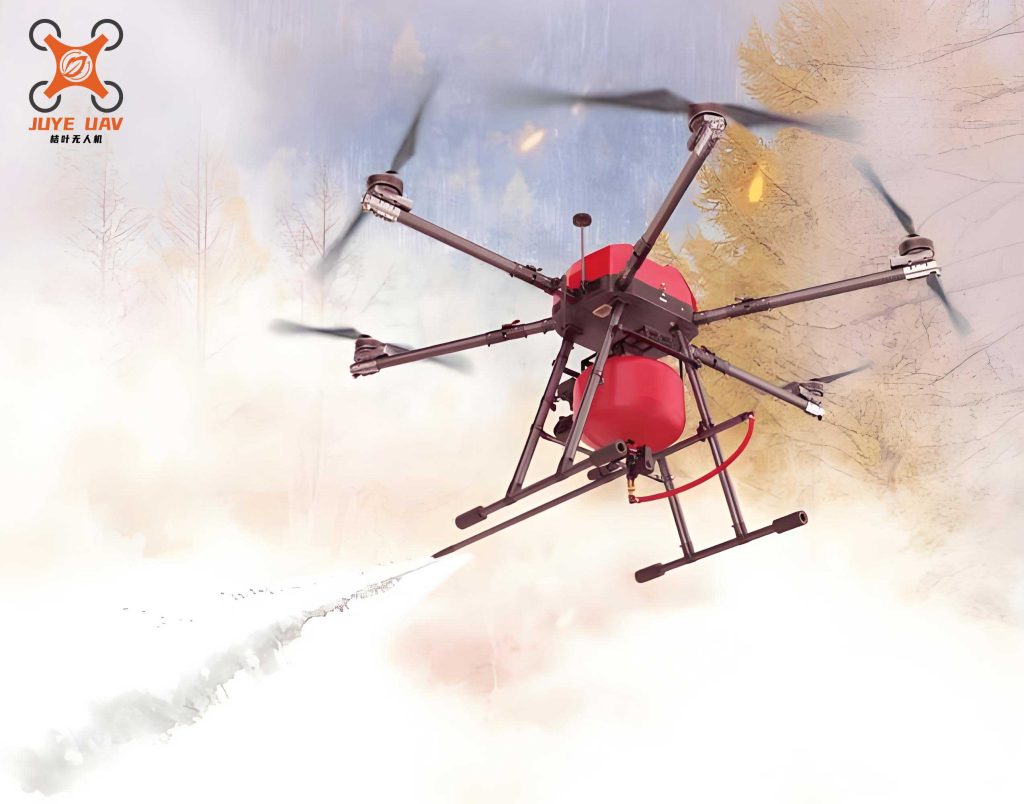
- Early-Strike Capability: Due to their rapid response, the first-arriving fire drone can be equipped with fire-suppressant grenades or ballistics (e.g., dry chemical, compressed aerosol foam). It can execute precision strikes on incipient fires in critical areas (like an electrical room or generator space) before ground forces are set up, potentially containing the fire’s growth.
- Aerial Hose Deployment: A groundbreaking development is the tethered fire drone or “Dragon Drone” system. These heavy-lift drones are physically connected to a ground-based pump via a hose, which also supplies power, allowing for indefinite flight time. They can hoist a fire hose stream to previously unreachable heights. For instance, certain systems can deploy a DN25 hose to 100 meters or a DN40 hose to 55 meters, effectively acting as a flying standpipe and enabling direct external attack on fires in the mid-section of super-tall buildings.
- Ventilation Support: Drones can be used to strategically perform or assess the effects of tactical ventilation operations.
Optimized Path Planning for Coordinated Fire Drone Reconnaissance Squadrons
While a single fire drone is powerful, a coordinated squadron can conduct simultaneous, comprehensive reconnaissance of a large, complex fire floor in a fraction of the time. The key challenge is efficient path planning: assigning specific search areas to each drone in the squadron to minimize total mission time and ensure full coverage without redundancy.
1. Problem Formulation as a Multiple Traveling Salesman Problem (MTSP)
The search area on a fire floor can be discretized into a grid of $N$ critical points or “search nodes” that must be visually inspected (e.g., corridor intersections, room entrances, specific hazard locations). Each node is defined by coordinates $(x_i, y_i)$. A squadron of $M$ fire drone units starts from a common launch point (e.g., a command post window, Node 0). The objective is to find $M$ paths such that every other node $(1, 2, …, N)$ is visited exactly once by one drone, and all drones return to the start point, minimizing the total distance traveled by the squadron.
This is a classic Multiple Traveling Salesman Problem (MTSP). If we have $N+1$ nodes (indexed 0 to $N$) and $M$ salesmen (drones), a potential solution can be represented as a permutation of the list $[1, 2, …, N]$ with $M-1$ copies of the start node ‘0’ inserted. For example, for $N=4$ nodes and $M=3$ drones, a solution permutation like $[3, 0, 2, 1, 0]$ decodes as:
- Drone 1 path: $0 \rightarrow 3 \rightarrow 0$
- Drone 2 path: $0 \rightarrow 2 \rightarrow 1 \rightarrow 0$
- Drone 3 path: $0 \rightarrow 0$ (effectively idle, a possible but sub-optimal outcome the algorithm must avoid through cost weighting).
2. Mathematical Model and Genetic Algorithm Solution
Let $d_{ij}$ be the Euclidean distance between node $i$ and node $j$:
$$ d_{ij} = \sqrt{(x_i – x_j)^2 + (y_i – y_j)^2} $$
The objective is to minimize the total path distance $D_{total}$ for the squadron:
$$ \text{Minimize: } D_{total} = \sum_{m=1}^{M} D_m $$
where $D_m$ is the distance traveled by drone $m$. For a drone assigned a sequence of nodes $[0, k_1, k_2, …, k_p, 0]$, its distance is:
$$ D_m = d_{0,k_1} + \sum_{q=1}^{p-1} d_{k_q, k_{q+1}} + d_{k_p,0} $$
subject to the constraint that every node $1..N$ appears in exactly one drone’s sequence.
We employ a Genetic Algorithm (GA) in MATLAB to solve this NP-hard optimization problem. GAs are inspired by natural selection, using a population of candidate solutions (chromosomes) that evolve over generations.
Algorithm Steps in MATLAB:
- Initialization: Define parameters: number of drones `salesmen = 3`, population size `pop_size = 80`, maximum generations `num_iter = 5000`. Generate random initial population of permutations.
- Fitness Evaluation: For each chromosome (solution permutation), decode it into $M$ paths. Calculate the total distance $D_{total}$. The fitness score is inversely proportional to the distance (shorter path = higher fitness).
% Pseudocode for distance calculation per chromosome totalDist = zeros(pop_size, 1); for each chromosome p in population decode p into M routes with start/end at node 0; d = 0; for each route r in the M routes d = d + distance_matrix(0, first_node_of_r); for each consecutive pair (node_a, node_b) in route r d = d + distance_matrix(node_a, node_b); end d = d + distance_matrix(last_node_of_r, 0); end totalDist(p) = d; end - Selection: Select parent chromosomes for mating, favoring those with higher fitness (tournament selection is commonly used).
- Crossover: Combine parts of two parent chromosomes to produce offspring (e.g., using ordered crossover to maintain valid permutations).
- Mutation: Randomly alter parts of an offspring chromosome with a small probability (e.g., swap two nodes) to maintain genetic diversity.
- Elitism: Preserve the best-performing chromosome(s) from the current generation directly into the next.
- Iteration: Repeat steps 2-6 for `num_iter` generations. Track the global minimum distance found.
distHistory = zeros(num_iter, 1);
globalMin = Inf;
globalBestRoute = [];
for iter = 1:num_iter
    ... % Evaluate fitness, select, crossover, mutate
    [minDistCurrent, idx] = min(totalDist);
    distHistory(iter) = minDistCurrent;
    if minDistCurrent < globalMin
        globalMin = minDistCurrent;
        globalBestRoute = population(idx, :); % Save the best route
    end
end
3. Simulation Results and Path Visualization
Applying this GA to a simulated fire floor with 30 search nodes and 3 fire drone units yields an optimized cooperative search plan. The algorithm converges to a solution that minimizes the total flight distance while ensuring all nodes are covered. The resulting paths, each assigned to a different drone, are disjoint and efficient, demonstrating clear area partitioning for simultaneous reconnaissance. The convergence plot of the GA shows a rapid decrease in total path distance, stabilizing at the global minimum, confirming the effectiveness of the optimization. This coordinated approach, powered by such algorithms, ensures that a fire drone squadron can provide a complete situational picture in the shortest possible time, a critical factor in dynamic super-tall building fires.
| Metric | Single Fire Drone (Sequential) | Coordinated Fire Drone Squadron (MTSP-Optimized) |
|---|---|---|
| Time to Full Coverage | $T_{single} = \frac{D_{all}}{v}$ where $D_{all}$ is distance to visit all N nodes. |
$T_{squad} \approx \frac{max(D_1, D_2, …, D_M)}{v}$ Drone with longest assigned path determines mission time. |
| Total Energy Consumption | High (one drone carries entire load). | Distributed, but total sum may be similar or slightly higher due to less-than-perfect splits; operational time reduction is the key benefit. |
| Reconnaissance Redundancy | None. Single point of failure. | High. If one drone fails, others continue; areas can be dynamically reassigned. |
| Data Fusion Complexity | Low (single stream). | Higher, but manageable with synchronized geotagging and a common operational picture software. |
Conclusion and Future Outlook
The continuous rise of super-tall buildings presents an enduring challenge to urban fire safety, exposing the strategic and tactical limitations of traditional ground-based firefighting assets. In this context, the fire drone has emerged as a transformative force multiplier. Its capabilities in providing real-time, high-fidelity intelligence from within the heart of a fire, guiding evacuations, sustaining both victims and responders through aerial logistics, and even participating in direct suppression, fundamentally enhance the efficacy and safety of fire rescue operations. The optimization of multi-drone squadron tactics through advanced algorithms like MTSP solvers ensures that this technology can be deployed with maximum efficiency, enabling rapid, comprehensive situational awareness. As fire drone technology continues to evolve—with improvements in autonomy, payload capacity, sensor fusion, and airspace communication—its integration into standard firefighting doctrine for high-rise and super-tall buildings is not just advantageous but essential. The future of firefighting in the vertical city lies in the symbiotic partnership between courageous ground crews and sophisticated aerial partners like the fire drone, working in concert to save lives and protect property against one of humanity’s oldest and most formidable adversaries.