
In recent years, as urban development accelerates, the proliferation of high-rise residential buildings has become a hallmark of modern cities. However, this progress brings significant safety challenges, particularly regarding fire hazards. I have observed that residential fires, especially in high-rises, often lead to severe casualties and property damage due to dense populations, numerous combustibles, and difficult rescue operations. Therefore, exploring innovative solutions like fire drones is crucial. Through analyzing fire statistics from 2017 to 2019, I aim to delve into the characteristics and causes of residential fires, the design elements and functional requirements of fire drones, and灭火 methods, ultimately proposing a “monitoring and integration” fire drone using sonic technology for residential areas. This article will detail these aspects from a first-person perspective, emphasizing the role of fire drones in enhancing fire safety.
Fire, defined as uncontrolled combustion in time and space, possesses devastating destructive power. In China, from 2017 to 2019, fire incidents remained alarmingly high, with annual reports of 281,000, 237,000, and 233,000 fires, respectively. These resulted in significant casualties and economic losses, as summarized in Table 1. The data underscores the persistent threat of fires, particularly in residential areas, where over half of fire-related deaths occur. For instance, in 2018, residential fires accounted for 79.7% of total fatalities, highlighting the urgent need for improved prevention and response mechanisms. From my analysis, I note that fires often occur at night, between 10 PM and 6 AM, with electrical faults being a primary cause. This pattern suggests that early detection and rapid intervention are key to mitigating risks, and fire drones can play a pivotal role in achieving this.
| Year | Number of Fires (10,000) | Deaths (Persons) | Injuries (Persons) | Direct Property Loss (Billion CNY) |
|---|---|---|---|---|
| 2017 | 28.1 | 1,390 | 881 | 36.0 |
| 2018 | 23.7 | 1,407 | 798 | 36.75 |
| 2019 | 23.3 | 1,335 | 837 | 36.12 |
Residential fires exhibit distinct characteristics such as突发性, mutability, and difficulty in suppression. From my research, I find that indoor fires often start unexpectedly due to factors like overloaded electrical circuits or aging wiring, especially at night when detection is delayed. The mutability refers to how fire spread is influenced by variables like可燃物 location, type, and quantity, as well as wind direction. In high-rise buildings, complex layouts and abundant combustible materials accelerate火势蔓延, making containment challenging within the critical first 30 minutes. Moreover, evacuation is hampered by inadequate消防设施, psychological factors like panic and趋光性, and structural issues such as improperly designed防盗门窗. These insights drive my focus on developing fire drones that can address these complexities through advanced monitoring and rapid response.
The design of a fire drone involves multiple modules and systems that must协同工作 to ensure effective operation in harsh fire environments. Based on my experience, I emphasize that a fire drone’s airframe should be lightweight yet strong, with a rational layout for stability. Key components include radar modules for stable signal transmission, waterproof and heat-resistant materials to withstand high temperatures and烟雾, and anti-explosion features for safety. For night operations, I incorporate night-vision cameras and auxiliary lighting. The core systems of a fire drone, as I conceptualize, are outlined in Table 2, which summarizes the essential elements and their functions. This holistic approach ensures that the fire drone can perform reliably in diverse residential fire scenarios.
| Component | Function | Requirements |
|---|---|---|
| Airframe | Provides structural support and houses systems | Lightweight, high-strength, stable design |
| Radar System | Enables定位 and navigation in low-visibility conditions | Stable connection,抗干扰能力 |
| Fire Suppression System | Executes灭火 operations (e.g., sonic waves) | 兼容性 with various fire types,高效性 |
| Gimbal Camera | Captures real-time footage for monitoring | Night-vision capability, high resolution |
| Power Module | Supplies energy for flight and systems | Long endurance,快速充电 |
| Flight Control Module | Manages autonomous or manual flight operations | Precision control, adaptability to wind |
When selecting a灭火 method for fire drones, I evaluate traditional approaches like灭火剂喷洒 (e.g., dry powder, foam) and灭火弹发射. However, from my analysis, these methods have limitations: they may not suit all fire types (e.g., dry powder is ineffective on metal fires), require frequent replenishment, and pose environmental or safety risks. In contrast, sonic wave灭火 technology, which uses low-frequency sound waves (30–60 Hz) to separate oxygen from flames, offers significant advantages. The principle can be described by the wave equation for sound propagation in air: $$ \frac{\partial^2 p}{\partial t^2} = c^2 \nabla^2 p $$ where \( p \) is pressure and \( c \) is the speed of sound. This technology is versatile, environmentally friendly, and无需维护, making it ideal for integration into fire drones. I calculate the effectiveness based on frequency and intensity, with the灭火效率 \( \eta \) given by: $$ \eta = \frac{E_{\text{extinguished}}}{E_{\text{total}}} = f(I, \nu) $$ where \( I \) is sound intensity and \( \nu \) is frequency. This reinforces my decision to adopt sonic waves for the fire drone design.
My proposed fire drone design embodies a “butterfly” aesthetic, with a symmetrical quadcopter airframe in消防用色 (black and red) for visual appeal and警示. It is wall-mounted on a wireless charging dock for easy deployment. The fire drone integrates advanced sensors, including infrared dual-color temperature sensors for accurate火情监测 despite烟雾, and蒲微呼吸器 to prevent moisture damage. The use of carbon fiber composites enhances strength and电磁屏蔽, while an internal aluminum layer protects electronic components. Key functionalities, as I envision, include autonomous fire detection, sonic wave emission for初期灭火,语音广播 for evacuation guidance, and逃生路线投影 to assist trapped individuals. The operational process involves continuous monitoring; upon detecting a火源, the fire drone automatically disengages, locates the fire, and emits sonic waves to suppress it. If火势 escalates, it alerts authorities and aids in疏散, as illustrated in the灭火过程. This “监察打一体化” approach ensures that the fire drone can respond swiftly and effectively.
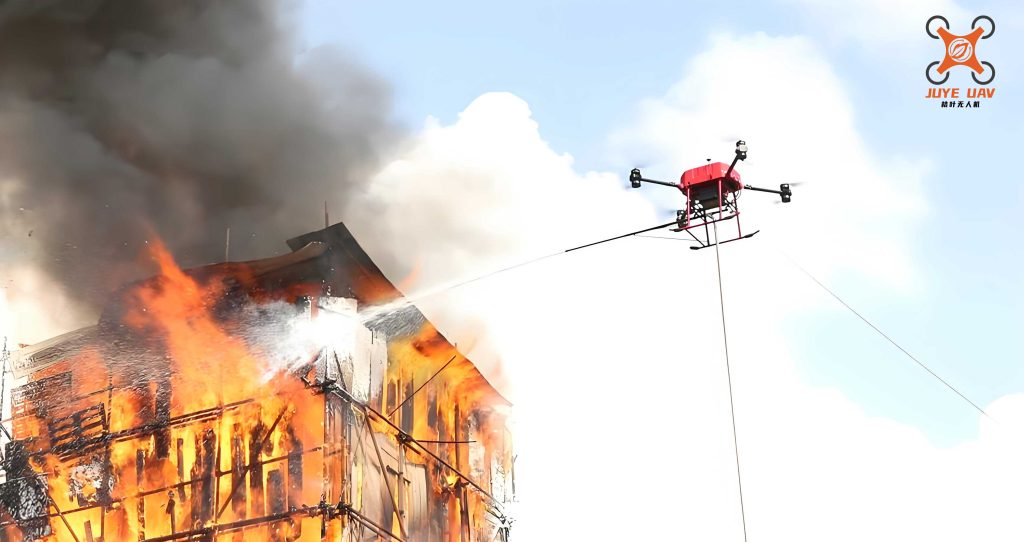
To quantify the performance of the fire drone, I model its response time \( T_r \) as a function of detection delay \( D \) and flight speed \( v \): $$ T_r = D + \frac{d}{v} $$ where \( d \) is the distance to the火源. By minimizing \( D \) through real-time sensors and optimizing \( v \), the fire drone can achieve rapid intervention. Additionally, the sonic wave’s灭火 capability can be expressed in terms of声压级 \( L_p \) and frequency range: $$ L_p = 20 \log_{10}\left(\frac{p}{p_0}\right) \text{ dB} $$ where \( p_0 \) is the reference pressure. For effective灭火, I target \( L_p \) levels above 120 dB within 30–60 Hz. This technical foundation ensures that the fire drone meets practical requirements for residential safety.
In conclusion, the integration of fire drones into residential fire safety strategies represents a transformative advancement. From my perspective, transitioning from traditional消防产品 to intelligent systems like the fire drone can significantly reduce火灾发生率 and enhance救援效率. The sonic wave-based fire drone, with its monitoring, suppression, and疏散 capabilities, addresses the unique challenges of high-rise住宅区. However, I acknowledge that further innovation is needed to mature technologies such as autonomous navigation and heat resistance. Collaborative efforts between research institutions and消防部门 will be essential to refine the fire drone’s design and expand its applications. Ultimately, I believe that widespread adoption of fire drones can create safer living environments, mitigating the devastating impact of fires and saving lives. As I continue to explore this field, I remain committed to advancing fire drone technology for the benefit of society.
Throughout this article, I have emphasized the importance of fire drones in modern fire safety. By leveraging data analysis, technical design, and innovative灭火 methods, the fire drone stands as a promising solution to residential fire hazards. As I reflect on the火灾统计 and design considerations, it is clear that proactive measures, supported by advanced tools like the fire drone, are crucial for building resilient communities. I encourage ongoing research and development to optimize fire drone性能 and ensure their seamless integration into everyday safety protocols. With continued focus, fire drones will undoubtedly play a pivotal role in shaping a fire-safe future.