
The landscape of emergency response, particularly firefighting, is undergoing a profound transformation. For decades, firefighters have entered perilous situations with intelligence limited by ground-level perspectives and communication systems vulnerable to the very disasters they combat. My analysis of modern operational challenges reveals a critical gap: the need for persistent, reliable, and multi-dimensional situational awareness. Traditional ground-based communication infrastructure, while extensive, is often the first casualty in structural collapses, wildfires, or large-scale natural disasters. Satellite communication, though robust against terrestrial damage, involves costly, specialized equipment not readily deployable by every first-response unit. It is within this crucible of need and technological advancement that the fire drone emerges not merely as a tool, but as a cornerstone for next-generation emergency communication and operational strategy. This aerial platform transcends being a simple camera in the sky; it is becoming a mobile communications hub, a remote sensor, and a logistics partner, fundamentally reshaping how command structures perceive and manage crises.
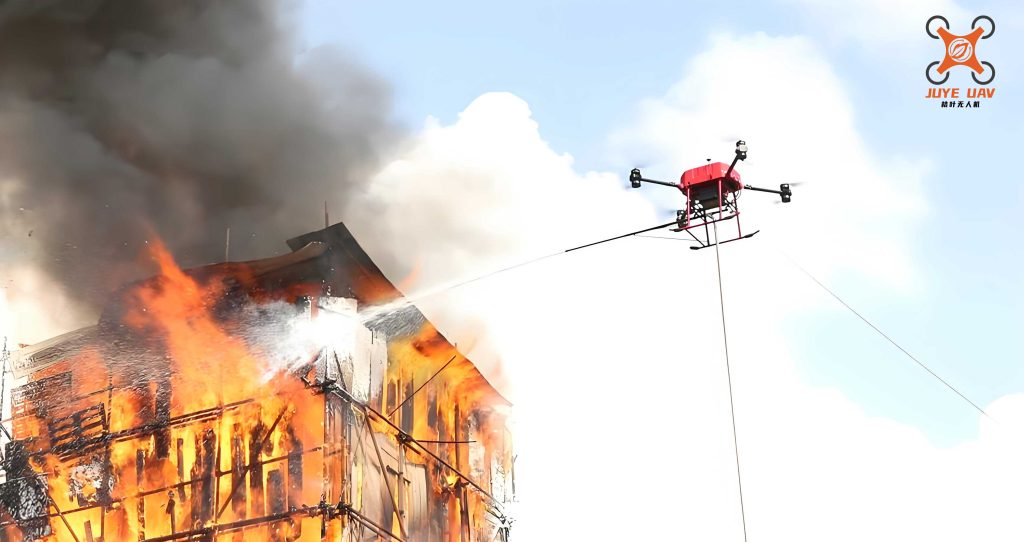
The efficacy of any emergency response hinges on the quality and timeliness of information available to commanders. In fire service operations, communication must embody two paramount characteristics: Real-time Fidelity and Unyielding Reliability. The fire drone is uniquely positioned to address both. Real-time fidelity demands that video, audio, and sensor data from the heart of the incident flow instantaneously to decision-makers. A delay of seconds can mean the difference between a contained event and a catastrophic escalation. The fire drone serves as a mobile, elevated node, bypassing ground clutter and providing a direct data pipeline. Reliability is tested in the extreme environments firefighters operate in—intense heat, toxic smoke, blinding water spray, and structural instability. Engineered for resilience, a modern fire drone can operate where human scouts cannot, ensuring the communication link persists even when all else fails. The following table contrasts the traditional communication model with one augmented by fire drone technology:
| Communication Aspect | Traditional Model | Fire Drone-Augmented Model |
|---|---|---|
| Perspective & Data Source | Ground-level reports, fixed cameras, manual reconnaissance. | Overhead, multi-angle, real-time aerial video and thermal imaging. |
| Communication Link Stability | Vulnerable to ground damage, physical obstructions, and signal interference. | Airborne link less susceptible to ground-level obstacles; can act as a temporary repeater. |
| Deployment Speed | Time-consuming to set up fixed masts or satellite terminals. | Rapid launch (minutes) providing immediate overhead coverage. |
| Operational Risk | High risk to personnel conducting physical reconnaissance. | Mitigates risk by removing personnel from immediate danger for initial assessment. |
| Data Comprehensiveness | Often fragmented and localized. | Holistic, wide-area situational overview integrated with targeted inspection data. |
The advantages of the fire drone can be summarized by a conceptual metric for operational awareness gain. Let us define Awareness Gain ( $G_A$ ) as a function of coverage area, data resolution, and latency. While simplified, it illustrates the value proposition:
$$
G_A(t) = \int_{0}^{t} \left( \frac{A_c(\tau) \cdot R_d(\tau)}{L(\tau)} \right) d\tau
$$
Where:
$A_c(t)$ = Effective area coverage (m²/sec), significantly higher for a drone than a ground team.
$R_d(t)$ = Data resolution (a composite of visual, thermal, gas detection clarity).
$L(t)$ = Latency (seconds), minimized by direct drone-to-command video links.
$t$ = Time since deployment.
This integral shows that the cumulative awareness provided by a fire drone, due to its high $A_c$ and low $L$, quickly surpasses that of traditional methods, leading to superior decision-making.
Core Application Domains of the Fire Drone in Communication and Beyond
The application of fire drone technology extends far beyond basic aerial photography. Its role in emergency communication is multi-faceted, creating a layered network of information and capability.
1. Multi-Channel Audio-Visual Data Link and Situational Mapping
The primary and most developed application is the establishment of a robust, multi-channel audio-visual data link. Modern fire drone systems are equipped with high-definition visual and thermal cameras, loudspeakers, and microphones. They integrate seamlessly into existing Incident Command Systems via secure network gateways and 4G/5G links. The video feed is not merely for viewing; it is the foundation for real-time mapping and modeling. By transmitting overlapping image streams, photogrammetry software can construct accurate 3D models of the disaster site, allowing commanders to measure distances, identify structural weaknesses, and plan ingress/egress routes virtually. The fire drone thus becomes the eyes and ears of the command post, creating a Common Operational Picture (COP) that is dynamically updated.
| Function | Technology Enabler | Communication/Output |
|---|---|---|
| Real-Time Video Feed | HD/Zoom Cameras, Low-Latency Digital Data Link (e.g., COFDM) | Live stream to command vehicle and HQ; basis for COP. |
| Thermal Imaging & Gas Detection | Radiometric Thermal Cameras, Multi-Gas Sensors | Heat maps, hotspot identification, gas plume tracking; data overlaid on video. |
| 3D Scene Reconstruction | Onboard GPS/RTK, Photogrammetry Software Processing | Accurate 3D model of incident site for tactical planning and post-incident analysis. |
| Two-Way Audio | High-Power Loudspeaker, Noise-Canceling Microphone | Ability to broadcast warnings/instructions to victims and receive audible responses. |
2. Large-Area Remote Sensing and Persistent Illumination
For wildfires, industrial accidents, or large-scale flood events, the fire drone platform is adapted for wide-area remote sensing. While satellite imagery provides macro-scale data, the fire drone offers unparalleled flexibility and resolution for meso-scale monitoring. A swarm or sequential deployment of fire drone units can perform systematic scans, creating time-series data of fire fronts, floodwater spread, or chemical dispersion. To counteract traditional limitations of payload and stability—which can cause image distortion—modern approaches use fleet synchronization and advanced post-processing algorithms. Furthermore, by equipping a fire drone with high-lumen LED arrays and autonomous hover capabilities, it can provide sustained, mobile illumination over critical work areas during night operations, effectively extending the operational window for ground teams.
The value of a fire drone swarm for reconnaissance can be modeled by considering coverage efficiency. For $n$ drones with a sensor swath width $w$ and average velocity $v$, the effective parallel search area rate $S_{rate}$ is:
$$
S_{rate} = n \cdot w \cdot v \cdot \eta
$$
Here, $\eta$ represents an efficiency factor (0 < $\eta$ < 1) accounting for coordination overlap and communication latency between drones. Optimizing $\eta$ through autonomous swarm algorithms is a key research frontier, making the fire drone fleet exponentially more effective.
3. Aerial Payload Delivery and Communication Relay
Perhaps one of the most lifesaving applications is the use of fire drone as a precision logistics and initial contact platform. In scenarios where victims are trapped on a roof, across a ravine, or in water, a fire drone can deliver critical initial aid. Payloads such as life jackets, respirators, hydration packs, or communication radios can be transported and dropped with precision. More strategically, a fire drone can deploy a lightweight tension line to establish a precursor connection for heavier rope systems, pioneering a rescue path without endangering personnel. This function directly enhances communication by delivering two-way radios to isolated victims, establishing a vital human link.
| Mission Type | Typical Payload | Communication & Operational Impact |
|---|---|---|
| Precision Airdrop | Emergency radios, EPIRBs, medical supplies, life preservers. | Establishes direct voice contact with victims; sustains life until rescue. |
| Line Deployment | Lightweight, high-strength pilot line spool. | Enables subsequent setup of heavy-duty rope systems (tyrolian, highline) for technical rescue. |
| Mobile Communications Node | LTE/5G picocell, mesh radio repeater. | Extends cellular or tactical radio coverage into “dead zones” created by terrain or disaster. |
The concept of extending communication range is central to the fire drone‘s value in remote or complex terrain. By acting as an airborne repeater, a fire drone can link isolated ground teams back to the command net. The effective communication radius $R_{eff}$ with an aerial repeater at altitude $h$ is greater than the ground-level radius $R_g$ due to reduced obstruction:
$$
R_{eff} \approx \sqrt{(2k \cdot R_e \cdot h)} + \sqrt{(2k \cdot R_e \cdot h_{command})}
$$
Where $R_e$ is the effective Earth radius and $k$ is a propagation factor. A fire drone at a few hundred meters altitude can dramatically increase $R_{eff}$, reconnecting fragmented teams.
4. Indoor Navigation and Occupant Guidance
A critical and technically demanding frontier is the use of fire drone for interior reconnaissance in structure fires or collapsed buildings. GPS is unavailable indoors, and environments are dark, smoky, and cluttered. Advanced fire drone systems are overcoming this through Simultaneous Localization and Mapping (SLAM) using LiDAR, ultrasonic sensors, and visual-inertial odometry. These drones can autonomously explore and map interior layouts, identifying heat sources, structural hazards, and—crucially—the location of victims. Integrated two-way audio allows the drone to guide disoriented occupants to safety by providing audible instructions or by simply leading the way, with its lights and sound serving as a beacon. This directly addresses the high casualty rate among firefighters in interior operations by performing the high-risk primary search remotely.
| Technology for Indoor Fire Drone | Principle | Role in Communication & Guidance |
|---|---|---|
| Visual-Inertial SLAM | Uses cameras and IMU to track motion and build a map in real-time without GPS. | Creates a navigable map of the unknown interior; shares map data with command. |
| LiDAR/ToF Sensors | Measures distance to objects with laser pulses, effective in smoke. | Detects obstacles, voids, and the shape of rooms; ensures drone and victim safety. |
| AI-based Victim Detection | Machine learning models trained to identify human forms in thermal/visual feed. | Automatically flags victim location on the shared map, prioritizing rescue. |
| Autonomous Navigation | Path-planning algorithms to explore efficiently and return to entry point. | Ensures the drone completes its mission and returns with data, maintaining the information link. |
The Future Trajectory: From Tools to Intelligent Swarms
The evolution of the fire drone is moving from a remotely piloted tool toward an intelligent, collaborative agent within a broader ecosystem of emergency response. The future lies in the development of autonomous swarms. Imagine a scenario where the first arriving unit deploys a cluster of fire drone units. One ascends to provide a wide-area overview and communication relay. Others autonomously disperse to perform specific tasks: one maps the exterior perimeter with LiDAR, another enters a building to search for life signs, while a third monitors gas concentrations downwind. These drones communicate not only with the ground station but with each other, sharing data to build a unified, multi-perspective model of the incident in real-time.
This swarm intelligence can be governed by algorithms that optimize for maximum information gain or coverage. A potential objective function for a fire drone swarm could be to minimize the total uncertainty $U$ about the disaster state $S$ across all areas of interest $A_i$:
$$
\min \sum_{i} U(A_i, t) \quad \text{subject to} \quad \text{drone energy, communication, and safety constraints.}
$$
Here, $U(A_i, t)$ decreases as drones gather sensor data from area $A_i$. The drones would collaboratively decide their flight paths to reduce overall uncertainty most efficiently.
The integration of Artificial Intelligence and Machine Learning will be pivotal. AI will enable fire drone systems to automatically recognize critical patterns—identifying a flashover condition from thermal imagery, predicting structural collapse from subtle deformations, or classifying chemical plumes from spectroscopic data. This processed intelligence, rather than raw data, will be communicated to commanders, accelerating the OODA (Observe, Orient, Decide, Act) loop to unprecedented speeds.
| Future Capability | Enabling Technologies | Impact on Emergency Communication |
|---|---|---|
| Fully Autonomous Swarms | Multi-agent AI, Mesh Networking, Advanced SLAM. | Self-organizing, resilient communication and data-gathering network that requires minimal human control. |
| Predictive Analytics Onboard | Edge Computing, Trained Neural Networks for disaster dynamics. | Drones communicate “insights” and “predictions” (e.g., “fire likely to breach this wall in 10 minutes”) rather than just video. |
| Interoperable Drone-Dock Systems | Automated docking stations on vehicles, wireless charging. | Enables persistent 24/7 aerial presence with rotating drones; communication link is never down. |
| Integrated CBRNe Sensing | Miniaturized spectroscopic and radiological sensors. | Provides immediate hazard identification and mapping for HAZMAT incidents, communicated as actionable overlay maps. |
In conclusion, the fire drone has irrevocably altered the paradigm of emergency response communication. It is no longer an accessory but a fundamental component of the incident command system, providing the lifeline of information upon which effective, efficient, and safe operations depend. From extending radio coverage and delivering critical payloads to mapping deadly interiors and forming intelligent swarms, the fire drone embodies the technological vanguard of public safety. As autonomy, AI, and robustness continue to advance, the future will see the fire drone evolve from a platform we operate to a collaborative partner we command, ultimately forging a safer path for both responders and the communities they serve.