
In my research, we have extensively explored the transformative role of fire drones in modern rescue operations. The increasing complexity of urban environments, with high-rise buildings, industrial facilities, and dense residential areas, has posed significant challenges to traditional firefighting methods. Fire drones, as agile and multifunctional aerial platforms, offer a groundbreaking solution to enhance efficiency, safety, and decision-making in fire rescue scenarios. This article delves into the applications, benefits, and future prospects of fire drones, leveraging first-hand insights and technical analyses to underscore their critical importance.
Traditional fire rescue methods often rely on ground-based operations, which face limitations in information gathering, operational safety, and command coordination. Firefighters encounter hazardous conditions such as high temperatures, toxic gases, and structural collapses, leading to high risks and reduced efficiency. For instance, in high-rise or confined space fires, ground equipment may struggle to access critical areas, while communication delays can hinder timely responses. These drawbacks highlight the urgent need for innovative technologies like fire drones to overcome such barriers and revolutionize rescue efforts.
Fire drones excel due to their remote controllability, rapid deployment, and high mobility. They can carry various sensors and payloads, enabling real-time data acquisition and targeted interventions. The keyword ‘fire drone’ encapsulates these capabilities, and throughout this discussion, we will emphasize how fire drones mitigate risks and improve outcomes. Below is a table summarizing the core advantages of fire drones compared to traditional methods:
| Aspect | Traditional Methods | Fire Drones |
|---|---|---|
| Information Gathering | Relies on ground observations, often limited by visibility and access. | Provides aerial views with thermal, visible, and multispectral imaging for comprehensive data. |
| Safety | Firefighters face direct exposure to dangers like heat and toxins. | Reduces human entry into hazardous zones through remote operations. |
| Response Time | Slower due to manual setup and mobility constraints. | Rapid deployment and agile movement for immediate action. |
| Cost-Effectiveness | Requires extensive manpower and equipment, leading to higher costs. | Minimizes resource use with automated missions and wide coverage. |
The integration of fire drones into rescue workflows begins with scene reconnaissance and fire monitoring. We utilize fire drones equipped with thermal imaging cameras to detect heat sources, even in smoky or dark conditions. The thermal data can be analyzed to identify high-temperature zones and assess structural integrity. For example, the temperature gradient across a building can be modeled using Fourier’s law of heat conduction, expressed as:
$$ q = -k \nabla T $$
where \( q \) is the heat flux, \( k \) is the thermal conductivity, and \( \nabla T \) is the temperature gradient. This helps predict potential collapse areas. Additionally, fire drones capture visible light and multispectral images to track fire spread and analyze smoke composition. In forest fires, multispectral data assesses vegetation moisture, aiding in predicting fire behavior. The efficiency of fire drones in reconnaissance can be quantified by the area coverage rate \( A_c \), given by:
$$ A_c = \frac{v \cdot t \cdot w}{R} $$
where \( v \) is the drone’s velocity, \( t \) is the flight time, \( w \) is the sensor width, and \( R \) is the resolution. This formula demonstrates how fire drones outperform manual surveys in speed and accuracy.
Beyond reconnaissance, fire drones actively assist in fire suppression. We deploy fire drones with onboard extinguishing systems, such as fire-retardant bombs or water mist sprayers, to target specific hotspots. For high-rise buildings, where traditional ladder trucks may fail to reach, fire drones can deliver precise water jets or break windows for ventilation. The effectiveness of a fire drone in灭火 can be modeled using the extinguishing agent delivery efficiency \( E_d \):
$$ E_d = \frac{m_a \cdot e_d}{d^2 \cdot t_d} $$
where \( m_a \) is the mass of the agent, \( e_d \) is the dispersion efficiency, \( d \) is the distance to the target, and \( t_d \) is the delivery time. This highlights how fire drones optimize resource use. In forest fire scenarios, fire drones create firebreaks by dropping retardants, with the coverage area calculated as:
$$ A_{break} = n \cdot \pi r^2 $$
where \( n \) is the number of drops and \( r \) is the effective radius of each drop. The table below summarizes key fire suppression applications of fire drones:
| Application | Fire Drone Role | Key Metrics |
|---|---|---|
| High-Rise Fire Support | Precise water jet delivery and window breaching. | Accuracy (>90%), response time (<5 minutes). |
| Forest Fire Control | Firebreak creation and hotspot targeting. | Coverage area (up to 2 km² per hour), drop precision. |
| Chemical Fire Handling | Dry powder dispersion for hazardous materials. | Agent dispersion rate, safety distance maintenance. |
Life search and rescue represent another critical domain for fire drones. We employ fire drones with infrared sensors to locate trapped individuals by detecting body heat, even through obstacles. The detection probability \( P_d \) can be expressed as:
$$ P_d = 1 – e^{-\lambda \cdot A_s \cdot t_s} $$
where \( \lambda \) is the search intensity, \( A_s \) is the search area, and \( t_s \) is the time. Fire drones also deliver emergency supplies like oxygen masks or medicines to victims, enhancing survival chances. Furthermore, fire drones collaborate with ground robots for coordinated missions; for example, a fire drone provides aerial imagery to guide a robot through debris. The synergy efficiency \( S_e \) in such collaborations is:
$$ S_e = \frac{R_{drone} + R_{robot}}{C_{total}} $$
where \( R_{drone} \) and \( R_{robot} \) are the success rates of drone and robot, respectively, and \( C_{total} \) is the total cost. This underscores the value of fire drones in multi-agent systems.
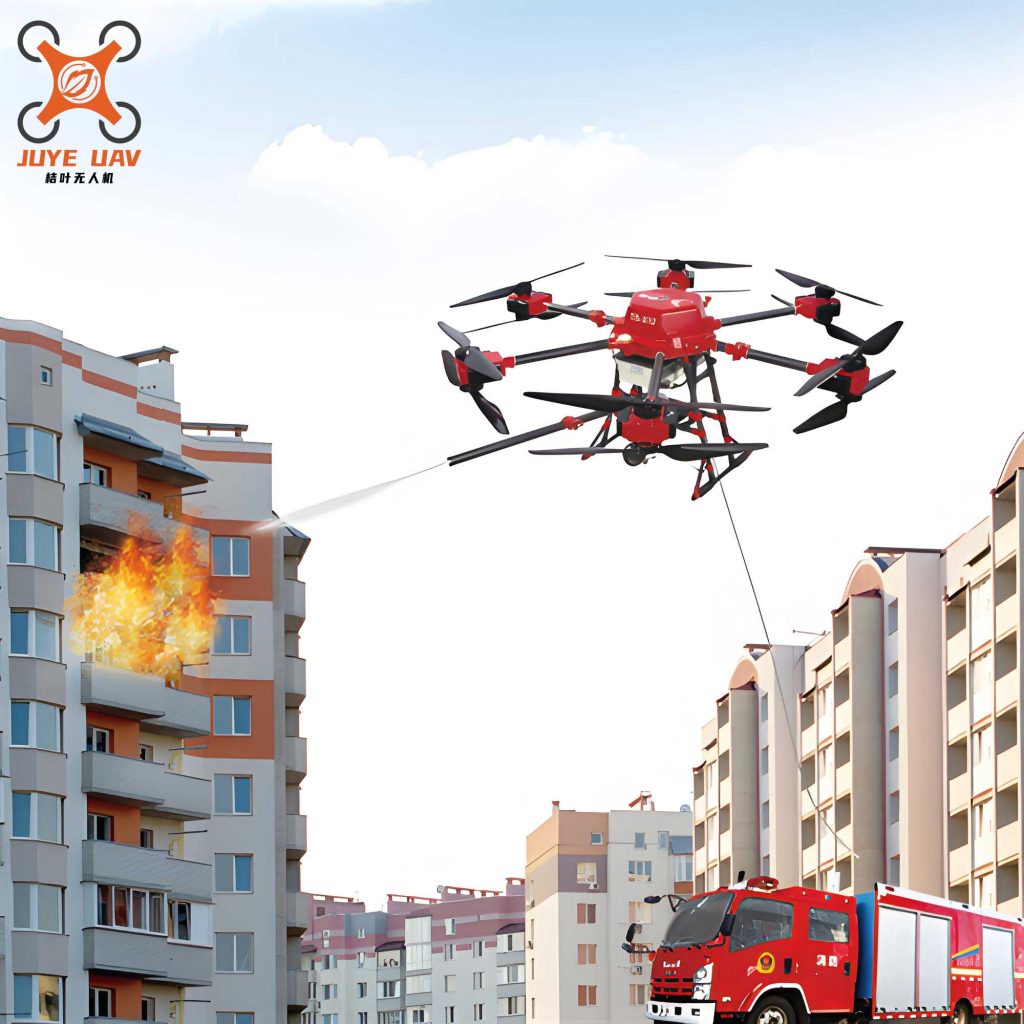
Command and decision support are greatly enhanced by fire drones. We integrate fire drones with data fusion systems that combine temperature, humidity, wind, and gas concentration readings to create real-time fire models. AI algorithms on fire drones analyze video feeds to identify fire sources and predict spread patterns. For instance, a fire drone’s AI can use convolutional neural networks (CNNs) for fire detection, with accuracy given by:
$$ Accuracy = \frac{TP + TN}{TP + TN + FP + FN} $$
where \( TP \) is true positives, \( TN \) is true negatives, \( FP \) is false positives, and \( FN \) is false negatives. Fire drones also facilitate multi-platform coordination, linking with command vehicles and other drones for seamless operations. The overall system effectiveness \( E_s \) can be modeled as:
$$ E_s = \sum_{i=1}^{n} w_i \cdot f_i(x) $$
where \( w_i \) are weights for different factors like data latency or coverage, and \( f_i(x) \) are performance functions. This holistic approach ensures that fire drones become central to smart firefighting networks.
Looking ahead, the future of fire drones hinges on technological advancements. We anticipate improvements in battery life, with energy density increases extending flight times. Hydrogen fuel cells and solar charging could further boost endurance. AI integration will enable autonomous decision-making, allowing fire drones to adapt to dynamic fire conditions without human intervention. Moreover, enhanced collaboration between fire drones and other systems, like automated fire trucks or IoT sensors, will create integrated rescue ecosystems. The potential growth can be summarized in the table below:
| Future Direction | Expected Impact | Fire Drone Role |
|---|---|---|
| Extended Endurance | Longer missions (e.g., >2 hours) for continuous monitoring. | Fire drones with advanced power systems. |
| AI Autonomy | Reduced reliance on operators for real-time adjustments. | Fire drones using machine learning for path planning. |
| System Integration | Seamless data exchange with ground and aerial assets. | Fire drones as nodes in a connected rescue network. |
In conclusion, fire drones represent a paradigm shift in rescue operations, addressing the inefficiencies and risks of traditional methods. Through our research, we have demonstrated how fire drones excel in reconnaissance, suppression, search, and command roles. The repeated emphasis on ‘fire drone’ throughout this article underscores its centrality to modern firefighting. As technology evolves, fire drones will become even more indispensable, driving towards smarter and safer rescue systems. We advocate for widespread adoption and continued innovation to harness the full potential of fire drones in safeguarding lives and property.