
The evolution of firefighting capabilities is intrinsically linked to technological advancement. Improving equipment is not merely an upgrade; it is a necessary pathway to enhance the operational effectiveness and safety of forest firefighting teams. In recent years, the rapid development of Unmanned Aerial Vehicle (UAV) technology has opened new frontiers in emergency response. Their ability to perform tasks through non-contact methods has significantly reduced risks to human personnel. This potential is particularly compelling in regions where traditional firefighting faces extreme challenges. The unique and demanding terrain of the Tibetan Plateau presents immense difficulties for ground-based firefighting operations. Confronted with realities such as scattered ignition points, treacherous access, and high operational risks, the integration of fire drone systems emerges as a critical and effective supplement to existing firefighting methodologies. These systems offer the potential for both direct and indirect fire suppression while providing crucial real-time logistical and informational support to task forces on the ground. This article explores, from a first-person analytical perspective, the feasibility, applicability, and tactical deployment of fire drone technology for combating forest fires on the Tibetan Plateau. By examining current technological trends alongside the distinct behavioral patterns of high-altitude forest fires, I will propose considerations for fire drone selection and the conceptual framework for dedicated operational units, aiming to contribute a reference model for the broader application of UAVs in wildland fire management.
1. A Technical Overview of Firefighting-Ready UAVs
An Unmanned Aerial Vehicle (UAV) is defined as a powered aerial vehicle that does not carry a human operator, uses aerodynamic forces for lift, can operate autonomously or be piloted remotely, and can carry various payloads. For firefighting applications, not all UAVs are created equal. Their suitability is dictated by design, which correlates directly with operational parameters. Broadly, UAVs for fire service can be categorized as follows:
| UAV Type | Key Characteristics | Primary Firefighting Role |
|---|---|---|
| Fixed-Wing | Long endurance (many hours), long range (100-900+ km), requires runway/launch system. | Large-area reconnaissance, patrol, communication relay (via satellite). |
| Multi-Rotor | Vertical Take-Off and Landing (VTOL), high maneuverability, limited endurance (typically <1 hr under load), short-medium range (10-20 km). | Tactical reconnaissance, direct fire attack (with payload), close support,物资投送. |
| Vertical Take-Off and Landing (VTOL) Fixed-Wing | Hybrid: VTOL convenience with fixed-wing efficiency for cruise. Good endurance and speed. | Extended-range tactical missions, detailed area scans where landing zones are limited. |
| Unmanned Helicopter | VTOL, good endurance and payload capacity, complex mechanics. | Heavy-lift operations, prolonged direct fire attack,区域巡护 (100-150 km radius). |
The operational concept for a fire drone in forested environments is clear: it must provide actionable intelligence or direct intervention. Current applications in pilot programs globally focus on command and control support, real-time fire spread monitoring, and in some cases, direct attack using dropped fire retardants or water. The vision for a dedicated fire drone, however, moves beyond adaptation to purpose-built design.
2. Characteristics of Forest Fires on the Tibetan Plateau
The efficacy of any technological solution must be evaluated against the specific problem set. Tibet’s forest fires exhibit unique signatures shaped by geography, climate, and vegetation.
2.1 Fire Source and Distribution: The primary cause is anthropogenic, accounting for a vast majority of incidents. Fires are temporally concentrated in the dry season (November to May) and spatially within the river valleys and mountainous regions of eastern, southern, and southeastern Tibet.
2.2 Fire Behavior Profile: The vertical zonation of vegetation and the complex topography lead to distinct fire behavior:
- Non-Contiguous Fire Perimeters: Discontinuous vegetation cover results in fire fronts composed of scattered points and intermittent lines, rather than continuous flaming fronts.
- Lateral Spread Dominance: With mountaintops often above the tree line or snow-covered and valley bottoms acting as natural barriers (rivers, roads), the primary vector for fire spread is laterally along the flanks of mountains.
- Spotting Potential: Intense burning coupled with erratic winds in complex terrain readily generates firebrands, leading to new ignition points ahead of the main fire, often requiring significant time to develop.
- Pronounced Diurnal Variation: Fire activity is typically subdued during the stable atmospheric conditions of morning and night. Afternoons bring increased wind speeds and variability, leading to rapid, intense, and unpredictable fire growth, including crown fires and potential blow-ups.
This behavioral profile highlights key challenges: accessing分散的火点, operating safely during volatile afternoon conditions, and efficiently suppressing fires that do not present traditional linear fronts. It is within this context that the fire drone finds its potential niche.
3. Feasibility Analysis: Fire Drones on the High Plateau
The proposition of deploying fire drone units in Tibet is not just feasible but represents a logical evolution in high-altitude firefighting. However, a clear-eyed analysis must weigh both advantages and current limitations.
3.1 Challenges of Conventional High-Altitude Firefighting:
- Accessibility: Extreme terrain, low oxygen, and sparse road networks make approaching the fireline physically demanding and time-consuming.
- Limited Tactical Window: The short period of stable morning conditions is often the only safe window for direct attack, severely constraining operations.
- Resource-Intensive Mop-up: Scattered smoldering points require disproportionate manpower to locate and extinguish.
- Logistical Strain: Supplying personnel with water, fuel, and equipment over difficult terrain is a major operational bottleneck.
3.2 Inherent Advantages of Fire Drones:
- Terrain Negation: Direct access to otherwise inaccessible slopes, cliffs, and分散的火点.
- Risk Mitigation: Removal of personnel from direct contact with volatile fire fronts and hazardous terrain.
- Rapid Response: Ability to quickly engage new spot fires or incipient-stage fires before they escalate.
- Tactical Flexibility: A single platform capable of reconnaissance, direct attack, and logistical support.
- Strategic Mobility: Ease of transport allows for rapid regional or national deployment.
The value proposition is clear: fire drones can extend the operational window (both temporal and geographical) and provide new suppression手段, with benefits outweighing costs given the high ecological and political value of Tibet’s forests.
3.3 Current Technological Limitations for Direct Suppression:
- Payload and Endurance: Most industrial UAVs have a战斗载重 under 100 kg and flight times under 1 hour, which is further reduced at high altitudes due to lower air density. Scaling for performance increases size and complexity.
- Command, Control, and Communications (C3): Mountainous terrain blocks line-of-sight radio links. Operating at lower altitudes for precision attack exacerbates communication dropout risks.
- Suppression Precision and Efficacy: Accurately targeting a fluid fire line from the air is challenging. Furthermore, achieving complete extinguishment (“three no’s”: no flames, no smoke, no heat) with a single, limited payload of a specific灭火剂 is difficult, often leading to rapid re-ignition.
4. Applicability and Envisioned Tactical Roles
The fire drone is not a panacea but a versatile tool within a combined-arms approach. Its roles can be categorized by operational objective:
| Tactical Role | Target / Objective | Fire Drone Action |
|---|---|---|
| Intelligence, Surveillance, Reconnaissance (ISR) & Communications | Overall situation awareness, fire spread tracking, crew safety overwatch. | High-altitude mapping, real-time video/data feed to command, low-altitude monitoring of fireline for crew warning. |
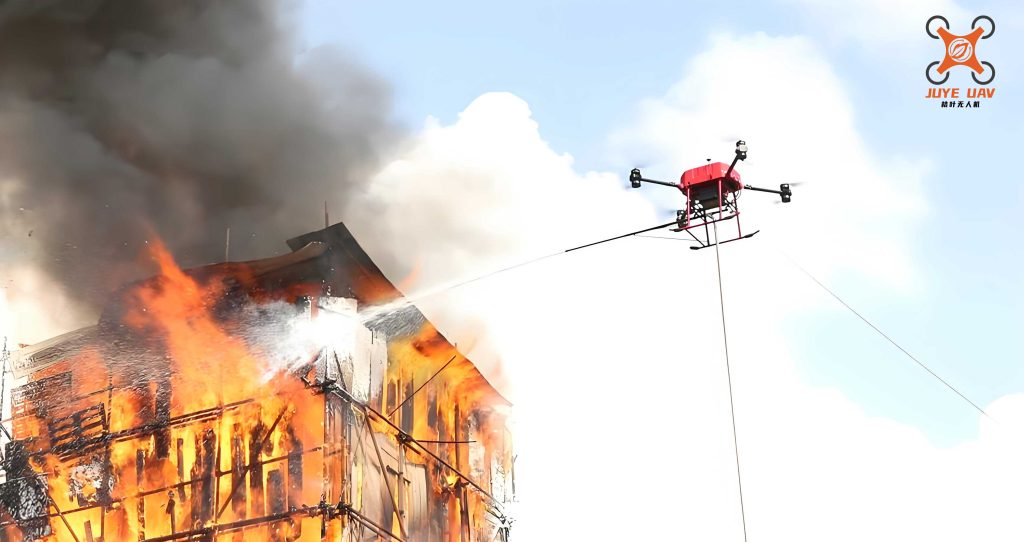
| Direct Attack | Isolated points, low-medium intensity flanks, cliff faces, incipient fires. | Precision application of water, foam, or retardant via spraying or gravity drop. Can act as an aerial pump relay for ground teams. |
| Confinement / Control | Head of a fire, critical flank, area ahead of fire spread. | Pre-wetting fuels with water/retardant to slow fire advance and reduce intensity, creating a window for ground forces. |
| Logistical Resupply | Forward teams requiring water, food, fuel, equipment, batteries. | Point-to-point delivery of critical supplies (≥30 kg), potentially including deployment of hose lines or portable pumps. |
The guiding principle is target matching: using the fire drone against the fires it is best suited to engage, thereby freeing ground forces for the tasks where human presence is indispensable.
5. Technical Specifications and Performance Requirements
For a fire drone to be effective in high-altitude forest fire scenarios, its design must be driven by tactical needs rather than adapted from other applications. I propose the following key performance parameters (KPPs) for a dedicated platform, evaluated at a baseline operational altitude of 3,000 meters:
| Parameter | Minimum Requirement | Rationale / Calculation Basis |
|---|---|---|
| Useful Payload | ≥ 30 kg (灭火剂); Max Payload ≥ 50 kg | Sufficient suppressant volume for meaningful intervention on multiple spot fires or a short火线 section. |
| Endurance (Fully Laden) | ≥ 30 minutes | Based on approx. 5 km transit to target, 10 min on-station work, and return. Allows for meaningful sortie duration. $$ T_{\text{sortie}} = T_{\text{transit}} + T_{\text{station}} + T_{\text{reserve}} $$ |
| Suppression System | On-board pump for water/foam; non-pressurized tank; capable of penetrating forest canopy (canopy cover ≥0.8). | Pressurized tanks are single-use and heavy. A pumped system allows for refill from remote water sources (streams, portable tanks) and controlled application. |
| Data Link Range & Robustness | Reliable C3 link ≥ 5 km, 360° coverage, tree/terrain penetration capability. | Must maintain control when flying behind terrain features during attack runs. |
| Environmental Tolerance | Operate in winds ≤ 25 km/h (5级风); safe return in winds ≤ 38 km/h. | High-altitude winds are common; platform must be stable and controllable. |
| Turn-around Time | Refuel/recharge & re-arm ≤ 2 min; full mission prep ≤ 5 min. | Critical for sustaining rapid, continuous operations, especially in a swarm model. |
| Targeting System | AI-based fire/spot detection; automated targeting accuracy ≤ 10 m CEP. | Reduces operator cognitive load and improves strike accuracy in smoky, dynamic environments. |
The effective area coverage \( A_{\text{coverage}} \) for a single sortie can be roughly modeled as a function of payload, application rate, and endurance:
$$ A_{\text{coverage}} = \frac{P_{\text{payload}}}{\rho_{\text{application}}} \cdot \eta $$
where \( P_{\text{payload}} \) is the mass of suppressant, \( \rho_{\text{application}} \) is the required application rate (e.g., kg/m² for retardant), and \( \eta \) is an operational efficiency factor accounting for transit time and targeting. For a 30 kg payload of Class A foam applied at 0.2 kg/m² with an efficiency of 0.6, a single fire drone could treat approximately 90 m² of fuel bed per sortie.
5.2 C3 and Swarm Intelligence: To overcome terrain-induced communication blackouts, a layered C3 architecture is essential:
- Aerial Relay: A high-altitude UAV (fixed-wing or VTOL) acts as a communication node between ground control and low-flying attack fire drones.
- Satellite Link (SATCOM): For beyond-line-of-sight operations in deep valleys, integrated SATCOM provides a reliable, if latent, control channel.
- Autonomous Swarm Operations: Pre-programmed flight paths and AI-driven target recognition allow a group of fire drones to operate semi-independently, with high-level tasking from a single operator (“fly to grid sector X and suppress all detected heat signatures”).
5.3 Modular Mission Payloads: The concept of a single-purpose fire drone is limiting. A modular system with quick-swap payload bays is envisioned:
- Liquid Dispenser Module: For water, foam, or retardant.
- Dry Chemical / Retardant Canister Module: For precision drops on specific points.
- Cargo Hook / Release Module: For logistical resupply or equipment deployment.
- Enhanced ISR Module: Featuring multispectral or infrared sensors for hotspot detection through smoke.
6. Organizational Concept: The Fire Drone Team
Given the limitations of individual platforms, effectiveness will be achieved through coordinated team operations. I conceptualize a Fire Drone Team as an integrated element within a larger firefighting force.
6.1 Team Structure and Personnel:
| Team Element | Personnel | Primary Function |
|---|---|---|
| Reconnaissance & Command (R&C) | 4-6 persons | Operates long-range UAVs for overall situational awareness, mission planning, and communications relay. Interfaces with incident command. |
| Attack Element (x3) | 15-20 persons per element (10-15 pilots, 5 ground crew) | The core suppression unit. Pilots operate attack fire drones in coordinated swarms. Ground crew manages refueling/rearming, maintenance, and payload mixing. |
| Logistics & Transport Element | 8-10 persons (4-6 pilots, 4 ground crew) | Operates heavy-lift fire drones for supply delivery, equipment transport, and potentially deploying hose lines or setting up remote water supply points. |
6.2 Platform Mix for the Team: A balanced fleet is crucial:
- R&C Element: 2 x Fixed-wing/VTOL (long endurance), 2 x Multi-rotor (quick-launch tactical view).
- Each Attack Element: 12-18 x Multi-rotor fire drones (primary direct attack platform).
- Logistics Element: 5-8 x Heavy-lift Multi-rotor/Unmanned Helicopter fire drones.
This structure allows for sustained operations through rotational sorties, with the Logistics Element supporting both the Attack Elements and ground forces.
6.3 Training and Sustainment: Proficiency in such a team requires a significant investment. Initial certification for pilots and technicians should be conducted by accredited civilian or military institutions. Ongoing training must include live-fire exercises in representative terrain. Maintenance and parts supply chains must be established, considering the remote deployment areas. Vehicle platforms (mobile command posts and equipment transport) are integral to team mobility and rapid deployment.
In conclusion, the integration of fire drone technology into the high-altitude firefighting arsenal is not merely an incremental improvement but a potential paradigm shift. The unique challenges of the Tibetan Plateau—dispersed fires, inaccessible terrain, and short operational windows—align remarkably well with the inherent strengths of UAV systems: precision, persistence, and the removal of personnel from immediate danger. While current technology faces hurdles in payload, endurance, and communications, the trajectory of development is rapidly addressing these gaps. By proactively defining operational concepts, technical requirements, and organizational frameworks centered on the fire drone, fire management agencies can guide industry development and prepare for the effective deployment of these systems. The future of wildland firefighting in complex environments will undoubtedly be augmented, and in specific scenarios, led, by intelligent, collaborative teams of aerial robots working in concert with human expertise on the ground.