
As a firefighter with extensive experience in rescue operations, I have observed firsthand the critical role that communication plays in ensuring successful outcomes during emergencies. The environments we often encounter—such as high-rise buildings, underground complexes, petrochemical plants, and remote wilderness areas—pose significant challenges to traditional communication systems. Ground-based networks can be disrupted by physical obstacles, extreme temperatures, water submersion, or noise interference, while satellite communication, though reliable, requires specialized equipment that is not always deployable in time-sensitive scenarios. In this context, fire drones have emerged as a transformative technology, offering unparalleled advantages in enhancing fire emergency communication. This article delves into the requirements for effective fire emergency communication and explores the multifaceted applications of fire drones, supported by technical analyses, mathematical models, and comparative tables to provide a comprehensive overview.
The adoption of fire drones in firefighting represents a paradigm shift, leveraging their mobility, payload capacity, and real-time data transmission capabilities. From my perspective, integrating fire drones into our operational protocols has not only improved communication reliability but also increased the safety of both rescuers and victims. In the following sections, I will detail the specific needs of fire emergency communication, discuss how fire drones address these needs through various applications, and highlight future directions for this technology. Throughout, I will emphasize the term “fire drone” to underscore its centrality in modern fire rescue strategies.
Requirements for Fire Emergency Communication
Fire emergency communication systems must satisfy stringent criteria to support life-saving operations. First and foremost, information must be real-time and accurate. During a fire incident, delays in transmitting audio, video, or data from the rescue site to the command center can lead to misguided decisions and catastrophic outcomes. Real-time feeds enable commanders to assess situations dynamically, allocate resources efficiently, and adjust tactics promptly. This necessitates a robust网状应急通信体系 (mesh emergency communication system) that can adapt to changing conditions, such as shifting fire fronts or structural collapses.
Secondly, communication must be secure and reliable. Rescue operations frequently occur in extreme conditions where interference, signal attenuation, or equipment failure are common. For instance, high temperatures can degrade electronic components, while水下作业 (underwater operations) may block radio waves. Reliability can be quantified using availability metrics, as shown in the formula below:
$$ A = \frac{MTBF}{MTBF + MTTR} $$
Here, \( A \) represents availability, \( MTBF \) is the mean time between failures, and \( MTTR \) is the mean time to repair. For fire emergency communication, we target an availability of \( A \geq 0.99 \), ensuring minimal downtime. Additionally, the system must be resilient to multipath fading and noise, which can be modeled using the signal-to-noise ratio (SNR):
$$ SNR = \frac{P_r}{N} $$
where \( P_r \) is the received power and \( N \) is the noise power. A high SNR (e.g., >20 dB) is essential for clear audio and video transmission.
Thirdly, coverage area is a critical factor. Large-scale disasters like wildfires or industrial explosions require communication over vast regions. Traditional ground-based networks often have limited range due to terrain or infrastructure damage. Fire drones can extend this coverage by acting as aerial relays, creating temporary networks that bridge communication gaps. The required coverage radius \( R \) can be derived from the rescue area’s geometry, often approximated as a circle with area \( \pi R^2 \).
To summarize these requirements, the following table outlines key performance indicators (KPIs) for fire emergency communication systems:
| KPI | Target Value | Description | Impact on Rescue Operations |
|---|---|---|---|
| Latency | < 100 ms | Time delay in data transmission | Enables real-time decision-making |
| Availability | > 99% | Uptime of communication links | Ensures continuous operation |
| Data Rate | > 10 Mbps | Bandwidth for video/audio streams | Supports high-definition feeds |
| Coverage Radius | > 5 km | Maximum communication range | Facilitates large-area operations |
| Payload Capacity | > 5 kg | Weight fire drone can carry | Allows for sensor and equipment deployment |
Meeting these KPIs is challenging with conventional methods, but fire drones offer innovative solutions, as discussed in the next sections.
Applications of Fire Drones in Fire Emergency Communication Support
Fire drones are versatile platforms that can be configured for diverse communication tasks. Based on my experience, I categorize their applications into five main areas: large-area remote sensing and monitoring, multi-channel audio and video communication, extension of communication coverage, visual tracking and GPS-based following, and aerial delivery/public address. Each application leverages the unique capabilities of fire drones to overcome specific challenges in fire rescue.
Large-Area Remote Sensing and Monitoring
In major incidents like wildfires or chemical spills, rapid situational awareness is crucial. Fire drones equipped with advanced sensors—such as high-resolution cameras, thermal imagers, LiDAR, and multispectral scanners—can survey large areas quickly and transmit data in real-time. Compared to satellite遥感 (remote sensing), which may have latency or resolution limitations, fire drones provide immediate, high-precision imagery. However, fire drones face stability issues due to their light weight and susceptibility to wind gusts. Vibrations can affect sensor accuracy, necessitating correction algorithms.
To mitigate these issues, we deploy multiple fire drones in coordinated swarms. Data from each fire drone is fused using techniques like Kalman filtering or machine learning to enhance accuracy. The coverage area of a single fire drone can be estimated using geometric formulas. For a sensor with a field of view (FOV) angle \( \theta \) (in radians) and flight altitude \( h \), the ground coverage area \( A_{cover} \) is:
$$ A_{cover} = \pi \times (h \times \tan(\theta/2))^2 $$
For example, if a fire drone flies at 150 meters with a FOV of 60 degrees (\( \theta = \pi/3 \) radians), the coverage area is approximately:
$$ A_{cover} = \pi \times (150 \times \tan(\pi/6))^2 = \pi \times (150 \times 0.577)^2 \approx 78,540 \, \text{m}^2 $$
This demonstrates how fire drones can efficiently monitor zones equivalent to several football fields. Moreover, fire drones can operate at night using infrared or照明设备 (lighting equipment), extending rescue capabilities into darkness. The table below compares remote sensing methods for fire rescue:
| Method | Resolution | Latency | Cost per Mission | Risk to Personnel | Role of Fire Drones |
|---|---|---|---|---|---|
| Satellite遥感 | Moderate (1-10 m) | High (hours to days) | $10,000+ | None | Complementary for pre-planning |
| Manned Aircraft | High (0.1-1 m) | Moderate (30-60 min) | $5,000-$20,000 | High (pilot exposure) | Alternative for large-scale mapping |
| Fire Drones | High (0.01-0.5 m) | Low (real-time) | $500-$2,000 | Low (remote operation) | Primary for real-time monitoring |
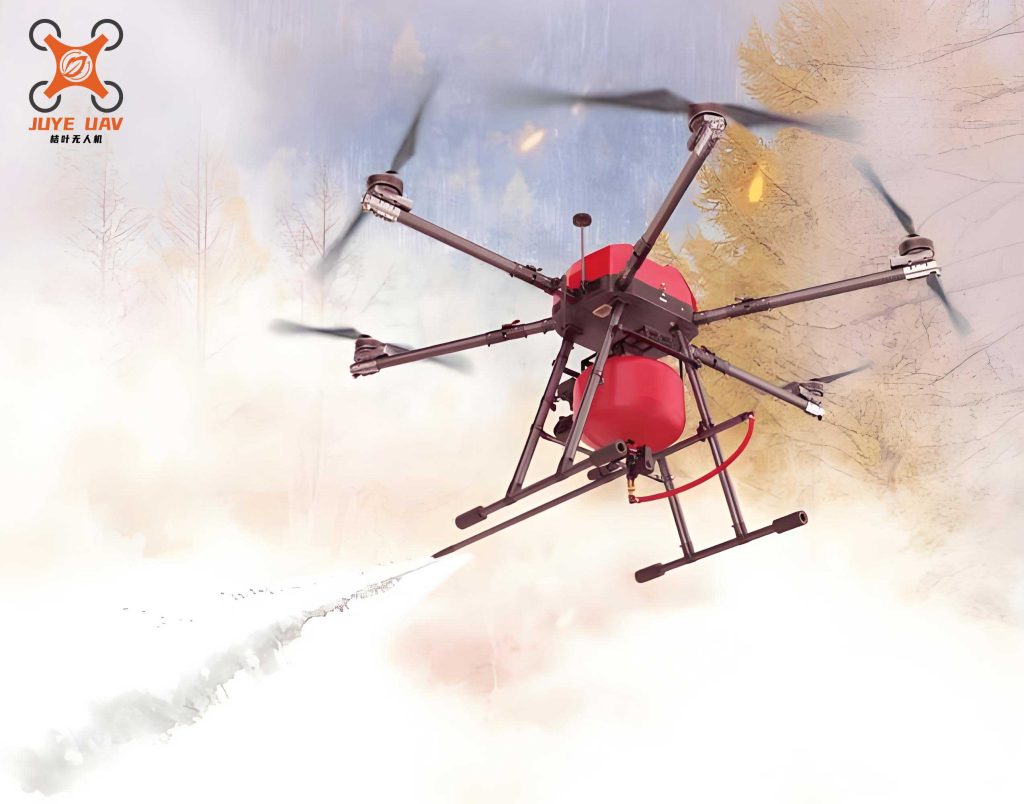
The image above depicts a fire drone in action, showcasing its compact design and sensor payloads. Such fire drones are indispensable for providing aerial intelligence during complex rescues.
Multi-Channel Audio and Video Communication
Fire drones enable multi-channel audio and video communication by integrating with existing fire command networks. Equipped with音视频图传设备 (audio-video transmission devices) and communication modules, a fire drone can relay live feeds from the rescue site to the command center. This allows commanders to view panoramic images and hear现场声音 (on-site sounds), facilitating better coordination. In practice, we use fire drones to establish point-to-point links or mesh networks, depending on the terrain.
The data rate required for video transmission depends on resolution and compression. For uncompressed 1080p video at 30 frames per second (fps) with 24 bits per pixel, the data rate \( R \) is:
$$ R = f_r \times bpp \times w \times h = 30 \times 24 \times 1920 \times 1080 = 1,492,992,000 \, \text{bps} \approx 1.5 \, \text{Gbps} $$
However, using compression standards like H.265, this can be reduced to 5-10 Mbps, which is feasible for fire drone transmission via LTE or dedicated radio frequencies. The quality of service (QoS) can be evaluated using the peak signal-to-noise ratio (PSNR):
$$ PSNR = 10 \log_{10}\left(\frac{MAX_I^2}{MSE}\right) $$
where \( MAX_I \) is the maximum pixel value (e.g., 255 for 8-bit images) and \( MSE \) is the mean squared error between original and transmitted video. A PSNR above 30 dB indicates good quality.
Fire drones also support双向通信 (two-way communication), enabling rescuers to communicate with trapped individuals. For instance, in a high-rise fire, a fire drone can hover outside a window, using speakers and microphones to guide victims to safety. This application reduces the need for rescuers to enter hazardous zones prematurely.
Extension of Communication Coverage
Fire drones can act as aerial base stations to extend communication coverage in areas where ground infrastructure is damaged or absent. By leveraging自组网技术 (ad-hoc networking), fire drones create temporary mesh networks. A typical setup involves a汇聚机 (aggregator) mounted on a fire drone, which coordinates with ground-based路由机 (routers) and终端机 (terminals) to form a scalable network. The extended coverage radius depends on the fire drone’s altitude and transmission power.
Using the free-space path loss model, the path loss \( L \) in decibels (dB) over distance \( d \) (in kilometers) and frequency \( f \) (in MHz) is:
$$ L = 20 \log_{10}(d) + 20 \log_{10}(f) + 32.44 $$
For a fire drone at 200 meters altitude transmitting at 2.4 GHz (2400 MHz), the maximum communication distance \( d_{max} \) for a tolerable loss of 100 dB can be solved as:
$$ 100 = 20 \log_{10}(d_{max}) + 20 \log_{10}(2400) + 32.44 $$
$$ 20 \log_{10}(d_{max}) = 100 – 20 \log_{10}(2400) – 32.44 \approx 100 – 67.6 – 32.44 = -0.04 $$
$$ d_{max} \approx 10^{(-0.04/20)} \approx 0.995 \, \text{km} $$
This calculation assumes ideal conditions; in practice, factors like foliage or buildings increase loss, but fire drones can be deployed in swarms to form relay chains, effectively extending range to 20-50 km. The following table summarizes coverage extension capabilities:
| Fire Drone Configuration | Number of Units | Typical Altitude (m) | Coverage Radius (km) | Data Rate per Link (Mbps) | Application Scenario |
|---|---|---|---|---|---|
| Single Fire Drone | 1 | 100-300 | 5-10 | 10-50 | Localized incidents |
| Swarm of Fire Drones | 5-10 | 200-500 | 20-50 | 50-100 (aggregate) | Large-scale disasters |
| Integrated with Satellites | N/A | N/A | Global | 1-10 (high latency) | Remote areas |
This extension capability is vital for operations in remote forests or after earthquakes where ground networks are destroyed.
Visual Tracking and GPS-Based Following
For indoor rescue operations, fire drones equipped with visual tracking and GPS following capabilities are invaluable. These fire drones use微型摄像头 (micro-cameras) and computer vision algorithms to navigate complex interiors, avoiding obstacles and tracking moving targets such as rescuers or victims. The tracking system can be modeled using a state-space approach, such as the Kalman filter, which estimates the target’s position and velocity based on noisy measurements.
Let \( x_t \) denote the state vector (e.g., position and velocity) at time \( t \), and \( z_t \) be the observation from the fire drone’s camera. The Kalman filter equations include prediction and update steps:
Prediction:
$$ \hat{x}_{t|t-1} = F_t \hat{x}_{t-1|t-1} $$
$$ P_{t|t-1} = F_t P_{t-1|t-1} F_t^T + Q_t $$
Update:
$$ K_t = P_{t|t-1} H_t^T (H_t P_{t|t-1} H_t^T + R_t)^{-1} $$
$$ \hat{x}_{t|t} = \hat{x}_{t|t-1} + K_t (z_t – H_t \hat{x}_{t|t-1}) $$
$$ P_{t|t} = (I – K_t H_t) P_{t|t-1} $$
Here, \( F_t \) is the state transition matrix, \( Q_t \) is process noise covariance, \( H_t \) is observation matrix, \( R_t \) is observation noise covariance, and \( K_t \) is the Kalman gain. This allows the fire drone to maintain a safe distance while following a target, ensuring continuous communication.
Additionally, fire drones can use GPS modules for remote control. Rescuers carry GPS-enabled devices, and the fire drone follows their位置 (position) using a proportional-integral-derivative (PID) controller. The control output \( u(t) \) is given by:
$$ u(t) = K_p e(t) + K_i \int_0^t e(\tau) d\tau + K_d \frac{de(t)}{dt} $$
where \( e(t) = p_r(t) – p_d(t) \) is the error between rescuer position \( p_r \) and fire drone position \( p_d \), and \( K_p, K_i, K_d \) are tuning parameters. This enables the fire drone to autonomously hover near the rescuer, relaying audio and video feeds without manual piloting.
Aerial Delivery and Public Address Systems
Fire drones are also used for aerial delivery of rescue supplies, such as呼吸面罩 (breathing masks), medicines, life jackets, and communication devices. In inaccessible areas, fire drones can drop ropes or equipment to establish rescue channels. The payload capacity of a fire drone is a key parameter, determined by its design and propulsion system. The lift force \( L \) required to carry a payload of mass \( m \) is given by:
$$ L = m \times g $$
where \( g = 9.8 \, \text{m/s}^2 \) is acceleration due to gravity. For a fire drone with \( n \) rotors, each rotor must provide thrust \( T = L/n \). The thrust of a rotor can be approximated as:
$$ T = k_t \times \omega^2 $$
where \( k_t \) is a thrust constant and \( \omega \) is angular velocity. Thus, for a fire drone to carry a 10 kg payload with four rotors, the total lift needed is 98 N, and each rotor must produce at least 24.5 N of thrust.
Furthermore, fire drones equipped with loudspeakers can broadcast instructions to trapped individuals, aiding in evacuation. This is particularly useful in noisy environments where verbal communication is difficult. The sound pressure level (SPL) at a distance \( r \) from the speaker can be estimated as:
$$ SPL = SPL_0 – 20 \log_{10}\left(\frac{r}{r_0}\right) $$
where \( SPL_0 \) is the reference SPL at distance \( r_0 \). For effective communication, SPL should exceed 70 dB at the target location.
Technical Specifications and Performance Metrics
To effectively deploy fire drones, understanding their technical specifications is essential. Based on my experience, I have compiled a table of typical fire drone models and their capabilities:
| Fire Drone Model | Max Payload (kg) | Flight Time (minutes) | Communication Range (km) | Sensor Suite | Cost (USD) |
|---|---|---|---|---|---|
| DJI Matrice 300 RTK | 2.7 | 55 | 15 | Thermal camera, RGB camera, LiDAR | $20,000 |
| Parrot Anafi USA | 0.5 | 32 | 5 | Zoom camera, thermal sensor | $7,000 |
| Autel Robotics EVO II | 1.2 | 40 | 9 | 8K camera, thermal option | $10,000 |
| Custom-built Fire Drone | 10 | 25 | 20 | Modular sensors, loudspeaker | $15,000 |
The performance of a fire drone communication system can be further analyzed using network throughput models. For a mesh network with \( n \) fire drones, the aggregate throughput \( T_{agg} \) can be approximated using the formula:
$$ T_{agg} = \frac{W}{n} \log_2\left(1 + \frac{SNR}{n}\right) $$
where \( W \) is the bandwidth. This shows that adding fire drones can increase coverage but may reduce per-link throughput due to interference—a trade-off that must be managed in deployment.
Challenges and Future Directions
Despite their advantages, fire drones face several challenges. Battery life limits flight time, often to 30-60 minutes, which may be insufficient for prolonged operations. To address this, we are exploring swappable batteries, solar charging, or tethered power systems. Regulatory issues, such as airspace restrictions and privacy concerns, also pose hurdles. However, with proper training and collaboration with aviation authorities, these can be mitigated.
Looking ahead, the integration of人工智能 (AI) and物联网 (IoT) will enhance fire drone capabilities. AI algorithms can enable autonomous fire spread prediction, victim detection in smoke, and adaptive communication routing. IoT sensors on fire drones can monitor environmental parameters like temperature or gas concentrations, transmitting data to cloud platforms for real-time analysis. The concept of蜂群技术 (swarm technology), where multiple fire drones operate collaboratively, promises to revolutionize large-scale rescue operations.
Moreover, advancements in材料科学 (materials science) may lead to lighter and more durable fire drones, increasing payload capacity and resilience. The future fire drone could be a fully autonomous system that integrates with smart city infrastructure, providing seamless communication during emergencies.
Conclusion
As a firefighter, I firmly believe that fire drones are indispensable tools for modern fire emergency communication. By providing real-time data, extending coverage, enabling visual tracking, and facilitating supply delivery, fire drones significantly enhance rescue efficiency and safety. The mathematical models and tables presented in this article underscore the technical feasibility and benefits of deploying fire drones in various scenarios.
To summarize, the core applications of fire drones and their impact are encapsulated in the following table:
| Application | Key Technologies | Benefits | Future Enhancements |
|---|---|---|---|
| Remote Sensing | Cameras, LiDAR, Thermal Sensors | Real-time monitoring, large coverage | AI-based image analysis, swarm mapping |
| Audio-Video Communication | Video Encoding, Wireless Transmission | Enhanced situational awareness | 5G integration, low-latency codecs |
| Coverage Extension | Ad-hoc Networks, Aerial Base Stations | Extended range, network resilience | Dynamic spectrum access, relay optimization |
| Visual Tracking | Computer Vision, GPS | Autonomous navigation, target following | Deep learning for obstacle avoidance |
| Aerial Delivery | Payload Mechanisms, Flight Control | Rapid supply transport | Precision dropping, autonomous logistics |
In conclusion, the continuous evolution of fire drone technology promises a future where fire emergencies are managed with unprecedented precision and effectiveness. By investing in research, training, and infrastructure, we can harness the full potential of fire drones to save lives and protect communities. The fire drone is not just a tool; it is a lifeline in the most challenging environments.