
In my years of experience as a fire rescue specialist, I have witnessed the transformative impact of technology on emergency response, particularly in hazardous environments like chemical plants. The advent of fire drones, or unmanned aerial vehicles (UAVs), has revolutionized our approach to chemical fire rescue operations. These sophisticated devices are not just tools; they are integral partners in saving lives and mitigating disasters. This article delves into the comprehensive application of fire drones in chemical fire rescue, exploring their concepts, advantages, technical requirements, functional implementations, and practical applications. Through detailed analysis, tables, and formulas, I aim to provide a thorough understanding of how fire drones are reshaping firefighting paradigms.
To begin, let me define what a fire drone is. A fire drone is a type of unmanned aircraft operated via remote control or autonomous programming, comprising a flight vehicle, sensors, data transmission systems, and a ground control station. In chemical fire rescue, we primarily utilize multi-rotor fire drones for their agility and vertical take-off capabilities, though fixed-wing models are also employed for long-endurance missions. The core components include propulsion systems (electric or fuel-based), imaging devices like thermal cameras, and communication modules. For instance, electric fire drones rely on lithium batteries, offering stability but limited flight time, while fuel-powered variants provide extended operation but with higher risk. The versatility of fire drones allows us to tailor them to specific rescue scenarios, making them indispensable in modern firefighting.
Chemical fires present unique challenges that demand specialized responses. Based on my observations, these fires are characterized by sudden onset, massive energy release, and complex interconversions between explosion, leakage, and combustion. For example, a leakage of flammable chemicals can form premixed fuels with air, leading to rapid ignition. The energy released during such events is staggering; consider the combustion of gasoline, which can be modeled using the heat release formula: $$ Q = m \cdot \Delta H_c $$ where \( Q \) is the total heat released (in joules), \( m \) is the mass of fuel (in kg), and \( \Delta H_c \) is the heat of combustion (approximately 44 MJ/kg for gasoline). If 3000 kg of gasoline ignites, the heat release calculates to: $$ Q = 3000 \, \text{kg} \times 44 \times 10^6 \, \text{J/kg} = 1.32 \times 10^{11} \, \text{J} $$ This immense energy can elevate temperatures to 2000°C, posing severe threats to responders and infrastructure. Below is a table summarizing key characteristics of chemical fires:
| Characteristic | Description | Impact on Rescue |
|---|---|---|
| Sudden Onset | Rapid ignition due to leaks and reactions | Limited time for response; requires quick reconnaissance |
| High Energy Release | Large amounts of heat and toxic byproducts | Increases danger; necessitates remote monitoring |
| Interconversion | Explosion, leakage, and burning cycles | Complicates rescue; demands continuous surveillance |
The advantages of fire drones in such environments are manifold, as I have seen in numerous operations. Their strong environmental adaptability allows them to operate in恶劣 conditions where human access is restricted. For accuracy, fire drones equipped with measurement modules can capture data with precision, often using sensors that follow the error model: $$ \sigma = \sqrt{\sigma_{\text{sensor}}^2 + \sigma_{\text{env}}^2} $$ where \( \sigma \) is the total measurement error, \( \sigma_{\text{sensor}} \) is sensor inaccuracy, and \( \sigma_{\text{env}} \) is environmental interference. Additionally, fire drones are cost-effective due to modular designs and low maintenance, and their high flexibility enables one-person operation in confined spaces. The broad视野 from wide-angle cameras and infrared systems enhances situational awareness. To illustrate, here’s a comparison table of fire drone types:
| Type of Fire Drone | Key Advantages | Typical Use in Chemical Fire Rescue |
|---|---|---|
| Multi-rotor Fire Drone | High maneuverability, vertical take-off/landing | Close-range inspection, payload delivery |
| Fixed-wing Fire Drone | Long endurance, stable flight | Large-area reconnaissance, mapping |
| Hybrid Fire Drone | Combines hover and forward flight | Versatile missions in complex terrains |
Deploying fire drones effectively requires adherence to stringent technical requirements. From my perspective, reliability is paramount, ensuring that the fire drone operates flawlessly under stress, which can be quantified by mean time between failures (MTBF): $$ \text{MTBF} = \frac{\text{Total operational time}}{\text{Number of failures}} $$ A high MTBF indicates robust performance. Controllability involves intuitive interfaces, often assessed through response time \( t_r \) to commands: $$ t_r = t_{\text{processing}} + t_{\text{transmission}} $$ where \( t_{\text{processing}} \) is onboard computation delay and \( t_{\text{transmission}} \) is data lag. Stability is critical for safe flight, governed by dynamics equations like: $$ m \ddot{x} = F_{\text{thrust}} – F_{\text{drag}} $$ where \( m \) is drone mass, \( \ddot{x} \) is acceleration, and forces include thrust and drag. Integration compatibility ensures seamless communication with command systems, supporting real-time data fusion.
The functional realization and expansion of fire drones have significantly enhanced our rescue capabilities. For aerial monitoring, I have utilized fire drones with thermal imagers that detect heat signatures based on Planck’s law: $$ I(\lambda, T) = \frac{2hc^2}{\lambda^5} \frac{1}{e^{\frac{hc}{\lambda k_B T}} – 1} $$ where \( I \) is spectral radiance, \( \lambda \) is wavelength, \( T \) is temperature, \( h \) is Planck’s constant, \( c \) is light speed, and \( k_B \) is Boltzmann’s constant. This allows us to identify hotspots invisible to the naked eye. In auxiliary灭火, fire drones carry extinguishing agents, with discharge rate modeled as: $$ \dot{V} = A \cdot v $$ where \( \dot{V} \) is volume flow rate, \( A \) is nozzle area, and \( v \) is exit velocity. For rescue support, fire drones deliver equipment like ropes, optimizing payload capacity \( P \) through: $$ P = m_{\text{drone}} \cdot g \cdot \eta $$ where \( g \) is gravity and \( \eta \) is efficiency factor. Language interaction via speakers enables guidance to trapped individuals, and strong lighting systems illuminate dark scenes, with intensity \( L \) given by: $$ L = \frac{\Phi}{4\pi d^2} $$ where \( \Phi \) is luminous flux and \( d \) is distance. These functionalities make fire drones versatile tools in our arsenal.
In practical applications, fire drones excel in various aspects of chemical fire rescue. For灾情侦查, they provide rapid entry into hazardous zones, transmitting live footage to command centers. The data acquisition process involves sampling at frequency \( f_s \): $$ f_s \geq 2 \cdot f_{\text{max}} $$ per the Nyquist theorem, ensuring accurate signal capture. This enhances指挥调度效率 by reducing decision latency \( \tau \): $$ \tau = \frac{D}{B} $$ where \( D \) is data size and \( B \) is bandwidth. A notable example is during a化工火灾扑救, where fire drones equipped with gas sensors detected toxic leaks, allowing us to contain the area promptly. The concentration \( C \) of hazardous substances can be estimated using: $$ C = C_0 e^{-kt} $$ where \( C_0 \) is initial concentration, \( k \) is decay constant, and \( t \) is time. Moreover, fire drones aid in火灾预防 through routine patrols, identifying risks before escalation. To visualize their role, consider this image showcasing a fire drone in action:
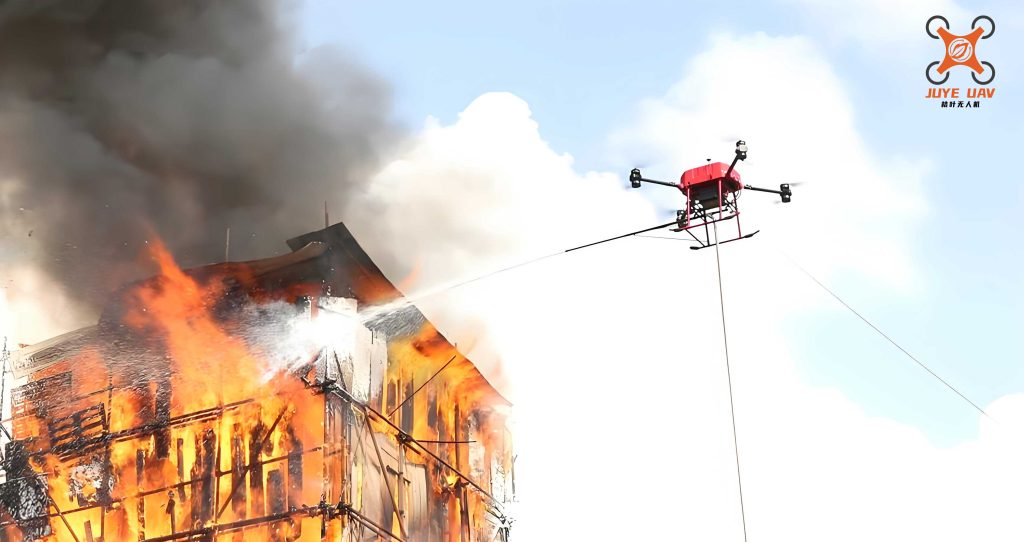
The image above highlights a fire drone surveying a chemical plant, emphasizing its compact design and advanced sensors. In such scenarios, the fire drone’s ability to operate in high-risk areas without endangering personnel is invaluable. For instance, during an incident involving explosive materials, we deployed a fire drone to assess structural integrity using strain calculations: $$ \epsilon = \frac{\Delta L}{L} $$ where \( \epsilon \) is strain, \( \Delta L \) is deformation, and \( L \) is original length. This data informed our stabilization efforts. Additionally, fire drones facilitate post-fire analysis by creating 3D maps via photogrammetry, with accuracy dependent on point cloud density \( \rho \): $$ \rho = \frac{N}{V} $$ where \( N \) is number of points and \( V \) is volume. The integration of fire drones into our protocols has elevated救援质量和效率, as evidenced by reduced response times and improved safety records.
Looking ahead, the evolution of fire drones promises even greater advancements. With artificial intelligence, autonomous navigation can be optimized using path planning algorithms like A*: $$ f(n) = g(n) + h(n) $$ where \( f(n) \) is total cost, \( g(n) \) is cost from start, and \( h(n) \) is heuristic estimate. Enhanced sensor fusion will enable real-time hazard prediction, leveraging Bayesian inference: $$ P(A|B) = \frac{P(B|A) P(A)}{P(B)} $$ where \( P(A|B) \) is posterior probability. As a fire rescue professional, I advocate for continuous training on fire drone operations, ensuring that teams harness their full potential. The fire drone is not merely a device; it is a catalyst for safer, more efficient rescue missions in the volatile realm of chemical fires.
In conclusion, the application of fire drones in chemical fire rescue represents a paradigm shift toward technology-driven emergency response. From my firsthand experience, these systems offer unmatched capabilities in reconnaissance, data collection, and direct intervention. By adhering to technical standards and expanding functionalities, we can mitigate the devastating effects of chemical fires. The fire drone stands as a testament to innovation, empowering us to protect lives and property with unprecedented precision. As we embrace this technology, I am confident that fire drones will become ubiquitous in firefighting, setting new benchmarks for safety and efficacy in hazardous environments.