
As a professional deeply engaged in the fields of forestry management and technological integration, I have witnessed firsthand the evolving challenges of forest fire management. The increasing frequency and intensity of wildfires demand innovative, efficient, and safe solutions. In this context, the emergence and maturation of Unmanned Aerial Vehicles (UAVs), specifically engineered or adapted as fire drone systems, have revolutionized our operational paradigms. This article presents my detailed, first-person perspective on the multifaceted applications of fire drone technology across the entire spectrum of forest fire management, from preventive vigilance to active suppression and post-event analysis. I will employ technical summaries, comparative tables, and mathematical models to elucidate their transformative impact.
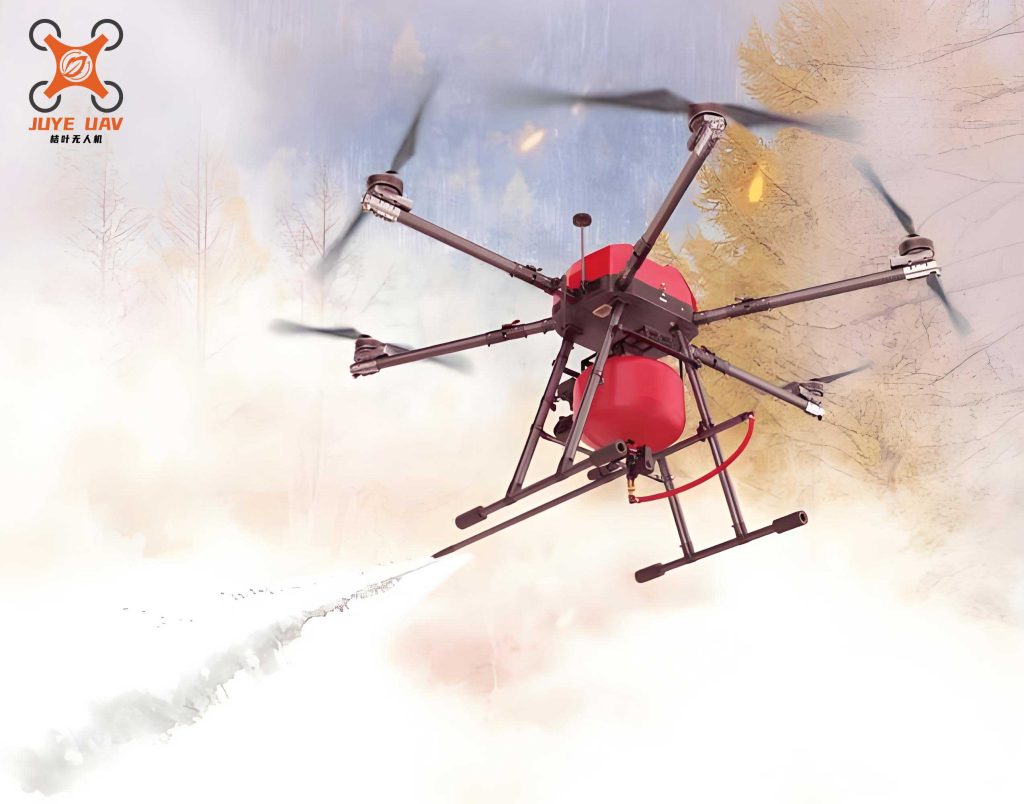
The core advantage of deploying a fire drone lies in its synergistic blend of capabilities: superior aerial mobility, real-time data acquisition, and the ability to operate in hazardous environments without risking human life. Compared to traditional methods, a fire drone provides an unparalleled force multiplier. It can access rugged, remote, or actively burning terrain that ground crews cannot, offering a “god’s-eye view” that is critical for situational awareness. The operational cost, when weighed against the value of protected resources and human safety, is remarkably favorable. My analysis begins with their role in the critical phase of prevention.
I. The Proactive Guardian: Fire Drone in Forest Fire Prevention
Prevention is invariably more effective and economical than suppression. Here, the fire drone transitions from a mere tool to a persistent surveillance asset.
1.1 Automated Patrols and Surveillance
Traditional patrols reliant on human observers in towers or vehicles are constrained by line-of-sight, terrain, and fatigue. My implementation of automated fire drone patrols involves pre-programmed geofenced routes covering high-risk areas. The efficiency gain is quantifiable. Consider a forest zone of area $A$ (in km²). A ground vehicle patrol with an effective visual range $r_g$ (in km) and speed $v_g$ would require time $t_g$ to achieve a basic coverage:
$$ t_g \approx \frac{A}{\pi r_g^2} \cdot \frac{1}{v_g} $$
In contrast, a fire drone flying at altitude $h$ with a sensor field-of-view yielding a ground swath width $w_d$ and speed $v_d$ covers the area in:
$$ t_d \approx \frac{A}{w_d \cdot v_d} $$
Given that $w_d \gg \pi r_g^2$ for typical altitudes and modern electro-optical sensors, $t_d \ll t_g$. The fire drone eliminates blind spots, monitors illegal activities (like unauthorized campfires), and assesses vegetation health and fuel loads systematically.
| Aspect | Traditional Human/Vehicle Patrol | Fire Drone Patrol |
|---|---|---|
| Coverage Area per Unit Time | Low | Very High |
| Access to Difficult Terrain | Poor | Excellent |
| Data Consistency & Objectivity | Variable, Subjective | High, Digitally Recorded |
| Operational Risk | Moderate (e.g., vehicle accidents) | Low (only asset risk) |
| Initial Response to Sighting | Slow, requires repositioning | Immediate, can hover and track |
1.2 Early Warning and Ignition Detection
Integrating advanced vision algorithms with fire drone payloads is a game-changer. Using visible-light and thermal infrared (TIR) cameras, a fire drone can automatically detect anomalies. The algorithm often compares pixel temperature $T_{pixel}$ against a dynamic background threshold $T_{background}$ and looks for rapid spatial growth. A simple detection logic can be modeled as:
$$ \text{Ignition Flag} = \begin{cases}
1 & \text{if } T_{pixel} > T_{background} + \Delta T_{threshold} \text{ AND } \frac{dA_{hot}}{dt} > 0\\
0 & \text{otherwise}
\end{cases} $$
Where $dA_{hot}/dt$ is the rate of change of the high-temperature area. Upon flagging, the fire drone can geo-tag the location (coordinates $x, y$), estimate fire size, and transmit an alert in real-time to the command center, triggering a rapid initial response.
1.3 Training and Simulation
We regularly use fire drone platforms in training exercises. They can simulate fire fronts (using smoke generators or LED arrays), providing a dynamic, realistic training environment for incident commanders. Data from these exercises, recorded by the fire drone, is invaluable for debriefing and refining tactics, communication protocols, and resource deployment strategies.
II. The Dynamic Responder: Fire Drone in Active Fire Suppression
When prevention fails, the fire drone becomes an indispensable asset on the fireline. Its roles are diverse and critical.
2.1 Real-Time Reconnaissance and Situational Awareness
This is the most significant contribution. A fire drone provides immediate, over-the-hill intelligence. It maps the fire perimeter $P(t)$, identifies active flanks and the head fire, and spots spot fires ahead of the main front. By tracking these parameters over time, we can estimate the Rate of Spread (ROS):
$$ ROS = \frac{dP}{dt} \cdot k $$
where $k$ is a terrain and fuel-type factor. This data feeds into fire behavior models like Rothermel’s surface fire spread model, which, while complex, conceptually uses inputs like fuel moisture, slope, and wind speed—all of which a fire drone can help estimate or measure directly with added sensors.
2.2 Payload Delivery and Tactical Suppression
Specialized fire drone systems are capable of carrying payloads for direct intervention. This includes:
- Communication Relays: A fire drone can act as a temporary cell tower or radio repeater, solving line-of-sight communication blackouts common in valleys.
- Suppressant Delivery: Larger multirotor or fixed-wing fire drone models can carry and precisely drop fire retardant gels, water, or compressed air fireballs onto specific targets, such as a spot fire threatening to crown or a critical section of a control line.
- Ignition for Backfiring: In a controlled manner, some fire drone units are equipped with delayed incendiary spheres (Dragon Eggs) to execute precise backburning operations, a dangerous task for ground crews.
The payload capacity $m_{payload}$ is a key metric, and it directly limits operational scope. The required power $P_{req}$ for a multirotor fire drone to hover with payload is roughly:
$$ P_{req} \propto (m_{frame} + m_{battery} + m_{payload})^{3/2} $$
This cubic relationship highlights the engineering challenge in creating heavy-lift suppression fire drone platforms.
2.3 Logistics and Resource Support
A fire drone excels at light logistics. It can air-drop critical supplies (water, medical kits, batteries, tools) to isolated firefighter crews or trapped individuals, maintaining their operational capacity and safety until ground egress is possible.
2.4 Search and Rescue (SAR) Operations
Equipped with Thermal Imaging Cameras (TIC), a fire drone can quickly scan large areas of smoke-obscured or nighttime terrain to locate missing personnel. The thermal contrast between a human body (approx. 310 K) and the ambient environment (which can vary widely) makes detection possible. The received infrared signal strength $S$ at the sensor follows Stefan-Boltzmann law principles:
$$ S \propto \epsilon \sigma A T^4 $$
where $\epsilon$ is emissivity, $\sigma$ is Stefan-Boltzmann constant, $A$ is area, and $T$ is temperature. The fire drone‘s TIC visualizes this signal, creating a heat map that reveals human shapes.
2.5 Post-Containment Monitoring and Mop-Up
After the main fire front is contained, the most labor-intensive phase begins: mop-up. A fire drone with a TIR camera can efficiently identify remaining hotspots (smoldering stumps, roots) that are invisible to the naked eye. It can guide ground crews directly to these targets, dramatically increasing their efficiency and ensuring the fire is truly extinguished, preventing flare-ups.
III. Technical Specifications and Payload Integration: A Summary Table
The effectiveness of a fire drone mission is dictated by its airframe capabilities and sensor suite. The following table categorizes typical fire drone configurations based on their primary role.
| Drone Class / Role | Typical Platform | Key Specifications | Primary Payloads | Mission Focus |
|---|---|---|---|---|
| Light Scout | Small Multi-rotor (e.g., DJI Mavic/Matrice) | Endurance: 30-45 min, Range: 10-15 km, Lightweight | Visible HD Camera, Basic TIR (e.g., FLIR Tau), GPS | Rapid assessment, small patrols, initial ignition confirmation. |
| Heavy Recon & SAR | Large Multi-rotor or VTOL Fixed-Wing | Endurance: 60-120+ min, Range: 50+ km, Stable in wind | High-res Zoom Camera, Radiometric TIR (640×512), LiDAR, Gas Sensor | Detailed mapping, perimeter tracking, SAR, hotspot detection, gas leak detection. |
| Suppression & Logistics | Heavy-Lift Multi-rotor (e.g., DJI Agras frame) | Payload: 10-50 kg, Endurance: 20-40 min (under load) | Liquid/Retardant Tank & Pump, Payload Release Mechanism, Comm Relay | Precise retardant/water drops, equipment delivery, backburn ignition. |
| Long-Endurance Monitor | Fixed-Wing | Endurance: 4-24 hours, Range: 100s of km | Multi-spectral Imagers, High-res TIR, Satellite Comms | Large-area patrols, post-fire damage assessment, fuel load analysis. |
IV. The Future Trajectory: Autonomous Swarms and AI Integration
The next frontier, in my view, involves moving beyond single fire drone operations. The future lies in coordinated fire drone swarms and deeper AI integration. Imagine a scenario where a mothership fixed-wing fire drone patrols a vast forest district. Upon detecting a potential ignition, it deploys a swarm of smaller scout fire drone units to converge on the location, triangulate its size and intensity, and predict its spread using real-time onboard processing of wind and terrain data. This swarm could then dynamically guide heavy-lift suppression fire drone to optimal drop points, all while maintaining a communication mesh network. The path planning for such a swarm could involve complex optimization algorithms to minimize total mission time $T_{total}$:
$$ \min T_{total} = f(n, \mathbf{p}_i(t), \mathbf{v}_i, E_i, C_{ij}) $$
where $n$ is the number of fire drone units, $\mathbf{p}_i(t)$ their positions, $\mathbf{v}_i$ velocities, $E_i$ energy states, and $C_{ij}$ communication links, subject to collision avoidance and coverage constraints.
V. Conclusion
In my professional assessment, the integration of fire drone technology is not merely an upgrade to existing forest fire management practices; it represents a fundamental shift. From providing persistent, intelligent surveillance that prevents disasters, to delivering fearless, data-rich reconnaissance and direct intervention during a crisis, the fire drone has proven itself as a versatile and critical tool. The quantitative advantages in coverage speed, operational safety, and decision-support quality are undeniable. As battery technology, autonomy, and sensor miniaturization continue to advance, the capabilities of the fire drone will only expand, solidifying its role as the indispensable sentinel of our forests. The future of effective, efficient, and safe wildland firefighting is inextricably linked to the intelligent deployment of these aerial systems.