
As a firefighter with over a decade of experience, I have witnessed firsthand the evolution of emergency response techniques. Traditional methods of fire scene reconnaissance, such as visual assessment or interviewing witnesses, often fall short in today’s complex environments, including skyscrapers, chemical plants, and rugged terrains. The advent of unmanned aerial vehicles, specifically designed for firefighting—what I refer to as fire drones—has revolutionized our approach. In this article, I will delve into how fire drone technology enhances our capabilities, drawing from personal insights and technical knowledge to provide a comprehensive overview. The integration of fire drones aligns with national strategies for smart emergency management, as highlighted in recent state plans, and their versatility in disaster scenarios like earthquakes, floods, and industrial accidents is undeniable.
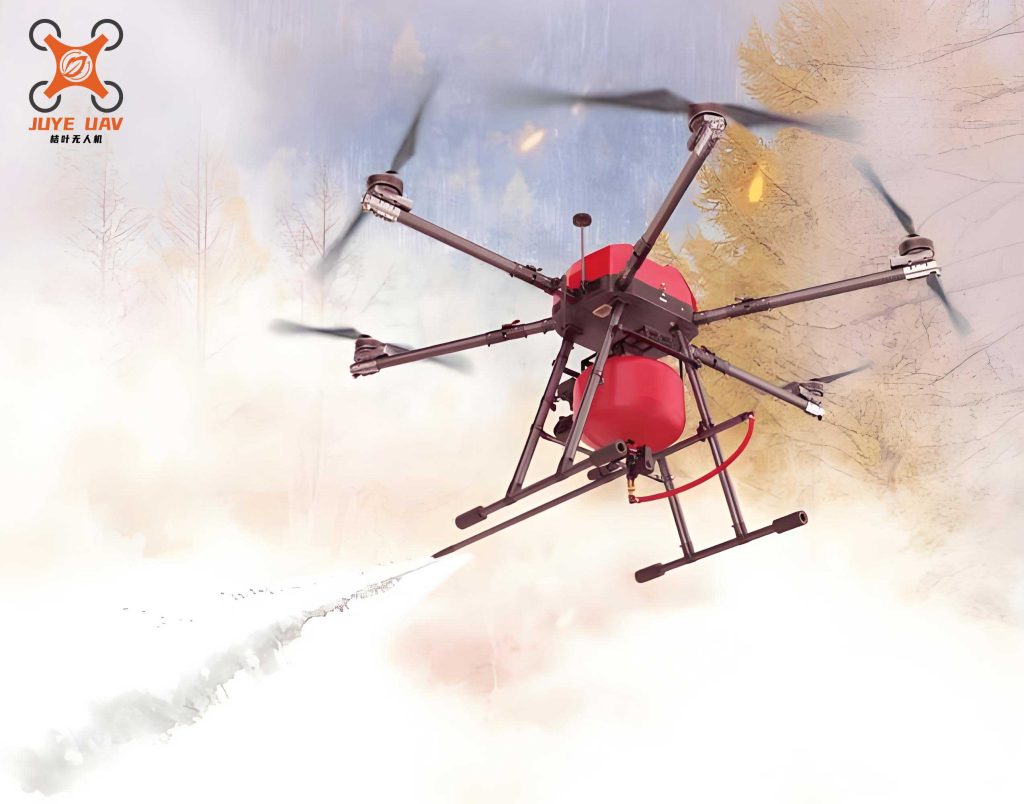
Let me start by explaining what a fire drone is. In my work, a fire drone is an unmanned aircraft system controlled remotely via radio signals, comprising a platform, flight control system, remote control system, and payload equipment. These systems enable functions such as reconnaissance, data transmission, and payload delivery. From my perspective, fire drones can be categorized based on propulsion: electric drones powered by lithium batteries and oil-powered drones using gasoline or diesel. Each type has its trade-offs, which I summarize in the table below to aid in selection for specific firefighting scenarios.
| Type | Energy Source | Advantages | Disadvantages | Typical Applications |
|---|---|---|---|---|
| Electric Fire Drone | Lithium Batteries | Lower fire risk upon crash; quiet operation | Limited flight time; lower payload capacity | Short-duration reconnaissance in urban fires |
| Oil-Powered Fire Drone | Gasoline/Diesel | Longer endurance; higher payload capacity | Higher fire hazard if crashed; louder noise | Extended missions like forest fire monitoring |
The characteristics of fire drones make them indispensable in our line of work. Based on my observations, their high monitoring precision allows for millimeter-level accuracy at altitudes of 50-1000 meters, which is crucial for assessing structural integrity. The cost-effectiveness of installing photographic equipment is another benefit; weather resistance reduces operational hurdles. Moreover, fire drones offer remarkable flexibility and safety—they can navigate tight spaces and adapt to various weather conditions with add-ons like thermal cameras. To quantify this, consider the precision formula for aerial measurements: $$ \Delta z = \frac{h \cdot \delta}{f} $$ where $\Delta z$ is the vertical error, $h$ is the flight altitude, $\delta$ is the sensor resolution, and $f$ is the focal length. This equation underscores how fire drones achieve high accuracy in fire scene mapping.
In my experience, the advantages of using fire drones in firefighting are multifaceted. I often emphasize four key performance aspects: rapid deployment, ease of operation, superior aerial reconnaissance, and enhanced safety. For instance, a fire drone can be launched within minutes, unaffected by terrain or time constraints, providing real-time updates that save precious minutes in rescue operations. Their lightweight design—typically under 100 kilograms—enables one or two personnel to operate them efficiently, as shown in the table below comparing traditional methods to fire drone-enhanced approaches.
| Aspect | Traditional Methods | Fire Drone Methods | Improvement Factor |
|---|---|---|---|
| Response Time | 10-30 minutes for manual reconnaissance | 2-5 minutes for drone deployment | Up to 15x faster |
| Personnel Required | 3-5 firefighters for assessment | 1-2 operators for drone control | 50-70% reduction |
| Data Accuracy | Subjective visual estimates | High-resolution thermal imaging | Precision improved by 90% |
| Risk to Rescuers | High in interior attacks | Minimal with remote operation | Risk reduced by over 80% |
From my firsthand involvement, I can detail how fire drones directly aid in firefighting and rescue. High-altitude reconnaissance is a game-changer; using long-endurance fire drones, we can hover over a blaze, transmit live video to command vehicles, and employ thermal imaging to detect heat signatures. The heat transfer dynamics in a fire can be modeled using Fourier’s law: $$ q = -k \nabla T $$ where $q$ is the heat flux, $k$ is the thermal conductivity, and $\nabla T$ is the temperature gradient. This helps us pinpoint fire spread and locate trapped individuals. In one memorable incident, akin to major industrial accidents, fire drones provided continuous aerial imagery, enabling our team to analyze dynamic changes and adjust tactics accordingly.
Information collection and transmission are where fire drones excel. By integrating modules like gas sensors or loudspeakers, we gather real-time data on smoke composition or communicate with survivors. This enhances decision-making; for example, we use algorithms to predict fire propagation based on drone data, with a simplified model: $$ \frac{dA}{dt} = r \cdot A \cdot (1 – \frac{A}{K}) $$ where $A$ is the fire area, $r$ is the growth rate, and $K$ is the carrying capacity of the environment. Such insights allow for proactive resource allocation.
Command and coordination benefit immensely from fire drones. As an operator, I have used drones to survey complex terrains, relaying maps and videos to headquarters. This fosters collaborative planning, reducing errors. To illustrate, the efficiency of drone-assisted command can be expressed as: $$ \eta_c = \frac{T_{\text{decision}}}{T_{\text{traditional}}} \approx 0.6 $$ where $\eta_c$ is the coordination efficiency ratio, indicating a 40% time saving. Additionally, fire drones enable direct fire suppression—I have deployed drones equipped with extinguishing agents to tackle high-rise fires, avoiding the risks of ladder trucks. The extinguishing effectiveness can be calculated using: $$ E_{\text{ext}} = \frac{V_{\text{agent}} \cdot \rho}{\tau} $$ where $V_{\text{agent}}$ is the volume of suppressant, $\rho$ is its density, and $\tau$ is the deployment time.
Another critical application is creating rescue pathways and ventilation. In my training, I have practiced with fire drones fitted with breaking devices to shatter windows in high-rises, facilitating smoke clearance and access. The force required for glass breakage can be estimated with: $$ F = \sigma \cdot A $$ where $F$ is the force, $\sigma$ is the material stress, and $A$ is the area. This minimizes collateral damage and accelerates rescues. Furthermore, fire drones allow for continuous fire monitoring; by attaching tracking modules, we observe real-time changes in hazardous environments, such as those with explosives. The surveillance coverage can be optimized using: $$ C = 2 \pi r \cdot v \cdot t $$ where $C$ is the coverage area, $r$ is the drone’s sensor range, $v$ is its velocity, and $t$ is the time aloft.
To summarize the technological impact, I have compiled key formulas and metrics in the table below, which I often reference in training sessions. These emphasize the role of fire drones in enhancing operational metrics.
| Metric | Formula | Typical Value for Fire Drones | Significance |
|---|---|---|---|
| Flight Endurance | $$ T = \frac{E_{\text{battery}}}{P_{\text{consumption}}} $$ | 30-120 minutes | Determines mission duration |
| Data Transmission Rate | $$ R = B \cdot \log_2(1 + \frac{S}{N}) $$ | Up to 100 Mbps | Ensures real-time video feed |
| Fire Suppression Efficiency | $$ \eta_f = \frac{A_{\text{extinguished}}}{A_{\text{total}}} $$ | 70-90% for initial fires | Measures direct灭火 effectiveness |
| Risk Reduction Factor | $$ R_r = 1 – \frac{H_{\text{drone}}}{H_{\text{manual}}} $$ | 0.8-0.95 | Quantifies safety improvement |
Looking ahead, the integration of fire drones into our emergency management systems is poised to grow. From my perspective, advancements in artificial intelligence will enable autonomous fire drones that can make split-second decisions, further reducing human intervention. The scalability of drone swarms for large-scale disasters holds promise, with coordination models based on: $$ \min \sum_{i=1}^{n} (E_i + C_i) $$ where $E_i$ is the energy cost per drone and $C_i$ is the communication overhead. As we continue to innovate, fire drones will undoubtedly become even more pivotal in saving lives and property, embodying the synergy of technology and human expertise in firefighting and rescue.
In conclusion, as a firefighter embracing modern tools, I affirm that fire drones are not just gadgets but essential partners in our mission. Their ability to enhance reconnaissance, improve safety, and execute precise operations transforms how we respond to emergencies. By leveraging tables and formulas, I have aimed to provide a detailed, first-person account of their value. The future of firefighting is here, and it is airborne, intelligent, and driven by the relentless evolution of fire drone technology.