
In modern firefighting and rescue operations, the environments faced by fire departments are increasingly complex, ranging from earthquake disasters and flood rescues to mountain salvages and large-span high-rise fires. Traditional methods often fall short in adapting to these dynamic scenarios, highlighting the need for advanced technologies. As a first-person observer in this field, I have witnessed how fire drones revolutionize emergency response by enhancing situational awareness, improving decision-making, and reducing risks to personnel. This article delves into the principles, advantages, and multifaceted applications of fire drones, supported by technical analyses, formulas, and tables to provide a comprehensive overview. The integration of fire drones into消防 systems is not just an innovation but a necessity for efficient and safe operations.
The core of a fire drone lies in its ability to operate via radio remote control or autonomous programming, making it an unmanned aerial vehicle (UAV) that is compact, cost-effective, and highly adaptable. A typical fire drone system comprises several subsystems: ground command and control, aerial video surveillance, flight management, real-time radio image transmission, GPS navigation, autopilot, 3G image relay links, and high-capacity lithium-polymer power units. These components work in synergy to enable functions like aerial reconnaissance, monitoring, and辅助救援. For instance, the flight dynamics can be modeled using Newton’s laws, where the force balance is given by: $$ \vec{F}_{net} = m \frac{d\vec{v}}{dt} $$ Here, \( \vec{F}_{net} \) represents the net force from thrust, drag, gravity, and lift, \( m \) is the drone’s mass, and \( \vec{v} \) is its velocity vector. This equation underpins the agility of fire drones, allowing them to navigate tight spaces in urban fires or rugged terrains in natural disasters.
| Advantage | Description | Impact on消防 |
|---|---|---|
| Mobility and Flexibility | Lightweight (often under 1000g), portable by 1-2 personnel, operable in confined or inaccessible areas. | Enables rapid deployment in交通中断 scenarios, such as collapsed buildings or forest fires. |
| Broad Surveillance Capability | Equipped with wide-angle cameras, infrared sensors, and data links for beyond-visual-range control. | Provides全方位 views of fire scenes, aiding in hotspot identification and victim location. |
| Ease of Operation | User-friendly remote controls with real-time video feeds, requiring minimal training for effective use. | Reduces operational complexity, allowing firefighters to focus on strategy rather than piloting. |
| Safety and Reliability | Resistant to harsh conditions (e.g., high temperatures, toxic gases), minimizing human exposure to hazards. | Lowers casualty risks in explosive or chemical incidents, enhancing overall mission safety. |
One of the most critical applications of fire drones is in fire scene reconnaissance. When a blaze erupts, these drones can swiftly ascend to survey the area,不受地形限制. For example, in high-rise fires, where traditional ladder trucks may fail, a fire drone can capture thermal images to pinpoint ignition sources using infrared technology. The heat flux detection can be quantified by: $$ Q = \epsilon \sigma A (T^4 – T_0^4) $$ where \( Q \) is the radiative heat flux, \( \epsilon \) is emissivity, \( \sigma \) is the Stefan-Boltzmann constant, \( A \) is the area, and \( T \) and \( T_0 \) are the target and ambient temperatures, respectively. This data helps commanders allocate resources efficiently. Moreover, fire drones integrate gas sensors to detect hazardous substances like CO or methane, with concentration levels modeled as: $$ C(x,t) = \frac{M}{\sqrt{4\pi D t}} e^{-\frac{x^2}{4Dt}} $$ Here, \( C \) is concentration, \( M \) is source mass, \( D \) is diffusion coefficient, \( x \) is distance, and \( t \) is time. Such analytical capabilities make fire drones indispensable for assessing chemical risks in industrial fires.
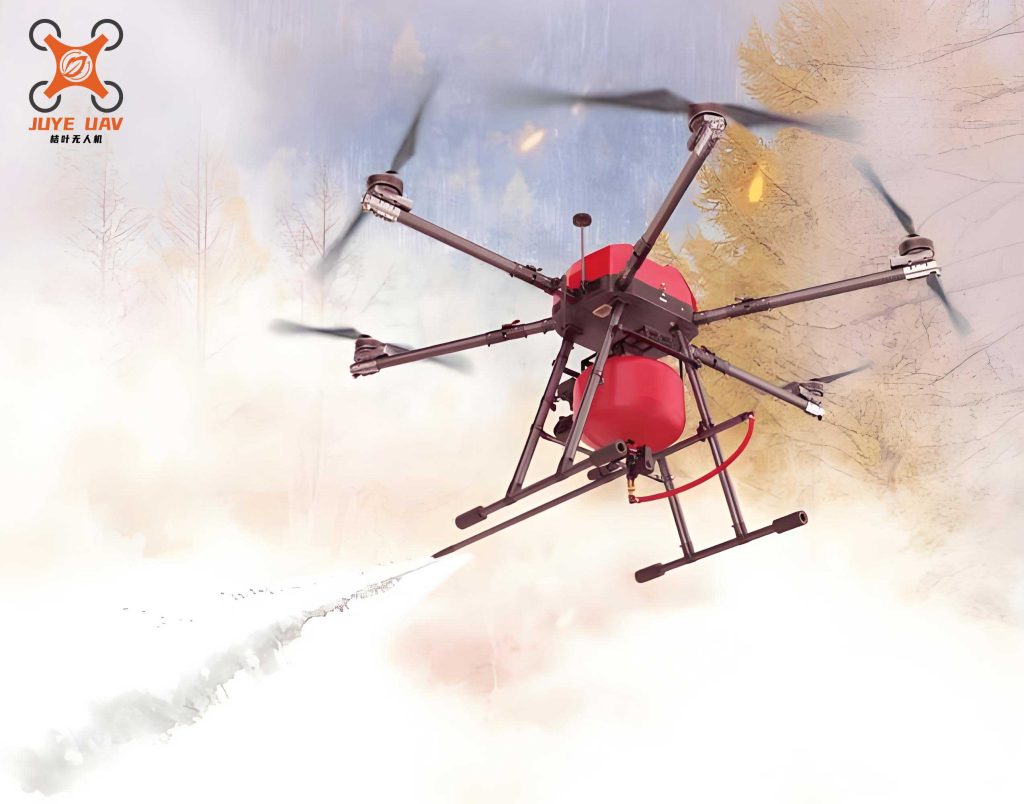
Beyond reconnaissance, fire drones excel in real-time monitoring and tracking during disaster response. They can hover over a dynamic fire, transmitting live footage to ground stations, which aids in tracking火势蔓延. The video transmission range relies on wireless communication models, such as the Friis transmission equation: $$ P_r = P_t G_t G_r \left( \frac{\lambda}{4\pi R} \right)^2 $$ where \( P_r \) and \( P_t \) are received and transmitted powers, \( G_t \) and \( G_r \) are antenna gains, \( \lambda \) is wavelength, and \( R \) is distance. This ensures stable feeds even in smoky environments. In a案例 study, fire drones have been used to monitor forest fire perimeters, with data processed to predict spread rates using cellular automata models: $$ S_{t+1} = f(S_t, N, \theta) $$ where \( S \) represents fire state, \( N \) is neighborhood cells, and \( \theta \) encompasses wind and humidity factors. This predictive power allows for proactive evacuations and resource deployment.
The辅助救援功能 of fire drones are manifold, extending to communication relay, supply delivery, and emergency mapping. For instance, in mountain rescues where ground access is blocked, a fire drone can carry绳索 or medical kits, with payload capacity calculated by: $$ W_{max} = T – m g $$ where \( W_{max} \) is maximum payload weight, \( T \) is thrust, and \( g \) is gravitational acceleration. This enables life-saving airdrops. Additionally, fire drones serve as临时转信台 in通信中断 scenarios, leveraging mesh networking principles. The network throughput can be estimated using Shannon’s theorem: $$ C = B \log_2(1 + \frac{S}{N}) $$ where \( C \) is channel capacity, \( B \) is bandwidth, and \( S/N \) is signal-to-noise ratio. This ensures continuous coordination among rescue teams. Furthermore, fire drones facilitate emergency测绘 by generating 3D maps via photogrammetry, with accuracy derived from: $$ \sigma_z = \frac{H}{B} \sigma_p $$ where \( \sigma_z \) is vertical error, \( H \) is flight height, \( B \) is baseline distance, and \( \sigma_p \) is pixel resolution. These maps aid in planning rescue routes in坍塌 structures.
| Scenario | Fire Drone Function | Key Metrics |
|---|---|---|
| Urban High-Rise Fires | Aerial thermal imaging for hotspot detection, gas monitoring. | Detection range: up to 500m; Temperature accuracy: ±2°C. |
| Forest and Wildland Fires | Perimeter surveillance, spread prediction, communication relay. | Flight endurance: 30-60 minutes; Coverage area: 10 km² per sortie. |
| Chemical and Industrial Incidents | Toxic gas sensing, real-time video feeds for remote assessment. | Gas detection sensitivity: 1 ppm; Transmission latency: <100 ms. |
| Natural Disasters (e.g., Earthquakes) | Search and rescue via cameras, supply delivery to trapped victims. | Payload capacity: 2-5 kg; Operational wind resistance: 12 m/s. |
| Building Inspections and Prevention | Routine aerial patrols for fire hazard identification. | Inspection speed: 20 buildings per hour; Data storage: 128 GB. |
In terms of辅助监督, fire drones play a proactive role in fire prevention by conducting aerial inspections of buildings, especially skyscrapers. They can identify potential hazards like blocked fire escapes or faulty wiring, with data integrated into消防 monitoring systems. The efficiency of such patrols can be optimized using path planning algorithms, such as the traveling salesman problem formulated as: $$ \min \sum_{i=1}^n \sum_{j=1}^n c_{ij} x_{ij} $$ subject to constraints ensuring each node is visited once. This minimizes energy consumption for the fire drone. Moreover, the drones archive高清 imagery for compliance checks, leveraging machine learning models to flag anomalies. For example, a convolutional neural network (CNN) for defect detection might use: $$ y = \sigma(W * x + b) $$ where \( y \) is the output, \( \sigma \) is activation function, \( W \) are weights, \( * \) denotes convolution, \( x \) is input image, and \( b \) is bias. This automation enhances消防 safety protocols.
The technological evolution of fire drones continues to advance, with future trends pointing toward greater autonomy and integration. For instance, swarm robotics could enable multiple fire drones to collaborate in large-scale disasters, with coordination governed by boid models: $$ \vec{v}_i(t+1) = \vec{v}_i(t) + \alpha \vec{v}_{align} + \beta \vec{v}_{cohesion} + \gamma \vec{v}_{separation} $$ Here, \( \vec{v}_i \) is velocity of drone \( i \), and terms represent alignment, cohesion, and separation forces. This would allow for distributed sensing and faster response. Additionally, advancements in battery technology, such as solid-state cells, promise longer flight times, modeled by: $$ E = \int P(t) dt $$ where \( E \) is energy and \( P \) is power consumption. Coupled with AI-driven analytics, fire drones are set to become even more pivotal in消防 ecosystems.
In conclusion, as I reflect on the transformative impact of fire drones, it is clear that they are indispensable tools in modern firefighting and rescue. From侦查 to辅助救援, these UAVs enhance operational efficiency, safety, and accuracy. The formulas and tables presented herein underscore the technical rigor behind their deployment. Looking ahead, continuous innovation in fire drone technology will further empower消防部队 to tackle emergencies with unprecedented precision. Embracing these advancements is not merely an option but a critical step toward saving lives and protecting property in an increasingly hazardous world.