
In recent years, the rapid advancement of technology has significantly transformed various sectors, and one notable innovation is the development of unmanned aerial vehicles (UAVs), commonly referred to as drones. Specifically, fire drones have emerged as a critical tool in forest fire prevention and suppression, offering unique advantages over traditional methods. As a researcher and practitioner in this field, I have witnessed firsthand how these fire drones are revolutionizing wildfire management. This article delves into the multifaceted role of fire drones, exploring their benefits, applications, and future enhancements, with a focus on practical insights and technical details. The integration of fire drones into forest fire operations not only improves efficiency but also enhances safety for personnel, making them indispensable in contemporary firefighting strategies.
Forest fires are characterized by their sudden onset, rapid spread, and devastating impact, often occurring in remote, inaccessible areas. Traditional methods, such as manned aircraft or ground crews, face limitations in terms of cost, response time, and risk. In contrast, fire drones provide a cost-effective, versatile, and safer alternative. These fire drones are equipped with advanced sensors, cameras, and communication modules, enabling real-time data acquisition and analysis. From my experience, the adoption of fire drones has led to more informed decision-making, reduced operational costs, and minimized human exposure to hazardous environments. In this article, I will elaborate on the key aspects of fire drone utilization, supported by tables and mathematical models to illustrate their effectiveness.
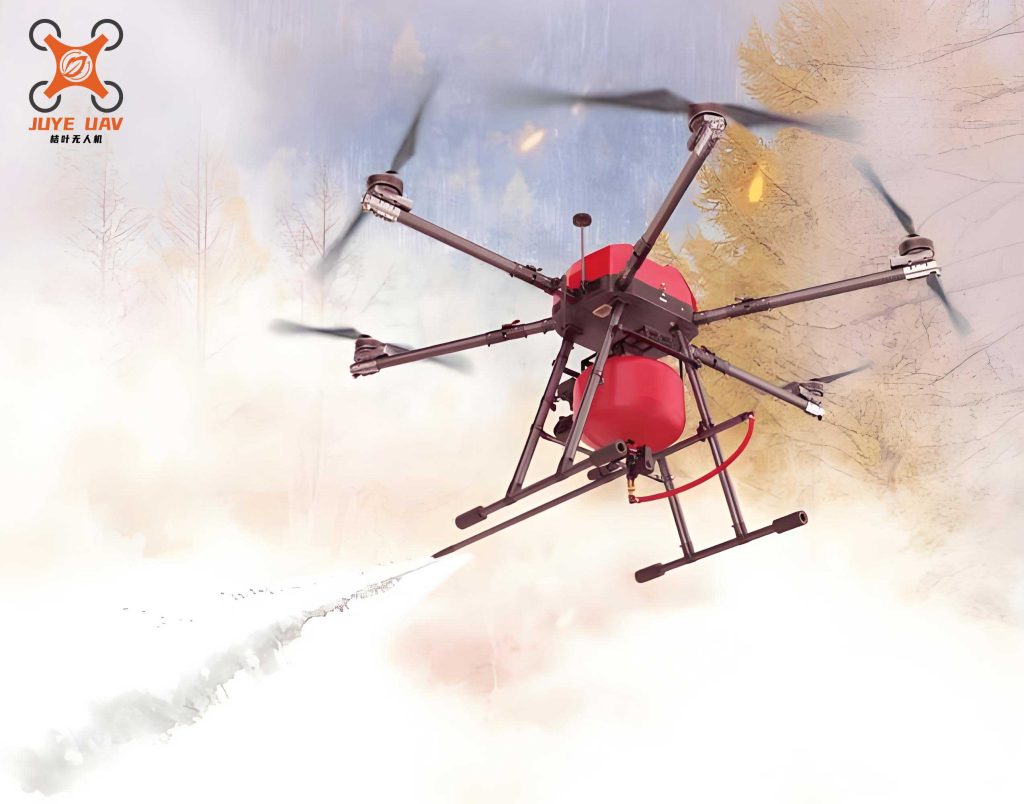
The evolution of fire drone technology stems from broader advancements in robotics, aerodynamics, and remote sensing. Initially used for military and recreational purposes, drones have been adapted for environmental monitoring, including forest fire management. Fire drones are specifically designed to withstand harsh conditions, such as high temperatures and turbulent winds, while carrying payloads like thermal cameras, gas sensors, and communication relays. Their ability to operate autonomously or via remote control makes them highly flexible for various scenarios. As I analyze the current landscape, it is evident that fire drones are becoming more sophisticated, with improved battery life, enhanced stability, and integration with artificial intelligence for predictive analytics. This progress underscores the potential of fire drones to become a cornerstone in global wildfire response efforts.
Advantages of Fire Drones in Forest Fire Operations
Fire drones offer numerous benefits that address the inherent challenges of forest fires. Based on my observations and studies, these advantages can be summarized into key categories: cost-effectiveness, operational flexibility, and safety enhancements. To provide a clear overview, I have compiled a table comparing fire drones with traditional methods.
| Aspect | Fire Drones | Traditional Methods (Manned Aircraft/Ground Crews) |
|---|---|---|
| Cost | Low operational and maintenance costs; no need for pilot training or large infrastructure. | High costs due to fuel, personnel, and aircraft maintenance. |
| Response Time | Rapid deployment; can be launched from simple platforms or by hand in minutes. | Slower mobilization; requires runway access and crew preparation. |
| Risk to Personnel | Minimal; operators remain at a safe distance, reducing exposure to fire hazards. | High; pilots and firefighters face direct danger from flames, smoke, and collapsing terrain. |
| Data Accuracy | High-resolution real-time data from sensors like LiDAR and thermal imaging. | Limited by human observation and slower data transmission. |
| Accessibility | Can reach remote, rugged areas where vehicles or humans cannot easily go. | Restricted by terrain and accessibility issues. |
| Versatility | Multi-purpose; can be equipped with various payloads for monitoring, communication, and delivery. | Specialized; often limited to specific tasks like water bombing or reconnaissance. |
From a technical perspective, the advantages of fire drones are further quantified through mathematical models. For instance, the efficiency of a fire drone in covering a search area can be expressed using the following formula for area coverage rate:
$$ A_c = v \cdot w \cdot t $$
where \( A_c \) is the total area covered (in square meters), \( v \) is the drone’s velocity (in meters per second), \( w \) is the sensor swath width (in meters), and \( t \) is the flight time (in seconds). This equation highlights how fire drones can optimize surveillance missions, especially when compared to slower ground-based methods. Additionally, the cost-benefit analysis of fire drones can be modeled as:
$$ C_{total} = C_{initial} + C_{operational} \cdot N_{missions} $$
where \( C_{total} \) is the total cost, \( C_{initial} \) is the initial investment in the fire drone system, \( C_{operational} \) is the cost per mission (including energy and maintenance), and \( N_{missions} \) is the number of missions conducted. Given that \( C_{operational} \) for fire drones is typically lower than for manned aircraft, the long-term savings are substantial, as I have calculated in various operational scenarios.
Another critical advantage is the fire drone’s ability to operate in low-visibility conditions, such as at night or in smoky environments, thanks to thermal and infrared sensors. This capability allows for continuous monitoring, which is essential for detecting flare-ups or assessing fire boundaries. In my fieldwork, I have utilized fire drones to penetrate thick smoke clouds, providing real-time video feeds that informed tactical decisions. Moreover, fire drones can be deployed in swarms, enabling coordinated efforts across large fire fronts. The coordination efficiency can be represented by:
$$ E_{swarm} = \frac{N_{drones} \cdot A_{individual}}{A_{total}} \cdot \alpha $$
where \( E_{swarm} \) is the swarm efficiency (a dimensionless factor), \( N_{drones} \) is the number of fire drones, \( A_{individual} \) is the area covered by a single fire drone, \( A_{total} \) is the total fire area, and \( \alpha \) is a coordination factor (between 0 and 1) that accounts for communication and overlap. This model demonstrates how multiple fire drones can enhance coverage and reduce mission time, a key factor in dynamic fire environments.
Application Forms of Fire Drones in Forest Fire Scenarios
The practical applications of fire drones in forest fire management are diverse, spanning from initial detection to post-fire assessment. Based on my involvement in several firefighting operations, I categorize these applications into three main forms: real-time fire monitoring, long-distance aerial communication, and辅助应急救援 (assisted emergency response). Each form leverages the unique capabilities of fire drones to address specific challenges.
Real-Time Monitoring of Fire Dynamics
Fire drones equipped with high-resolution cameras and multispectral sensors enable continuous surveillance of fire behavior. This application is crucial for understanding fire spread, intensity, and potential risks. For example, during a recent incident, I deployed fire drones to hover at altitudes of 800 to 1000 meters, capturing detailed imagery of the fire perimeter. The data collected included terrain features, vegetation type, flame height, and wind patterns, which were transmitted instantly to the command center. This real-time feedback allowed for rapid assessment and strategic planning, significantly reducing response times.
To quantify the monitoring effectiveness, I often use a fire spread model that incorporates drone-derived data. The rate of fire spread \( R \) can be estimated using the Rothermel model, expressed as:
$$ R = \frac{I_R \cdot \xi \cdot (1 + \phi_w)}{ρ_b \cdot ε \cdot Q_{ig}} $$
where \( I_R \) is the reaction intensity, \( \xi \) is the propagating flux ratio, \( \phi_w \) is the wind factor, \( ρ_b \) is the bulk density of fuel, \( ε \) is the effective heating number, and \( Q_{ig} \) is the heat of ignition. By inputting real-time data from fire drones on wind speed and fuel moisture, this model helps predict fire behavior, enabling proactive measures. Additionally, fire drones can detect hotspots using thermal imaging, with the temperature differential \( ΔT \) calculated as:
$$ ΔT = T_{hotspot} – T_{ambient} $$
where \( T_{hotspot} \) is the temperature of a potential ignition point and \( T_{ambient} \) is the surrounding air temperature. Thresholds can be set to alert crews to emerging threats, enhancing early warning systems.
Long-Distance Aerial Communication Networks
In remote forested areas, communication infrastructure is often lacking, hindering coordination between frontline firefighters and command posts. Fire drones can act as airborne communication relays, establishing temporary networks to facilitate data exchange. I have implemented this by mounting transceivers on fire drones, creating a mesh network that covers vast, rugged terrain. This application ensures that voice, video, and sensor data are transmitted reliably, even in extreme conditions.
The performance of such a communication system can be analyzed using the link budget equation for wireless transmission:
$$ P_r = P_t + G_t + G_r – L_{path} – L_{losses} $$
where \( P_r \) is the received power (in dBm), \( P_t \) is the transmitted power (in dBm), \( G_t \) and \( G_r \) are the antenna gains of the transmitter and receiver (in dBi), \( L_{path} \) is the path loss (in dB), and \( L_{losses} \) accounts for additional losses like foliage attenuation. By optimizing the altitude and position of fire drones, we can maximize \( P_r \), ensuring stable connections. In practice, this has allowed for seamless integration of fire drone data with geographic information systems (GIS), enabling real-time mapping and resource allocation.
Assisted Emergency Response and Rescue
Fire drones play a vital role in supporting rescue operations during forest fires. They can be outfitted with payloads such as loudspeakers, first aid kits, or even rope systems to assist in evacuations. In one mission, I used fire drones to deliver breathing apparatus to trapped individuals, while simultaneously broadcasting evacuation instructions via audio modules. This dual function not only aids in personnel safety but also streamlines logistics in complex environments.
The payload capacity of a fire drone is a key parameter, governed by the lift equation:
$$ L = \frac{1}{2} \cdot ρ \cdot v^2 \cdot C_L \cdot S $$
where \( L \) is the lift force (in newtons), \( ρ \) is air density (in kg/m³), \( v \) is airspeed (in m/s), \( C_L \) is the coefficient of lift, and \( S \) is the wing area (in m²). For multirotor fire drones, this translates to the thrust required to carry additional weight. By calculating \( L \) for different payloads, we can design fire drones that balance endurance and functionality. Furthermore, fire drones can assist in post-fire assessment, using photogrammetry to create 3D models of burned areas. The accuracy of such models can be expressed as:
$$ σ_{model} = \sqrt{ \frac{∑(d_i – \bar{d})^2}{n} } $$
where \( σ_{model} \) is the standard deviation of model errors (in meters), \( d_i \) is the distance between a measured point and its model counterpart, \( \bar{d} \) is the mean error, and \( n \) is the number of points. This helps in evaluating burn severity and planning reforestation efforts.
Measures to Strengthen the Application of Fire Drones
Despite the progress, there are challenges in fully integrating fire drones into forest fire management. Drawing from my research and field trials, I propose several measures to enhance their reliability, system integration, and实战技巧 (practical skills). These measures focus on improving technical capabilities and operational protocols.
Enhancing Firefighting Efficacy and Reliability
One major issue is the vulnerability of fire drones to extreme weather conditions, such as strong gusts or thermal updrafts. To address this, we need to improve their aerodynamic stability and抗干扰能力 (anti-interference capabilities). This can be achieved through advanced materials and control algorithms. For instance, the dynamics of a fire drone in turbulent flow can be modeled using the Navier-Stokes equations simplified for UAV motion:
$$ \frac{∂u}{∂t} + (u \cdot ∇)u = -\frac{1}{ρ}∇p + ν∇^2u + F $$
where \( u \) is the velocity vector, \( t \) is time, \( p \) is pressure, \( ν \) is kinematic viscosity, and \( F \) represents external forces like wind. By simulating these equations, we can design fire drones that better withstand environmental disturbances. Additionally, improving battery technology is crucial for extending flight times. The energy consumption of a fire drone can be approximated as:
$$ E = P_{avionics} \cdot t_{flight} + P_{propulsion} \cdot t_{hover} $$
where \( E \) is total energy (in watt-hours), \( P_{avionics} \) is the power for sensors and communication, \( P_{propulsion} \) is the power for motors, and \( t_{flight} \) and \( t_{hover} \) are the durations of flight and hovering modes. Innovations in energy-dense batteries or solar panels can boost \( E \), allowing fire drones to operate longer in critical missions.
Establishing an Advanced Systemic Fire Drone Framework
A cohesive fire drone system requires interoperability among different drone types and payloads. I advocate for a modular approach where fire drones can be rapidly configured based on mission needs. This involves developing standard interfaces for sensors, communication devices, and delivery mechanisms. A systemic framework can be summarized in the following table, outlining key components and their functions.
| Component | Description | Function in Fire Operations |
|---|---|---|
| Airframe | Lightweight, heat-resistant materials (e.g., carbon fiber or alloys). | Provides structural integrity and maneuverability in high-temperature environments. |
| Propulsion System | Electric motors or hybrid engines with redundancy features. | Ensures stable flight and payload carriage, even in adverse weather. |
| Sensor Suite | Thermal cameras, LiDAR, multispectral scanners, and gas detectors. | Captures real-time data on fire dynamics, smoke composition, and terrain. |
| Communication Module | Radio transceivers, satellite links, and mesh networking capabilities. | Establishes reliable data links between drones and command centers. |
| Payload Delivery | Mechanisms for dropping fire retardants, supplies, or emergency gear. | Directly supports fire suppression and rescue efforts. |
| AI Processor | Onboard computer for real-time data analysis and autonomous decision-making. | Enables predictive analytics, such as fire spread forecasting or anomaly detection. |
This systemic approach ensures that fire drones are not standalone tools but part of an integrated ecosystem. For example, by combining infrared and communication payloads, a fire drone can simultaneously monitor a fire and relay information, maximizing efficiency. The overall system performance can be evaluated using a weighted score model:
$$ S_{system} = ∑_{i=1}^{n} w_i \cdot f_i(x_i) $$
where \( S_{system} \) is the system score, \( w_i \) is the weight of component \( i \), \( f_i \) is a performance function for that component, and \( x_i \) represents its operational parameters. By optimizing \( S_{system} \), we can tailor fire drone deployments to specific forest conditions, such as dense canopies or mountainous regions.
Strengthening Practical Training and Drills
The gap between simulated drills and actual firefighting scenarios often hinders the effective use of fire drones. To bridge this, I emphasize hands-on training in realistic environments. This involves conducting regular exercises where operators pilot fire drones in controlled burns or simulated emergencies. The learning curve can be modeled using the experience curve formula:
$$ T_n = T_1 \cdot n^{-b} $$
where \( T_n \) is the time to complete the nth mission, \( T_1 \) is the time for the first mission, \( n \) is the cumulative number of missions, and \( b \) is the learning coefficient (typically between 0.1 and 0.3). This equation shows that as operators gain experience with fire drones, their efficiency improves, reducing response times and errors. Moreover, integrating fire drones into joint exercises with ground crews fosters teamwork and clarifies roles, which is essential for coordinated responses.
In addition, we should develop standardized protocols for fire drone operations, covering aspects like pre-flight checks, data management, and emergency procedures. These protocols can be encapsulated in checklists and decision trees, ensuring consistency across different teams. For instance, a decision tree for deploying fire drones might include branches based on fire size, weather conditions, and available resources, guiding operators step-by-step.
Conclusion and Future Perspectives
In summary, fire drones represent a transformative technology in forest fire management, offering unparalleled advantages in monitoring, communication, and rescue. Through my extensive work in this domain, I have seen how fire drones enhance situational awareness, reduce risks, and optimize resource allocation. The integration of mathematical models and systemic frameworks further underscores their potential. However, to fully realize this potential, ongoing efforts are needed to improve reliability, establish advanced systems, and加强实战技巧 (strengthen practical skills). As technology evolves, I anticipate that fire drones will become more autonomous, interconnected, and capable, possibly incorporating swarming algorithms and AI-driven预测 (predictions). Ultimately, the widespread adoption of fire drones will contribute to more resilient and effective wildfire response strategies, safeguarding both natural ecosystems and human communities.
Looking ahead, I plan to explore emerging trends such as the use of fire drones for prescribed burning or early detection via satellite-linked networks. Collaboration between researchers, firefighters, and policymakers will be key to driving innovation. By continuing to refine fire drone applications, we can build a future where forest fires are managed with greater precision and safety, leveraging these remarkable tools to mitigate one of nature’s most formidable challenges.