
In recent years, the rapid advancement of unmanned aerial vehicle (UAV) technology has opened up new possibilities for industrial applications. As an enthusiast and designer in this field, I embarked on a project to develop a specialized cleaning drone aimed at improving the efficiency and safety of cleaning tasks for small high-rise building exteriors and glass surfaces. The motivation stems from the observation that while high-rise buildings often receive attention for automated cleaning solutions, small high-rise structures—typically public buildings with dispersed layouts and complex facades—are frequently neglected. Traditional methods rely on manual rope descent, which is inefficient, costly, and hazardous. Therefore, I sought to integrate drone mobility with cleaning robotics to create a versatile cleaning drone that could address these challenges. This article details my design process, from background analysis to practical verification, emphasizing the use of tables and formulas to summarize key aspects. The term “cleaning drone” will be reiterated throughout to highlight the core focus.
The design background is rooted in the convergence of two technological trends: the proliferation of UAVs and the evolution of cleaning robots. UAVs, initially military tools, have become accessible in civil domains due to cost reductions and technological maturation. Similarly, cleaning robots, as a subset of service robots, have gained traction in both household and commercial settings. However, their application to outdoor building maintenance remains limited. I identified a gap for small high-rise buildings, where facade irregularities—such as protruding windowsills and varied materials—complicate cleaning. My goal was to design a cleaning drone that leverages multi-rotor agility to navigate these complexities while performing effective cleaning. This project not only aims to enhance cleaning efficiency but also explores innovative UAV applications beyond typical uses like photography or agriculture.
To contextualize my work, I analyzed the current state of UAVs and cleaning robots. UAVs are categorized into consumer-grade and industrial-grade types. Industrial UAVs, such as those for crop spraying or logistics, offer robust platforms for customization. Multi-rotor UAVs, with three or more rotors, are particularly advantageous due to their mechanical simplicity, low cost, and maneuverability. Compared to climbing吸附式 robots that require intricate suspension systems, multi-rotor cleaning drones can operate independently, using sensors and thrusters to maintain proximity to walls. This eliminates the need for heavy吊索, reducing setup time and increasing flexibility. For cleaning robots, I reviewed common types, as summarized in Table 1, which classifies them by environment and function. This analysis informed my design by highlighting essential features like liquid dispensing and brush mechanisms.
| Environment | Type | Primary Functions | Operation Mode |
|---|---|---|---|
| Indoor | Household | Dust sweeping, mopping | Autonomous |
| Outdoor | Commercial/Public | Spraying, scrubbing, waste collection | Manual or Autonomous |
| Specialized | Building Exterior | High-pressure washing,刷洗 | Often manual with辅助 |
The cleaning environment for building exteriors involves diverse materials like glass, concrete, and composite panels, which I categorized in Table 2 based on common properties. These materials affect cleaning methods; for instance, glass requires gentle scrubbing to avoid scratches, while concrete may need stronger detergents. The cleaning process typically follows a sequence: pre-wetting with water, applying清洁剂, scrubbing to remove dirt, and rinsing with water. This流程 can be represented mathematically to optimize效率. Let the cleaning efficiency $E$ be defined as the area cleaned per unit time, given by:
$$E = \frac{A}{t}$$
where $A$ is the area in square meters and $t$ is the time in seconds. For my cleaning drone, I aimed to maximize $E$ by reducing $t$ through automated navigation and effective scrubbing. The cleaning process involves fluid dynamics; the flow rate of water and detergent can be modeled using the Bernoulli equation for incompressible fluids:
$$P + \frac{1}{2}\rho v^2 + \rho gh = \text{constant}$$
where $P$ is pressure, $\rho$ is density, $v$ is velocity, $g$ is gravity, and $h$ is height. This helps in designing the spray system to ensure adequate coverage.
| Material | Characteristics | Cleaning Challenges |
|---|---|---|
| Glass | Smooth, transparent | Streaks, hard water stains |
| Concrete | Porous, rough | Dirt accumulation, mold |
| Composite Panels | Lightweight, varied textures | Chemical sensitivity |
| Metal Cladding | Reflective, prone to corrosion | Oxidation, scratching |
Building on this analysis, I proceeded to design the multi-rotor cleaning drone. The platform construction involved selecting components for stability and payload capacity. I used a quadcopter configuration due to its balance of simplicity and control. The key modules included a flight controller, GPS, optical flow sensor, motors, electronic speed controllers (ESCs), and a清洁机构. Table 3 lists the specifications and choices for my prototype. The total weight was optimized to ensure sufficient thrust; the maximum lift force $F_{\text{lift}}$ for a quadcopter can be estimated as:
$$F_{\text{lift}} = 4 \times (k \cdot \omega^2)$$
where $k$ is a motor thrust constant and $\omega$ is the angular velocity of each rotor. For my design, with motors rated at 1150 grams of thrust each, the theoretical maximum is 4600 grams. After accounting for the platform weight of 1250 grams and additional载荷, the net payload was around 1500 grams, which allowed for carrying cleaning tools and fluids. This payload capacity is crucial for the cleaning drone to perform effectively without compromising flight time.
| Component | Model/Specification | Function |
|---|---|---|
| Flight Controller | Pixhawk-based | Stabilization, navigation |
| Motors | Brushless, 1000 kV | Generate thrust |
| ESCs | 30 A | Control motor speed |
| Battery | LiPo, 5000 mAh | Power supply |
| GPS Module | U-blox NEO-M8N | Positioning |
| Optical Flow Sensor | PX4Flow | Precise hovering near walls |
| 清洁机构 | Custom-built with brush and spray | Perform cleaning actions |
A critical aspect of the cleaning drone is its ability to maintain a fixed position close to building walls, where GPS signals may be weak or blocked. To address this, I implemented a dual-mode positioning system combining GPS and optical flow. When operating in open areas, GPS provides global coordinates, but near walls, signal degradation occurs. The optical flow sensor uses computer vision to detect pixel movement relative to the ground, enabling precise localization. The optical flow vector $\mathbf{v} = (v_x, v_y)$ is derived from image sequences using the Lucas-Kanade method, which solves:
$$I_x v_x + I_y v_y + I_t = 0$$
where $I_x$, $I_y$ are spatial gradients, and $I_t$ is the temporal gradient of the image intensity $I$. This allows the cleaning drone to adjust its position dynamically. In practice, I integrated this with a PID controller for stability. The PID control law for each axis is:
$$u(t) = K_p e(t) + K_i \int_0^t e(\tau) d\tau + K_d \frac{de(t)}{dt}$$
where $u(t)$ is the control output, $e(t)$ is the error between desired and actual position, and $K_p$, $K_i$, $K_d$ are tuning parameters. This ensured the cleaning drone could hover steadily even in windy conditions or when interacting with the wall.
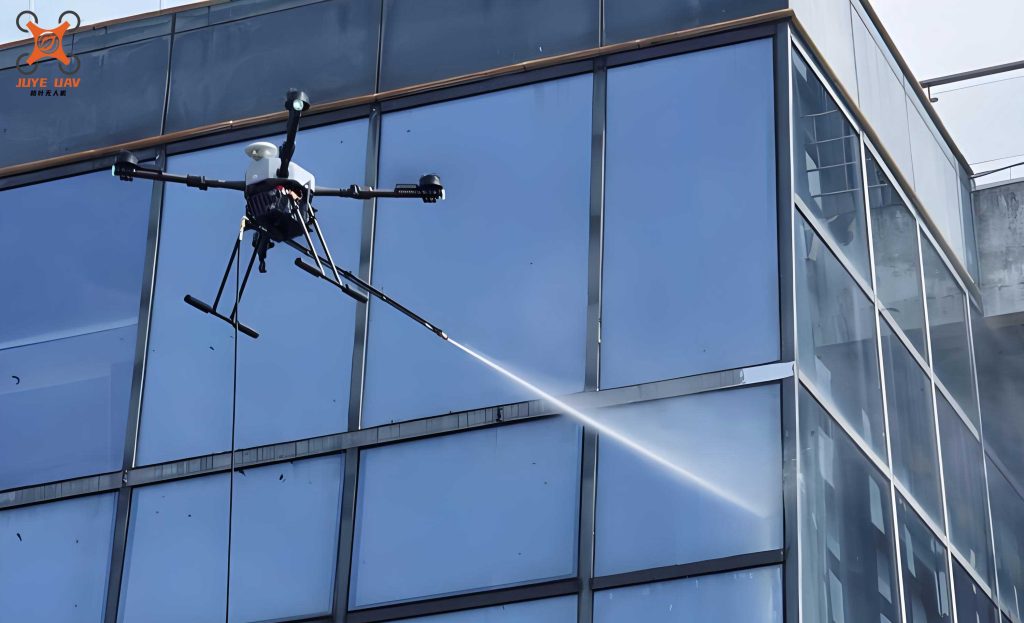
The cleaning mechanism was designed to handle the standard流程: pre-wetting, detergent application, scrubbing, and rinsing. I incorporated a rotating brush driven by a central motor via a belt system, extending 10 cm beyond the drone’s propellers to reach the surface. The brush uses nylon bristles for durability and minimal water absorption. Above the brush, I installed three misting nozzles connected to two separate fluid lines—one for water and one for detergent—using 7 mm outer diameter tubing. This allows sequential spraying based on清洁步骤. The fluid flow rate $Q$ through the nozzles can be calculated using:
$$Q = C_d A \sqrt{\frac{2 \Delta P}{\rho}}$$
where $C_d$ is the discharge coefficient, $A$ is the nozzle area, and $\Delta P$ is the pressure difference. By controlling $Q$, I optimized fluid usage for different surface types. The entire cleaning assembly is lightweight to preserve payload capacity, with the brush motor and nozzles adding approximately 300 grams.
However, when the cleaning drone contacts the wall, reaction forces can destabilize the platform. To mitigate this, I designed a stabilization机构 consisting of four spring-loaded连杆 attached at the corners of the drone frame. These连杆 act as dampers, converting point contacts into a stable面接触. The force analysis involves balancing the horizontal reaction force $F_r$ from the wall with the spring force $F_s = k \Delta x$, where $k$ is the spring constant and $\Delta x$ is the compression. For equilibrium during cleaning:
$$\sum F_x = F_{\text{thrust}} – F_r – F_s = 0$$
where $F_{\text{thrust}}$ is the drone’s forward thrust. This design ensures smooth operation and reduces oscillations. Additionally, the cleaning drone’s外壳 is made of ABS plastic in a symmetrical circular shape to protect components from water and debris, while high-visibility colors aid in orientation during flight.
For navigation, I developed an automatic path planning system using an Arduino microcontroller to simulate遥控器 inputs. The system pre-plans cleaning routes as vertical lines on building facades, as illustrated in Figure 4. The drone takes off, approaches the wall using GPS coordinates, switches to optical flow for precise positioning, and executes the cleaning path by moving downward. After completing a strip, it retreats, ascends to the next strip, and repeats. The path planning algorithm computes the bearing angle $\theta$ between the drone’s current position $(x_1, y_1)$ and the target waypoint $(x_2, y_2)$:
$$\theta = \arctan\left(\frac{y_2 – y_1}{x_2 – x_1}\right)$$
adjusted for quadrant. The drone then rotates to align with $\theta$ before moving forward. This automation enhances the cleaning drone’s efficiency by minimizing manual control.
In terms of performance verification, I tested the cleaning drone on small high-rise buildings with mixed外墙 materials. The average cleaning time for one square meter was 90 seconds, yielding an efficiency $E = 0.0111 \, \text{m}^2/\text{s}$. Compared to manual methods that can take over 5 minutes per square meter, this represents a significant improvement. The cleaning drone operated reliably in winds up to 3-4级, thanks to the PID-tuned stability. Battery life was initially limited to 5 minutes with an external water hose, but by switching to a tether power system in future iterations, I aim to extend operation to 15 minutes or more. The use of a cleaning drone in this context not only boosts productivity but also reduces risks for human workers.
Looking ahead, several enhancements can be made to the cleaning drone. For instance, implementing a系留 power solution would eliminate battery constraints, allowing continuous operation. Advanced sensors like LiDAR could improve obstacle avoidance for complex facades. Moreover, machine learning algorithms could optimize cleaning paths based on dirt patterns. The integration of these features will further solidify the cleaning drone as a versatile tool for building maintenance. Throughout this project, the term “cleaning drone” has been central, reflecting its role as a transformative technology.
In conclusion, my design and verification of a multi-rotor cleaning drone demonstrate the potential for UAVs to revolutionize exterior cleaning tasks. By combining无人机机动性 with robotic cleaning mechanisms, I created a system that addresses the unique challenges of small high-rise buildings. The cleaning drone achieves higher efficiency, improved safety, and cost savings over traditional methods. This work contributes to the broader field of industrial UAV applications, offering insights for future developments. As UAV technology continues to evolve, the cleaning drone stands out as a practical innovation with real-world impact, paving the way for smarter, more automated urban maintenance solutions.