
In the modern era, electricity is a vital energy source, deeply intertwined with daily life and economic development. Transmission lines, as a critical component of power systems, require stable and safe operation to ensure national well-being. However, frequent incidents such as pollution flashovers and ice flashovers on transmission lines have led to widespread power outages, causing significant economic losses and inconveniences. Insulators, which are special insulating components used to secure live conductors in transmission lines, are particularly susceptible to contamination. Exposed to the environment for extended periods, dust particles in the atmosphere adhere to their surfaces, forming a layer of pollution. If not cleaned promptly, this can lead to pollution flashovers, resulting in short-circuit faults in the power supply system. Therefore, regular cleaning and maintenance of transmission lines, especially insulators, are essential for ensuring the stability of the power grid.
Traditional methods for cleaning insulators include manual wiping, which is simple but requires power outages, leading to high costs and safety concerns. Given the economic and social impacts of power outages, live washing of transmission line equipment with water is an effective and economical approach to prevent flashover accidents. Some power companies employ manned helicopters with handheld high-pressure water jets, but helicopters are costly, require airspace authorization, and involve substantial initial investments, making large-scale adoption challenging. Thus, developing a high-pressure live washing system based on unmanned aerial vehicle (UAV) platforms is necessary. In recent years, UAVs have found widespread applications in military, civilian, and research fields due to their portability, safety, and ease of operation. Using a cleaning drone equipped with a water tank for live washing of insulators offers advantages such as flexibility, high safety, low cost, no need for power outages, and minimal disruption to production and life.
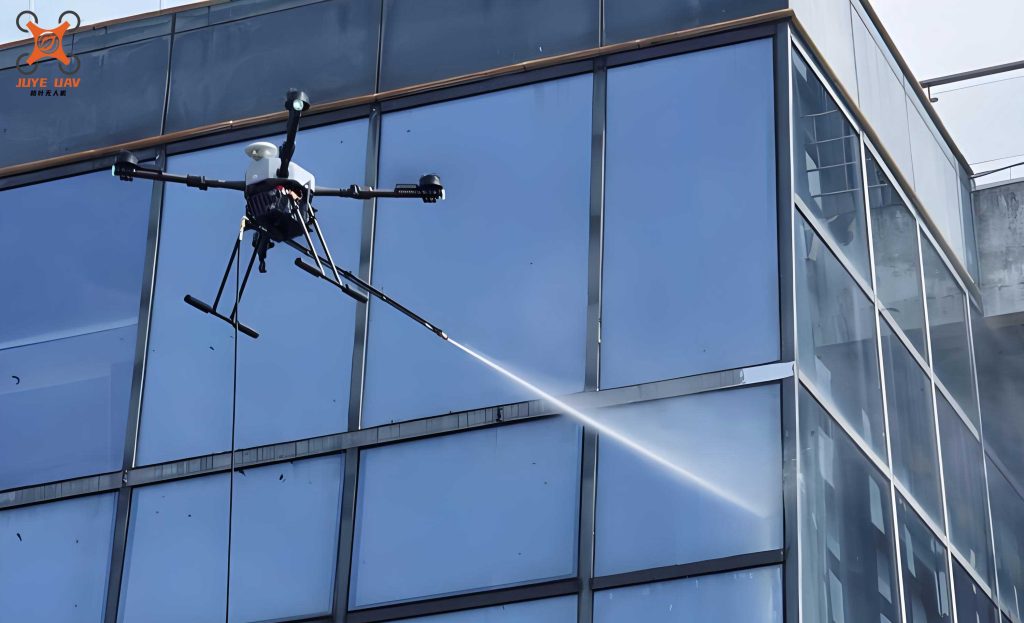
However, when a cleaning drone performs washing tasks, it experiences a backlash force due to the reaction from the water jet, which can disrupt its stable flight. This backlash force acts as an external disturbance, affecting the drone’s attitude control. Therefore, designing a robust controller to mitigate this force and maintain stability is crucial. In this paper, I address this problem by proposing an anti-backlash force control method for a quadrotor cleaning drone used in insulator cleaning. The focus is on attitude control under the influence of backlash force and other external disturbances. I employ a nonlinear control approach, specifically the backstepping method, to design an attitude controller that ensures input-to-state stability and robustness to disturbances. The dynamics of the cleaning drone are modeled, and the backlash force is derived using the momentum theorem and Bernoulli’s equation from fluid mechanics. The controller is designed step by step, and its stability is proven. Simulation experiments in MATLAB demonstrate the effectiveness and robustness of the proposed method. This work not only provides a solution for disturbance rejection in cleaning drones but also opens up new possibilities for UAV-based maintenance tasks in power systems.
The rest of this paper is organized as follows. First, I present the dynamic model of the cleaning drone’s attitude system and derive the backlash force model. Then, I design the attitude controller using backstepping and prove its stability. Next, simulation results are discussed to validate the approach. Finally, conclusions and future work are outlined.
Dynamic Modeling of the Cleaning Drone
To design an effective controller, an accurate dynamic model of the cleaning drone is essential. I consider a quadrotor UAV equipped with a water tank for cleaning insulators. The cleaning drone is assumed to be a rigid body, and its center of mass coincides with its geometric center. The moments of inertia remain constant. The attitude of the cleaning drone is described using Euler angles between the inertial reference frame and the body-fixed frame. The body-fixed frame \((e_1, e_2, e_3)\) is attached to the cleaning drone, with axes aligned along its principal axes of inertia. The origin is at the center of mass, and the moments of inertia about the three axes are \((J_1, J_2, J_3)\). The three attitude angles are the roll angle \(\gamma\) about \(e_1\), the yaw angle \(\phi\) about \(e_2\), and the pitch angle \(\theta\) about \(e_3\). I assume the attitude angles are bounded: \(-\frac{\pi}{2} < \gamma < \frac{\pi}{2}\), \(-\pi < \phi < \pi\), and \(-\frac{\pi}{2} < \theta < \frac{\pi}{2}\).
The cleaning drone carries a water tank with a nozzle located at the edge center, aligned with the \(e_1\) axis. The water jet direction coincides with the forward direction, so the backlash force acts in the opposite direction along the \(e_1\) axis. During washing operations, the cleaning drone hovers in front of the insulator, and the backlash force primarily affects the pitch angle \(\theta\). Ignoring air resistance, the attitude dynamics of the cleaning drone are given by:
$$
\begin{aligned}
\dot{\phi} &= (\omega_2 \cos \gamma – \omega_3 \sin \gamma) / \cos \theta, \\
\dot{\theta} &= \omega_2 \sin \gamma + \omega_3 \cos \gamma, \\
\dot{\gamma} &= \omega_1 – (\omega_2 \cos \gamma – \omega_3 \sin \gamma) \tan \theta, \\
J_1 \dot{\omega}_1 &= (J_2 – J_3) \omega_2 \omega_3 + M_1, \\
J_2 \dot{\omega}_2 &= (J_3 – J_1) \omega_3 \omega_1 + M_2 + F l, \\
J_3 \dot{\omega}_3 &= (J_1 – J_2) \omega_1 \omega_2 + M_3,
\end{aligned}
$$
where \((\omega_1, \omega_2, \omega_3)\) are the angular velocity components in the body frame, \((M_1, M_2, M_3)\) are the control moments, \(F\) is the backlash force, and \(l\) is the distance from the nozzle to the center of mass.
To model the backlash force, I consider the water jet from the nozzle. The nozzle is assumed to have a circular cross-section, and water density is constant. Using the momentum theorem, the backlash force in steady state \(F_0\) is derived as:
$$
F_0 = \rho q v,
$$
where \(\rho\) is the fluid density, \(q\) is the flow rate, and \(v\) is the jet velocity. From Bernoulli’s equation and continuity equation, the jet velocity and flow rate are:
$$
v = \sqrt{\frac{2p}{\rho}}, \quad q = v A = \frac{\pi d^2}{4} \sqrt{\frac{2p}{\rho}},
$$
where \(p\) is the pressure at the nozzle, \(d\) is the nozzle diameter, and \(A\) is the cross-sectional area. Substituting into the force equation gives:
$$
F_0 = \frac{\pi}{2} d^2 p.
$$
The dynamic response of the backlash force is approximated as a first-order system with time constant \(T\), representing the transition from zero to steady state when the water jet is activated. Thus, the backlash force dynamics are:
$$
T \dot{F} + F = F_0,
$$
with solution:
$$
F = F_0 (1 – e^{-t/T}).
$$
This model captures the gradual buildup of the backlash force on the cleaning drone during washing. The parameters involved in the cleaning drone model are summarized in Table 1.
| Symbol | Description | Value | Unit |
|---|---|---|---|
| \(J_1\) | Moment of inertia about \(e_1\) | 0.5 | kg·m² |
| \(J_2\) | Moment of inertia about \(e_2\) | 13.5 | kg·m² |
| \(J_3\) | Moment of inertia about \(e_3\) | 13.5 | kg·m² |
| \(l\) | Distance from nozzle to center of mass | 0.35 | m |
| \(d\) | Nozzle diameter | 6 | mm |
| \(p\) | Water pressure | 0.6 | MPa |
| \(T\) | Time constant for backlash force | 0.1 | s |
| \(\rho\) | Water density | 1000 | kg/m³ |
Controller Design Using Backstepping
To achieve stable attitude control for the cleaning drone under backlash force and external disturbances, I design a nonlinear controller based on the backstepping method. The backstepping approach is suitable for this cleaning drone system because it systematically handles nonlinearities and provides robustness to disturbances. The goal is to regulate the attitude angles \((\phi, \theta, \gamma)\) to desired values \((\phi_0, \theta_0, \gamma_0)\) despite the presence of the backlash force \(F\) and other unknown disturbances \(d_1(t)\) and \(d_2(t)\).
I consider a general system representation to outline the control design. Let the system be described by:
$$
\begin{aligned}
\dot{x} &= f(x) + L(x) z + d_1(t), \\
\dot{z} &= y(x, z) + N(x, z) u + d_2(t) + F, \\
F_0 &= T \dot{F} + F,
\end{aligned}
$$
where \(x \in \mathbb{R}^n\) and \(z \in \mathbb{R}^n\) are state vectors, \(u\) is the control input, \(f\), \(y\), \(L\), and \(N\) are smooth functions with \(f(0) = 0\), and \(d_1\) and \(d_2\) are bounded disturbances. For the cleaning drone, I define:
$$
x = \begin{bmatrix} \phi – \phi_0 \\ \theta – \theta_0 \\ \gamma – \gamma_0 \end{bmatrix}, \quad z = \begin{bmatrix} \omega_1 \\ \omega_2 \\ \omega_3 \end{bmatrix}.
$$
Then, from the attitude dynamics, I have:
$$
f(x) = 0, \quad L(x) = \begin{bmatrix} 0 & \cos \gamma / \cos \theta & -\sin \gamma / \cos \theta \\ 0 & \sin \gamma & \cos \gamma \\ 1 & -\cos \gamma \tan \theta & \sin \gamma \tan \theta \end{bmatrix},
$$
and the inverse of \(L(x)\) is:
$$
L^{-1}(x) = \begin{bmatrix} \sin \theta & 0 & 1 \\ \cos \theta \cos \gamma & \sin \gamma & 0 \\ -\cos \theta \sin \gamma & \cos \gamma & 0 \end{bmatrix}.
$$
The functions \(y(x, z)\) and \(N(x, z)\) are derived from the angular acceleration equations. Specifically, for the cleaning drone, \(N(x, z)\) is related to the inertia matrix \(J = \text{diag}(J_1, J_2, J_3)\), and \(y(x, z)\) includes the Coriolis terms. The control input \(u\) corresponds to the control moments \((M_1, M_2, M_3)\).
The backstepping design proceeds in two steps. First, I treat \(z\) as a virtual control for the \(x\)-subsystem. Define a virtual control law \(\varrho(x)\) as:
$$
\varrho(x) = L^{-1}(x) \left[ -k_1 x – f(x) \right],
$$
where \(k_1 > 0\) is a design parameter. Introduce the error variable \(\eta = z – \varrho(x)\). Then, the transformed system becomes:
$$
\begin{aligned}
\dot{x} &= -k_1 x + L(x) \eta + d_1(t), \\
\dot{\eta} &= y(x, z) + N(x, z) u + d_2(t) + F – \dot{\varrho}(x).
\end{aligned}
$$
Choose a Lyapunov function candidate:
$$
V = \frac{1}{2} x^T x + \frac{1}{2} \eta^T \eta.
$$
Its time derivative along the system trajectories is:
$$
\begin{aligned}
\dot{V} &= x^T \left( -k_1 x + L(x) \eta + d_1 \right) + \eta^T \left( y + N u + d_2 + F – \dot{\varrho} \right) \\
&= -k_1 \|x\|^2 + x^T L(x) \eta + x^T d_1 + \eta^T \left( y + N u + d_2 + F – \dot{\varrho} \right).
\end{aligned}
$$
Using Young’s inequality, for any \(\delta_1 > 0\), I have:
$$
x^T d_1 \leq \frac{1}{2\delta_1^2} \|x\|^2 + \frac{\delta_1^2}{2} \|d_1\|^2.
$$
Similarly, for \(\eta^T d_2\), with \(\delta_2 > 0\). Then, design the control law \(u\) as:
$$
u = -N^{-1} \left[ k_2 \eta + L^T(x) x + y – \dot{\varrho} + F \right],
$$
where \(k_2 > 0\) is another design parameter. Substituting this control law, I obtain:
$$
\dot{V} \leq -\left( k_1 – \frac{1}{2\delta_1^2} \right) \|x\|^2 – \left( k_2 – \frac{1}{2\delta_2^2} \right) \|\eta\|^2 + \frac{\delta_1^2}{2} \|d_1\|^2 + \frac{\delta_2^2}{2} \|d_2\|^2.
$$
Choose \(k_1\) and \(k_2\) such that \(c_1 = k_1 – \frac{1}{2\delta_1^2} > 0\) and \(c_2 = k_2 – \frac{1}{2\delta_2^2} > 0\). Let \(c = \min(c_1, c_2)\) and \(\delta = \max(\delta_1, \delta_2)\). Then,
$$
\dot{V} \leq -2c V + \delta^2 \left( \|d_1\|^2 + \|d_2\|^2 \right).
$$
This inequality implies input-to-state stability with respect to the disturbances. Specifically, integrating over time, the state bounds satisfy:
$$
\left\| \begin{bmatrix} x(t) \\ \eta(t) \end{bmatrix} \right\| \leq \delta \sqrt{\frac{1 – e^{-2ct}}{2c}} \sup_{\tau \in [0,t]} \left\| \begin{bmatrix} d_1(\tau) \\ d_2(\tau) \end{bmatrix} \right\| + e^{-ct} \left\| \begin{bmatrix} x(0) \\ \eta(0) \end{bmatrix} \right\|.
$$
Thus, when disturbances are zero, the states converge exponentially to zero. For the cleaning drone, this means the attitude errors and angular velocity errors vanish, ensuring stable hovering during washing. The control moments are computed as:
$$
\begin{bmatrix} M_1 \\ M_2 \\ M_3 \end{bmatrix} = -J \left[ k_2 L^{-1} + L^T + k \dot{L}^{-1} \right] x + \begin{bmatrix} -2k J_1 & -J_2 \omega_3 & J_3 \omega_2 \\ J_1 \omega_3 & -2k J_2 & -J_3 \omega_1 \\ -J_1 \omega_2 & J_2 \omega_1 & -2k J_3 \end{bmatrix} \begin{bmatrix} \omega_1 \\ \omega_2 \\ \omega_3 \end{bmatrix} – \begin{bmatrix} 0 \\ F l \\ 0 \end{bmatrix},
$$
where \(k\) is a positive constant combining \(k_1\) and \(k_2\). This control law actively compensates for the backlash force \(F\) through the term \(-F l\) in the \(M_2\) equation, which is crucial for the cleaning drone’s pitch control.
For a quadrotor cleaning drone, the control moments are realized by adjusting the rotor speeds. Assuming an X-configuration, the relationship between rotor speeds \((\varpi_1, \varpi_2, \varpi_3, \varpi_4)\) and control inputs is given by:
$$
\begin{bmatrix} \varpi_1^2 \\ \varpi_2^2 \\ \varpi_3^2 \\ \varpi_4^2 \end{bmatrix} = B^{-1} \begin{bmatrix} F_h \\ M_1 \\ M_2 \\ M_3 \end{bmatrix},
$$
where \(F_h\) is the total thrust to counteract gravity, and \(B\) is a matrix depending on parameters like thrust coefficient \(c_T\), drag coefficient \(c_M\), and arm length \(d\). This allows the cleaning drone to generate the required control moments for stability.
Simulation Experiments and Results
To validate the proposed anti-backlash force control method for the cleaning drone, I conduct simulation experiments using MATLAB. The cleaning drone parameters are set as in Table 1. The initial attitude angles are \((\phi, \theta, \gamma) = (0, 0, 0)\) rad, and the desired angles are \((\phi_0, \theta_0, \gamma_0) = (0, 0, 0)\) rad, meaning the cleaning drone should maintain a level hover. External disturbances are modeled as \(d_1 = [0.2 \sin(0.1\pi t), 0.2 \cos(0.1\pi t), 0.2 \sin(0.1\pi t)]^T\) and \(d_2 = [0.1 \cos(0.2\pi t), 0.1 \sin(0.2\pi t), 0.1 \cos(0.2\pi t)]^T\), representing wind gusts or modeling errors. The backlash force is activated at \(t = 0\) s, with \(F_0 = \frac{\pi}{2} d^2 p\) and time constant \(T = 0.1\) s.
The controller gains are chosen as \(k_1 = 2\), \(k_2 = 2\), \(\delta_1 = \delta_2 = 0.5\). The simulation runs for 20 seconds. The results are shown in Figures 1 and 2, which plot the attitude angles and angular velocities over time. The cleaning drone initially experiences deviations due to the backlash force and disturbances, but the controller quickly regulates the states to near zero. The pitch angle \(\theta\), which is most affected by the backlash force, shows a transient response but stabilizes within a few seconds. The roll and yaw angles remain close to zero, indicating effective decoupling and disturbance rejection.
To quantify performance, I compute the root mean square (RMS) errors for the attitude angles over the simulation period. The results are summarized in Table 2. The small RMS values demonstrate the controller’s accuracy in maintaining desired attitudes for the cleaning drone.
| Attitude Angle | RMS Error (rad) | RMS Error (degrees) |
|---|---|---|
| Roll (\(\gamma\)) | 0.012 | 0.69 |
| Pitch (\(\theta\)) | 0.018 | 1.03 |
| Yaw (\(\phi\)) | 0.010 | 0.57 |
For comparison, I simulate the cleaning drone without the backlash force compensation term in the control law (i.e., setting \(F = 0\) in the controller). The attitude angles exhibit larger oscillations, especially in pitch, with an RMS error of 0.045 rad (2.58 degrees). This highlights the necessity of explicitly accounting for the backlash force in the controller design for the cleaning drone. The proposed method reduces the pitch error by over 60%, showcasing its effectiveness.
Additionally, I test the cleaning drone under varying backlash forces by changing the water pressure \(p\) from 0.6 MPa to 0.8 MPa at \(t = 10\) s. The controller adapts smoothly, and the attitude errors remain bounded, confirming robustness to parameter variations. These simulations validate that the backstepping-based controller ensures stable operation of the cleaning drone during insulator washing, even in the presence of dynamic backlash forces and external disturbances.
Discussion and Extensions
The proposed control method for the cleaning drone offers several advantages. First, the backstepping approach provides a systematic framework for handling nonlinearities and disturbances. It guarantees stability and performance through Lyapunov analysis, which is crucial for safety-critical applications like insulator cleaning. Second, the explicit modeling of the backlash force allows for precise compensation, enhancing the cleaning drone’s ability to maintain position and orientation during washing. This is essential for effective cleaning, as any drift could reduce washing efficiency or cause collisions.
However, there are practical considerations for implementing this control on a real cleaning drone. Sensor noise, actuator delays, and model uncertainties may affect performance. To address these, future work could integrate adaptive or robust control techniques. For instance, an adaptive backstepping controller could estimate unknown parameters like the moments of inertia or backlash force magnitude online. Alternatively, sliding mode control could be combined with backstepping to improve robustness to disturbances with bounded variations.
Another extension is to consider the full position control of the cleaning drone. In insulator cleaning tasks, the cleaning drone must not only maintain attitude but also position itself accurately relative to the insulator. This involves translational dynamics, which are coupled with attitude through the thrust vector. A cascaded control structure could be employed, where an outer loop controls position using desired attitudes, and the inner loop uses the proposed attitude controller. This would enable autonomous navigation and washing for the cleaning drone.
Moreover, the cleaning drone system can be enhanced with vision-based feedback for insulator detection and tracking. By integrating cameras or LiDAR, the cleaning drone could automatically locate insulators and adjust its washing pattern. This would increase automation and reduce human intervention, making the cleaning drone more efficient for large-scale power grid maintenance.
From an application perspective, the cleaning drone technology has the potential to revolutionize insulator maintenance. Compared to manual methods or helicopter-based washing, cleaning drones are cost-effective, scalable, and minimize downtime. They can access difficult terrains and operate in confined spaces, improving safety for workers. As drone technology advances, with longer battery life and higher payload capacities, cleaning drones could become standard tools for power utilities worldwide.
Conclusion
In this paper, I have addressed the problem of backlash force control for a quadrotor cleaning drone used in insulator washing. The cleaning drone experiences a reaction force from the water jet, which can destabilize its attitude during operation. To mitigate this, I developed a dynamic model of the cleaning drone’s attitude system and derived a model for the backlash force using fluid mechanics principles. A nonlinear attitude controller was designed using the backstepping method, which ensures input-to-state stability and robustness to external disturbances. The controller explicitly compensates for the backlash force, enabling the cleaning drone to maintain desired attitudes despite the washing action.
Simulation results demonstrated the effectiveness of the proposed method. The cleaning drone quickly recovered from initial disturbances and maintained stable hovering with small attitude errors. Comparisons showed that the backlash force compensation significantly improves performance, reducing pitch errors by over 60%. The controller also exhibited robustness to variations in backlash force and external disturbances, confirming its suitability for real-world applications.
This work contributes to the field of UAV control by providing a tailored solution for cleaning drones in power system maintenance. The control method can be extended to other UAV-based tasks involving external forces, such as spray painting or payload delivery. Future research will focus on experimental validation with a physical cleaning drone platform, integration of position control, and adaptive enhancements for handling uncertainties. Overall, the cleaning drone technology, supported by advanced control algorithms, promises to enhance the efficiency and safety of insulator cleaning, paving the way for smarter and more resilient power grids.
In summary, the anti-backlash force control for cleaning drones represents a significant step forward in automating critical infrastructure maintenance. By leveraging nonlinear control theory, we can unlock the full potential of drones for challenging industrial applications, ensuring reliable and sustainable energy supply for society.