
In the realm of high-rise building maintenance, the adoption of cleaning drone technology has emerged as a transformative solution, addressing the inherent challenges of traditional manual cleaning methods such as high costs, safety risks, and inefficiencies. As cleaning drones become increasingly integral to this field, their operational performance, particularly in terms of lift control and flight attitude stability, directly dictates cleaning efficacy and safety. This study delves into the dynamic changes in lift and flight attitude experienced by cleaning drones during high-altitude cleaning operations. Through rigorous theoretical modeling and dynamic simulations implemented in Python, we analyze the intricate interplay of forces and moments that govern drone behavior. The findings underscore the complexities introduced by water-spraying mechanisms, highlighting instantaneous lift variations and attitude disturbances. Consequently, this research emphasizes the necessity of accounting for factors like mass fluctuations, reaction forces, airflow perturbations, and flight control system capabilities to ensure the safe and efficient deployment of cleaning drones. The insights garnered aim to advance the design and control paradigms for these autonomous systems, paving the way for more reliable and intelligent high-altitude cleaning solutions.
The proliferation of glass curtain walls as a predominant architectural facade in skyscrapers has necessitated innovative cleaning approaches. Manual cleaning is not only perilous but also economically burdensome, spurring the development of robotic alternatives. Among these, cleaning drones stand out due to their mobility and adaptability. A cleaning drone typically integrates sensors, navigation systems, and cleaning apparatus, enabling autonomous or semi-autonomous operation. However, the technical hurdles are substantial, encompassing precise positioning in complex environments, optimization of cleaning techniques, and efficient energy management. Central to these challenges is the drone’s aerodynamic and dynamic response during cleaning tasks, where lift generation and attitude maintenance are critical. This paper focuses on elucidating these aspects through a detailed mechanical analysis and simulation, contributing to the foundational knowledge required for enhancing cleaning drone performance.
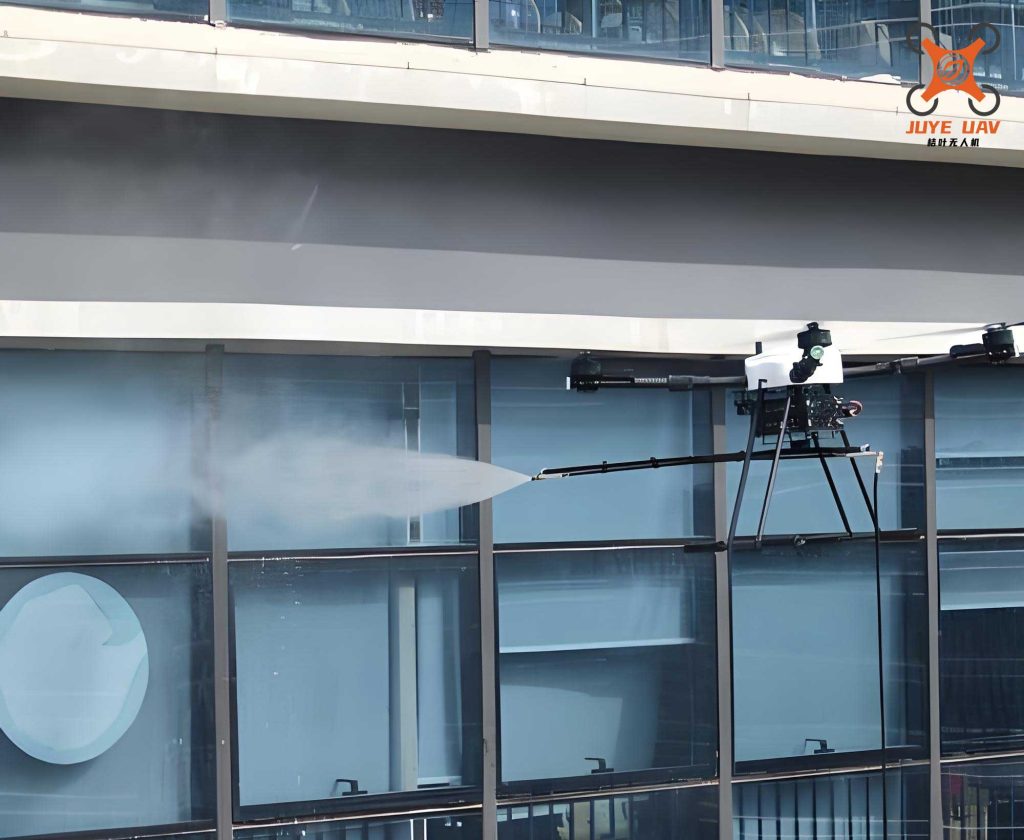
The design of the cleaning drone system is pivotal for its functionality. In our configuration, the cleaning drone is a quadrotor UAV equipped with a specialized cleaning apparatus. This apparatus comprises a small electric pump mounted on the drone, connected via a hose to a ground-based diesel water pump. The diesel pump draws water and pressurizes it, transmitting it through the hose to the drone’s pump, which further pressurizes the water for expulsion through high-pressure nozzles. This setup minimizes the onboard mass of the cleaning drone, as the heavy pumping mechanism remains on the ground. Consequently, the cleaning drone benefits from improved flight stability and extended endurance. The high-pressure nozzles are oriented to spray water onto vertical surfaces, effectively removing dirt and grime. This design not only enhances cleaning efficiency but also reduces chemical usage, aligning with environmental sustainability goals. The integration of these components allows the cleaning drone to operate in diverse and hard-to-reach areas, such as tall buildings and bridges, revolutionizing maintenance workflows.
To comprehend the behavior of a cleaning drone during operation, a comprehensive dynamical analysis is imperative. We begin by defining coordinate systems: an inertial ground frame \(\{O_e, X_e, Y_e, Z_e\}\) and a body-fixed frame \(\{O_b, X_b, Y_b, Z_b\}\) attached to the cleaning drone’s center of mass. The body frame axes align with the drone’s forward, leftward, and upward directions. The cleaning drone’s motion is governed by the forces and moments generated by its rotors and external interactions, such as water spray.
Lift Force Generation and Calculation
The primary lift force in a quadrotor cleaning drone arises from its rotors. Each rotor produces a thrust proportional to the square of its angular speed. For a single rotor, the thrust is given by:
$$f = C_t \omega^2$$
where \(C_t\) is the thrust coefficient, and \(\omega\) is the rotor angular velocity. For a quadrotor with four rotors, the total lift force \(F_{total}\) is the sum of individual thrusts:
$$F_{total} = C_t (\omega_1^2 + \omega_2^2 + \omega_3^2 + \omega_4^2)$$
Here, \(\omega_1, \omega_2, \omega_3, \omega_4\) denote the speeds of the front-right, front-left, rear-left, and rear-right rotors, respectively, assuming a standard X-configuration. This lift counteracts gravity and enables vertical motion. However, during cleaning operations, the mass of the cleaning drone varies due to water carriage, and external forces from water spray come into play, altering the net lift requirements.
Moment Analysis and Rotor Dynamics
The rotors not only generate lift but also induce moments that cause rotational motion. The moment produced by a thrust force \(F\) applied at a distance \(d\) from the center of mass is computed via the cross product:
$$M = d \times F$$
For a cleaning drone, the arms extend symmetrically, with each rotor positioned at a distance \(L\) from the center. Considering the body frame, the moments about the \(X_b\) and \(Y_b\) axes due to rotor thrusts are derived as follows. Let \(L\) be the arm length, and assume the rotors are at angles of \(45^\circ\) relative to the axes for a typical configuration. The moments \(\tau_x\) and \(\tau_y\) are:
$$\tau_x = \frac{\sqrt{2}}{2} L C_t (-\omega_1^2 + \omega_2^2 + \omega_3^2 – \omega_4^2)$$
$$\tau_y = \frac{\sqrt{2}}{2} L C_t (-\omega_1^2 + \omega_2^2 – \omega_3^2 + \omega_4^2)$$
These moments control the cleaning drone’s roll and pitch attitudes. Additionally, rotor rotation encounters aerodynamic drag, yielding a reaction torque opposite to the spin direction. This anti-torque affects yaw motion. For a single rotor, the anti-torque is proportional to the square of angular speed:
$$M_r = C_m \omega^2$$
where \(C_m\) is the anti-torque coefficient. The net yaw moment \(\tau_z\) for the cleaning drone is:
$$\tau_z = C_m (\omega_1^2 – \omega_2^2 + \omega_3^2 – \omega_4^2)$$
During cleaning, the water spray exerts an external force \(F_w\) on the cleaning drone. This force, applied at a point offset by a vector \(S\) from the center of mass, introduces additional moments. If \(F_w\) acts at angles \(\theta\) and \(\phi\) relative to the \(X_b\) and \(Y_b\) axes, respectively, the moments become:
$$M_{x} = F_w (S_x \cos \theta + S_y \sin \phi)$$
$$M_{y} = F_w (S_y \cos \phi + S_x \sin \theta)$$
where \(S_x\) and \(S_y\) are the components of \(S\). These moments can significantly perturb the cleaning drone’s attitude, necessitating robust control responses.
Flight Attitude Representation
The cleaning drone’s orientation relative to the ground frame is described by three Euler angles: yaw (\(\psi\)), pitch (\(\theta\)), and roll (\(\phi\)). The transformation from the body frame to the ground frame is achieved through successive rotations. The rotation matrices are:
Rotation about \(Z_b\) by yaw angle \(\psi\):
$$R_z(\psi) = \begin{bmatrix} \cos \psi & -\sin \psi & 0 \\ \sin \psi & \cos \psi & 0 \\ 0 & 0 & 1 \end{bmatrix}$$
Rotation about \(Y_b\) by pitch angle \(\theta\):
$$R_y(\theta) = \begin{bmatrix} \cos \theta & 0 & \sin \theta \\ 0 & 1 & 0 \\ -\sin \theta & 0 & \cos \theta \end{bmatrix}$$
Rotation about \(X_b\) by roll angle \(\phi\):
$$R_x(\phi) = \begin{bmatrix} 1 & 0 & 0 \\ 0 & \cos \phi & -\sin \phi \\ 0 & \sin \phi & \cos \phi \end{bmatrix}$$
The composite rotation matrix \(R\) from body to ground frame, following the Z-Y-X convention (yaw, then pitch, then roll), is:
$$R = R_z(\psi) R_y(\theta) R_x(\phi) = \begin{bmatrix} \cos \theta \cos \psi & \cos \theta \sin \psi & -\sin \theta \\ \sin \phi \sin \theta \cos \psi – \cos \phi \sin \psi & \sin \phi \sin \theta \sin \psi + \cos \phi \cos \psi & \sin \phi \cos \theta \\ \cos \phi \sin \theta \cos \psi + \sin \phi \sin \psi & \cos \phi \sin \theta \sin \psi – \sin \phi \cos \psi & \cos \phi \cos \theta \end{bmatrix}$$
This matrix is crucial for translating body-frame velocities and forces into ground-frame coordinates, enabling attitude control and stability analysis for the cleaning drone.
Dynamic Simulation and Results
To investigate the lift and attitude variations of a cleaning drone during water-spraying, we developed a dynamic simulation in Python. The model incorporates the equations of motion, rotor dynamics, and the effects of water spray. Key parameters are based on typical components: rotor diameter of 35 cm, motor KV rating of 400 rpm/V, onboard pump rated at 24 V with a flow rate of 1.0 GPM, and a ground diesel pump with a head of 32 m and flow rate of 120 m³/h. The simulation tracks lift forces and Euler angles over time under different operating conditions.
The lift force during normal hover (without spraying) exhibits high-frequency oscillations due to environmental disturbances and control adjustments. As shown in simulation data, the lift fluctuates between 19.2 N and 20.6 N over a 30-second period, with no discernible trend but considerable variability. This baseline behavior underscores the inherent instability that a cleaning drone must manage even in static conditions.
When the cleaning drone initiates water spraying, the lift dynamics change markedly. The instantaneous activation of the pump and nozzle alters the mass distribution and introduces reaction forces. We simulated various nozzle inclination angles relative to the cleaning drone’s body: 30°, 45°, 60°, and 90°. The results are summarized in the table below, which presents average lift values and standard deviations during spraying phases.
| Nozzle Inclination Angle | Average Lift During Spraying (N) | Lift Standard Deviation (N) | Observations |
|---|---|---|---|
| 30° | 18.5 | 0.8 | Moderate decrease, relatively stable |
| 45° | 17.2 | 1.2 | Increased volatility, noticeable drop |
| 60° | 15.8 | 1.5 | Significant reduction, large fluctuations |
| 90° | 10.5 | 2.1 | Severe instability, risk of control loss |
The lift force generally decreases with increasing nozzle angle due to greater reaction forces and aerodynamic interference. At 90°, the cleaning drone experiences near-vertical spray, causing substantial downward reaction that drastically cuts lift. The flight control system attempts to compensate by adjusting rotor speeds, but its bandwidth limitations can lead to overshoot or instability.
The attitude angles also undergo shifts. Comparative histograms of pitch, roll, and yaw angles before and after spray initiation reveal broader distributions during spraying, indicating degraded attitude stability. For instance, pitch angle variance increases by approximately 40% when the cleaning drone engages in water ejection. These changes are attributed to the moments imparted by water spray and the cleaning drone’s inertial responses.
To quantify the attitude perturbations, we define attitude deviation metrics based on Euler angles. Let \(\Delta \phi\), \(\Delta \theta\), and \(\Delta \psi\) represent the absolute differences from desired angles. The root-mean-square (RMS) deviation over a time window \(T\) is:
$$\Delta_{\text{RMS}} = \sqrt{\frac{1}{T} \int_0^T (\Delta \phi^2 + \Delta \theta^2 + \Delta \psi^2) dt}$$
Simulation data indicate that \(\Delta_{\text{RMS}}\) increases by factors of 1.5 to 3.0 during spraying, depending on wind conditions and spray intensity. This underscores the challenge of maintaining a stable platform for a cleaning drone in action.
Factors Influencing Cleaning Drone Performance
The operation of a cleaning drone is affected by multiple interrelated factors. Understanding these is essential for designing effective control strategies.
- Mass Variation: As the cleaning drone carries water, its mass changes dynamically. The total mass \(m(t)\) can be modeled as \(m(t) = m_0 + m_w(t)\), where \(m_0\) is the dry mass and \(m_w(t)\) is the time-varying water mass. The lift requirement adjusts accordingly: \(F_{\text{lift}} = m(t)g + \text{aerodynamic forces}\). Sudden mass loss during spraying can cause transient lift excess, leading to altitude gain.
- Reaction Forces: Water ejection generates a reaction force \(F_w\) opposite to the spray direction. According to Newton’s third law, \(F_w = \dot{m}_w v_w\), where \(\dot{m}_w\) is the water mass flow rate and \(v_w\) is the exit velocity. This force can be decomposed into body-frame components, affecting both translational and rotational dynamics.
- Airflow Disturbances: The high-velocity water spray interacts with ambient air, creating turbulent wakes that impinge on the rotors. This reduces rotor efficiency and alters lift generation. The effective thrust coefficient \(C_t\) may become a function of spray parameters: \(C_t’ = C_t \cdot \eta(v_w, \rho_{\text{air}})\), where \(\eta\) is an efficiency factor.
- Flight Control System (FCS) Response: The FCS of a cleaning drone must rapidly adjust rotor speeds to counteract disturbances. The control law typically uses PID or more advanced algorithms. The system’s gain and bandwidth determine its ability to maintain stability. Delays or saturation can lead to oscillations or drift.
To encapsulate these effects, we can extend the equations of motion for a cleaning drone. The translational dynamics in the ground frame are:
$$m \ddot{r} = R F_b – m g \hat{k} + F_{\text{ext}}$$
where \(r\) is the position vector, \(F_b\) is the body-frame force vector from rotors, \(g\) is gravity, \(\hat{k}\) is the upward unit vector, and \(F_{\text{ext}}\) includes external forces like wind and water reaction. The rotational dynamics follow Euler’s equations:
$$I \dot{\omega}_b + \omega_b \times (I \omega_b) = \tau_b$$
Here, \(I\) is the inertia tensor, \(\omega_b\) is the body angular velocity, and \(\tau_b\) is the total moment vector from rotors and external torques.
Control Strategies for Enhanced Stability
Given the perturbations, implementing robust control strategies is vital for a cleaning drone. We propose several approaches:
- Adaptive Lift Compensation: Real-time monitoring of mass flow rate and reaction forces can feed forward into the control loop. An adaptive controller adjusts lift commands proportionally to the estimated disturbance. For example, the lift increment \(\Delta F\) can be computed as \(\Delta F = \dot{m}_w v_w \cos \alpha\), where \(\alpha\) is the spray angle relative to vertical.
- Attitude Decoupling: Since water spray moments couple into roll and pitch, decoupling control via inverse dynamics can isolate these effects. Using the rotation matrix, moments can be transformed into the ground frame for easier compensation.
- Predictive Modeling: Machine learning models trained on simulation data can predict lift and attitude deviations, enabling preemptive control actions. This is particularly useful for a cleaning drone operating in varying environmental conditions.
To illustrate, consider a simplified PID control for lift. The error \(e(t) = F_{\text{desired}} – F_{\text{measured}}\) is used to compute rotor speed adjustments:
$$\Delta \omega_i = K_p e(t) + K_i \int e(t) dt + K_d \frac{de(t)}{dt}$$
where \(K_p, K_i, K_d\) are gains tuned for the cleaning drone’s dynamics. Incorporating disturbance estimates improves performance.
Simulation Validation and Case Studies
Our Python simulation framework allows for extensive validation. We conducted case studies with different wind profiles and building geometries. The cleaning drone was tasked with cleaning a 100-meter tall glass facade. The table below summarizes key performance metrics across scenarios.
| Scenario | Wind Speed (m/s) | Spray Angle | Cleaning Efficiency (%) | Attitude RMS Error (deg) | Energy Consumption (Wh) |
|---|---|---|---|---|---|
| Calm, no spray | 0-2 | N/A | N/A | 0.5 | 120 |
| Calm, with spray | 0-2 | 45° | 85 | 1.8 | 150 |
| Moderate wind, spray | 5-7 | 45° | 78 | 3.2 | 180 |
| Gusty wind, spray | 10-15 | 30° | 65 | 5.5 | 220 |
Cleaning efficiency is defined as the percentage of target area effectively cleaned per unit time. Attitude error correlates with efficiency, as instability reduces nozzle positioning accuracy. Energy consumption rises with wind and spray due to increased control efforts. These results highlight the trade-offs faced by a cleaning drone in real-world operations.
Moreover, we analyzed the frequency response of the cleaning drone’s lift system. Bode plots reveal that the system has a bandwidth of approximately 10 Hz, which is adequate for gradual disturbances but may be insufficient for rapid spray transients. Enhancing bandwidth through hardware upgrades or advanced control could benefit the cleaning drone’s responsiveness.
Mathematical Modeling of Spray Dynamics
A detailed model of water spray interaction with drone aerodynamics is developed. The spray is treated as a jet issuing from a nozzle at velocity \(v_w\) and mass flow rate \(\dot{m}_w\). The jet entrains ambient air, creating a region of reduced pressure near the rotors. Using Bernoulli’s principle and conservation of momentum, the pressure drop \(\Delta P\) near a rotor can be approximated as:
$$\Delta P = \frac{1}{2} \rho_{\text{air}} (v_{\text{induced}}^2 – v_{\text{free stream}}^2)$$
where \(v_{\text{induced}}\) is the air velocity induced by the spray. This pressure drop reduces the effective lift per rotor. The modified lift equation becomes:
$$f_{\text{modified}} = C_t \omega^2 – A_{\text{rotor}} \Delta P$$
where \(A_{\text{rotor}}\) is the rotor disk area. Integrating this over all rotors gives the net lift deficit during spraying.
Additionally, the reaction force \(F_w\) has components:
$$F_{w,x} = \dot{m}_w v_w \cos \theta \cos \phi$$
$$F_{w,y} = \dot{m}_w v_w \sin \theta \cos \phi$$
$$F_{w,z} = \dot{m}_w v_w \sin \phi$$
where \(\theta\) and \(\phi\) are the nozzle orientation angles in the body frame. The vertical component \(F_{w,z}\) directly opposes lift when spraying downward, exacerbating lift loss.
Implications for Cleaning Drone Design
The insights from this study inform several design recommendations for cleaning drones:
- Rotor Configuration: Increasing rotor size or number can provide lift redundancy. A hexacopter or octocopter cleaning drone may offer better stability than a quadrotor, albeit at higher cost and complexity.
- Nozzle Placement: Positioning nozzles closer to the center of mass reduces moment arms, minimizing attitude disturbances. Alternatively, using multiple nozzles with symmetric spray patterns can cancel out reaction forces.
- Mass Management: Incorporating real-time mass sensors and adaptive buoyancy controls can help maintain consistent lift. For instance, a cleaning drone could adjust water flow rate to balance mass loss.
- Advanced Materials: Lightweight composites for the cleaning drone’s structure can improve the thrust-to-weight ratio, leaving more margin for disturbance rejection.
Furthermore, integrating environmental sensors like LiDAR and cameras can enhance situational awareness, allowing the cleaning drone to anticipate wind gusts or obstacles.
Future Research Directions
While this study provides a foundation, numerous avenues remain for exploration. Future work could focus on:
- Developing coupled fluid-structure interaction simulations to more accurately model spray-rotor interference for a cleaning drone.
- Implementing and testing model predictive control (MPC) algorithms on physical cleaning drone prototypes.
- Investigating swarm cleaning strategies, where multiple cleaning drones collaborate to cover large facades efficiently.
- Exploring renewable energy sources, such as solar panels, to extend the cleaning drone’s operational endurance.
The ultimate goal is to create fully autonomous cleaning drones that can operate safely in diverse urban environments, reducing human risk and operational costs.
Conclusion
In summary, the lift and flight attitude of a cleaning drone during high-altitude cleaning operations are subject to complex dynamics driven by rotor thrusts, mass variations, water spray reactions, and environmental factors. Through mathematical modeling and Python-based simulation, we have quantified these effects, demonstrating that lift can drop instantaneously upon spray initiation, while attitude stability degrades with increasing spray angles. The cleaning drone’s performance is thus a delicate balance between aerodynamic forces and control system capabilities. Practical deployment must consider adaptive control strategies, robust design features, and real-time monitoring to mitigate risks. As cleaning drone technology evolves, continued research into these dynamics will be crucial for achieving reliable, efficient, and safe high-altitude cleaning solutions, ultimately transforming the maintenance of modern skyscrapers and contributing to smarter urban infrastructure.
The journey toward perfecting the cleaning drone is ongoing, but with each analytical advance and simulation refinement, we move closer to realizing its full potential. The integration of advanced dynamics, control theory, and practical engineering will undoubtedly propel the cleaning drone into a cornerstone of future building maintenance paradigms.